GCSE Geography vs History: Sixth Form Choices
GCSE geography vs history sixth form choices explained: learn what admissions teams value, compare both subjects and choose the route supporting stronger grades.
Choosing between Geography and History can feel strangely permanent. One option form, one tick, and suddenly you are imagining an admissions tutor years later judging the decision.
The direct answer to the GCSE geography vs history sixth form question is reassuring: sixth forms do not generally favour one over the other. Both are established academic humanities, and both satisfy the humanities element of the English Baccalaureate. Admissions decisions usually depend more on your overall GCSE grades, English and maths results, and whether you meet the requirements for your proposed A Level subjects.
The better choice is normally the subject you are more likely to enjoy, revise consistently and achieve a strong grade in.
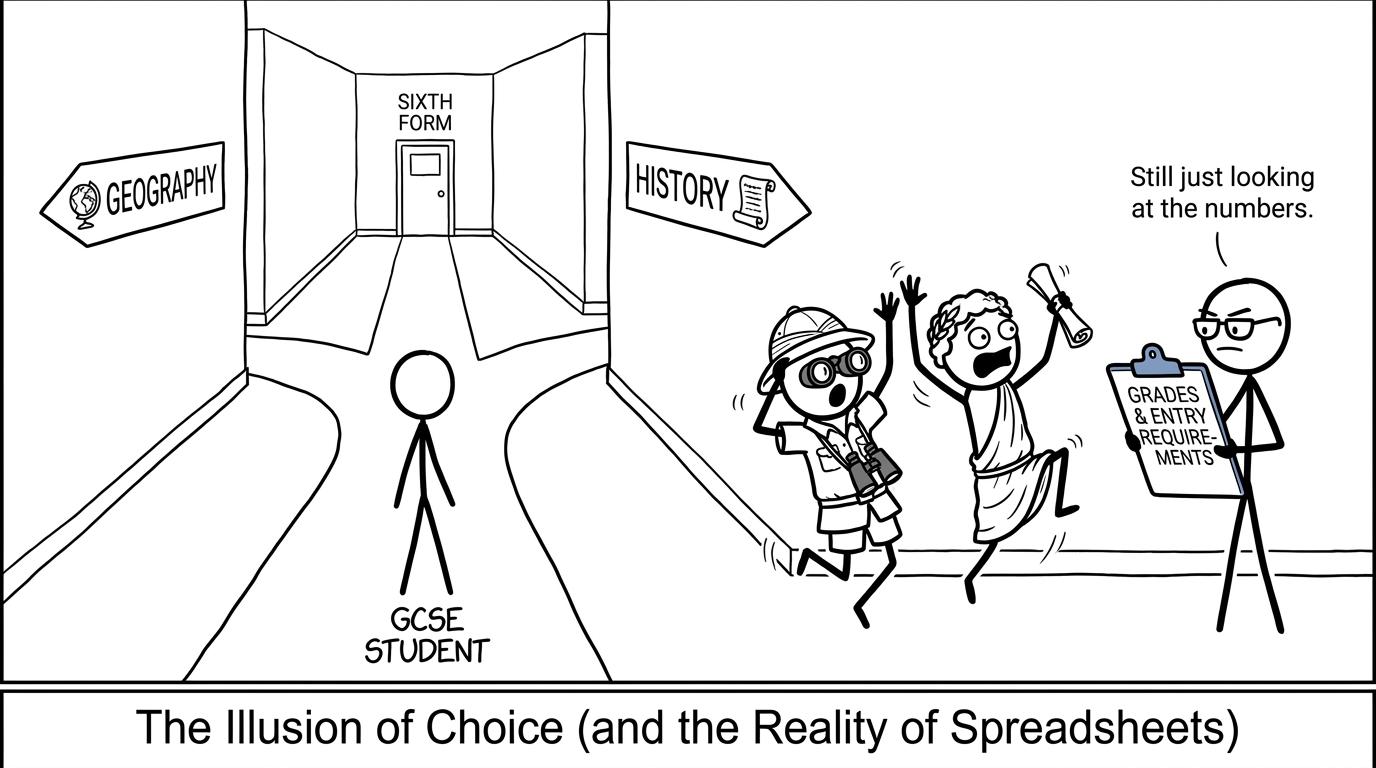 Two GCSE subject paths reaching the same sixth form door
The short answer: neither automatically looks better
There is no national sixth form admissions rule saying that GCSE History is more impressive than GCSE Geography, or vice versa. Individual schools and colleges set their own admissions policies, but current published requirements commonly focus on three things:
- achieving the institution's overall GCSE grade threshold;
- securing required grades in English and maths;
- meeting subject-specific requirements for your intended A Levels.
A sixth form may require a particular grade in GCSE History before allowing you to take A Level History. Another may accept a strong English grade when History was unavailable or not studied. Similar variation exists for A Level Geography: some institutions require GCSE Geography, while others consider English or another humanities subject.
That variation is why you should check the admissions policy and course guide for every sixth form you may apply to. Do not rely on a general rumour when the actual requirement is usually written down.
A quick decision checklist
Before choosing, ask:
- Which course content genuinely interests me?
- Do I prefer evaluating historical sources or interpreting geographical data?
- Which subject's extended questions suit my writing style?
- Am I considering either subject at A Level?
- What do my likely sixth forms require?
- In which subject am I most likely to earn the stronger grade?
- How will the workload fit alongside English, science and GCSE maths revision?
The last two questions often matter more than the supposed prestige of the subject.
What sixth forms actually examine
An application is usually a collection of evidence, not a beauty contest between two GCSE titles. Admissions teams want to know whether you can manage the next level of study.
Overall GCSE performance
Many sixth forms establish a minimum profile across several GCSEs. They may ask for a certain number of passes, a group of grades at 555 or above, or several grades at 666 and above. Selective institutions can set higher thresholds.
A strong History grade and a strong Geography grade both contribute to that profile. In most situations, a Grade 777 in the subject that suits you will help more than choosing the supposedly more impressive option and receiving a weaker result.
English and maths grades
English and maths appear frequently in general and subject-specific entry criteria. Essay-based A Levels may require a suitable English grade. Mathematics, Further Mathematics and some sciences or social sciences commonly set their own GCSE maths thresholds.
This makes your maths preparation relevant even if you are currently worrying about humanities. Use the MathsGenie AQA GCSE Maths revision hub if you follow AQA, or begin from the MathsGenie free maths revision homepage to find lessons and exam practice for your course.
Subject-specific requirements
If you already want to take A Level History, GCSE History is usually the most direct preparation and may be an explicit condition. If A Level Geography is your goal, GCSE Geography may likewise be required or preferred.
However, policies are not identical. Some sixth forms publish alternative qualifying subjects, particularly when an applicant's school did not offer the relevant GCSE. Check the exact wording for your intended year of entry because course availability and admissions criteria can change.
Geography and History are both respected humanities
The Department for Education's EBacc framework includes either Geography or History in its humanities component. It does not rank one above the other.
That does not mean the subjects are interchangeable. They develop overlapping academic habits through different material.
| GCSE Geography often develops | GCSE History often develops |
|---|---|
| Interpretation of maps, graphs and numerical data | Evaluation of contemporary sources |
| Understanding of physical and human processes | Analysis of causes, consequences and change |
| Fieldwork and geographical enquiry | Comparison of historical interpretations |
| Decisions based on evidence from varied resources | Arguments supported by precise contextual knowledge |
| Extended explanations and evaluative judgements | Extended explanations and substantiated judgements |
Both demand knowledge, careful reading and reasoned writing. Neither is an easy shortcut.
When Geography may be the better choice
Geography may fit you if you enjoy connecting human decisions with the physical world. Depending on your exam board and specification, topics can include hazards, landscapes, urban change, development, ecosystems and resource management.
It also contains a noticeable quantitative element. You may interpret graphs, compare data, work with scale, use statistics or assess fieldwork methods. That can complement maths, economics, environmental science and the natural sciences, although it is not a substitute for the required GCSEs in those subjects.
Choose Geography because its mixture of data, places, processes and evaluation matches your strengths, not because someone has labelled it more scientific.
For students balancing several data-heavy subjects, a structured revision routine matters. The best order for learning GCSE maths topics can help you organise maths without letting it compete chaotically with case studies and fieldwork revision.
When History may be the better choice
History may suit you if you enjoy investigating why events happened, what changed and how evidence can support different conclusions. GCSE specifications assess knowledge alongside concepts such as causation, consequence, significance, similarity, difference, continuity and change.
You will also analyse sources and interpretations. Strong answers depend on selecting relevant evidence and shaping it into a clear judgement rather than merely remembering a long list of facts.
History can provide useful preparation for essay-based A Levels such as History, Politics, English Literature, Religious Studies and Law. Yet it does not create an automatic admissions advantage for those courses. A sixth form's published criteria remain more important than a broad claim about which subjects appear impressive.
Choose History if you are comfortable reading closely, retaining contextual detail and writing evidence-led arguments under timed conditions.
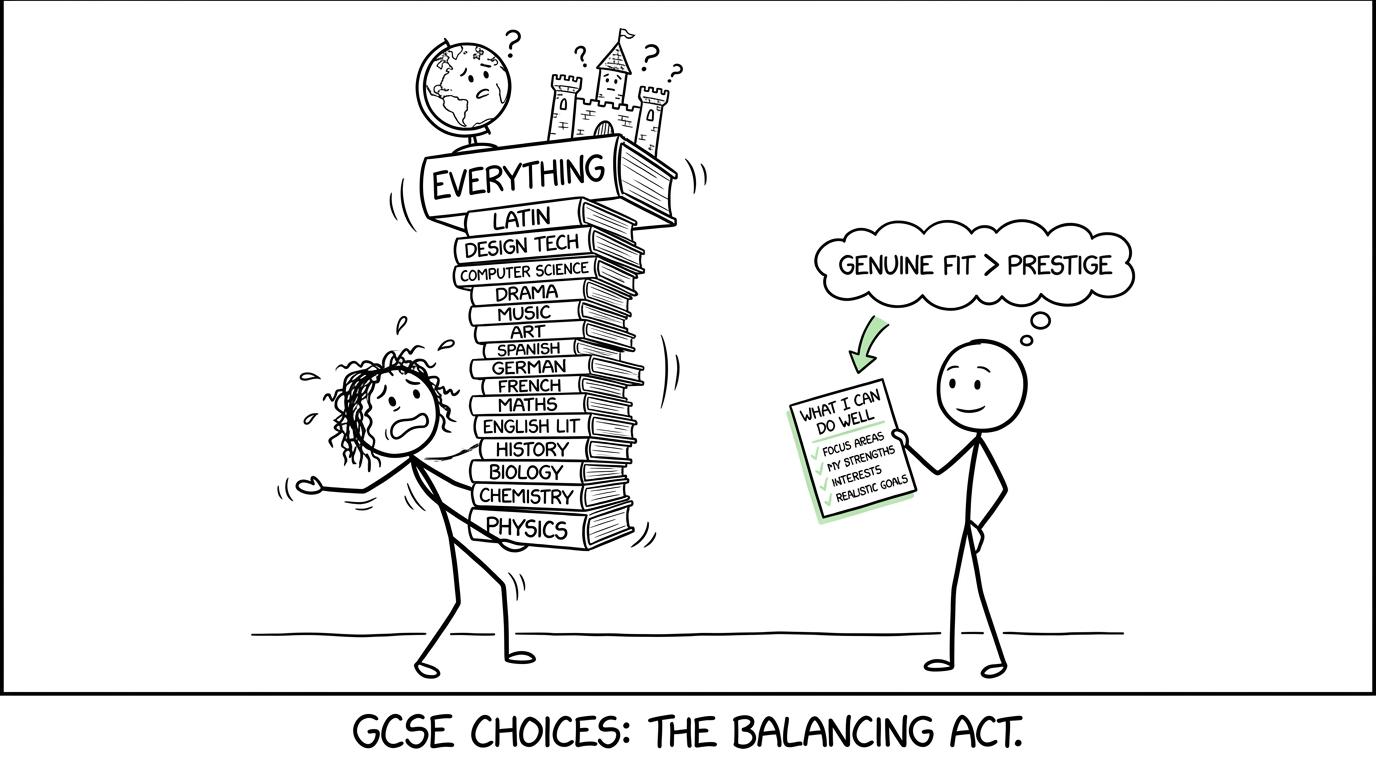 A useful checklist outweighing an impossible pile of revision
Which subject works better alongside GCSE maths?
Either can work well. The practical question is how each one affects your complete timetable.
Geography has visible links to data handling, graphs, ratios, scale and statistics. History may offer greater contrast if much of your timetable already involves numerical subjects. Neither combination is inherently superior.
Think about cognitive load. If you choose subjects whose revision demands all feel identical, exam season can become tiring. On the other hand, choosing a subject only for variety is unwise if you dislike its content. A sustainable combination balances interest, ability and workload.
Maths deserves particular attention because it is commonly included in sixth form entry conditions. Short, regular practice is usually easier to sustain than occasional marathon sessions. Foundation and Higher mini tests can reveal gaps quickly, while revision lessons and practice questions help you repair them.
When you progress to complete papers, follow a deliberate cycle: attempt, mark, diagnose, relearn and retest. The MathsGenie guide to using GCSE past papers properly explains why the learning happens after the paper as much as during it.
How to make the choice without guessing
Start with the courses, not their reputations. Ask both teachers to show you the specification, a recent paper and examples of typical homework. Course content differs across Edexcel, AQA, OCR and Eduqas, so a friend's description may not match what your school teaches.
Next, look ahead. Make a shortlist of sixth forms and record:
- their general admissions threshold;
- required English and maths grades;
- requirements for each A Level you might choose;
- whether GCSE Geography or History is compulsory, preferred or replaceable by another subject;
- the date on which the policy was published.
Then consider your present evidence: class assessments, teacher feedback, enjoyment and willingness to revise. Predicted grades can inform the choice, but they are not a verdict on what you can eventually achieve.
Finally, protect time for your core subjects. If starting revision feels difficult, use a small repeatable routine rather than waiting for motivation. The GCSE revision guide for reluctant students offers a practical learn, practise, mark and fix cycle.
Common mistakes when comparing Geography and History
Assuming History is automatically more academic
Both subjects are recognised academic GCSEs with demanding specifications. History's emphasis on essays does not make it universally more rigorous, just as Geography's use of data does not make it universally more valuable.
Choosing solely for a future career
Most careers do not depend on this single GCSE choice. If a future course has formal prerequisites, check them. Otherwise, building strong grades and transferable skills is usually the wiser priority.
Ignoring the actual specification
The subject name tells you less than the topics, question styles and assessment structure. Look at the course your school genuinely offers, including its exam board.
Believing the easier subject is the same for everyone
A student who enjoys source evaluation may find History more natural. Someone who reads maps and data confidently may prefer Geography. Difficulty depends partly on fit.
Neglecting maths because it is not an option subject
Maths is often central to sixth form eligibility and may determine access to A Level Maths, Further Mathematics, sciences, economics or computing. Keep using mark schemes, practice questions and timed tests throughout Year 111111, rather than trying to recover everything near the exams.
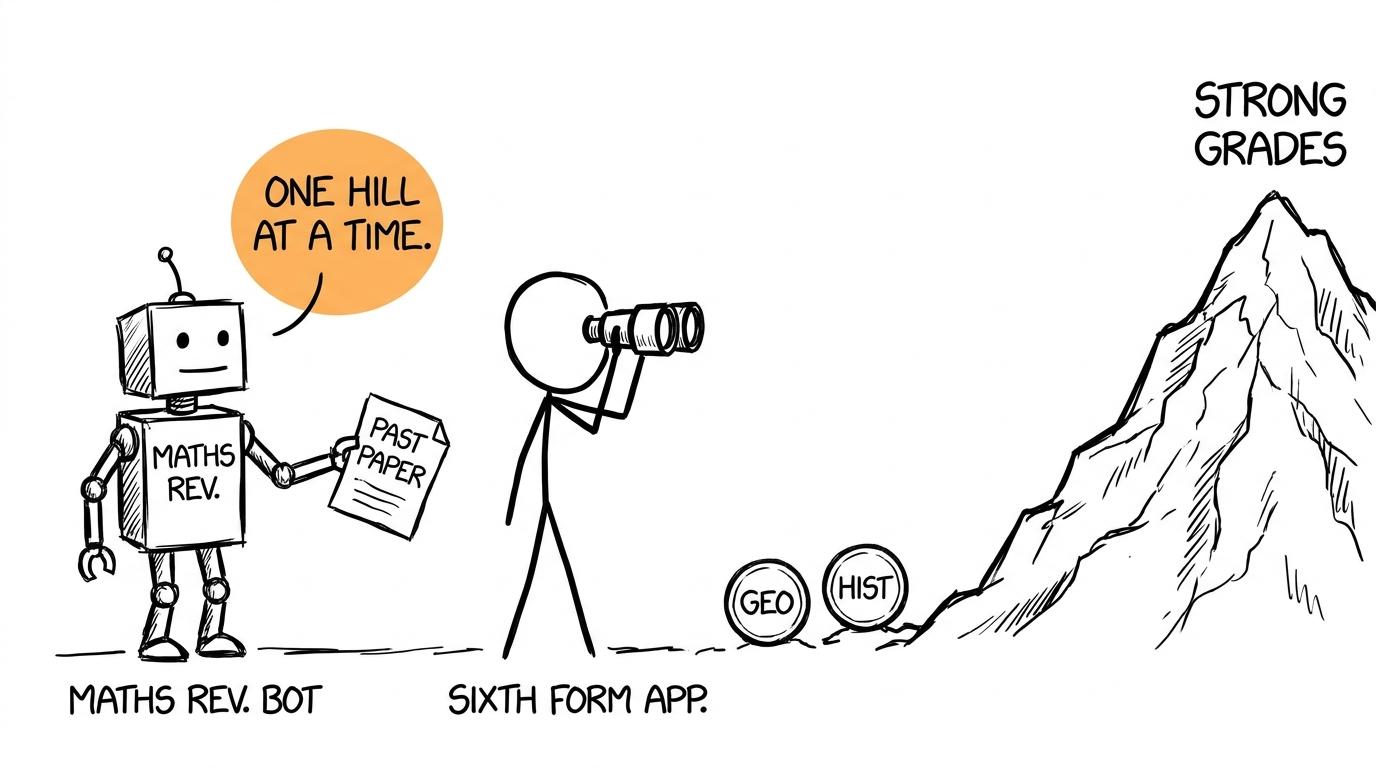 An application looking beyond subject labels towards strong grades
Choose for achievement, not appearance
For most applicants, neither GCSE Geography nor GCSE History looks better in isolation. Sixth forms are more interested in whether you meet their published entry criteria and have the grades needed for your proposed programme.
Choose the subject whose content and assessment style give you the best chance to stay curious, work consistently and achieve well. If you hope to continue one at A Level, verify that course's requirements before submitting your options.
Then turn your attention to the grades you can influence now. Make MathsGenie's GCSE and A Level revision resources your maths base: use free revision lessons, practice questions, mark schemes, video solutions, mini tests, past papers and predicted papers. A sixth form application is strengthened less by finding a magical subject label than by building a record of steady, convincing work.