

GCSE Geography Time Pressure Mistakes to Avoid
GCSE geography time pressure mistakes can cost easy marks. Learn to pace answers, decode command words, use figures and finish each exam calmly and well.
The clock becomes loudest when you stop looking at it. One difficult question absorbs your attention, several minutes disappear, and suddenly the final section looks much longer than it did before.
The most damaging GCSE geography time pressure mistakes are usually not gaps in geographical knowledge. They are avoidable exam habits: misreading a command word, spending too long on a low-mark question, ignoring a resource, omitting units, writing an unsupported conclusion or leaving straightforward questions blank.
The solution is not simply to write faster. It is to make better decisions while the clock is running.
Your quick time-pressure checklist
Before moving on from any question, check:
- What is the command word?
- How many marks is the question worth?
- Does it require a figure, map, case study or fieldwork example?
- Have you answered every part of the wording?
- Is your response proportionate to the marks available?
- For a calculation, have you shown working and included units?
- For an evaluative question, have you made a supported judgement?
This routine takes seconds. Under pressure, those seconds can prevent several lost marks.
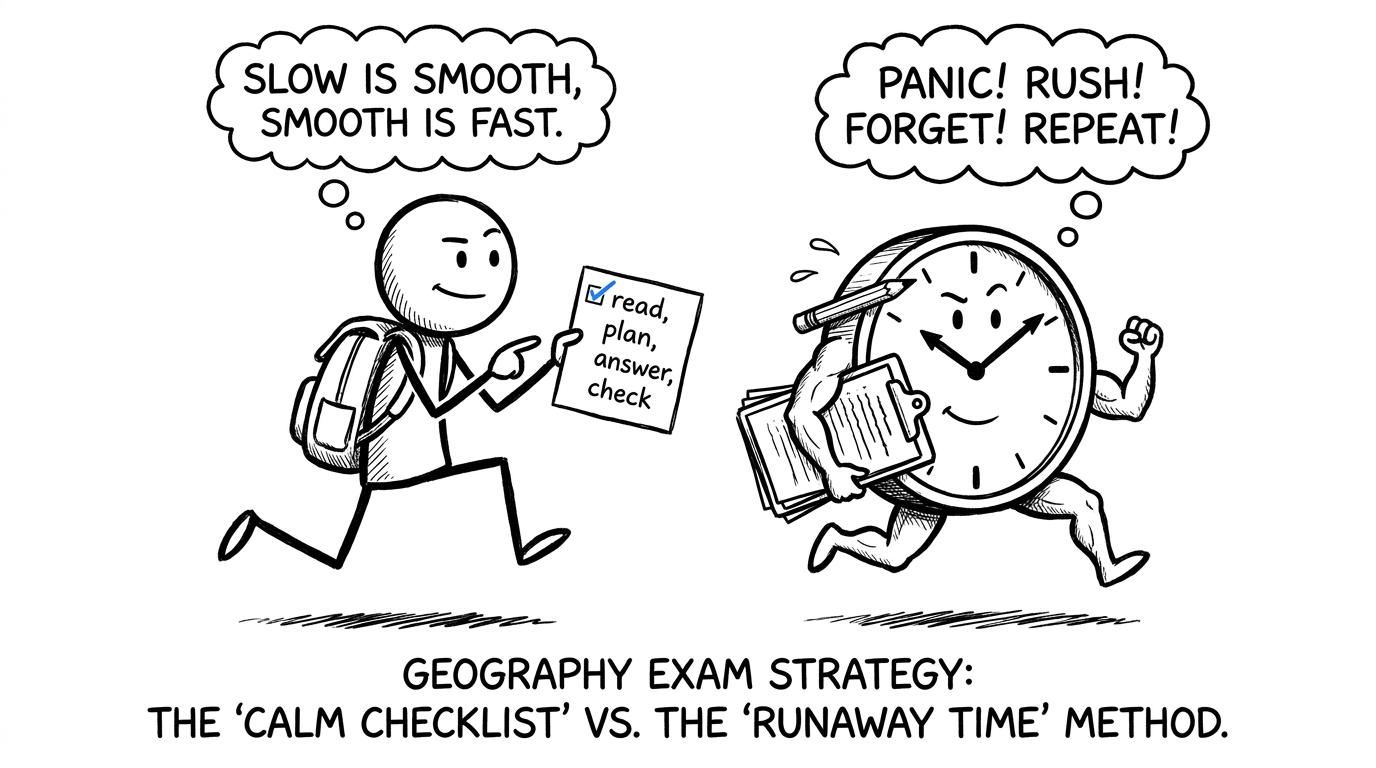 A student calmly racing an exam clock with a short checklist
Treat marks as a guide to time
A paper is a budget. Every minute spent in one place is unavailable somewhere else.
Your exact pace depends on the paper, so check the current specification and the instructions on its front cover. A useful starting calculation is:
minutes per mark=available working timeavailable marks\text{minutes per mark}=\frac{\text{available working time}}{\text{available marks}}minutes per mark=available marksavailable working timeAllow some time for reading instructions, checking optional questions and reviewing answers. AQA teaching guidance has suggested practising at roughly one mark per minute, but this is a training guide rather than a universal rule for every board and paper.
Paper structures differ across AQA, Edexcel, OCR and Eduqas. They can also change. For example, Pearson increased the duration of Edexcel Geography A Paper 1 and Geography B Paper 2 by 151515 minutes for examinations from summer 202620262026. Always train with the timing for your current specification rather than relying on an old revision video or past-paper cover.
The important principle is stable: the mark tariff should influence the time you invest. A short-answer question should not receive the time intended for an extended judgement.
Mistake: answering the topic instead of the command word
A student may know everything about coastal management and still underperform if the question asks them to evaluate it but they only describe it.
Official exam-board guidance treats command words as instructions:
- Describe means give an account of a feature, pattern or process.
- Explain means show why something happens, linking causes and effects.
- Compare requires direct similarities or differences between both items.
- Assess means weigh evidence or factors to reach a judgement.
- Evaluate means consider value, success or effectiveness and reach a supported conclusion.
- Justify means provide reasons showing why a choice is appropriate.
Under pressure, pause before writing. Box or underline the command word, identify the topic and notice any limiting phrase such as “using Figure 3”, “in a UK city” or “from your fieldwork”.
A compact method is BUG: box the command word, underline the key terms, then glance back at the question before moving on. This echoes AQA guidance and helps stop a rehearsed answer drifting away from the actual task.
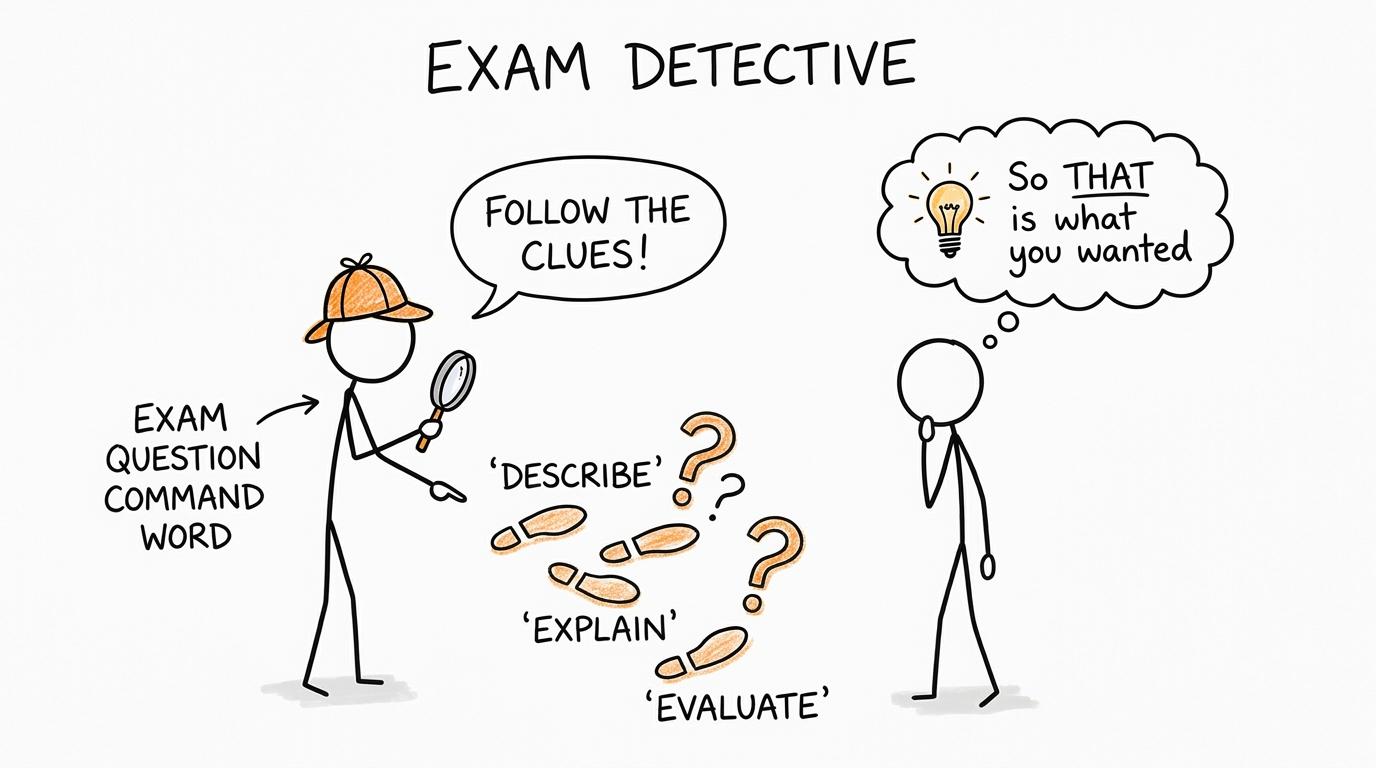 A command-word detective revealing what the question actually wants
Mistake: writing too much for low-tariff questions
Time pressure often begins much earlier than students realise. A one-mark response becomes three sentences. A brief definition becomes a paragraph. By the final section, the accumulated overspending becomes a crisis.
For a low-tariff question, give exactly what is requested. If one precise statement answers it, stop. Extra writing does not create extra available marks, and an unnecessary sentence can introduce a contradiction.
Higher-tariff questions require a different kind of investment. They commonly reward developed reasoning, application, interpretation or judgement. Depth matters more than unloading every fact you remember.
Before an extended response, spend a brief moment selecting:
- the argument you will make;
- the most relevant evidence;
- the geographical process or relationship you will explain;
- the counterargument or limitation, where required;
- the judgement that answers the wording.
A short plan usually saves time because it prevents repetition and mid-answer changes of direction.
Mistake: ignoring figures and geographical resources
Examiner feedback repeatedly warns about students overlooking photographs, maps, graphs and other supplied resources. This becomes more common when students rush and treat the resource as decoration.
If the question says “using Figure 2”, make your use visible. Refer to a pattern, location, value, contrast or feature from that figure, then connect it to your own geographical understanding where required. Merely copying a sentence from the source is not analysis.
Use a ruler when accuracy matters. Read both axes, inspect the scale and check the units before interpreting a graph. On a map, confirm whether the question asks for a direction, distance, grid reference, relief pattern or evidence of land use.
Students who need to strengthen this area can use MathsGenie’s AQA GCSE Geography statistical skills guide. The wider GCSE Statistics revision area is also useful for averages, data displays and interpretation, while the scatter graphs revision guide reinforces correlation, lines of best fit and sensible estimates.
Mistake: rushing geographical calculations
Geography papers can assess percentages, averages, range, scale, rates of change and graph interpretation. These marks are vulnerable when students try to complete every calculation mentally.
Write the relevant operation before using your calculator. For percentage change, the structure is:
percentage change=new value−original valueoriginal value×100\text{percentage change}=\frac{\text{new value}-\text{original value}}{\text{original value}}\times 100percentage change=original valuenew value−original value×100For the mean:
mean=total of the valuesnumber of values\text{mean}=\frac{\text{total of the values}}{\text{number of values}}mean=number of valuestotal of the valuesAfter calculating, check the instruction for rounding and include units unless they are already printed in the answer space. Ask whether the answer is geographically plausible. A calculator can process an incorrect entry perfectly; only you can notice that the result makes no sense.
The transferable number, percentage, ratio and graph skills in the GCSE Maths revision hub can make these questions feel more automatic. That matters because fluency reduces the mental effort required when the paper is already demanding your attention elsewhere.
Mistake: emptying an entire case study onto the page
Knowing many facts can create its own time-management problem. Under pressure, students sometimes write everything they remember about a named place, hoping that some of it must be relevant.
Selection is stronger than volume. Choose evidence that directly supports the question. Include a named location and accurate, specific detail where it adds value, but do not force in memorised statistics that you cannot recall reliably. Never invent a figure.
Case-study knowledge earns its place when it does work: demonstrating scale, supporting a comparison, explaining an effect or strengthening a judgement. A fact that does none of these is using time without advancing the answer.
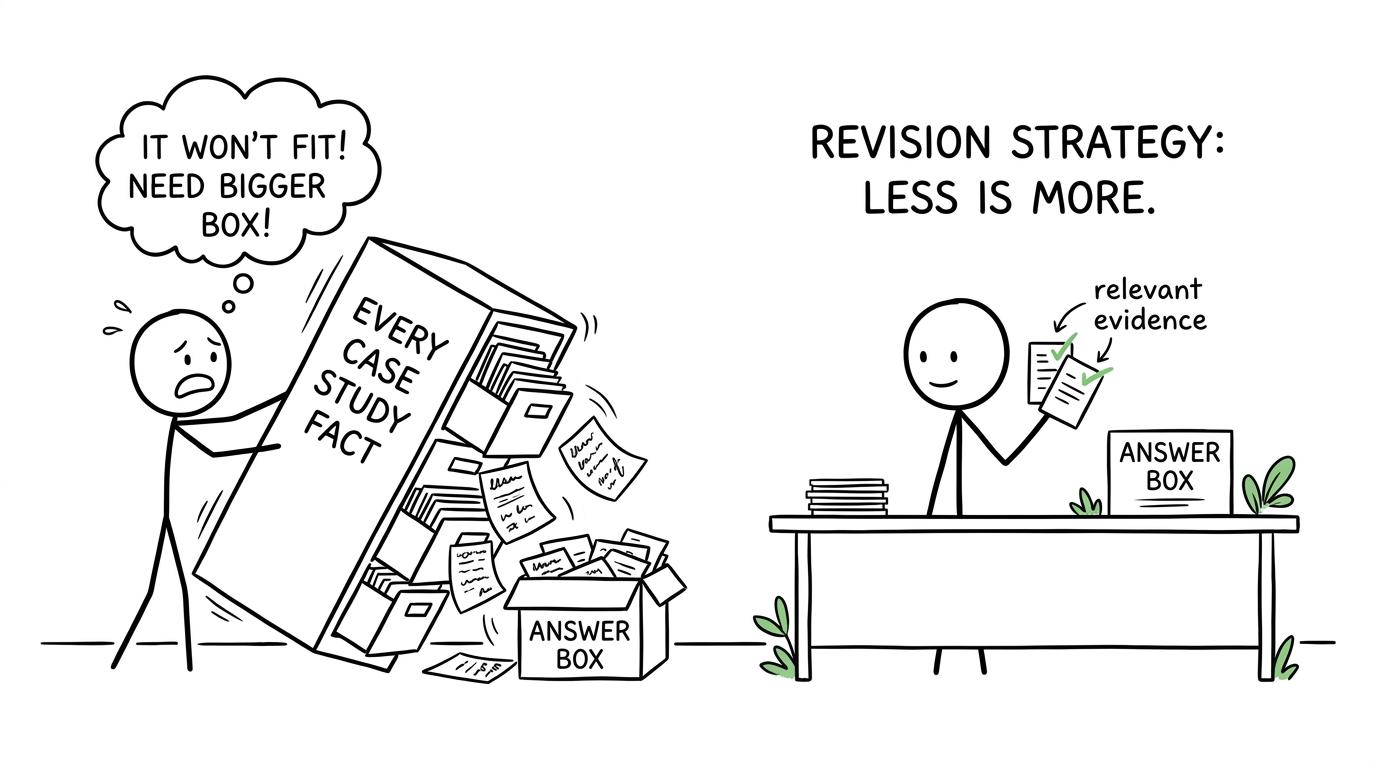 A student trying to squeeze every case-study fact into one tiny answer box
Mistake: confusing fieldwork stages
Fieldwork responses can unravel quickly when students confuse the enquiry question, data collection, presentation, analysis, conclusion and evaluation. Recent Eduqas examiner feedback has specifically highlighted confusion between data collection and presentation.
Learn your fieldwork as a sequence rather than a collection of disconnected notes:
- the enquiry question or hypothesis;
- why the location and sampling method were chosen;
- how primary or secondary data were collected;
- how results were presented;
- what patterns or relationships appeared;
- what conclusion the evidence supported;
- how reliability, accuracy or validity could be improved.
Read whether the question concerns your physical or human fieldwork. A fluent answer about the wrong investigation cannot meet the task.
Common mistakes in the final minutes
Leaving blanks
A blank response cannot earn a mark. If time is short, write a concise, relevant attempt. For an extended question, prioritise a clear argument, evidence and judgement rather than abandoning it because a polished essay is no longer possible.
Forgetting optionality
Some specifications contain choices. Answering too many optional questions wastes time; answering the wrong combination can leave required material untouched. Read the rubric before beginning and mark your choices clearly.
Losing legibility
AQA examiner feedback has warned that handwriting can become difficult to read under time pressure. Speed is useful only while your response remains legible. Use paragraphs, leave a clear gap between answers and cross out errors neatly.
Ending evaluation without a judgement
Listing advantages and disadvantages is not automatically evaluation. Finish by deciding which factor, option or argument is most significant, then support that decision using the question’s context.
Missing graph-completion questions
Graph and diagram tasks may have little or no conventional answer space, making them easy to overlook. Scan every page before the end and check that plotted points, bars, lines, labels or map annotations are complete.
How to train before the exam
Time management improves through exposure, not hope. Begin with one timed section rather than immediately attempting a whole paper. Mark it carefully and classify each lost mark as knowledge, command word, resource use, calculation, timing or careless execution.
Then repeat the weak skill. MathsGenie’s guide to using past papers properly explains the useful cycle: attempt, mark, diagnose, repair and retest. You can find timed assessment materials through the past papers area, use GCSE mini tests for shorter bursts, and organise weaknesses with the MathsGenie revision resources.
Keep a small error log. Do not write “bad at geography”. Write the exact behaviour: “I described instead of explaining”, “I ignored the figure”, or “I spent too long on a low-mark question”. Specific mistakes can be trained out.
Make calm decisions before you need them
The goal is not to feel no pressure. The goal is to have a routine that still works when pressure arrives.
Read the command word. Match time to marks. Use the supplied evidence. Show calculation steps. Select case-study detail rather than dumping it. Move on when a question begins consuming the rest of the paper, then return if time allows.
MathsGenie can support the numerical and exam-technique side of geography through free revision lessons, practice questions, mini tests, past papers, predicted papers, mark schemes and video solutions. Start with the skill that most often slows you down, practise it under a realistic time limit, and let each mistake become an instruction for your next revision session.











