GCSE Geography Revision Drop-In Sessions: Worth It?
GCSE geography revision drop in sessions can be worthwhile when you arrive with clear questions. Learn when to attend and when solo revision is better.
Are geography revision drop-ins worth your time?
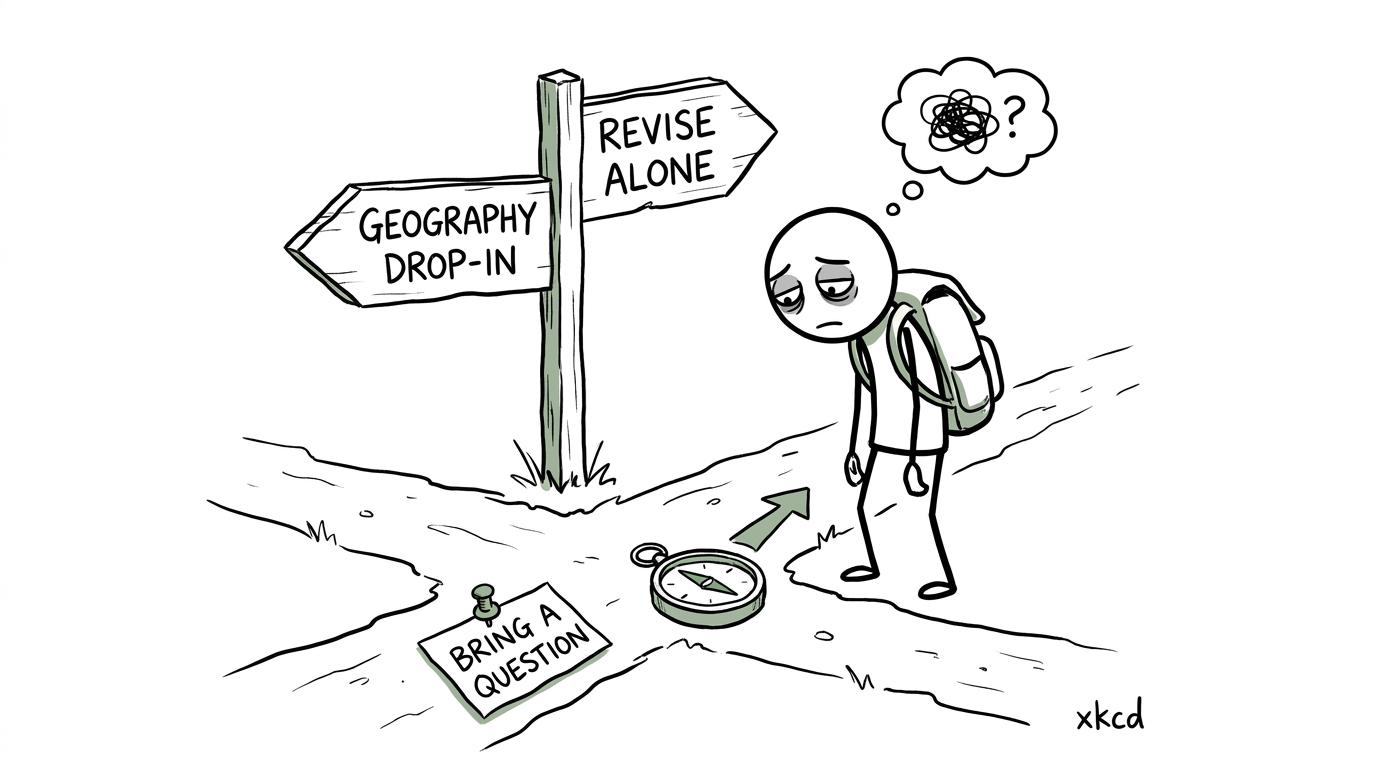
After-school revision creates a deceptively difficult choice. You could attend another teacher-led session, or go home and revise independently. If maths, English and science also need attention, every hour has an opportunity cost.
The short answer is that GCSE geography revision drop in sessions are worth attending when they provide targeted help you cannot easily give yourself. They are particularly useful for correcting misconceptions, improving extended responses, reviewing fieldwork and understanding why an answer lost marks. They are less valuable when you attend without a goal and spend the session passively copying notes.
The best strategy is usually not drop-ins or independent revision. It is a deliberate combination: identify a problem alone, take that problem to the session, then practise independently afterwards.
A quick decision checklist
Attend a geography drop-in if you:
- have a specific question or weak topic;
- need feedback on an extended answer;
- cannot understand the teacher feedback from a mock or practice paper;
- are uncertain about your fieldwork methods, conclusions or evaluation;
- keep losing marks on maps, graphs, data or unfamiliar resources;
- work better when a session gives your week some structure.
Revise alone instead if you:
- already understand the topic and mainly need retrieval practice;
- need uninterrupted time for a timed paper;
- would only sit at the back and reread notes;
- have a more urgent weakness in another subject;
- can answer your question reliably using your notes, specification and mark scheme.
 A GCSE student choosing between a geography drop-in and revising alone
What a productive geography drop-in should achieve
A revision session is not automatically effective because it happens in a classroom. Its value depends on what you do there.
Educational evidence supports targeted small-group help, useful feedback and strategies that encourage students to plan, monitor and evaluate their own learning. That does not prove that every school drop-in will improve every student’s grade. It does explain why a focused conversation with a teacher can be more useful than another hour of vague revision.
A worthwhile session should help you leave with at least one of the following:
- a misconception corrected;
- an answer improved using precise feedback;
- a difficult process explained clearly;
- a fieldwork limitation or conclusion understood;
- a short list of questions to practise next;
- a better judgement about your strongest and weakest areas.
“Revised coasts” is not a useful outcome. “I can now explain how hydraulic action and abrasion contribute to cliff retreat, and I have improved one exam response” is much more meaningful.
Why teacher access matters in GCSE Geography
Geography exams assess more than remembered facts. Across the current GCSE assessment framework, the broad weightings are:
- AO1 knowledge: 15%15\%15%;
- AO2 understanding: 25%25\%25%;
- AO3 application, interpretation, analysis, evaluation and judgement: 35%35\%35%;
- AO4 geographical skills and communication: 25%25\%25%.
The precise paper structure depends on whether you study AQA, Edexcel, OCR or Eduqas, so use your own specification. Unlike GCSE Maths, GCSE Geography is not normally divided into foundation and higher tiers.
The assessment weightings reveal why passive note-making has limits. Remembering a case-study fact may support AO1, but many marks depend on applying knowledge to a resource, analysing evidence or reaching a supported judgement. Those are areas where timely teacher feedback can be especially valuable.
Extended responses
A teacher can show whether your answer actually addresses the command word. For example, an evaluate question requires more than describing benefits and disadvantages. You normally need to weigh evidence and reach a justified conclusion that answers the question.
Bring a completed response rather than asking, “How do I answer long questions?” Ask something narrower:
- Is my judgement supported by the evidence?
- Where does my explanation become descriptive?
- Have I used the resource rather than merely copied from it?
- Which paragraph is preventing this answer from reaching the next level?
That turns the drop-in into feedback you can act upon.
Fieldwork and geographical enquiry
Fieldwork can be difficult to revise alone because your enquiry was specific to your school’s locations, methods and results. Exam-board specifications assess elements such as sampling, data collection, presentation, analysis, conclusions, limitations and evaluation. Some questions may also place fieldwork skills in an unfamiliar context.
Your teacher can help distinguish between a generic weakness and a limitation that genuinely affected your investigation. “We needed more data” is vague. The stronger thinking is to identify what additional data was needed, why it mattered and how collecting it could improve reliability or validity.
Maps, graphs and numerical skills
Geography contains quantitative work: scale, proportion, percentages, averages, rates, coordinates, graphical interpretation and statistical ideas may all appear in geographical contexts. These skills become easier through practice, not observation.
MathsGenie’s free GCSE Maths revision hub can support the mathematical side of geography. You can also revisit scatter graphs and lines of best fit or explore the broader GCSE Statistics revision area when data interpretation is costing you marks.
When revising alone is the better choice
Independent revision is usually better for tasks requiring repetition, recall or sustained concentration. You do not need a teacher beside you while retrieving definitions, learning case-study evidence or completing a timed paper under quiet conditions.
Solo revision also lets you move at your own pace. You can spend longer on urban change without waiting for the group, or skip a familiar weather-hazards explanation and concentrate on fieldwork evaluation.
The risk is that independent revision can feel productive without exposing weaknesses. Highlighting a page is comfortable because the answer remains visible. Closing the book and reconstructing the idea from memory is harder, but it gives you more honest information.
Use this cycle:
- retrieve what you know without notes;
- answer an exam-style question;
- mark it carefully;
- record the precise reason for each lost mark;
- take unresolved problems to the next drop-in;
- attempt a fresh question afterwards.
Maths students can apply exactly the same process using GCSE mini tests and the advice in finding your weakest GCSE topics. The subject changes, but the principle survives: evidence should decide what you revise next.
 A student replacing a huge sack of revision worries with one focused question
How to make GCSE geography revision drop in sessions effective
Arrive with evidence
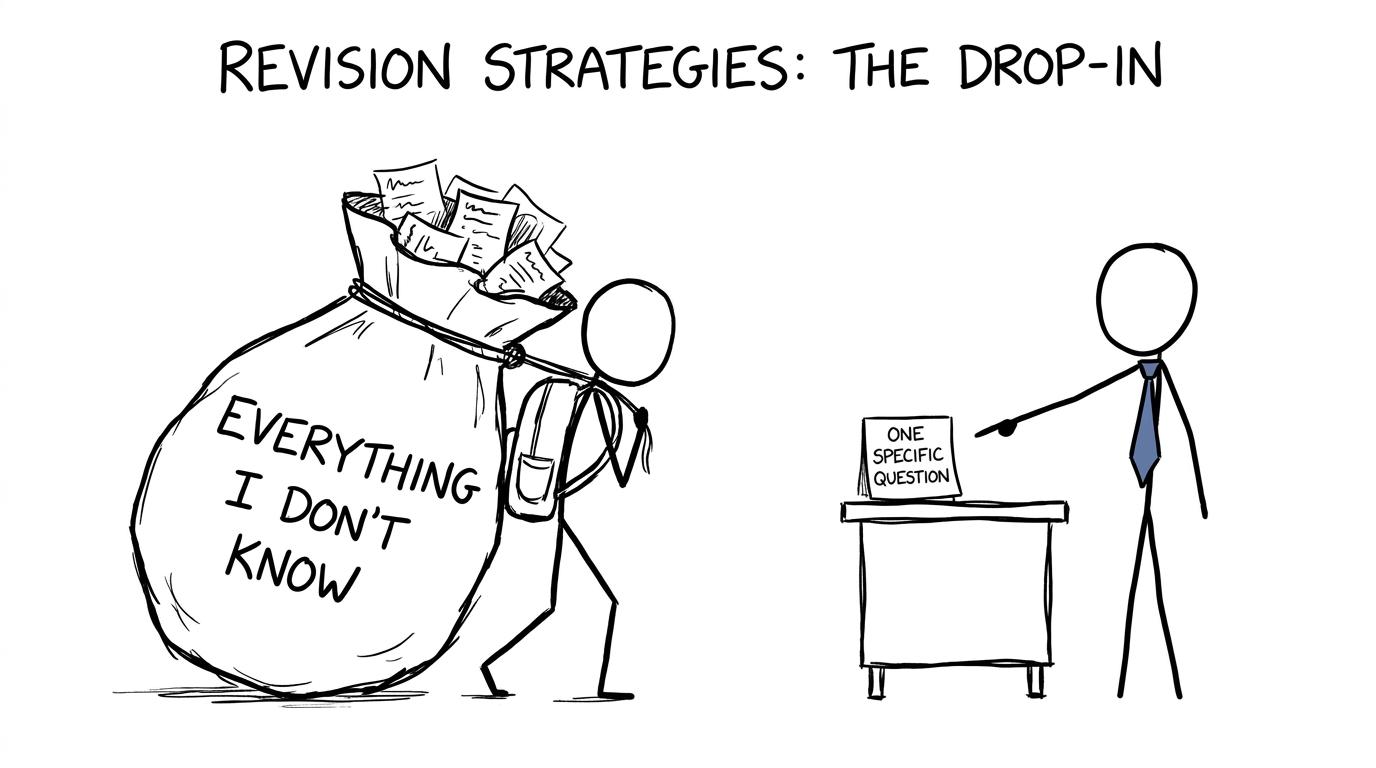
Bring one marked response, one resource question or a short list of uncertainties. A page containing corrections is more useful than saying you are “bad at human geography”.
Before attending, try the question yourself. Teachers can diagnose your thinking more accurately when they can see where it went wrong.
Ask questions that produce an action
Broad questions often receive broad answers. Replace “Can you explain rivers?” with “I understand erosion, but I cannot explain why a waterfall retreats upstream.” Replace “How do I improve?” with “Which part of this response needs more application?”
The smaller the question, the easier it is to leave with something you can practise.
Do not confuse recognition with recall
An explanation may make perfect sense while the teacher is speaking. That is recognition. The test is whether you can reproduce and apply it later without help.
At the end of the session, close your notes and write a brief summary from memory. Then schedule a related question for another day. The MathsGenie one-month revision plan demonstrates how retrieval, focused practice and later review can fit into a manageable GCSE routine.
Protect time for other subjects
A geography drop-in may be free financially, but it still costs time and energy. If it takes an hour and answers nothing you could not resolve independently, that hour may have been better spent on a weak maths topic.
Plan revision across subjects rather than accepting every available session. The GCSE maths revision timetable guide offers a useful framework for balancing targeted topic work with timed practice. Adapt the same idea for geography, science and English.
A practical hybrid revision routine
A strong week might contain three different types of work.
Before the drop-in: complete a short set of geography questions and mark them. Select no more than three issues requiring teacher help.
During the drop-in: ask those questions, annotate your original answers and confirm what a better response must do. If possible, attempt part of another question while support is available.
After the drop-in: answer a fresh question without notes. If the same mistake returns, the issue is not yet secure. Add it to your revision plan and revisit it later.
This prevents the session from becoming an isolated event. The teacher supplies diagnosis and feedback; independent work turns that feedback into a skill.
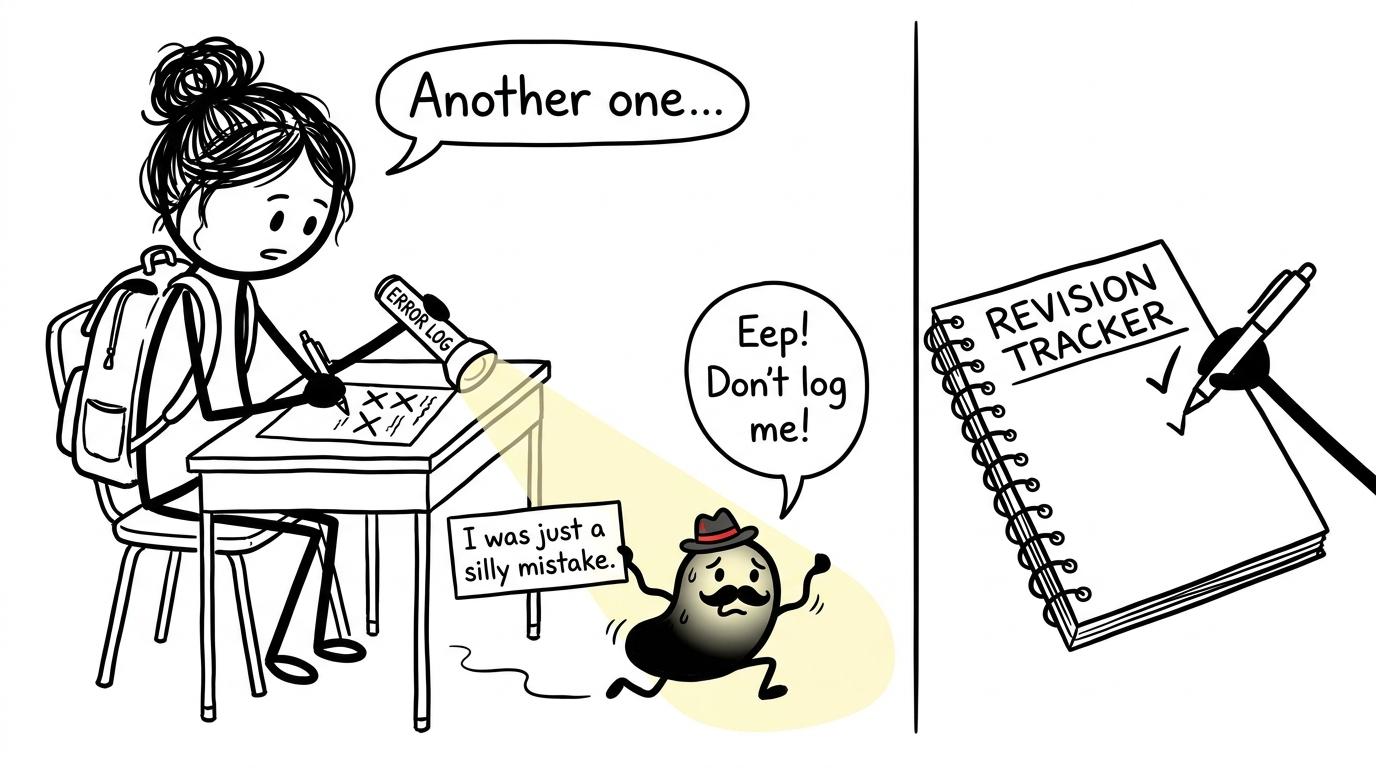 A revision error attempting to escape from a student's error log
Common mistakes to avoid
Attending without a purpose
Simply being present is not the same as revising. Decide what success will look like before the session begins.
Letting confident students control the session
Other students may ask useful questions, but their priorities are not automatically yours. Keep your own list and make sure at least one personal weakness is addressed.
Copying model answers word for word
A model can reveal structure and precision, but copying it does not prove you can construct an answer independently. Study why it works, close it, then write your own response.
Asking for predictions instead of securing the specification
Teachers may identify useful priorities, but no one can guarantee the exact questions. Predicted resources should guide practice, not replace broad specification coverage. The same caution applies to maths predicted-topic advice: recurring themes are not promises.
Ignoring the follow-up
Feedback has little value if it stays on the page. Record the correction, practise it and retest yourself. An error log helps distinguish a one-off slip from a repeated weakness.
The final verdict
School geography drop-ins are worth attending when you use them for what independent revision struggles to provide: expert diagnosis, clarification and feedback. They are not automatically better than revising alone, and they should not consume time merely because they appear on the school calendar.
Go with a question. Leave with an action. Then test whether the action worked.
As you balance geography with maths, use MathsGenie as your free revision base. Start with the GCSE Maths revision hub, then combine revision lessons and practice questions with mini tests, past papers, predicted papers, mark schemes and video solutions. A drop-in can point you in the right direction, but purposeful practice is what carries you the rest of the way.