

GCSE Geography Remark: Results Day Guide
GCSE geography remark guidance for results day: check boundaries, view your script, understand the risks and decide when to ask your school in 2026.
A result can feel final because it appears as one clean number. The work behind it was less tidy: several papers, many questions and hundreds of individual judgements. If your grade seems wrong, a GCSE geography remark may be worth considering, particularly when you are close to the next grade boundary and a teacher identifies a possible marking error.
Act quickly, but not blindly. Ask your school for your component marks, compare your total with the correct boundary and, where possible, let a Geography teacher inspect your marked script before requesting a review.
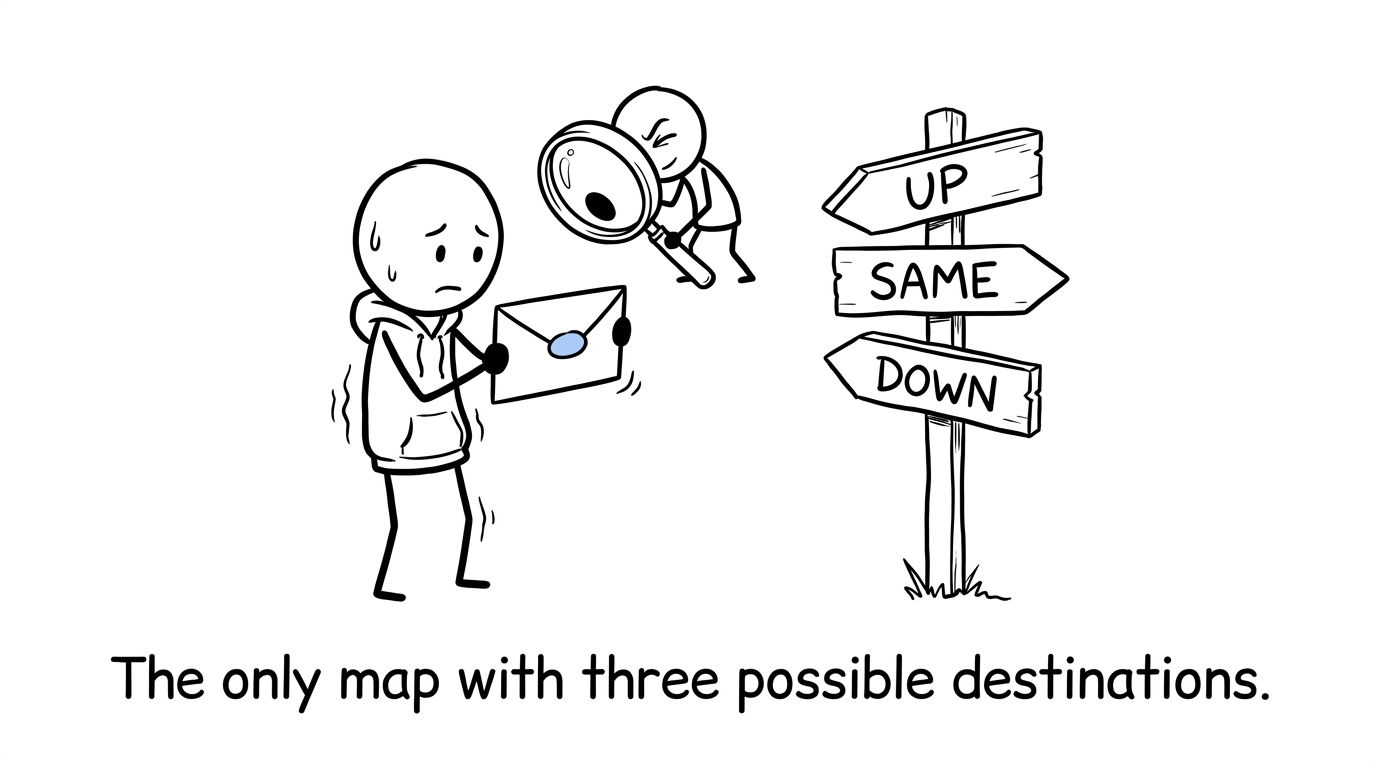 A student considering the three possible outcomes of a review
GCSE geography remark decision checklist
Before signing a request, check each of these points:
- Confirm your exam board and specification, such as AQA, Edexcel A, Edexcel B, OCR or Eduqas.
- Find your total mark and marks for each paper or component.
- Compare the total with the boundary for the grade above.
- Ask whether your school can obtain your marked scripts.
- Ask a Geography teacher to compare relevant answers with the mark scheme.
- Identify the paper most likely to contain a marking error.
- Check your school’s deadline and fee arrangements.
- Accept in writing that your mark and grade may rise, stay unchanged or fall.
Being one mark below a boundary is a reason to investigate, not automatic evidence that the mark is wrong.
How the GCSE geography re-mark process works
“Remark” is the familiar term, but the official service is normally called a review of marking or Service 222. It is not a completely fresh marking of the paper.
An independent reviewer checks the original marking to decide whether the mark scheme was applied correctly and whether any academic judgement was reasonable. A mark is changed when an error is found. It is not changed merely because another examiner might have awarded a different reasonable mark.
The review also includes clerical checks, such as confirming that every response was marked and that marks were recorded and totalled correctly. A separate Service 111 clerical re-check may be suitable where the concern is limited to an unmarked page, missing mark or addition error.
For the June 2026 series, GCSE results are released to students on 20 August 2026. The current JCQ deadline for awarding bodies to receive standard review requests is 24 September 2026. Schools often set earlier internal deadlines so their exams officers have time to process requests. Standard reviews should be completed within 202020 calendar days of receipt by the awarding body.
Your school or college normally submits the application. It must obtain your written consent after results have been published because the outcome can lower your mark or overall grade. Private candidates should contact their entering centre or follow their exam board’s private-candidate procedure.
Step-by-step: deciding whether to request a review
Check the correct grade boundary
Grade boundaries vary by year, board and specification. Do not compare an Edexcel A result with Edexcel B figures, or use a previous year’s boundary as though it applies to 2026.
Start with the GCSE grade boundaries hub, then select the page matching your entry:
- AQA GCSE Geography grade boundaries
- Edexcel GCSE Geography grade boundaries
- Eduqas GCSE Geography grade boundaries
- WJEC GCSE Geography grade boundaries
Calculate the gap between your total and the next boundary. Your exams officer or results sheet should also show the component marks needed to identify which paper deserves closer attention.
Ask to see the marked papers
Access to scripts lets your school obtain copies of marked papers. Ask immediately because access arrangements and deadlines vary between boards.
A Geography teacher can look for specific issues: an unmarked response, credit apparently missed in a data interpretation question, or an extended answer where the awarded level may not fit the published descriptors. Geography includes short, objective items as well as longer evaluative responses requiring examiner judgement, so professional inspection is more useful than simply remembering that an answer “felt good”.
Students following Edexcel A can revisit the paper structure through the Edexcel A GCSE Geography revision hub and compare question styles using Edexcel A Geography past papers and mark schemes.
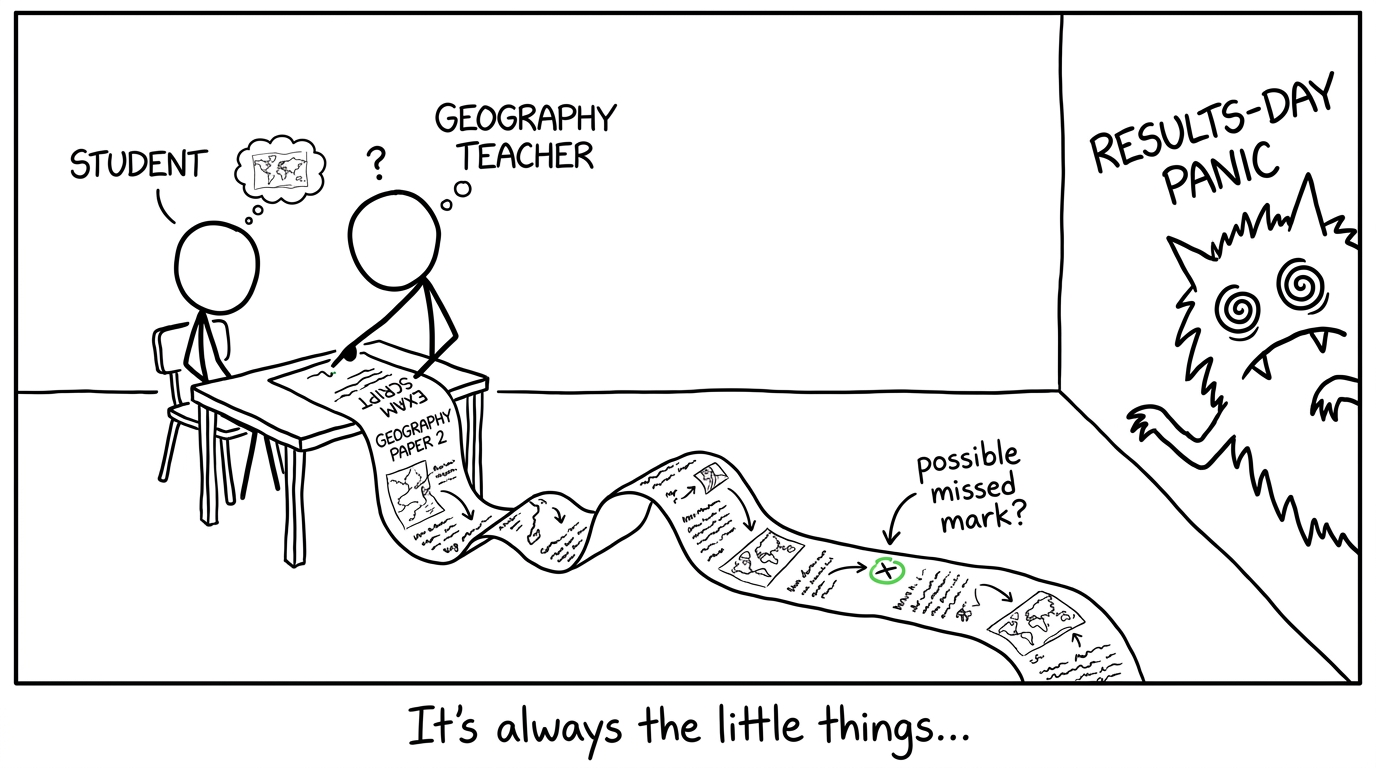 A teacher and student examining an exam script like a treasure map
Choose the relevant paper
Review requests are generally made for individual papers or components, with fees usually charged per component. You do not automatically need every Geography paper reviewed.
Prioritise evidence. A paper may justify review when a teacher can point to a plausible marking error and recovering the relevant marks could affect the qualification grade. If every answer appears reasonably marked and several marks are required, the case is weaker.
Submit consent through your school
Tell the exams officer which paper you want reviewed. Confirm the cost, payment rules and internal deadline before signing the consent form. Fees and refund arrangements differ between exam boards and centres, so rely on the current information supplied by your school rather than an old online figure.
When appealing a GCSE Geography grade is different
Appealing a GCSE Geography grade is not usually the first step. An appeal normally follows a completed review of marking and must be submitted through the centre. It considers whether a marking error remains or whether the correct procedure was followed; it is not simply another opportunity to seek extra marks.
If you remain concerned after the review, ask your head of centre or exams officer to explain the outcome and the board’s appeal deadline. Appeals are time-sensitive, and the mark can again rise, remain unchanged or fall.
Common mistakes to avoid
- Requesting a review based only on disappointment. Compare boundaries and inspect evidence first.
- Assuming a close result must increase. Distance from a boundary does not prove a marking error.
- Using the wrong specification’s boundary. Geography variants can have different maximum marks and boundaries.
- Waiting for the national deadline. Your school’s internal deadline may be much earlier.
- Expecting a complete fresh re-mark. Reviewers correct errors; they do not replace one reasonable judgement with another.
- Forgetting the downside. There is no grade protection for an individual review of marking.
Make the next decision evidence-led
Results day makes every mark feel emotional. The best response is quieter: verify the board, check the boundary, inspect the script and listen to subject-specific advice. Request a review when the evidence supports one, not because the phrase “nothing to lose” sounds comforting.
Begin with MathsGenie’s GCSE Geography grade boundaries, then speak to your teacher and exams officer promptly. When you are ready to prepare for your next exams, MathsGenie also brings together free GCSE Maths revision lessons and practice questions, mark schemes, video solutions, mini tests, past papers and GCSE predicted papers: everything needed to turn uncertain marks into a clear revision plan.











