GCSE Geography: No Background Knowledge Needed?
GCSE geography no background knowledge? It can be realistic if your school agrees. Learn what you must catch up, which skills matter and how to begin.
A late subject choice can feel like arriving halfway through a film. Everyone else seems to know the characters: erosion, urbanisation, grid references, fieldwork. You are still trying to understand the plot.
The reassuring answer to GCSE geography no background knowledge worries is that starting the course can be realistic. Eduqas explicitly states that its GCSE Geography specifications have no previous learning requirements, although entry decisions remain with the school or college. More broadly, GCSE courses are designed to develop geographical knowledge and skills, even though they normally build on Key Stage 3 geography.
Your school must still approve the change. If it does, your task is not to learn every fact ever taught in geography. It is to identify your specification, close the most important gaps and practise applying knowledge to unfamiliar resources.
Your starting checklist
Before changing subjects or beginning an accelerated catch-up plan, confirm:
- which exam board and specification your school uses
- which topics and optional units your class has selected
- which case studies and named examples have already been taught
- what fieldwork has taken place and how you can learn the enquiry process
- which assessments or internal deadlines you have missed
- whether your timetable gives you enough teaching and supervised support
- how much independent revision you can sustain alongside GCSE maths and your other subjects
The question is not simply, “Am I allowed to take geography?” It is, “Can I gain the required knowledge, skills and fieldwork understanding in the time available?”
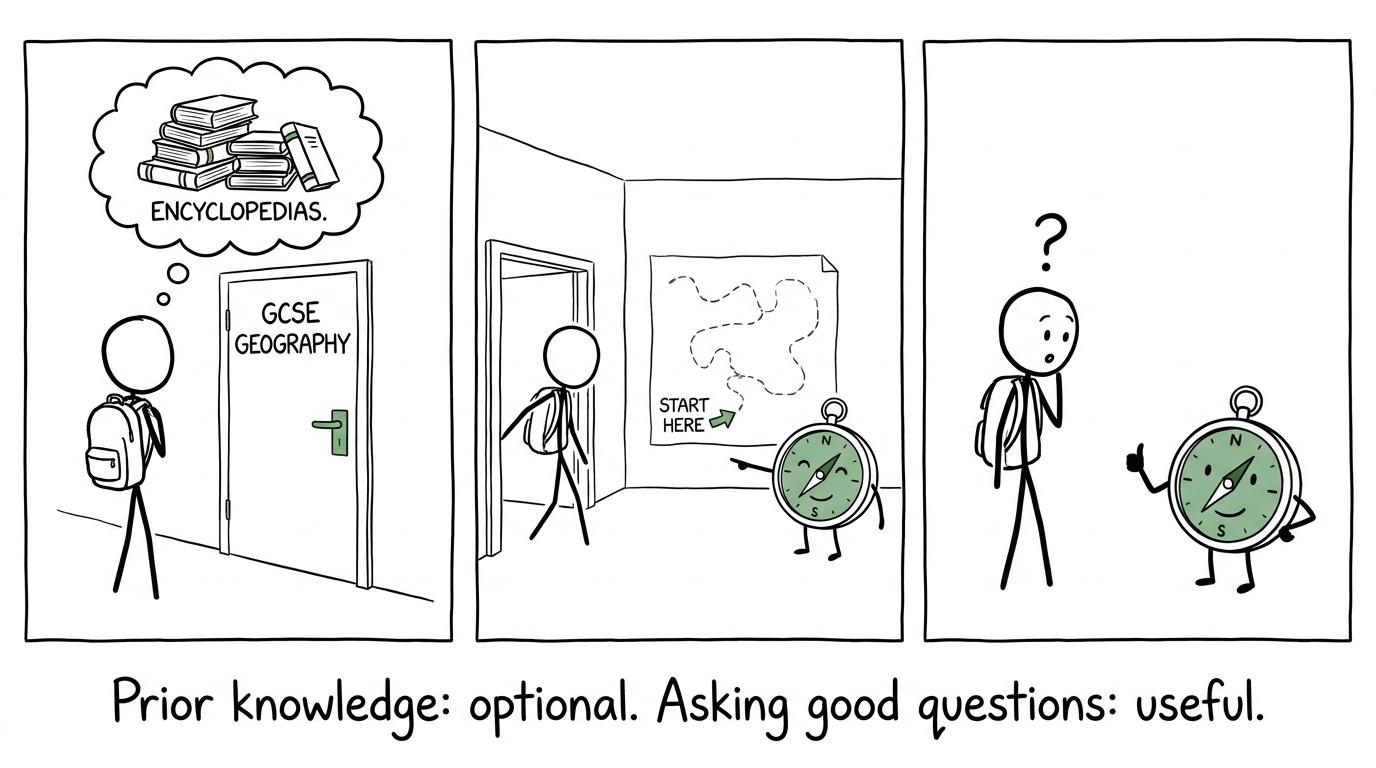 A student discovers that GCSE Geography has a clear starting path rather than a wall of encyclopaedias
Can you really begin GCSE Geography without the usual background?
Yes, potentially, but permission and practicality are separate issues.
Eduqas says there are no previous learning requirements for its Geography A and Geography B specifications. It also makes clear that schools and colleges can set their own entry requirements. Other courses similarly teach the assessed GCSE content, but official subject content expects progression from geographical ideas commonly encountered at Key Stage 3.
That means a school may reasonably consider:
- how far the class has progressed
- whether you can participate in or understand the required fieldwork
- whether teachers can provide missed resources
- your current timetable and workload
- whether changing subjects would create examination-entry problems
Ask your head of geography or examinations officer about your specific situation. Do not assume that arrangements at another school apply to yours.
Starting near the beginning of Year 10 is very different from joining shortly before the final examinations. Neither success nor failure can be promised from the calendar alone, but less time means that your catch-up plan must become more selective and demanding.
What knowledge will you need to catch up?
GCSE Geography combines physical geography, human geography, geographical applications and skills. The labels differ between AQA, Edexcel, OCR and Eduqas, so the specification used by your school must be your master checklist.
Physical and human processes
Physical geography may include natural hazards, ecosystems, weather and climate, rivers, coasts or distinctive landscapes. Human geography can include urban change, development, economic activity, resources and environmental challenges.
Do not begin by memorising isolated definitions. Learn each topic as a chain:
- what the process or issue is
- where it occurs
- why it occurs
- what effects it creates
- how people respond
- how those responses can be assessed
This structure turns facts into explanations. It also makes unfamiliar questions less intimidating because you can rebuild an answer from causes, effects and evidence.
Case studies and named examples
Specifications require case studies or examples, but your school's choices matter. One class may study a different city, hazard or landscape from another while covering the same specification requirement.
Ask for the exact case-study list. For each one, prepare a compact summary containing its location, relevant context, causes, effects, responses and a small set of secure evidence. Avoid collecting impressive-looking facts that you cannot connect to a question.
Fieldwork and geographical enquiry
National GCSE subject content requires fieldwork in at least two contrasting environments, involving physical and human processes and the collection of primary data. Exam boards assess students' understanding of the enquiry process, including data collection, presentation, analysis, conclusions and evaluation.
If you missed a visit, speak to your school immediately. The appropriate solution depends on the specification, the school's arrangements and the stage of the course. Reading somebody else's notes is not automatically equivalent to understanding why a method was chosen, how sampling worked or what limited the reliability of the conclusion.
The maths skills that give you a head start
Geography is not just a memory subject. Official specifications include cartographic, graphical, numerical and statistical skills. AQA, for example, states that geographical skills are assessed across its written papers.
For a student preparing for GCSE maths, this is useful news. Several familiar skills transfer directly:
- percentages and percentage change
- ratios and proportions
- mean, median, mode and range
- interpreting tables, bar charts, line graphs and pie charts
- recognising correlation in scatter graphs
- scale, distance and unit conversion
- rates of change and population density
- sampling, reliability and anomalous results
- using large or small values in standard form where appropriate
You should understand relationships such as:
percentage change=changeoriginal value×100\text{percentage change}=\frac{\text{change}}{\text{original value}}\times 100percentage change=original valuechange×100and:
mean=sum of the valuesnumber of values\text{mean}=\frac{\text{sum of the values}}{\text{number of values}}mean=number of valuessum of the valuesThe calculation is only the first step. In geography, you usually need to interpret what the result suggests, relate it to the place or process and recognise limitations in the evidence.
Use MathsGenie's percentage change lesson to strengthen a skill that appears naturally in population, climate and development data. The standard form revision resources can also help when geographical information uses very large populations, distances or measurements.
How to catch up quickly without trying to learn everything at once
The fastest useful plan is organised around the assessed course, not around a random geography textbook.
Establish the size of the gap
Print or save your exam-board specification and compare it with your teacher's scheme of work. Mark each section:
- secure
- partly understood
- not yet studied
- dependent on a school-selected case study
- connected to fieldwork
Then ask your teacher which missing areas are prerequisites for current lessons. Those come first. Learning coastal management may be urgent if the class is evaluating coastal strategies tomorrow; memorising a later optional unit may not be.
Use a repeatable revision cycle
For each small topic:
- learn the core vocabulary and process
- reduce it to a one-page summary or retrieval grid
- recall it without looking
- answer exam-style questions
- check the mark scheme
- record the exact omission or misunderstanding
- revisit it within a few days
This is more effective than repeatedly reading notes because it exposes the difference between recognising information and producing it under exam conditions. The same disciplined approach is explained in MathsGenie's guide to revising GCSE maths without wasting time.
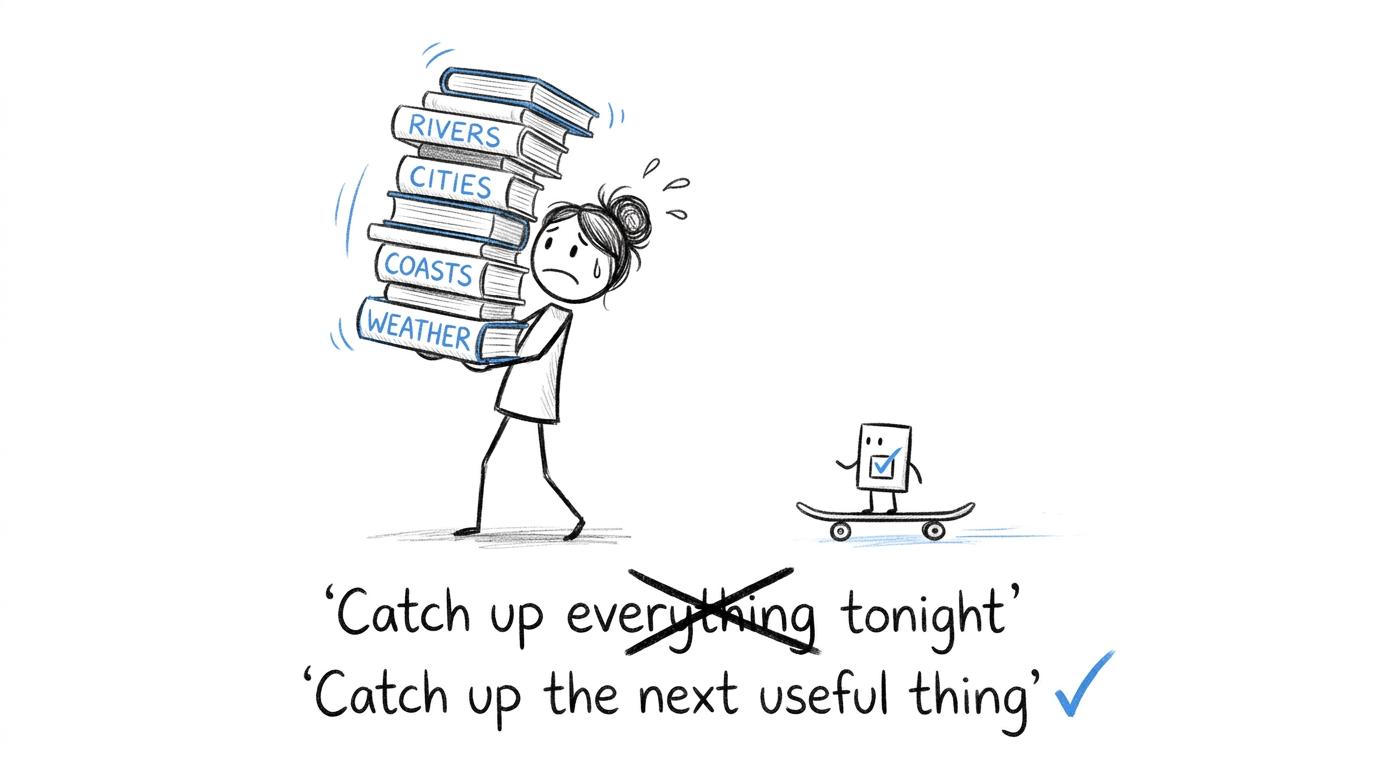 A huge tower of geography books loses a race to a calm, focused revision checklist
Separate knowledge from exam technique
A weak answer can come from two different problems. You may not know the content, or you may know it but fail to apply it to the command word and resource.
Keep two lists. The first records knowledge gaps such as a missing river process or insecure case-study evidence. The second records technique gaps such as failing to compare both data sets, omitting units or making a judgement without evidence.
This distinction matters in maths too. MathsGenie's overview of GCSE maths topics and revision priorities recommends moving from coverage to topic practice and then paper practice. The same sequence prevents you from attempting full geography papers before you have enough content to learn from them.
Protect your maths revision time
A new subject can consume every free evening because its gaps are visible. Your other GCSEs still matter.
Use short, scheduled blocks and give each session a defined output: one process recalled, one case study condensed or one set of questions marked. Keep your maths moving through the free MathsGenie GCSE and A Level revision hub rather than postponing it until geography feels “finished”. A subject is rarely finished; it becomes increasingly secure.
What a strong weekly plan should contain
A balanced catch-up week might include:
- two sessions on missed geographical content
- one session retrieving case studies and terminology
- one session on maps, graphs, data or fieldwork
- one set of timed exam questions followed by careful marking
- several protected GCSE maths sessions
- a short review with a teacher when clarification is needed
Increase or reduce this according to the gap and your available time. Avoid plans that depend on perfect concentration every day. A modest system that survives a tiring week is more valuable than an ambitious timetable abandoned after three days.
For mathematical skills, use revision lessons first, then practice questions and mark schemes. Once methods are secure, move to mini tests, past papers and predicted papers. Topics involving repeated rates of geographical change may also benefit from the repeated percentage change revision guide.
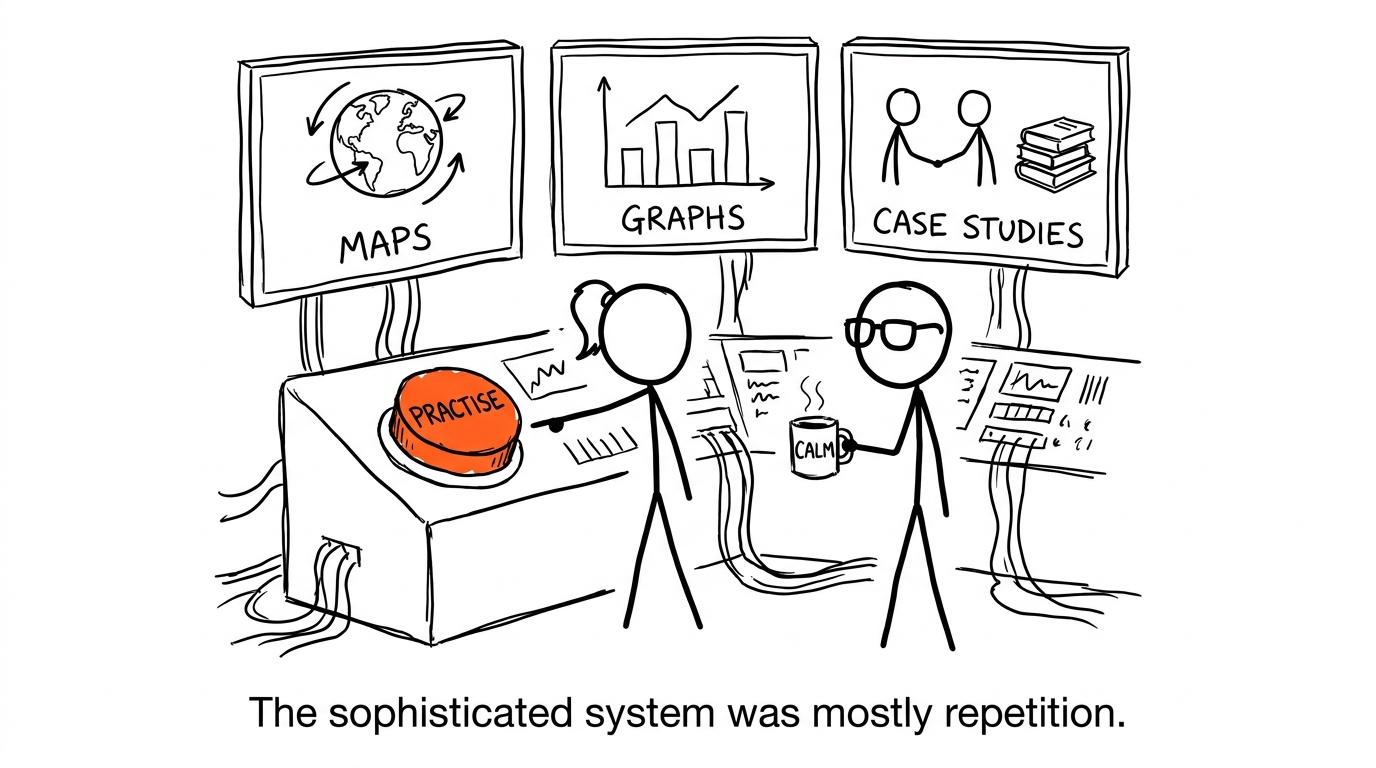 Students operate a calm revision control room powered mainly by practice
Common mistakes when starting Geography late
Treating the course as a list of facts
Knowledge matters, but questions also assess understanding, application, geographical skills and evidence-based judgement. Learn how ideas connect rather than memorising disconnected sentences.
Using the wrong case studies
Generic online notes may cover a different exam board or choices your school has not taught. Start with your specification and your teacher's case-study list.
Ignoring fieldwork until the examination
Fieldwork is part of GCSE Geography, not an optional extra. Learn the complete enquiry cycle and understand the particular investigations completed by your school.
Revising maths skills without geographical interpretation
A correct percentage or mean may not complete the task. State what the value shows, use the context and consider whether the evidence is representative or reliable.
Attempting full papers too early
Past papers are most useful after enough topic knowledge has been built. Otherwise, the score mainly confirms that you have not covered the course. Begin with focused questions, then increase the breadth and timing pressure.
Letting catch-up replace every other subject
The urgency of a late start can distort priorities. Agree a realistic weekly commitment with teachers and protect revision for maths, English and your other GCSEs.
A realistic decision, not a leap of faith
Taking GCSE Geography without the usual background knowledge is possible when your school permits it and there is enough time, teaching support and commitment to close the right gaps. Prior Key Stage 3 geography is helpful, but it is not a universal formal entry requirement. The decisive issue is whether you can master your specification's content, case studies, fieldwork understanding and geographical skills.
Begin with the specification. Ask direct questions. Build one secure layer at a time.
Meanwhile, keep your mathematical foundation strong with MathsGenie's free revision lessons, practice questions, video solutions and mark schemes. Use mini tests to expose gaps, then move to past papers and predicted papers when you are ready for timed practice. Geography may be the new subject, but careful, measurable revision is already a skill you can carry with you.