

GCSE Geography Grade Boundaries 2026 Explained
GCSE geography grade boundaries explained for 2026: learn when they appear, how raw marks become grades and what to check calmly on results day.
The difficult part of results day is often not opening the envelope. It is the minute afterwards, when you look at a Geography grade and wonder how a collection of essays, maps, calculations and fieldwork questions became one number.
The short answer is that GCSE geography grade boundaries are the minimum raw marks required for each grade. Exam boards set them after papers have been marked, taking the difficulty of that year's assessments into account. The official geography grade boundaries 2026 will be published on GCSE results day, Thursday 20 August 2026. They cannot be confirmed accurately beforehand.
Here is what you need to know:
- boundaries differ between exam boards and specifications;
- your overall qualification mark normally determines your grade;
- individual-paper boundaries may be notional rather than decisive;
- boundaries can change from one exam series to another;
- being close to a boundary does not automatically mean your marking was wrong.
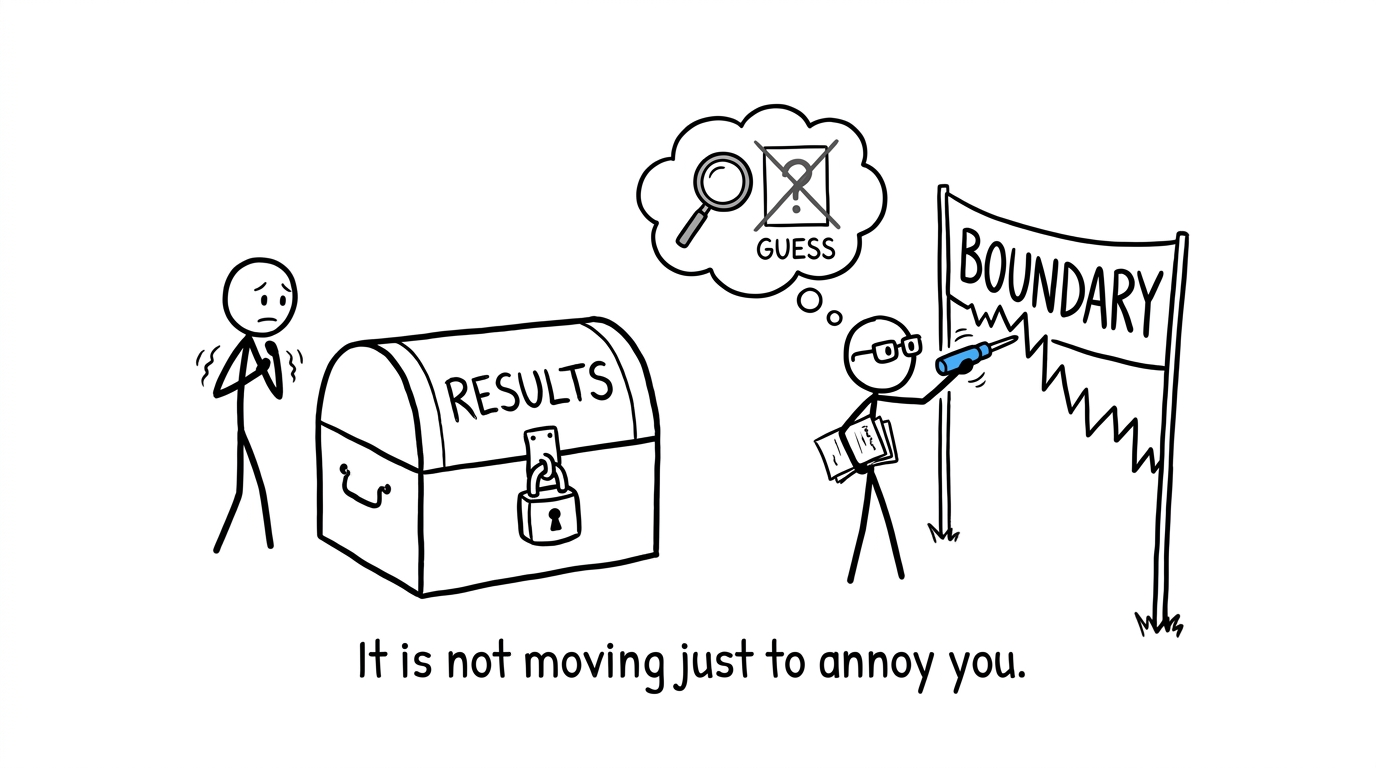 A student watches an examiner adjust a grade boundary finish line
How GCSE Geography grade boundaries work
A grade boundary is the lowest raw mark that earns a particular grade. If the grade 666 boundary is 152152152, for instance, a total mark of 152152152 receives grade 666. A mark of 151151151 falls into the grade below unless a review changes the mark.
Boundaries are not chosen before students sit the papers, and they are not fixed percentages that apply every year. Awarding organisations use evidence including the demands of the assessments and how students performed. This is intended to maintain a comparable standard when one year's paper is slightly more or less demanding than another.
That explains a result that can otherwise feel strange: a harder paper may have lower raw-mark boundaries, while a more accessible paper may have higher ones. The grade still represents the standard reached, not simply the percentage printed beside a mark.
In England, GCSE Geography uses grades 999 to 111, with grade 999 the highest. Geography is not divided into foundation and higher tiers, so all candidates taking the same specification enter the relevant common assessments.
When are geography grade boundaries 2026 released?
Official boundaries for the June 2026 series are released on Thursday 20 August 2026, the confirmed GCSE results day. JCQ guidance permits centres to give candidates their results from 8 am8\text{ am}8 am, although your school decides its collection arrangements. Exam boards also publish boundary documents on results day.
Until then, any table claiming to show confirmed 2026 boundaries is speculative. Previous boundaries can offer context, but they cannot tell you exactly what mark will secure a grade this year.
When checking the published document, match all of the following:
- the correct exam board, such as AQA, Edexcel, OCR or Eduqas;
- the exact Geography specification or route;
- the June 2026 exam series;
- the qualification-level maximum mark;
- the overall boundary, rather than an isolated paper figure.
MathsGenie's GCSE Geography revision hub separates resources by board, including AQA, Edexcel A, Edexcel B, OCR and Eduqas routes. That same distinction matters when reading boundary documents.
A worked GCSE Geography boundary example
Consider a fictional Geography qualification with a maximum of 240240240 marks. Suppose its published overall boundaries are:
| Grade | Minimum raw mark |
|---|---|
| 777 | 176176176 |
| 666 | 152152152 |
| 555 | 128128128 |
| 444 | 105105105 |
A candidate receives 159159159 marks. Because
152≤159<176,152 \leq 159 < 176,152≤159<176,the candidate earns grade 666.
Their percentage is
159240×100=66.25%.\frac{159}{240}\times 100=66.25\%.240159×100=66.25%.However, the grade comes from comparing the raw total with the published boundary, not from applying a universal percentage rule. This example is deliberately hypothetical and is not a prediction of the 2026 boundaries.
Overall boundaries and individual papers
Most GCSE Geography specifications contain several written papers or components. Your marks across those components are combined to produce an overall qualification mark.
Exam boards may also publish notional component boundaries. These illustrate approximately how performance on one paper relates to grades, but they do not award a separate GCSE grade for each paper. A weaker result on one component can be balanced by a stronger result elsewhere because the final award is based on the combined total.
This matters in Geography, where a candidate might feel confident about physical geography but less certain about human geography, fieldwork or geographical skills. One difficult section does not determine the qualification by itself.
Students who want to understand the content behind their result can revisit the AQA GCSE Geography revision guides, use AQA Geography flashcards, or explore the complete AQA Geography revision area. Edexcel students can instead use the board-specific Edexcel A Geography revision resources.
What to do on GCSE Geography results day
First, read the grade on your official results slip. Do not let a social-media boundary table become more authoritative than the result issued by your centre.
If your school provides your raw mark, compare it with the correct overall boundary. If it does not, ask a teacher or exams officer whether the mark is available. Then consider what the result means for your next step rather than focusing only on the distance from a boundary.
If the grade is unexpected, speak to your Geography teacher. Your centre can explain options such as obtaining a script or requesting a review of marking. A review checks whether the mark scheme was applied correctly; it is not an automatic award of extra marks, and marks can stay the same, rise or fall. Schools also have deadlines and may charge fees, so discuss the evidence and any progression requirement before proceeding.
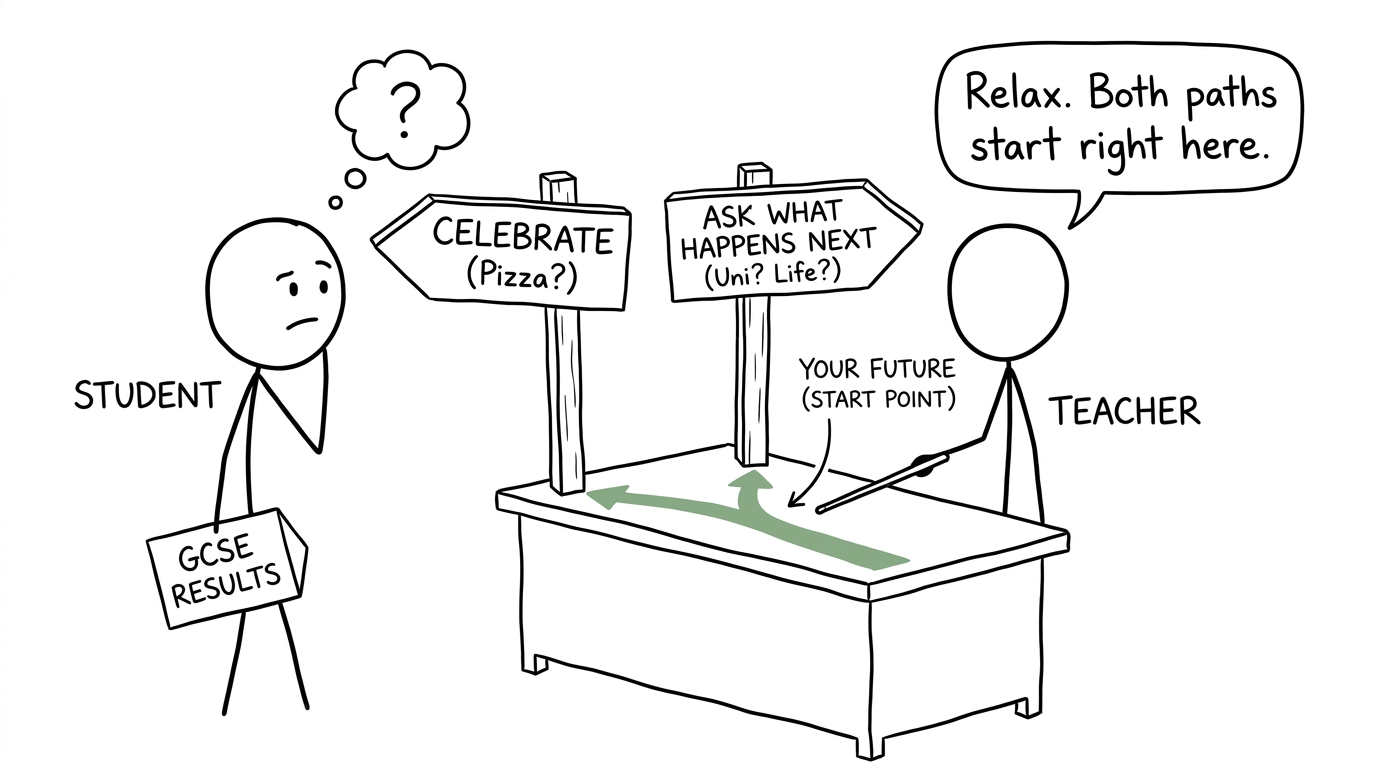 A student discovers that celebrating and asking for advice begin at the same results desk
Common mistakes when reading grade boundaries
Using another exam board's table
AQA boundaries do not apply to Edexcel, OCR or Eduqas qualifications. Even similarly named courses can have different papers, totals and assessment structures.
Treating old boundaries as a forecast
Past boundaries show what happened under past assessments. They are useful context, not a promise about 2026.
Looking at one paper in isolation
A notional paper boundary does not override the qualification total. Add the component marks using the board's published structure and check the overall row.
Assuming one mark below means an error
Every boundary creates a cut-off. Being close can feel especially frustrating, but proximity alone is not evidence of inaccurate marking.
Confusing percentages with fixed grades
There is no permanent rule saying a particular percentage always equals a particular Geography grade. Use the raw-mark table for the correct series and specification.
Your result is information, not a verdict
Results day compresses months of work into a small box on a page. That box matters, but it does not describe every skill you developed while interpreting maps, evaluating evidence or handling geographical data.
Check the correct 2026 boundary, ask for calm advice if something appears wrong, and then look forward. MathsGenie offers free GCSE Geography revision resources, including revision guides, past papers, practice questions, mark schemes, predicted papers and mini tests. If a geographical source question caused difficulty, the OCR visual and source skills guide also provides focused guidance.
Whatever appears in the envelope, your most useful next action is the same: understand the result accurately, then make the next decision with better information.











