

GCSE Geography Exam Start Time: What to Expect
GCSE geography exam start time explained: learn the official morning and afternoon sessions, when to arrive, and what happens before writing begins in school.

The strange thing about an exam timetable is that it can look precise while still leaving you with questions. It says “AM”, but when should you arrive? Does the paper begin at exactly 9.00 am? What happens if your school asks you to be there earlier?
The short answer is that the published GCSE geography exam start time is normally 9.00 am for a morning paper or 1.30 pm for an afternoon paper at UK centres following the main JCQ arrangements. However, schools and colleges have limited flexibility to start up to 303030 minutes earlier or later. Your personalised timetable and your exams officer’s instructions therefore take priority.
The important distinction is simple: the published session time, the time you enter the room and the moment you start writing are not always identical.
Your quick exam-time checklist
Before each Geography paper, confirm:
- your exam board, such as AQA, Edexcel, OCR or Eduqas
- the correct paper or component
- whether it is in the morning or afternoon session
- the arrival time set by your school
- the examination room and seat number, if provided
- the paper duration and any approved access arrangements
- what equipment you are permitted to bring
Do not rely on a timetable copied from social media or sent by a friend. Geography specifications have different components, and exam dates change each year. Use the final personalised timetable issued by your school or college.
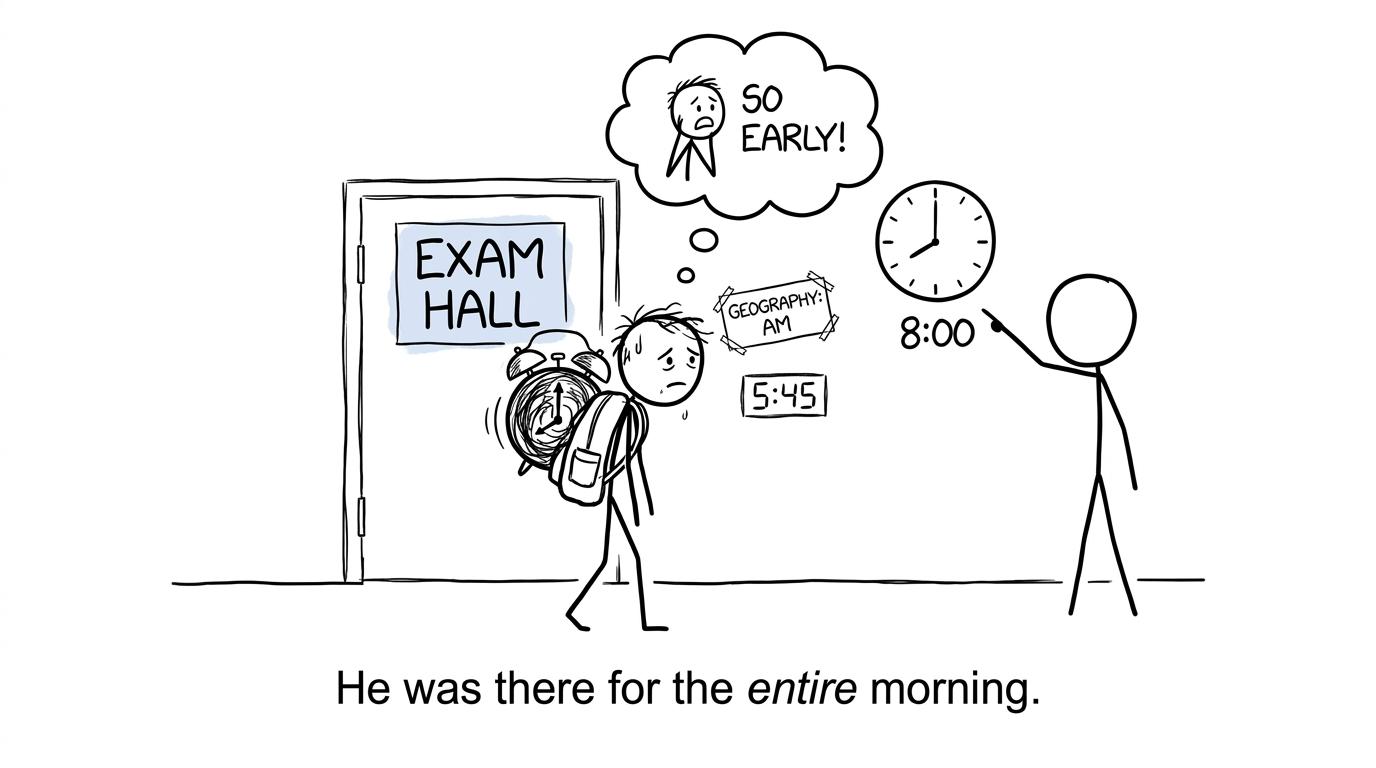 A GCSE student arriving extremely early with a giant alarm clock while an invigilator points calmly towards the exam hall
What time do GCSE Geography exams officially start?
For AQA, Pearson Edexcel, OCR and Eduqas examinations at UK centres, the standard published session times are:
| Exam session | Published start time | Normally permitted centre window |
|---|---|---|
| Morning | 9.00 am | 8.30 am to 9.30 am |
| Afternoon | 1.30 pm | 1.00 pm to 2.00 pm |
These windows come from the JCQ arrangements used by the main awarding bodies. They do not mean that students may choose when to arrive. They allow an examination centre to organise its papers safely around rooming, transport and other operational needs.
If your school timetable says that your Geography paper starts at 8.45 am, follow that instruction. If it says 1.15 pm, follow that instruction. The national published time explains the session; the school controls the practical arrangements within the permitted rules.
Students taking CCEA qualifications in Northern Ireland should be aware that its published morning session has traditionally been 9.15 am rather than 9.00 am. Always check the current CCEA and centre timetable if this applies to you.
Why your school may give you an earlier arrival time
A 9.00 am paper does not mean walking through the school gate at 8.59 am. Before writing can begin, the centre must organise candidates, check attendance and complete the required announcements.
Many schools ask students to arrive at least 151515 to 303030 minutes before their scheduled start. That is a sensible planning margin, but it is not a universal arrival rule. Your school may set a different time, so read its candidate guidance carefully.
Arriving early gives you time to:
- find the correct room without rushing
- check the seating plan
- use the toilet before entering
- store your phone and other unauthorised items correctly
- resolve a missing candidate number or timetable query
- settle before the invigilator begins the formal instructions
The benefit is not extra revision. It is fewer avoidable decisions. A calm arrival protects the attention you will soon need for map interpretation, fieldwork questions, resource booklets and extended responses.
A realistic walkthrough from arrival to writing
Knowing what happens next can make the morning feel less mysterious. Exact procedures vary by centre, but the sequence usually looks like this.
Before you leave home
Check the paper, date and session against your personalised timetable. Pack the permitted equipment requested by your centre, usually in a transparent pencil case. Geography papers may require standard writing equipment and, depending on the paper, items such as a ruler or calculator. Use your exam board’s instructions and your school’s equipment list rather than assuming.
Leave enough time for ordinary delays. Missing a bus is stressful; discovering that you remembered the wrong session is much worse.
When you reach school
Go to the reporting point named by your school. Do not assume that your normal classroom is the examination room. Large papers may be held in a sports hall, while smaller entries may use separate rooms.
Check notices quietly and tell a member of staff immediately if your name, room or paper appears to be wrong. This is exactly the kind of problem exams staff are there to resolve.
Entering the examination room
You will normally be directed to a specific desk. Your candidate details may already be displayed there. Place only authorised equipment on the desk and follow the centre’s rules for bags, watches, phones and other electronic devices.
A switched-off phone can still be an unauthorised item. Do not keep one in your pocket because you think it cannot cause a problem.
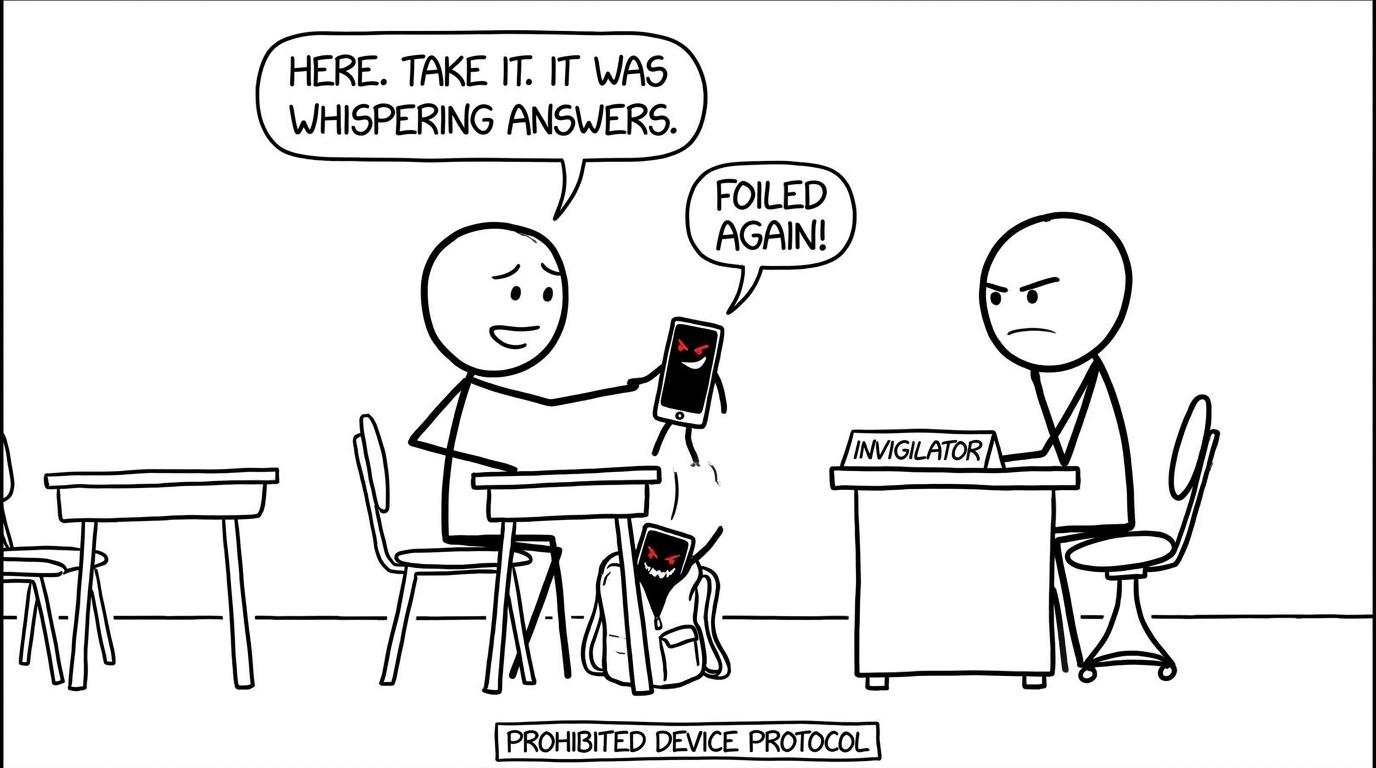 A student's phone portrayed as a sneaky villain being safely handed to an invigilator
The invigilator’s instructions
Once everyone is seated, the invigilator will identify the examination and explain the formal conditions. You may be asked to check the subject, paper code and tier or component, then complete the details on the front of the answer booklet.
Listen even if you have heard similar instructions before. A small difference may matter, such as whether you need a separate resource booklet or where particular answers must be written.
You must not open the question paper or begin writing answers until instructed.
When writing actually begins
The examination starts when the invigilator clearly announces that you may begin. The start and finish times should be displayed, and you must receive the full published duration of the paper.
If administrative checks delay the start, the finishing time should move accordingly. You do not lose examination time because it took longer to seat the room or deliver the instructions.
This is why “9.00 am exam” should be understood as a session arrangement, not permission to begin independently when a clock reaches 9.00 am.
Geography papers can be in different sessions
Do not assume every Geography examination is in the morning. Across recent timetables, different papers and components have appeared in both morning and afternoon sessions. The arrangement also depends on the exam board and annual timetable.
AQA, Edexcel, OCR and Eduqas use different paper titles and specification structures. One friend may be discussing Paper 2 while you are entered for a differently named component. Even when papers share a common national slot, their duration or materials may differ.
Use this order of trust:
- your final personalised timetable
- information from your school’s exams officer
- the final timetable published by your exam board
- your teacher’s reminder
If two sources appear to conflict, contact the exams officer. Do not decide which one “looks more likely”.
What if you have extra time or a timetable clash?
Approved extra time usually changes when you finish, not the published session of the examination. Your centre may seat you in another room or make other arrangements so that you receive your full entitlement without disruption.
A timetable clash is different. If two papers occupy the same session, the exams officer will organise the permitted supervision and sitting arrangements. You may take papers consecutively, with an approved supervised break, or follow another authorised plan.
Never create your own solution to a clash by choosing which examination to attend. Speak to the exams officer well beforehand and keep a written copy of the arrangement.
What should you do if you are running late?
Contact the school or college immediately. Tell them your name, examination and expected arrival time, then follow their instructions. If they tell you to continue to the centre, report directly to exams staff when you arrive.
JCQ rules distinguish between late and very late candidates, and additional security or reporting procedures may apply. Admission and the handling of your script depend on the circumstances. The worst response is to assume that being late means you should stay at home.
Build a margin into your journey instead. It is one of the few exam-day decisions that can remove stress before it appears.
Common mistakes around GCSE exam start times
Reading “AM” as an arrival time
“AM” identifies the examination session. It does not tell you when your school wants you to report. Find the separate arrival instruction.
Assuming every paper begins at 9.00 am
Morning and afternoon papers have different published times, and centres have controlled flexibility. Geography components can appear in either session.
Using somebody else’s timetable
A friend may follow another exam board or specification. Check your own candidate timetable and paper code.
Arriving exactly at the stated start
You need time to enter, store belongings and receive instructions. Aim for the reporting time set by your centre, not the last possible minute.
Bringing a phone or smartwatch to the desk
Follow the centre’s storage procedure. Switching a device off does not automatically make it authorised.
Starting when the wall clock reaches the hour
Begin only when the invigilator tells you to do so. You will still receive the full allowed time.
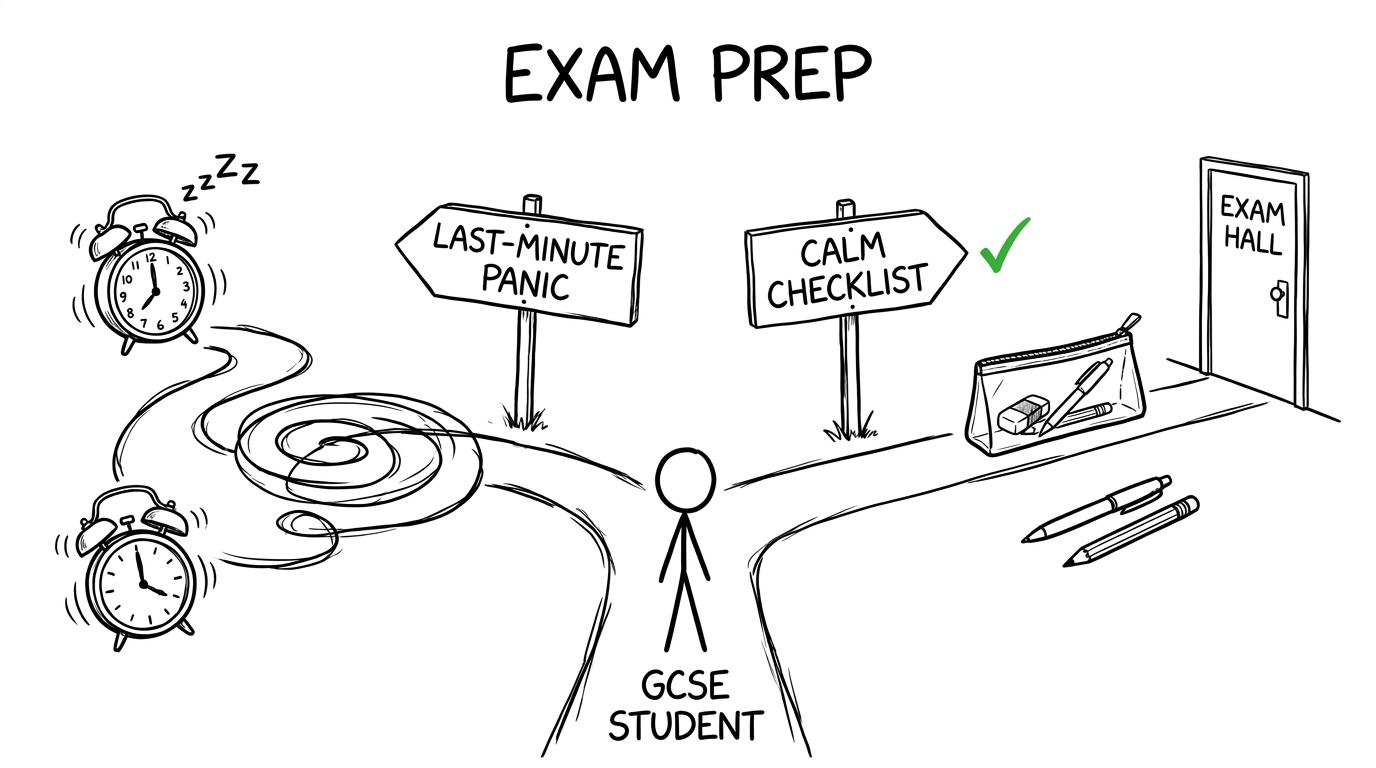 A student choosing the calm checklist path instead of the looping last-minute panic path
Use the same calm system for your maths exams
The practical lesson extends beyond Geography. GCSE maths papers also sit within national morning or afternoon sessions, so the same habits apply: verify the paper, arrive at the centre’s reporting time and wait for the invigilator’s instruction.
Preparation becomes easier when there is one reliable place to return to. Start with the free GCSE Maths revision hub, where you can select your board and use revision lessons, practice questions and paper resources.
For longer-term preparation, the best order for learning GCSE Maths topics helps turn a large specification into a manageable route. On busy school days, the 20-minute maths revision routine provides a shorter structure.
As examinations approach, use the guide to starting GCSE past papers to move from topic practice into timed work. Edexcel students can practise directly with Edexcel GCSE Maths past papers and mark schemes.
The final days should be organised rather than frantic. Follow the one-week GCSE Maths revision plan, then use the GCSE Maths night-before checklist to pack your equipment and protect your sleep.
Know the session, then follow your centre
The national answer is clear: GCSE Geography morning examinations are normally published for 9.00 am, while afternoon examinations are normally published for 1.30 pm at UK centres using the main JCQ arrangements. Your school may set a start within the permitted window, and it will normally ask you to arrive before that time.
So check your personalised timetable, follow your exams officer’s reporting instructions and wait for the invigilator before writing. The goal is not to memorise every administrative rule. It is to remove uncertainty before you enter the room.
Once your Geography arrangements are confirmed, return to MathsGenie and continue the work that improves maths marks: revision lessons to rebuild methods, practice questions and mini tests to check them, past papers and predicted papers to rehearse them, then mark schemes and video solutions to correct what went wrong. Calm exam days usually begin with clear plans made earlier.










