GCSE Geography and GCSE History Together?
GCSE geography and GCSE history together: see if taking both is realistic, how workloads compare, where they overlap and how to revise effectively.
Choosing GCSE options can feel strangely permanent. One form asks you to reduce several possible futures to a handful of boxes, often before you know what studying each subject will really involve. If you are considering GCSE geography and GCSE history together, the direct answer is yes: it is academically realistic, and there is no national rule preventing you from taking both. The real questions are whether your school allows the combination, whether the workload suits you, and whether you genuinely enjoy both subjects.
The English Baccalaureate requires geography or history, not both. However, that wording describes the minimum humanities requirement for the EBacc rather than a restriction. Your school's option blocks, staffing and timetable determine whether you can choose both.
The quick answer and decision checklist
Taking both subjects is sensible when most of the following are true:
- your school's option blocks allow the combination;
- you enjoy explaining ideas in writing, not just remembering facts;
- you are interested in both the modern world and the events that shaped it;
- you can manage case studies, historical examples and subject vocabulary;
- you are prepared for several written examinations at the end of Year Eleven;
- choosing both will not displace another subject you value more;
- you have enough weekly revision time for maths, English and science as well.
Before submitting your options, ask for the exact exam board and specification used by your school. Edexcel, AQA, OCR and Eduqas courses differ in their selected topics, paper structures and question styles. Your teachers can also confirm whether fieldwork days, compulsory trips or timetable clashes affect the choice.
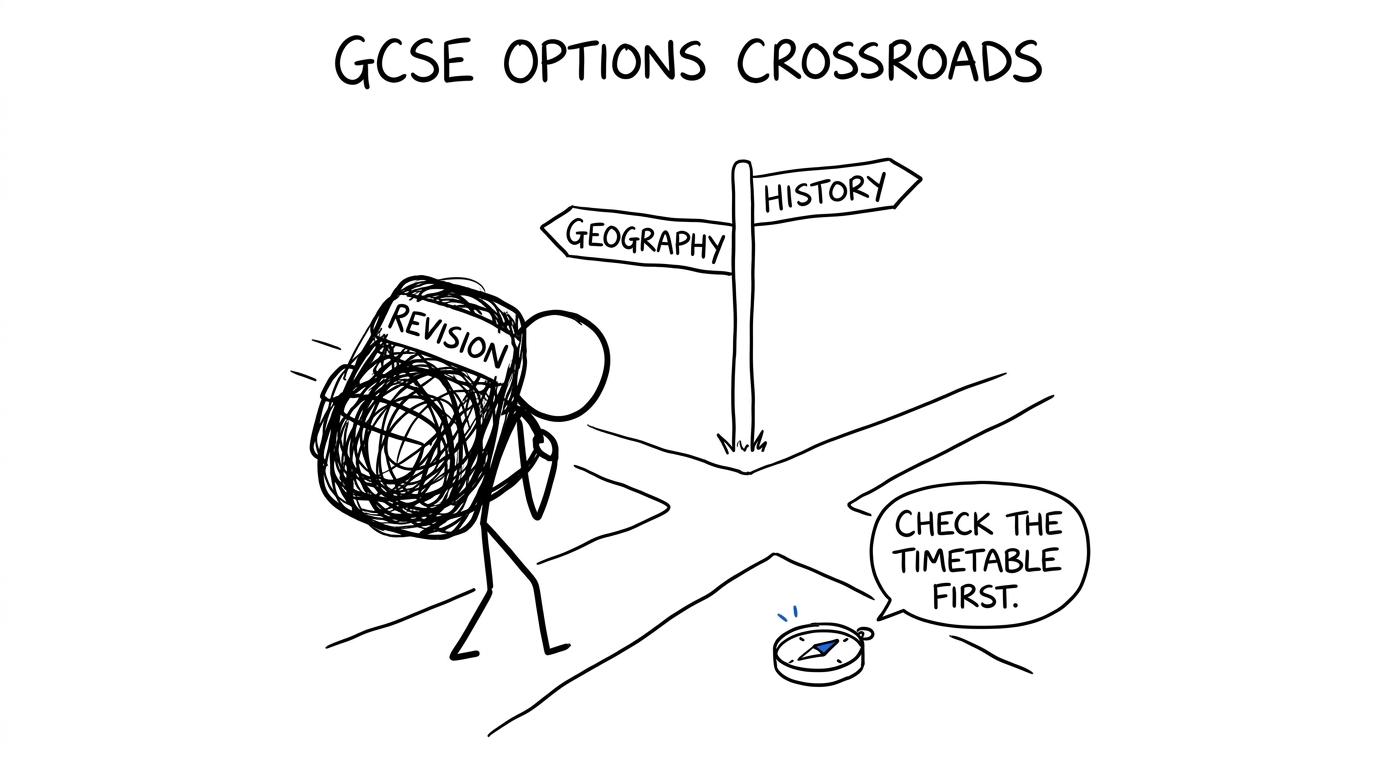 A student choosing between friendly Geography and History signposts
Is taking both subjects actually realistic?
Yes, for many students. Geography and history are separate GCSE qualifications, so taking both normally means using two option choices. Neither course is automatically reserved for a particular attainment group, and neither has foundation and higher tiers in the way GCSE maths does.
But possible and realistic are not quite the same thing.
The strongest reason to choose both is sustained interest. You will spend roughly two academic years reading about landscapes, communities, political decisions, conflict, development and change. Curiosity makes that workload easier because revision becomes the return to an interesting idea rather than the rescue of a forgotten one.
The weaker reason is that both subjects appear respectable. A subject's reputation will not write an extended response for you on a tired Wednesday evening. Enjoyment is not a soft consideration; it affects how consistently you pay attention, complete practice and revisit difficult material.
Your wider timetable matters too. A student taking both humanities alongside other content-heavy options may face competing deadlines and substantial recall demands. That does not make the combination unmanageable. It means organisation must begin before the final weeks of Year Eleven.
A useful first step is to put every subject into the MathsGenie revision planner. If geography and history fit only by squeezing maths into whatever time remains, the plan is not balanced yet.
How much overlap is there between geography and history?
There is meaningful overlap, but less direct duplication than students sometimes expect. The two subjects often investigate the same world through different questions.
History asks how and why societies changed over time. Geography examines how places, environments and human systems work, vary and interact. A shared topic does not therefore become the same lesson twice.
Shared themes
Depending on your school's chosen units, both courses may touch on:
- migration and changing populations;
- urban growth and industrialisation;
- power, conflict and international relationships;
- inequality and economic development;
- resource use and environmental decisions;
- the relationship between people and particular places.
For example, a historian might investigate the causes and consequences of migration in a particular period. A geographer may examine migration flows, push and pull factors, demographic effects and pressures on places. The context may overlap, but the concepts and examination questions remain distinct.
Shared skills
Both subjects reward students who can select evidence, form a judgement and communicate clearly. You may also encounter maps, photographs, written evidence, statistics and unfamiliar information.
There is useful crossover in:
- interpreting evidence rather than merely describing it;
- recognising cause and consequence;
- comparing places, periods or viewpoints;
- building a supported conclusion;
- using precise subject vocabulary;
- planning longer answers under time pressure.
These shared habits can make taking both more efficient. Learning to write a focused paragraph, for example, helps across humanities subjects. Yet the mark schemes are not interchangeable. A geographical conclusion may need to balance social, economic and environmental evidence, while a history response may require analysis of causation, significance, sources or interpretations.
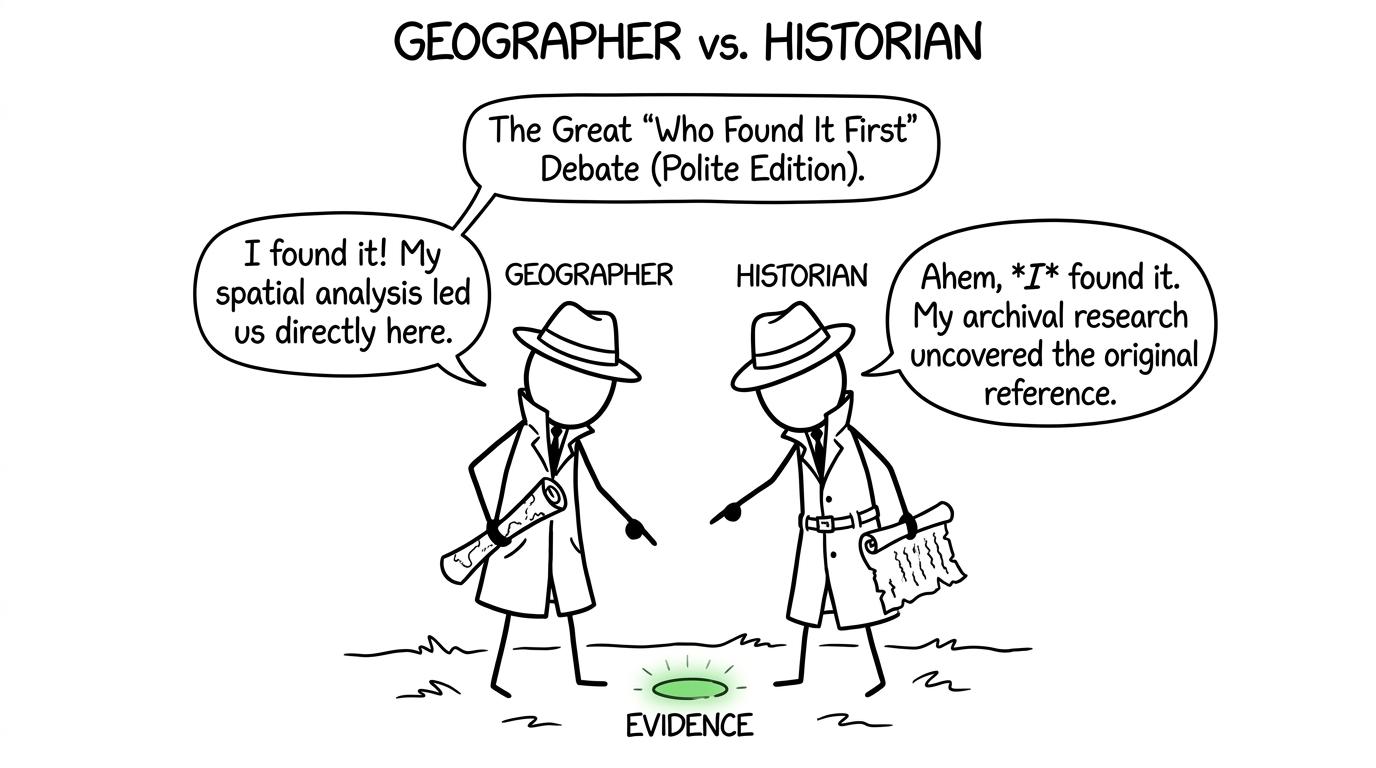 A geographer and historian investigating the same evidence
Where the subjects are genuinely different
The difference becomes clearer when you look at the official subject content.
GCSE geography includes physical and human geography, geographical skills, fieldwork and the application of knowledge to issues. Depending on the specification, you may study hazards, ecosystems, landscapes, cities, economic development and resource management. You will interpret maps, graphs and numerical information as well as write extended responses.
GCSE history is organised around periods, depth studies, thematic development and historical environments. National subject requirements include British, European or wider-world contexts across different timescales. Assessment focuses on knowledge and understanding, second-order concepts such as causation and change, contemporary sources, and later interpretations.
In practical terms, geography usually contains more data handling, map work, fieldwork and interaction between physical and human processes. History generally demands more chronological security, detailed contextual knowledge and careful evaluation of sources and interpretations.
Neither is simply a memory subject. Recall is the raw material, not the finished answer. Examiners reward what you do with knowledge.
How GCSE maths supports geography
For a student preparing for maths exams, geography can provide a useful second setting for quantitative skills. Specifications may require work with scales, coordinates, averages, percentages, graphs, proportional symbols, rates of change and statistical information.
That does not mean geography becomes another maths course. It means confidence with numbers reduces the mental effort needed to interpret geographical evidence. Skills involving ratio, maps and scale can transfer particularly well. The GCSE maths topics by exam board and tier guide can help you identify the relevant areas within your own maths specification.
Data interpretation is another valuable connection. Geography questions may ask what a graph shows, whether evidence supports a claim, or how two datasets compare. Maths teaches you to read the scale before reaching the conclusion. The Edexcel GCSE Statistics revision area offers additional practice with charts, sampling, averages, correlation and real-world data.
History has less direct mathematical content, but sequencing, proportional judgement and evidence comparison still matter. More importantly, history develops the habit of showing a chain of reasoning. That same discipline helps in multi-step maths problems: state what is known, make a justified move, and keep the argument connected.
The workload you should expect
The main challenge is not that either subject is impossibly hard. It is that both contain a large body of material and assess extended reasoning.
Current AQA specifications illustrate the difference clearly. AQA geography is assessed through papers covering physical geography, human geography, geographical applications, fieldwork and skills. AQA history uses papers covering modern-world and British-history components, with assessment objectives spanning knowledge, explanation, sources and interpretations. Other boards arrange the content differently, so always use your school's specification rather than assuming a friend's course is identical.
A sustainable revision pattern could include:
- one short retrieval session for each humanity every week;
- regular practice of one examination question rather than constant note-making;
- spaced revisiting of case studies, dates, examples and vocabulary;
- a separate weekly block for maths practice;
- occasional timed sections as examinations approach.
The principle is simple: several small returns beat one enormous rescue session.
For maths, short tests can protect regular practice when the humanities workload grows. The Edexcel GCSE Maths mini tests provide focused sessions that are easier to place between longer reading and writing tasks.
How to revise three demanding subjects without drifting
Maths, geography and history need different forms of practice. Treating them identically wastes time.
For history, use retrieval to rebuild chronology and factual detail, then answer questions using the command words and mark scheme for your board. For geography, combine case-study recall with maps, data, fieldwork methods and unfamiliar-resource questions. For maths, complete questions yourself, mark them, diagnose the exact error and try the skill again.
A weekly routine might rotate the emphasis rather than attempting every subject every evening. One session could contain geography retrieval followed by a short maths mini test. Another could combine a history essay plan with targeted maths questions. At the weekend, a longer timed paper can test whether knowledge survives examination conditions.
Use GCSE past papers organised by exam board to protect maths exam practice. When a full paper is too much, work on one section and review it carefully. The mark scheme is not merely a score sheet; it shows where your method became unclear.
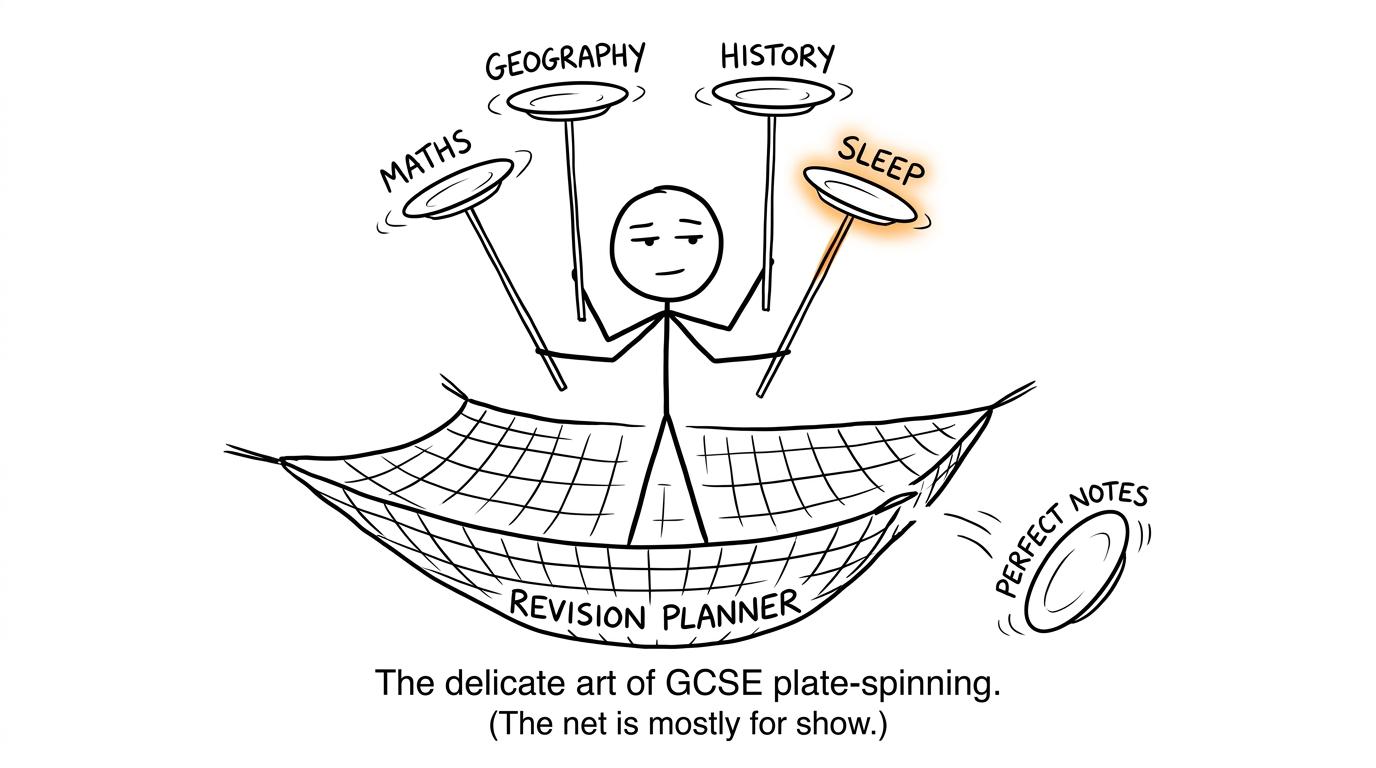 A student balancing subject plates above a revision planner
Common mistakes when choosing both subjects
Assuming the EBacc requires both
The EBacc humanities element requires geography or history. You may take both, but doing so is not necessary to meet that element.
Ignoring the option blocks
A combination may be permitted nationally but unavailable at your school because the lessons run simultaneously. Check before building your plans around it.
Believing the content will substantially repeat
Some themes connect, but the knowledge, terminology and assessment objectives are different. Choose both because you want both courses, not because you expect one set of notes to cover two GCSEs.
Underestimating extended writing
Knowing facts is not enough. Both subjects require selection, explanation and judgement under time pressure. Look at sample papers before choosing so the assessment style is not a surprise.
Letting maths revision disappear
Content-heavy options can absorb every available evening. Keep a non-negotiable maths routine using revision lessons, practice questions and short tests. The one-month GCSE maths revision plan provides a structure when examinations are approaching.
Choosing subjects for somebody else's future
Friends, family and teachers can offer useful perspectives, but you will attend the lessons and sit the papers. Consider your interests, current performance and possible sixth-form plans together.
Make the choice from evidence, not fear
Taking GCSE geography and GCSE history together is realistic when your timetable permits it and you are willing to manage two distinct bodies of knowledge. Their overlap lies mainly in themes and analytical habits, not in duplicated course content. Geography brings places, processes, fieldwork and data into focus. History brings chronology, causation, sources and interpretations. Together, they can offer a rich view of how the world became what it is and how it continues to change.
The best next step is practical: ask your school for the option blocks, exam boards, specifications and sample assessments. Then build a trial weekly timetable that includes every compulsory subject. A choice that works on paper should also work on an ordinary Tuesday.
MathsGenie can keep the maths side of that timetable calm and measurable. Start with the free GCSE past papers, use revision lessons and practice questions to repair weak topics, and add predicted papers and revision resources as the exams approach. Mark schemes, video solutions, mini tests and the revision planner turn a crowded subject list into a sequence of manageable next steps.