GCSE Geography 20 Minute Study Routine
GCSE geography 20 minute study routine for stronger recall, sharper exam skills and steady case-study revision without exhausting evening cramming at home.
The hardest part of GCSE Geography revision is often not the content. It is finding a realistic place for it between homework, maths practice, other subjects and everything else competing for your attention.
A gcse geography 20 minute study routine solves that problem by making revision small enough to begin and structured enough to matter. Spend 333 minutes retrieving old knowledge, 777 minutes strengthening one topic, 777 minutes answering a question and 333 minutes marking your work. Stop after 202020 minutes. Return tomorrow.
That may seem modest. But five sessions create 100100100 focused minutes across a week, without asking you to sacrifice an entire evening:
5×20=100 minutes 5 \times 20 = 100\text{ minutes} 5×20=100 minutesThe value is not simply the total time. Spacing revision across several days and actively retrieving information are more useful for long-term retention than repeatedly rereading the same page. Short sessions also leave room for structured GCSE maths revision, so Geography does not quietly consume the time needed for your other exams.
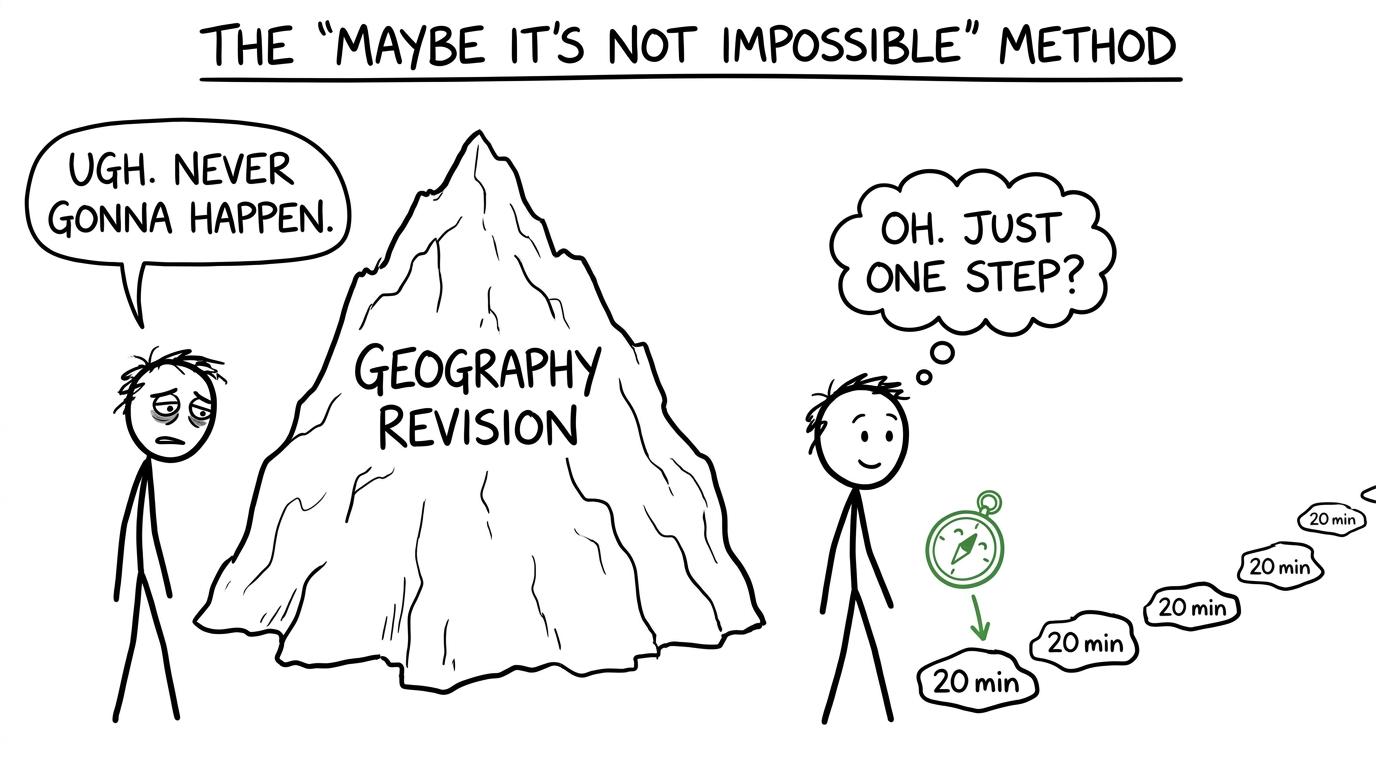 A student discovers that a huge geography revision mountain can be climbed in daily 20-minute steps
Your 20-minute Geography revision checklist
Use the same four-part routine each day:
- Minutes 000-333: retrieve. Write down what you remember without notes.
- Minutes 333-101010: repair. Check one precise gap using your specification, class materials or revision guide.
- Minutes 101010-171717: apply. Answer one exam question, interpret a resource or plan an extended response.
- Minutes 171717-202020: mark. Check accuracy and record one improvement.
Before starting, choose one narrow target. “Revise rivers” is too broad. Better targets include river landforms, hydrograph interpretation, one flood-management case study or evaluation of a fieldwork method.
Keep your textbook, specification checklist, question source and error log together. A routine loses much of its advantage if the first 888 minutes disappear while you search for materials.
Why short daily Geography revision works
A long revision session can feel productive because it produces many highlighted pages. Yet exams do not ask whether information looked familiar when your book was open. They ask whether you can retrieve, select and apply it independently.
Retrieval practice creates that useful difficulty. Closing your notes and reconstructing a process, case-study fact or fieldwork sequence exposes what is actually available to you. Checking the answer afterwards provides the feedback needed to correct errors.
Spacing matters too. If coasts appear on Monday and again on Friday, some forgetting will have occurred. Recovering the knowledge strengthens access to it. This is why the routine rotates topics rather than finishing one enormous block and abandoning it until the exam.
The goal is not to make every session easy. It is to make difficulty brief, specific and repeatable.
What to do in each part of the routine
Retrieve for three minutes
Start with a blank page. Use one prompt such as:
- List the stages of a physical process.
- Sketch and label a landform from memory.
- Recall the location, causes, effects and responses for a case study.
- Write the stages of your geographical enquiry.
- Define five key terms from yesterday’s topic.
Do not open your notes immediately when you hesitate. The attempt to remember is the task. After 333 minutes, compare your response with a reliable source and circle omissions.
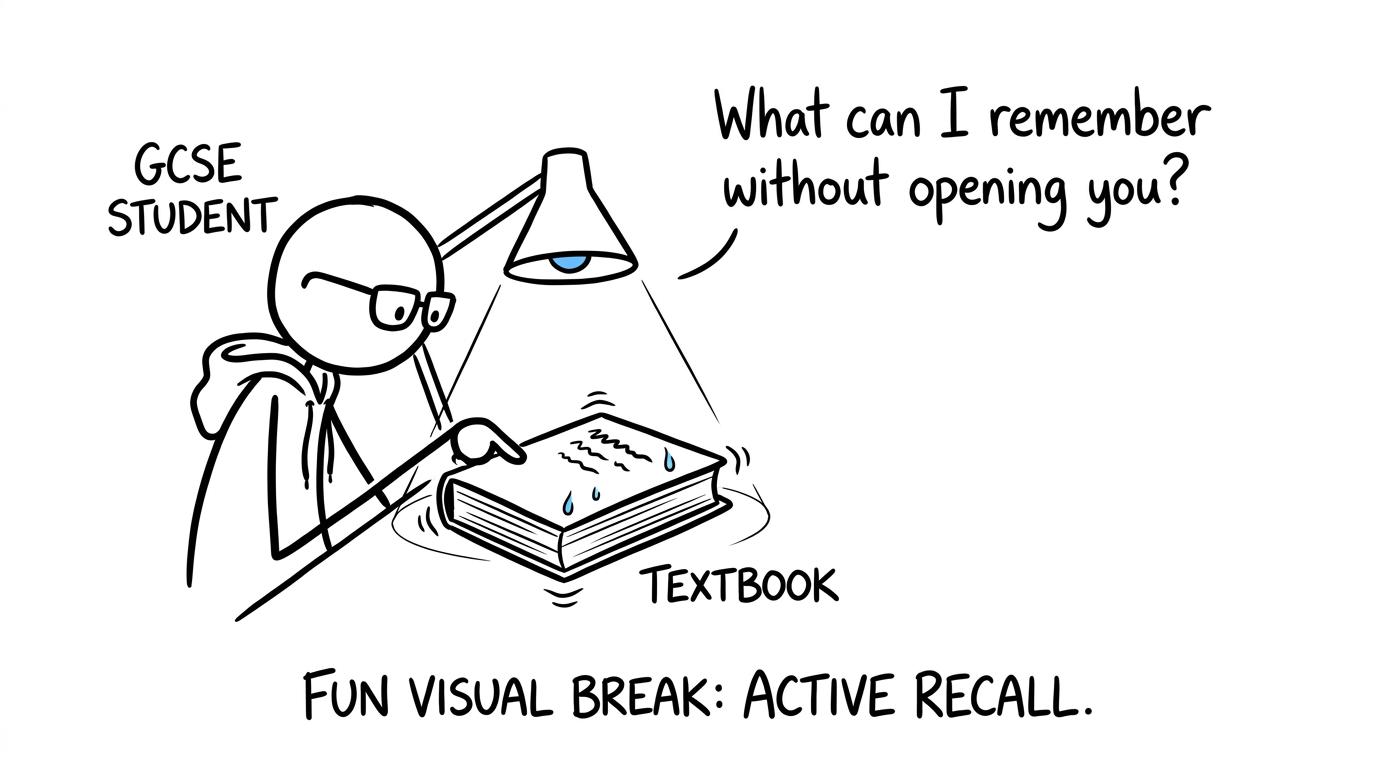 A student playfully interrogates a closed textbook to test what they can remember
Repair one knowledge gap for seven minutes
Use the next 777 minutes to fix the most important omission, not to copy an entire chapter. Geography specifications require knowledge of places, environments and processes, but they also assess understanding of relationships between them.
A useful repair note therefore goes beyond a definition. Connect cause to effect, process to landform, or management strategy to consequence. For case studies, organise information under a few stable headings: context, causes, effects, responses and judgement.
Accuracy matters more than collecting impressive-looking facts. Use the case studies and examples taught by your school, because specifications and selected options differ between AQA, Edexcel, OCR and Eduqas. Check your exam board and specification rather than borrowing a random online case study.
Apply your knowledge for seven minutes
Application turns memory into exam performance. Choose one manageable activity:
- answer a short explain question;
- annotate a map, photograph or graph;
- plan an extended response;
- write one evidence-supported paragraph;
- evaluate a fieldwork method;
- interpret unfamiliar data.
GCSE Geography assessment is not only a memory test. Across the assessment objectives, students must demonstrate knowledge and understanding, apply ideas, analyse information, make judgements and use geographical skills. Your routine should therefore include questions as well as flashcards.
When planning an extended response, decide your judgement before writing. Then select the evidence that supports or challenges it. A list of disconnected facts is rarely as persuasive as a short chain of geographical reasoning.
Mark and log for three minutes
Marking is where a completed question becomes useful revision. Use the available mark scheme or teacher guidance and ask:
- Did I answer the command word?
- Was my evidence specific?
- Did I explain the link between evidence and conclusion?
- Did I use the resource where required?
- What single change would improve this answer?
Write that change in an error log. Keep entries short: “used evidence but did not explain it”, “confused reliability with accuracy” or “forgot units”. Revisit the entry within the next few sessions.
This same feedback habit is valuable in maths. MathsGenie’s guide to starting GCSE past papers at the right time explains why reviewing errors matters more than merely accumulating completed papers.
A weekly GCSE Geography study rotation
A routine becomes easier when each day has a purpose. Adapt this rotation to the topics your school has taught:
- Monday: physical geography. Processes, hazards, landscapes or ecosystems.
- Tuesday: human geography. Urban change, development, resources or economic change.
- Wednesday: case studies. Retrieve precise evidence and practise applying it.
- Thursday: geographical skills. Maps, graphs, statistics and unfamiliar resources.
- Friday: fieldwork. Methods, sampling, presentation, conclusions and evaluation.
- Weekend: mixed review. Revisit errors or complete a longer exam section when time permits.
Fieldwork should not be left until the final week. Students may need to understand enquiry questions, data collection, presentation, analysis, conclusions and critical evaluation, including familiar and unfamiliar contexts.
Your own exam board may arrange these elements differently. The routine is a container, not a replacement for the specification. Use your teacher’s checklist to decide what belongs inside it.
Build Geography skills through maths revision
At least 10%10\%10% of the subject marks in GCSE Geography qualifications in England must assess mathematical and statistical techniques appropriate to the qualification. Data skills are therefore part of Geography, not an optional extra.
Common areas include averages, range, percentage change, scale, coordinates, graphs and relationships between variables. The percentage-change relationship is:
Percentage change=new value−original valueoriginal value×100 \text{Percentage change}=\frac{\text{new value}-\text{original value}}{\text{original value}}\times 100 Percentage change=original valuenew value−original value×100You can strengthen these skills through MathsGenie’s GCSE Geography statistical skills guide. For broader practice, use the GCSE Statistics revision hub, the percentages revision guide and scatter graph exam questions.
This overlap saves time. A session interpreting scatter graphs can support both geographical data analysis and GCSE Maths revision. Just remember that Geography also asks what the pattern means in context, whether anomalies exist and how reliable the conclusion may be.
Adjust the routine as exams approach
Early in revision, give more time to retrieving and repairing knowledge. Once coverage improves, shift the balance towards application and marking.
A later-stage session might use 222 minutes for recall, 444 minutes for checking and 111111 minutes for an exam response, leaving 333 minutes to mark. Keep the total at 202020 minutes on busy days. At weekends, you can add a timed paper section, but it should complement the daily habit rather than replace it.
Use a simple traffic-light tracker:
- Red: cannot recall or apply the topic.
- Amber: partial knowledge or inconsistent answers.
- Green: accurate under closed-book conditions.
Green does not mean finished forever. Schedule a later check. Memory needs maintenance, and confident topics can fade when they are ignored.
If Geography revision must sit alongside Foundation or Higher tier maths preparation, build one shared timetable rather than two competing plans. The MathsGenie GCSE revision timetable guide can help you organise topic practice, shorter tests and paper sessions without making every evening unrealistic.
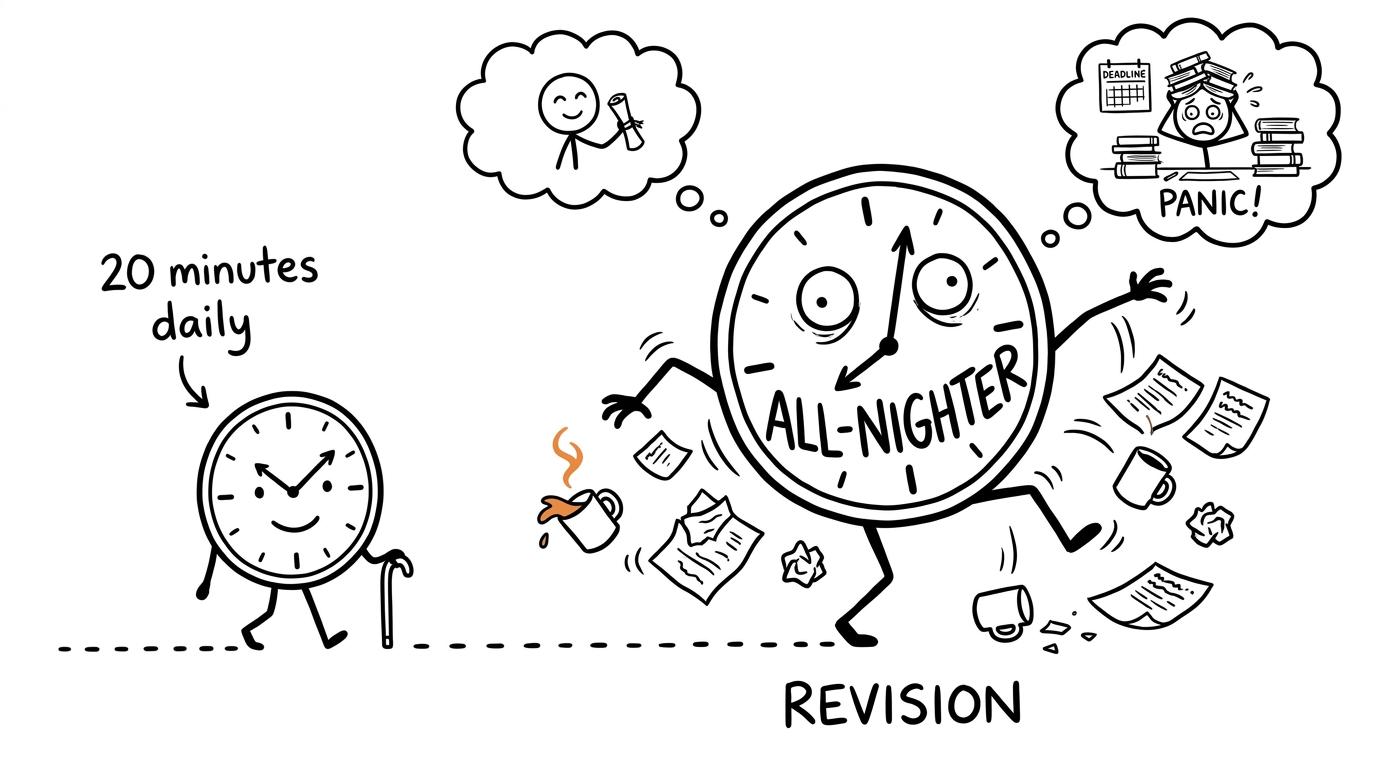 A calm daily revision clock steadily beats a chaotic all-nighter surrounded by coffee cups
Common mistakes with a 20-minute study routine
Rereading for the whole session
Rereading can support a specific repair, but it gives a weak picture of independent recall. Begin closed-book and finish with a question.
Choosing a topic that is too large
“Human geography” cannot be meaningfully revised in 202020 minutes. Choose one process, skill, case-study section or question type.
Making attractive notes without testing them
A neat page may help organise information, but it is not evidence that you can use that information. Follow every note-making activity with retrieval or application.
Revising case studies as isolated fact lists
Case-study knowledge must answer a question. Learn how evidence supports explanations and judgements, not merely place names and figures.
Ignoring fieldwork and data skills
Fieldwork, maps, graphs and statistics require regular practice. Include them in the weekly rotation instead of treating Geography as a collection of essays.
Marking without changing anything
Reading a mark scheme is not enough. Record the precise weakness and revisit it. The improvement loop matters more than the tick.
Turning one missed day into a lost week
Do not compensate with an exhausting late-night session. Restart with the next 202020-minute block. If an exam is imminent, use a calm plan like MathsGenie’s night-before revision checklist rather than sacrificing sleep to unfocused cramming.
Make the next 20 minutes count
A sustainable routine is deliberately unremarkable. One timer. One narrow target. One question. One correction. Its power appears gradually, when processes become easier to retrieve, case studies become easier to select and unfamiliar data stops feeling entirely unfamiliar.
Start today by choosing the Geography topic you are least able to explain without notes. Complete one 202020-minute cycle and write tomorrow’s target before you stop.
Then use MathsGenie as your free revision base for the numerical skills that connect Geography and maths. Work through revision lessons and practice questions, check your methods with mark schemes and video solutions, and build towards mini tests, past papers and predicted papers. Short, honest practice will not feel as dramatic as an all-nighter. That is precisely why it is more likely to become a routine you can keep.