GCSE Further Maths Grade and Sixth Form Entry
GCSE Further Maths grade and sixth form entry explained: learn what colleges prioritise, when your result helps and how to check exact course rules.
Opening a sixth-form prospectus can create a strange kind of panic. You find the subject you want, scan the entry requirements and wonder whether one extra result could decide everything.
For GCSE Further Maths grade sixth form entry requirements, the short answer is reassuring: most sixth forms and colleges place much more weight on your ordinary GCSE Mathematics grade than on an additional Further Maths qualification. Your Further Maths result can strengthen your application, particularly for A Level Maths or Further Maths, but it is rarely the main published condition for entry.
The important word is rarely, not never. Each provider sets its own course requirements, so the prospectus for the year you intend to enter is the final authority.
The quick answer at a glance
- General sixth-form entry: providers usually consider your overall GCSE profile, including English and Mathematics.
- A Level Maths: your GCSE Mathematics grade is normally the key subject requirement.
- A Level Further Maths: providers commonly require a higher GCSE Mathematics grade and require you to study A Level Maths alongside it.
- Your Further Maths result: useful evidence of mathematical readiness, but often not a formal requirement.
- A disappointing result: unlikely to block entry by itself unless the published policy specifically includes it.
- Your next action: read the current admissions policy and course guide, then ask the admissions team how your exact qualification is treated.
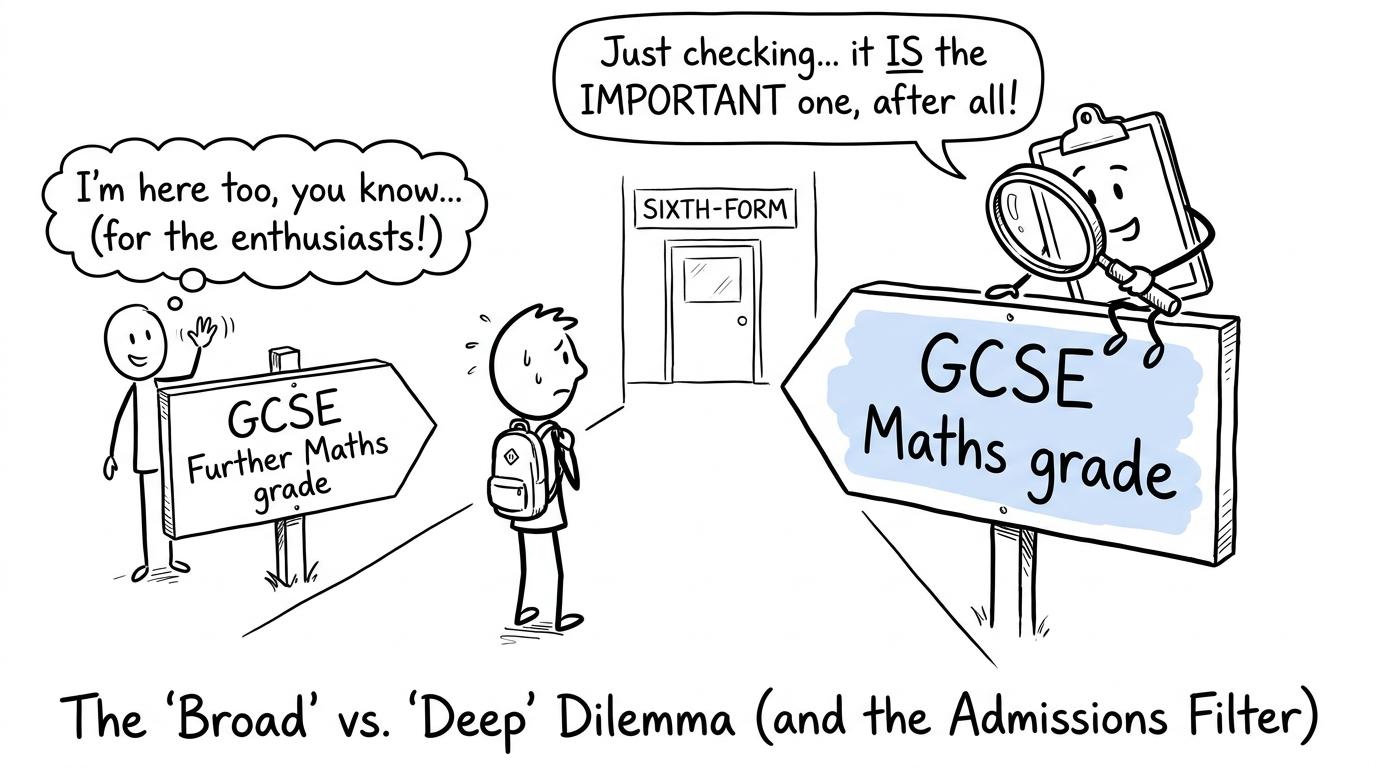 A sixth-form admissions officer pays more attention to the main GCSE Maths sign than the smaller Further Maths sign
How much weight does a GCSE Further Maths grade carry?
There is no national weighting that tells every sixth form to give a Further Maths grade a fixed amount of importance. School sixth forms may set published academic entry criteria, while colleges publish their own programme and subject requirements.
In practice, your result tends to carry one of three levels of weight.
| Application situation | Likely weight of Further Maths grade |
|---|---|
| Applying for a general sixth-form place | Usually limited, although it may contribute to an overall GCSE profile |
| Applying for A Level Maths | Helpful supporting evidence, but GCSE Mathematics is normally more important |
| Applying for A Level Further Maths | More relevant, especially when applicants are close to a threshold, but often still secondary to GCSE Mathematics |
| Applying for unrelated subjects | Usually little direct weight unless all GCSE results form an admissions score |
Current published criteria vary between providers, but a common pattern is a requirement around grade 666 or 777 in GCSE Mathematics for A Level Maths and around grade 777, 888 or 999 for A Level Further Maths. These are patterns, not national rules. Some providers set different thresholds, consider exceptional cases or use an additional assessment.
That distinction matters. A grade is not important merely because it appears on your results sheet. It matters when the admissions policy says how it will be used.
Why GCSE Mathematics usually matters more
A Level specifications build on the full GCSE Mathematics course. Sixth forms therefore use the ordinary GCSE Mathematics result as the clearest standardised indication that you have covered the necessary foundation.
Further Maths qualifications are not available in every school. Making one a universal entry condition would disadvantage applicants whose schools did not offer it. This helps explain why many published requirements focus on GCSE Mathematics instead.
For A Level Further Maths, providers also look for strong algebraic fluency, persistence and confidence with unfamiliar problems. An additional qualification can demonstrate those qualities, but your main Mathematics grade remains easier to compare across applicants.
If you are still preparing for your exams, the best way to protect your options is to strengthen the result that appears most often in entry criteria. Start with the GCSE Maths revision hub, where you can select Edexcel, AQA, OCR, Eduqas and other exam-board resources.
What does “GCSE Further Maths” actually mean?
Students often use “GCSE Further Maths” as a convenient name for several different qualifications. Admissions teams may not treat them as identical.
A common course is the AQA Level 2 Certificate in Further Mathematics. It is an untiered Level 222 qualification designed as an additional challenge for students who are expected to achieve high grades in GCSE Mathematics. It extends algebra and geometry while introducing material such as calculus and matrices. It is graded from 999 to 444.
Another possibility is OCR Level 3 FSMQ Additional Mathematics. Despite frequently being discussed alongside GCSE courses, this is a Level 333 Free Standing Mathematics Qualification rather than a GCSE. It is intended as enrichment for strong higher-tier students and includes areas such as calculus, logarithms and numerical methods.
Your certificate, statement of entry or school should confirm the qualification title and exam board. Use that exact title when asking an admissions team whether it contributes to an overall GCSE count or subject decision.
When your Further Maths grade may help
It provides evidence of readiness
A strong result suggests that you have already met unfamiliar notation, more demanding algebra and multi-step reasoning. That can support a conversation about suitability for A Level Maths or Further Maths.
If you want to understand the jump before choosing, read what to choose after GCSE Maths and preview the Edexcel A Level Maths revision resources. Looking at real course content is more useful than choosing solely because your GCSE result is high.
It may contribute to your overall profile
Some sixth forms calculate an admissions score from a specified number of GCSEs. An additional mathematics qualification may count, but this depends on the published rules. Policies sometimes exclude short courses, restrict which qualifications count or use only your best results.
Never assume that Further Maths is automatically an extra GCSE for admissions purposes. Ask whether the qualification is included and, if so, where it sits in the calculation.
It can support a borderline discussion
Suppose a course normally asks for grade 888 in GCSE Mathematics and you narrowly miss that threshold. A strong Further Maths result might give the department useful context. However, it does not automatically override the published requirement.
The provider may follow the threshold strictly, consider individual circumstances, offer an assessment or suggest A Level Maths without Further Maths. Only its admissions team can confirm which approach applies.
When the grade may matter less than you fear
A lower Further Maths grade does not erase a strong GCSE Mathematics performance. The additional course is deliberately challenging, and admissions departments can distinguish it from the main qualification.
If you achieve grade 888 or 999 in GCSE Mathematics but a lower grade in Further Maths, check the exact requirement before concluding that your plans have failed. Many providers specify only the main Mathematics grade for entry. The guide to what a grade 8 in GCSE Maths means can help you evaluate your next step without treating one result as your entire mathematical identity.
Likewise, not having taken Further Maths is not normally a problem where it is not listed as a prerequisite. A Level teachers expect students to arrive from different schools with different enrichment opportunities.
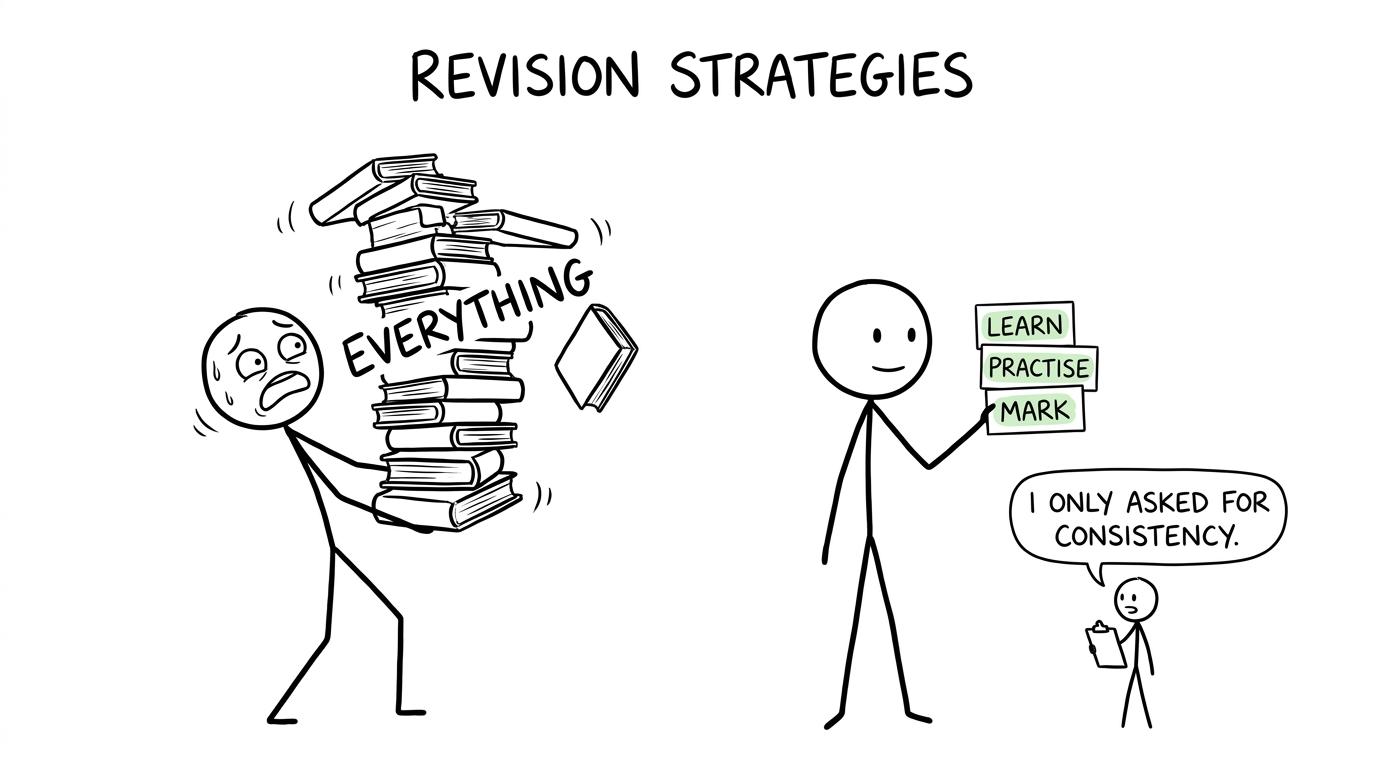 One student carries an impossible pile of revision while another follows a calm learn, practise and mark routine
How to check your own sixth form or college
Admissions questions become much calmer when they are turned into a checklist.
Read both sets of requirements
Look for:
- the general requirements for joining the sixth form or college;
- the specific requirement for A Level Maths;
- the separate requirement for A Level Further Maths;
- any overall GCSE score or best-subject calculation;
- rules for additional, short-course or non-GCSE qualifications;
- the entry year, because policies can change.
A general offer does not always guarantee access to every subject. You might qualify for the institution but not meet the higher threshold for a particular mathematics course.
Ask a precise question
Rather than asking, “Does Further Maths matter?”, give the admissions team the exact qualification title and your intended subjects. Ask whether it is a formal condition, supporting evidence or part of the overall grade calculation.
Also ask what happens if you miss the main Mathematics threshold by one grade. Do not rely on a rule remembered by an older student because course requirements can change between entry years.
Separate predicted grades from final entry
Predicted grades can shape applications, interviews and provisional course choices. Final enrolment is usually confirmed after your actual GCSE results are available and checked against the published conditions.
If your predictions are below a threshold, keep the course on your list where appropriate, but also discuss realistic alternatives. A prediction is evidence, not a final result.
How to strengthen your position before results day
The most useful strategy is not to obsess over how admissions staff might interpret one grade. It is to improve the evidence they will actually see.
Focus first on GCSE Mathematics, particularly higher-tier algebra, graphs, trigonometry, surds, indices and problem-solving. Use revision lessons to repair understanding, then practise exam questions without notes. Mark them carefully and record why each mark was lost.
Next, introduce mixed papers. The guide to when to start GCSE past papers explains how to move from mini tests to timed practice. If you study Edexcel, the efficient Edexcel GCSE revision guide offers a simple learn, practise, mark and retest cycle.
Finally, preview rather than pre-learn the entire A Level. The Edexcel A Level Further Maths hub lets you inspect lessons, questions and papers. Its purpose at this stage is to help you judge your interest and readiness, not to race through a new specification before finishing GCSEs.
Common mistakes when judging your chances
Assuming every provider uses the same grade threshold
There is no universal entry grade for A Level Maths or Further Maths. Check each institution separately and use the criteria for your entry year.
Treating Further Maths as a replacement for GCSE Mathematics
Additional Further Maths qualifications extend your learning. They do not normally replace the main GCSE Mathematics result used in subject entry requirements.
Calling every additional course the same qualification
AQA Level 222 Further Mathematics and OCR Level 333 FSMQ Additional Mathematics are different qualifications. Give admissions staff the exact title.
Hiding or inaccurately describing a result
Complete applications accurately and follow the provider's instructions about declaring qualifications. If a result concerns you, ask how it is considered rather than guessing that it must be fatal.
Revising only the hardest material
Challenging topics can feel impressive, but secure GCSE foundations usually have greater value for both entry and future progress. Do not sacrifice reliable marks in the main Mathematics papers to chase advanced content.
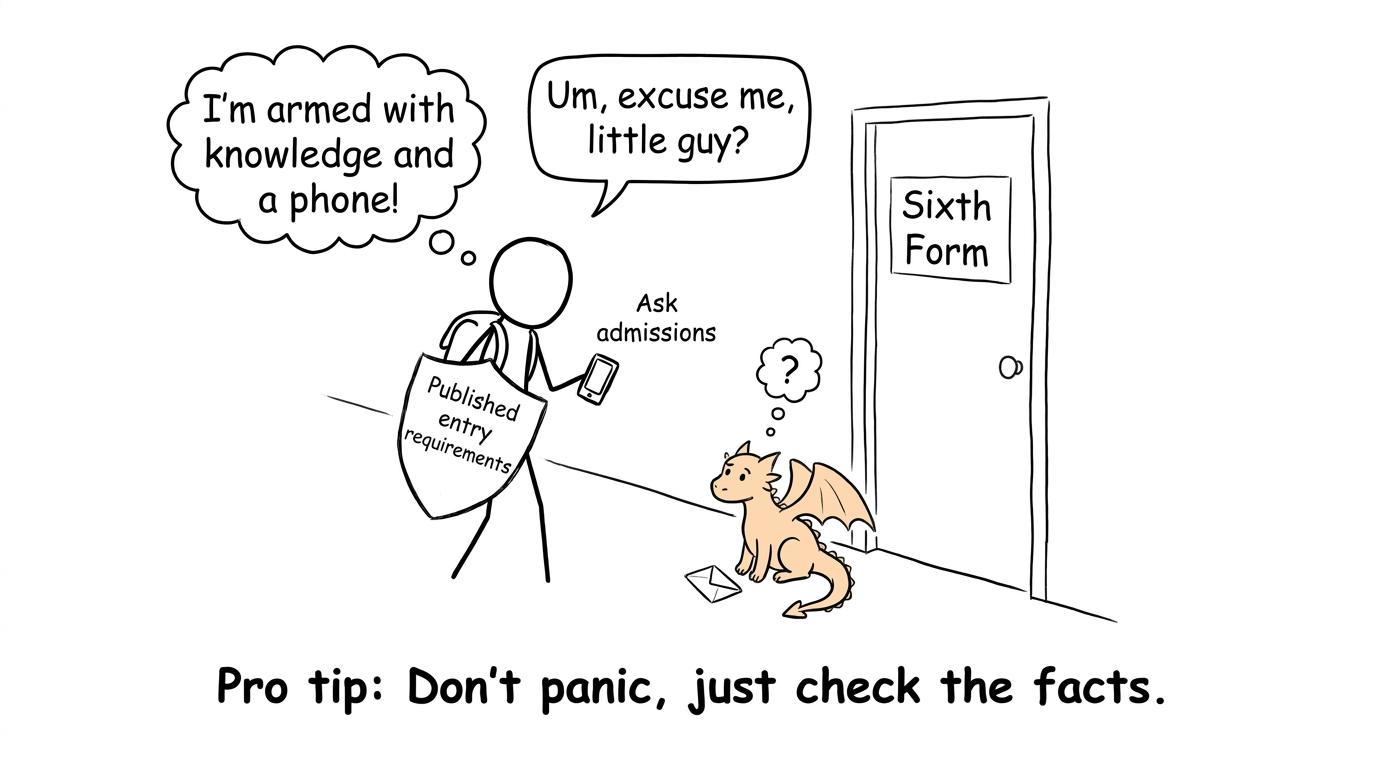 A student uses published requirements as a shield against a comically tiny results-day dragon
Your grade is evidence, not a verdict
Sixth forms and colleges can care about your GCSE Further Maths grade, particularly when you apply for a mathematically demanding programme. But in most published entry frameworks, the heavier weight falls on your ordinary GCSE Mathematics grade, your wider GCSE profile and whether you meet the stated subject threshold.
Check the policy. Name your qualification accurately. Ask direct questions when the wording is unclear. Then return your attention to the part you can still change: your preparation.
Use MathsGenie as your free revision base. Begin with revision lessons and practice questions, test yourself with mini tests, then move into past papers and predicted papers. Mark every attempt with the mark scheme and use video solutions to understand methods you could not complete. That routine does more than improve an application; it helps you arrive in sixth form ready for the mathematics waiting there.