GCSE Further Maths Exam Clash: Same-Week Revision
GCSE further maths exam clash same week? Build a calm revision plan, protect nearby subjects and use targeted practice to secure marks without cramming.
A crowded exam week creates a particular kind of panic. Further Maths needs concentration, but Biology is tomorrow, History follows, and ordinary GCSE Maths has not disappeared. Suddenly, every subject feels equally urgent.
If a GCSE Further Maths exam clash in the same week is worrying you, the answer is not to divide every evening equally. Give the nearest exam most of your time, protect Further Maths with short daily practice, and increase its share as the paper approaches. Your aim is continuity, not perfect balance.
There is also an important distinction: several exams in one week are not officially a timetable clash. A formal clash means two or more papers are scheduled in the same exam session. If that happens, contact your school's exams officer immediately. Your school, not the student, organises the arrangements under JCQ rules.
Your same-week revision checklist
Use this checklist before deciding what to revise:
- Confirm every date, session and paper on your individual timetable.
- Tell the exams officer immediately if two papers occupy the same session.
- Rank subjects by exam proximity, weakness and remaining content.
- Keep Further Maths active with a short daily minimum.
- Choose questions from diagnosed weak areas rather than revising everything.
- Mark each set and correct mistakes while the method is still fresh.
- Stop full papers when there is not enough time to review them properly.
- Protect sleep, meals, travel time and preparation for the next morning.
The AQA GCSE Further Maths revision hub gives you one place for lessons, questions, papers and mark schemes, reducing the number of decisions you need to make in an already busy week.
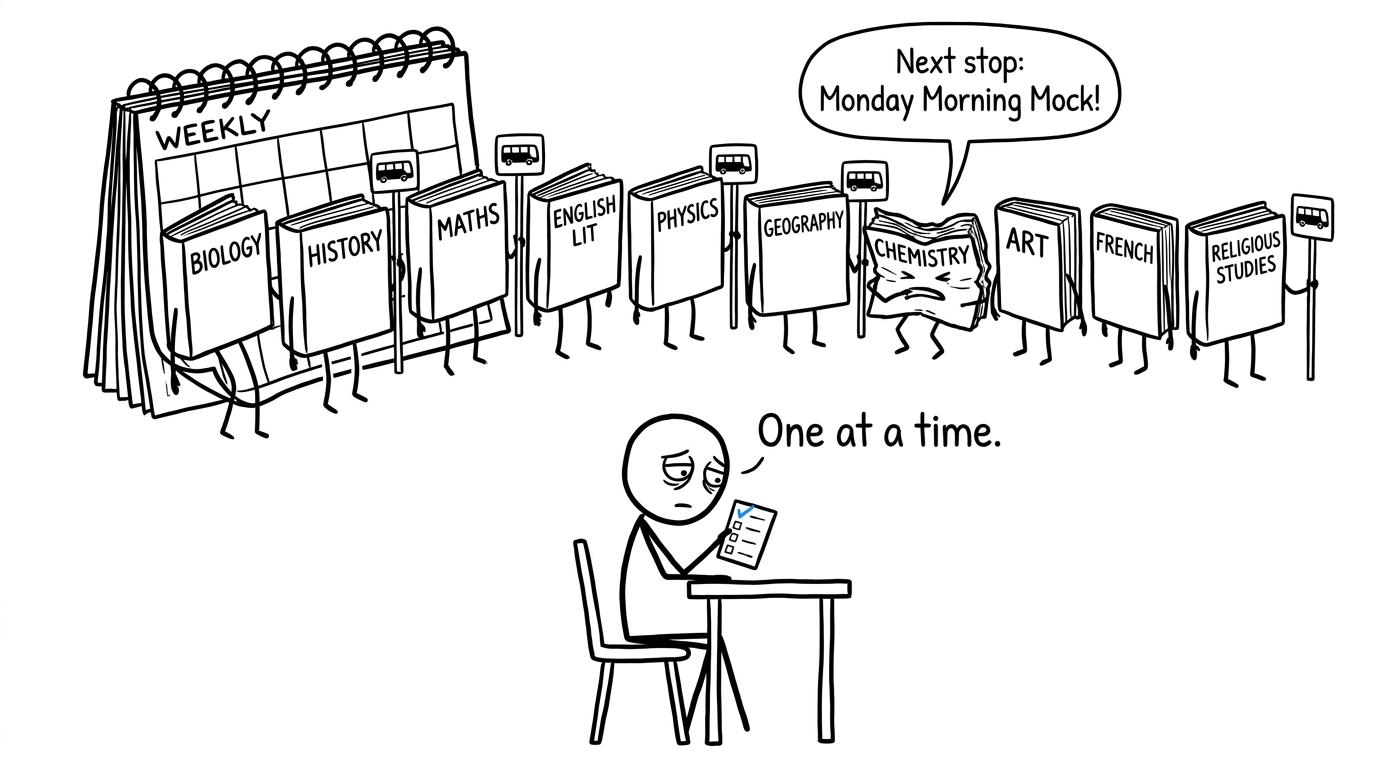 A student calmly handling a queue of exam subjects one at a time
First, identify what kind of clash you have
Students often use “clash” to mean any uncomfortable concentration of exams. That feeling is reasonable, but the practical response depends on the timetable.
Several exams during the same week
This is a workload problem. You will normally sit each paper at its published time, so your task is to allocate revision intelligently around those fixed points.
Start with the timetable issued by your school. Exam boards including AQA, Edexcel, OCR and Eduqas publish schedules, but your individual timetable is the document that reflects your actual entries, rooms and any approved arrangements.
Two exams in the same session
This is a formal timetable clash. JCQ rules allow centres to manage genuine clashes through procedures such as consecutive papers, supervised breaks or moving a paper to another permitted session in qualifying circumstances. The exact arrangement depends on the papers, their combined duration and your circumstances.
Do not create your own plan or assume that one exam has been cancelled. Speak to the exams officer and ask for the arrangement in writing. If supervised between papers, follow the school's instructions about phones, internet access, contact with other candidates and revision materials.
Understand the Further Maths paper you are protecting
“GCSE Further Maths” is a common classroom description, but many students sit the AQA Level 2 Certificate in Further Mathematics. It is not an ordinary tiered GCSE Maths paper. Under the current AQA specification, it has two written papers:
- Paper 111 is non-calculator, lasts 111 hour 454545 minutes and carries 808080 marks.
- Paper 222 is calculator, lasts 111 hour 454545 minutes and carries 808080 marks.
- Each paper contributes 50%50\%50% of the qualification.
- Content from any part of the specification may appear on either paper.
The specification covers number, algebra, coordinate geometry, calculus, matrix transformations and geometry. That broad coverage is why abandoning Further Maths for several days can make returning to it feel difficult.
Other schools may enter students for a different Level 222 qualification, such as OCR Additional Mathematics. Check the qualification title and paper code rather than assuming every “Further Maths” course has the AQA format.
Split attention by urgency, weakness and value
Equal time sounds fair. It is rarely sensible.
A subject examined tomorrow needs more attention than one examined in five days, but proximity is not the only consideration. A secure subject may need a brief refresh, while a weak paper with large gaps may deserve a longer block.
Use three questions:
- Urgency: How soon is the exam?
- Need: Where are you currently losing marks?
- Return: What can realistically improve before the paper?
On an evening before another subject's exam, Further Maths might receive only a 202020-minute maintenance session. Once that exam is finished, its share can rise. This moving allocation is more useful than setting one fixed percentage for the whole week.
The principle is simple: the nearest exam leads, but Further Maths never falls to zero.
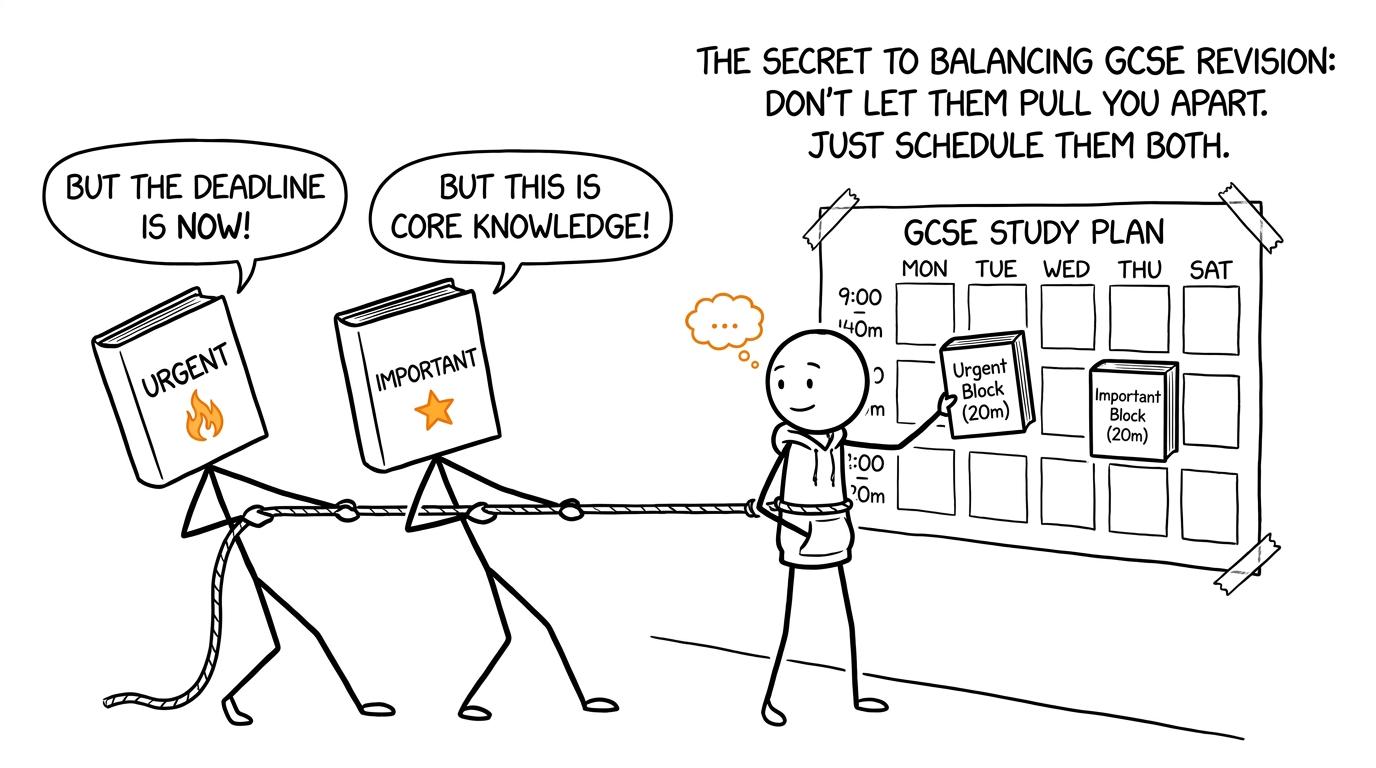 A student calmly places urgent and important revision into separate time blocks
Set a Further Maths daily minimum
Your daily minimum should be small enough to complete after a tiring paper. Around 202020 to 303030 focused minutes is often more realistic than promising yourself an entire evening.
A useful maintenance session contains:
- 555 minutes of retrieval from memory;
- 151515 to 202020 minutes of questions on one weak area;
- 555 minutes to mark, correct and record the next action.
This is not a miniature full paper. It is a bridge between longer sessions. The 20-minute GCSE maths revision routine can help you build that rhythm without spending half the session deciding where to begin.
Choose a precise target. “Revise algebra” is too broad. “Practise factorising harder quadratics” or “review matrix transformations” tells you what to open and what successful revision will look like.
Use the topic / paper / review loop
When time is scarce, feedback matters more than volume.
Rebuild one weak method
Use a short MathsGenie revision lesson, then move directly to practice questions. Avoid watching several videos in a row without writing anything. Recognition can feel like understanding until the notes disappear.
If ordinary GCSE Maths is also close, use the GCSE Maths revision hub to repair shared foundations such as algebra, graphs and geometry. Stronger core skills support both papers, although Further Maths also contains distinct content that needs separate practice.
Test the method under pressure
Complete a small question set without notes. You are checking whether you can select and carry out the method independently, not whether the explanation looked familiar.
For short ordinary GCSE Maths checks between exams, Target Tests and mini tests provide a more manageable option than a full paper.
Review before moving on
Mark immediately. Label each lost mark as one of four types:
- knowledge;
- method choice;
- accuracy;
- exam technique or timing.
Then correct the question without copying the solution line by line. A mistake log turns yesterday's lost marks into tomorrow's revision list.
When should you use full past papers?
Full papers are valuable, but they are expensive in time and energy. A paper completed without marking is only half a revision session.
Use a full Further Maths paper when you have time to sit it properly and review it afterwards. During a packed week, a timed section or selected group of questions may produce more improvement.
MathsGenie's guide to starting GCSE past papers explains how to move from diagnosis to timed practice. If an ordinary Edexcel GCSE Maths paper is also approaching, use the Edexcel GCSE Maths past papers with their mark schemes and worked solutions.
Predicted papers can provide extra unseen practice, but they are not forecasts of exact questions. Use the MathsGenie predicted papers and resources after topic repair, not instead of learning the specification.
Plan the evening before each exam
The evening before an exam should narrow your focus, not expand it.
Prioritise the next day's subject. For Further Maths, keep only a short maintenance block unless its paper is next. Review your error log, retrieve a few key methods and complete a small set of familiar question types. Starting an untouched major topic late at night usually creates more uncertainty than useful confidence.
Then prepare practical details: equipment, calculator where permitted, water, travel arrangements and alarms. The GCSE maths night-before plan offers a calm structure for choosing worthwhile final tasks.
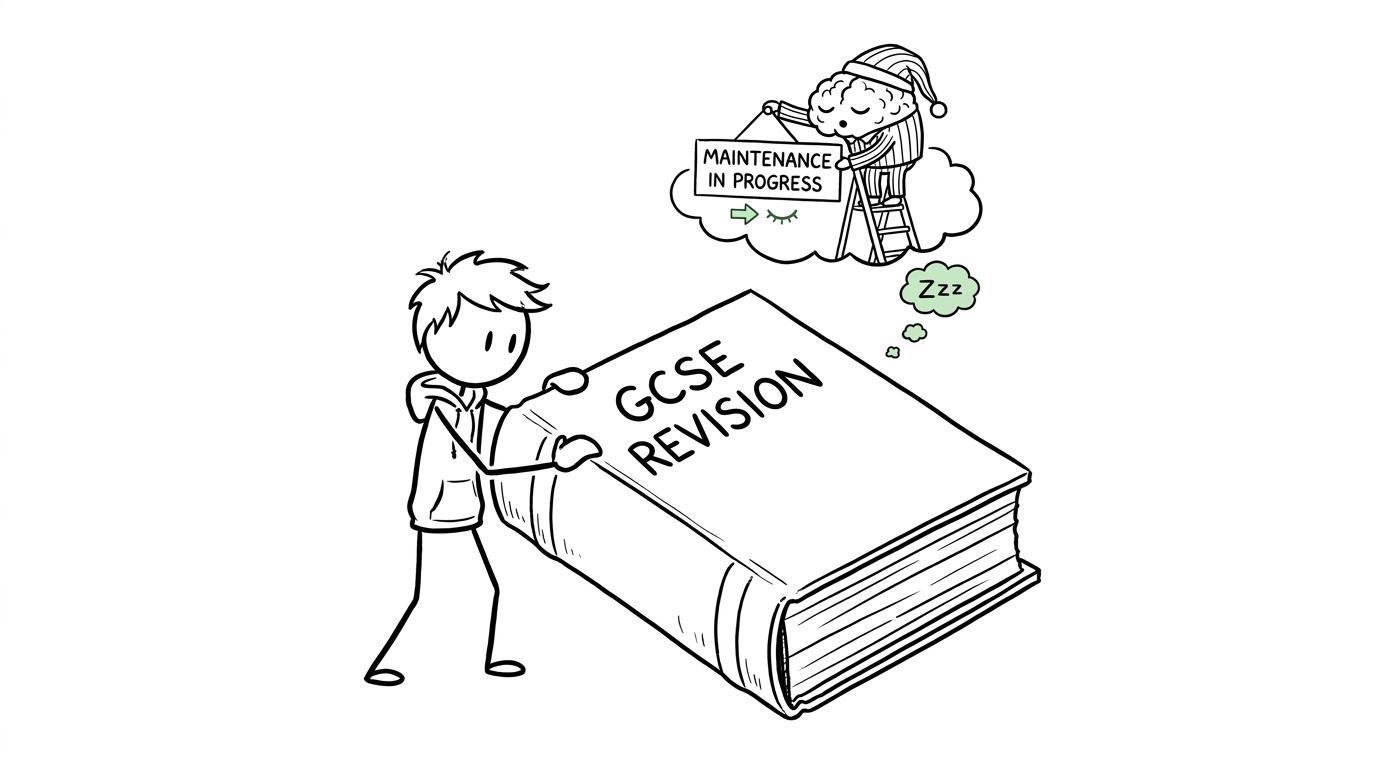 A tiny brain puts up a maintenance sign while a student closes a revision book at bedtime
Sleep is part of the plan rather than time stolen from it. Extending revision deep into the night may create extra hours on paper, but it can leave you less able to read carefully, sustain attention and check algebra the next day.
Common mistakes during a crowded exam week
Treating every subject equally
Equal blocks ignore which exam comes next and where improvement is still possible. Recalculate priorities each evening.
Dropping Further Maths completely
Several days without retrieval can make notation and methods feel unfamiliar. Keep a short daily minimum even when another exam leads.
Completing papers without reviewing them
A score tells you how the attempt went. The mark scheme and corrections tell you what to do next. Protect review time.
Revising favourite topics
Comfortable questions feel productive because they go well. Use your mistake log to choose the topics that actually cost marks.
Confusing a busy week with a formal clash
Exams on neighbouring days do not normally trigger timetable-clash arrangements. Papers in the same session might. Ask the exams officer rather than relying on friends or social media.
Sacrificing sleep to finish the plan
A timetable is a tool, not a debt. If an exam overruns emotionally or you are exhausted, shorten the session and preserve the most valuable task.
Turn a crowded week into a sequence
A difficult exam week looks overwhelming when you stare at all of it at once. It becomes more manageable when reduced to the next paper, the next weak topic and the next correction.
Let the nearest exam lead. Keep GCSE Further Maths alive with short, deliberate practice. As its paper approaches, shift towards timed questions, mark schemes and focused corrections. If two papers genuinely share a session, stop trying to solve the administrative problem yourself and speak to your exams officer.
Start now with the AQA GCSE Further Maths revision hub. Choose one weak topic, use the free revision lesson and practice questions, then check your work carefully. From there, MathsGenie's mini tests, past papers, predicted papers, mark schemes and video solutions can carry you from a crowded timetable to a clear next step.