GCSE Further Maths Busy Schedule: Survival Guide
GCSE further maths busy schedule? Build a realistic plan around sport, work and other subjects using short sessions, priorities and paper practice.
An empty revision timetable looks wonderfully organised. Real life rarely does. Training runs late, a shift appears at the weekend, three subjects set homework at once, and Further Maths gets pushed to the evening you were already using to recover.
If you are managing a GCSE further maths busy schedule, the answer is not to create more hours. It is to make the available ones count. Confirm your qualification, identify the topics costing you marks, and use short cycles of retrieval, practice, marking and repair. Protect your main GCSE subjects, but give Further Maths a small, dependable place in your week.
That is the survival strategy: less volume, better selection, honest marking and a routine that still works when life gets crowded.
Your quick survival checklist
- Confirm the exact qualification and exam board with your teacher.
- Protect your core GCSE Maths knowledge first.
- Choose two or three priority topics from recent assessments.
- Set a minimum session short enough to survive busy evenings.
- Answer questions rather than repeatedly reading notes.
- Mark every session and record the cause of each lost mark.
- Use short timed sets before attempting complete papers.
- Revisit mistakes within a few days.
- Keep sleep, meals and recovery in the plan.
Start by opening the GCSE Maths revision hub. Its board-specific resources, lessons, practice questions and shorter tests can help you strengthen the GCSE Higher skills on which Further Maths depends.
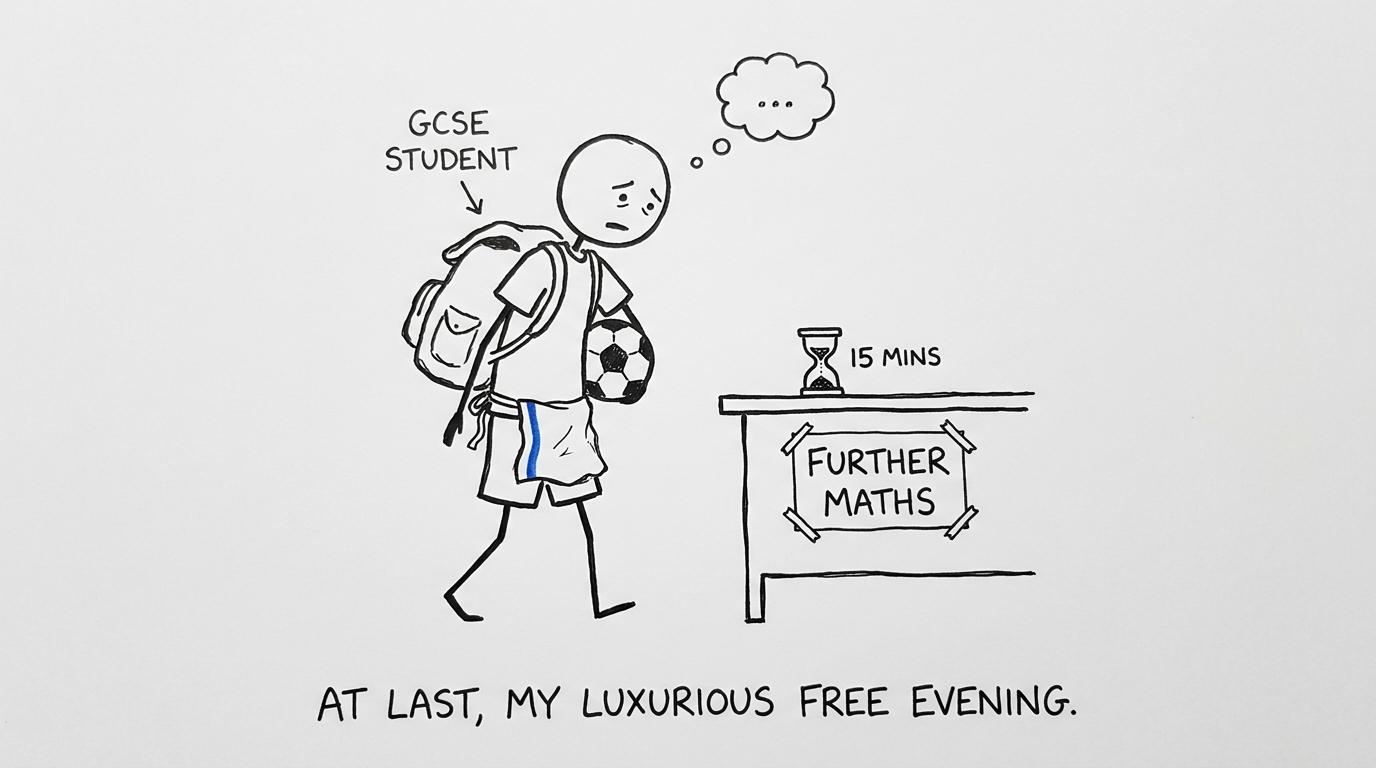 A busy student discovers a tiny window for Further Maths revision
First, find out what Further Maths you are taking
“GCSE Further Maths” is often used as a general name, but schools may enter students for different qualifications. One common route is the AQA Level 2 Certificate in Further Mathematics. Its official content includes number, algebra, coordinate geometry, calculus, matrix transformations and geometry. It is assessed through two papers, one non-calculator and one calculator paper.
Your school may use another qualification, so do not build a revision plan from a generic online topic list. Ask your teacher:
- What is the full qualification title and specification code?
- Which exam board are we following?
- What papers will I sit, and which allow a calculator?
- Which topics has our class completed?
- Are there school assessments or coursework deadlines before the examination?
This matters because ordinary GCSE Maths resources for Edexcel, AQA, OCR and Eduqas are not automatically Further Maths papers. They remain extremely useful for repairing shared Higher-tier skills, but your final paper practice must match the qualification you will actually sit.
The GCSE topics by exam board and tier guide can help you separate familiar Higher GCSE content from the extra material listed in your Further Maths specification.
Protect the mathematical foundations
Further Maths often feels like a collection of new techniques. Underneath, however, many questions still depend on a smaller set of familiar habits: manipulating algebra accurately, understanding functions, interpreting graphs, using exact values and sustaining a multi-step argument.
If factorising a quadratic is slow, more advanced algebra becomes expensive. If equations such as y=mx+cy = mx + cy=mx+c are insecure, coordinate geometry demands extra thought. If index laws and surds are fragile, an otherwise correct method can unravel during simplification.
When time is scarce, prioritise these foundations:
- expanding and factorising expressions;
- solving and rearranging equations;
- quadratics and simultaneous equations;
- indices, surds and exact arithmetic;
- functions and transformations of graphs;
- coordinate geometry;
- trigonometry and geometric reasoning.
Use the best order to learn GCSE Maths topics when several prerequisite gaps appear at once. You are not abandoning Further Maths by repairing GCSE algebra. You are removing the friction that makes every Further Maths question take longer.
Build a minimum viable revision week
A useful timetable is not the one designed for your calmest week. It is the one you can follow after an away match, a late shift or a difficult day at school.
Begin with fixed commitments. Put lessons, travel, training, work, meals and sleep into the week before adding revision. Then find two types of space:
- reliable slots, which are usually available;
- flexible slots, which can absorb a cancelled or delayed session.
A realistic minimum might look like this:
| Available window | Best use |
|---|---|
| 101010: 151515 minutes | Recall rules, retry one mistake or answer a few short questions |
| 202020: 303030 minutes | Revise one weak skill and complete targeted practice |
| 404040: 505050 minutes | Complete a mixed set, mini test or timed paper section |
| 606060 minutes or more | Sit and review a substantial section of a paper |
Do not automatically fill every free evening. A student balancing sport needs physical recovery; a student working late needs sleep; everyone needs enough attention left to learn. Revision completed while exhausted can create the feeling of effort without much useful feedback.
For broader planning, adapt the structure in the GCSE one-month revision plan. Reduce the session length if necessary, but preserve the cycle of diagnosis, focused practice and later retesting.
Use an anchor and a backup
Give each planned session an anchor and a backup. Your anchor might be Tuesday after dinner. Your backup might be Thursday morning or part of Sunday afternoon.
If Tuesday disappears, move the session once. Do not attempt to repay missed revision by doubling every later session. Revision debt behaves like financial debt: once it grows large enough, avoiding the plan feels easier than facing it.
Make each short session produce evidence
A short session needs a clear finish line. “Revise matrices” is vague. “Complete a short matrix set, mark it and identify one correction” produces evidence.
Use this compact loop:
Retrieve
Without opening notes, write down the rule, definition or process you think the topic requires. This reveals whether the knowledge is available when you need it.
Practise
Answer a small group of related questions. Avoid switching topic after every question during the learning stage; some repetition is needed before a method becomes reliable.
Mark
Check the answers immediately. Use the mark scheme or video solution to find the first place where your reasoning differed, not merely the final answer.
Repair
Write one precise correction. For example: “I reversed the order during a transformation” is more useful than “careless mistake”. Then answer another question requiring the corrected idea.
Retest
Return to the skill a few days later without notes. If the same error returns, it stays on the priority list.
This loop can fit into a short evening because it removes the decisions that normally consume the first ten minutes. MathsGenie’s revision lessons, practice questions, mark schemes and video solutions keep the stages together.
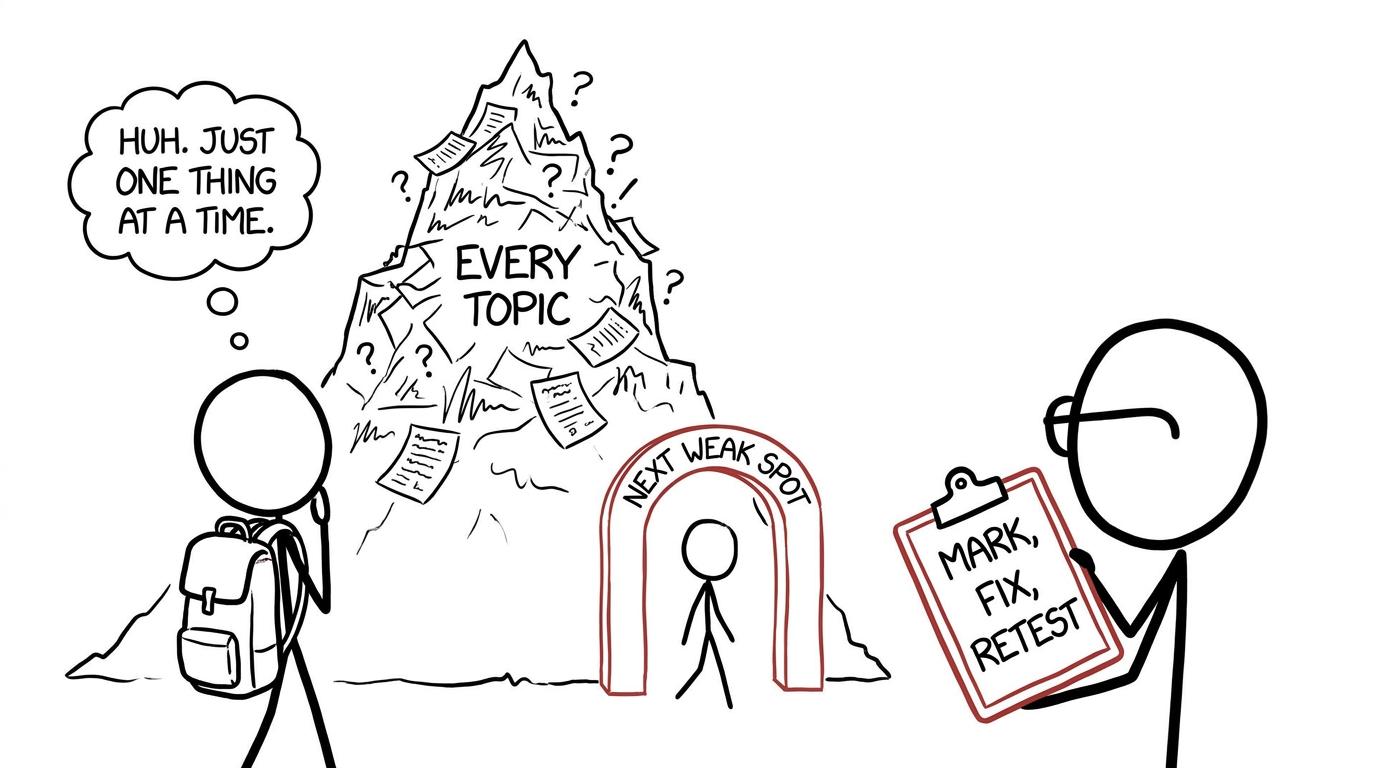 A student chooses the next weak spot instead of climbing every topic at once
Decide what to revise first
Do not rank topics solely by how difficult they look. Rank them by the marks they are currently costing you.
Use a recent test or appropriate paper section and classify each topic:
- Secure: you can answer unfamiliar questions accurately.
- Unstable: you know the method but make repeated errors.
- Missing: you cannot yet begin the question independently.
Give most of your limited time to unstable topics. They often need a smaller repair than missing topics and can become dependable relatively quickly. Keep secure topics alive through brief retrieval, and schedule missing topics when you have enough concentration for a lesson followed by practice.
A priority list should contain no more than three active topics. When one becomes secure, replace it. A list containing the whole specification is not a plan; it is a description of the course.
Use papers without losing an entire evening
Full papers are valuable, but they are not the only legitimate form of exam preparation. If sport, employment or other subjects make a complete sitting unrealistic, use a timed section, a half-length paper or a mini test.
The important sequence is:
- complete questions under controlled conditions;
- mark them accurately;
- classify each lost mark;
- repair the relevant topic;
- reattempt selected questions later.
The guide to starting GCSE past papers explains how paper practice can progress from targeted sections to complete timed papers. Use ordinary GCSE papers to maintain shared Higher skills, but reserve some sessions for papers specific to your Further Maths qualification.
Predicted papers can provide fresh practice near the examination, but they should supplement rather than replace official past papers. If you also need to prepare for your main GCSE Maths qualification, MathsGenie’s Edexcel predicted papers include mark schemes and worked solutions. Make sure the resource matches the examination named on your timetable.
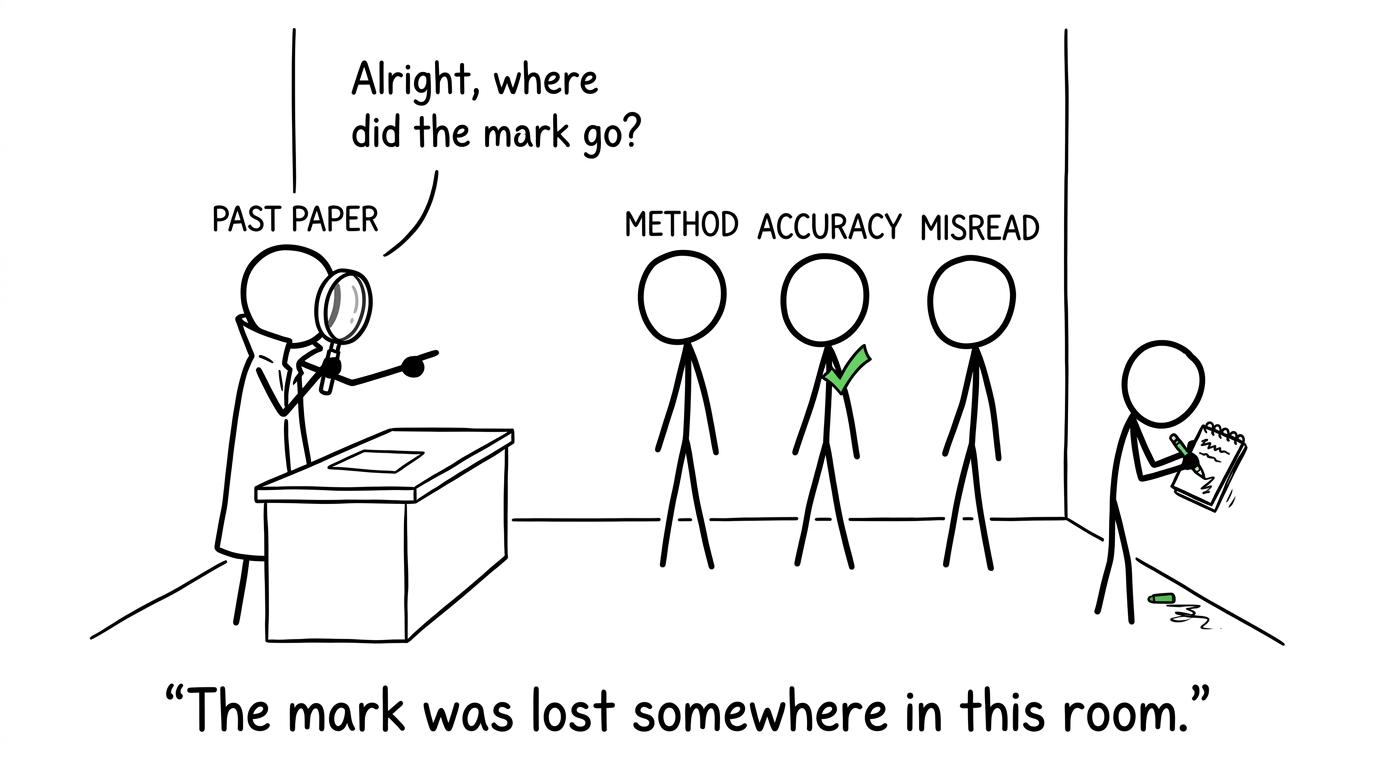 A revision detective investigates where a mark disappeared
Keep Further Maths in proportion
Further Maths should stretch you, not quietly consume the preparation needed for English, science or your main GCSE Maths papers. When deadlines collide, use three questions:
- Which examination or deadline comes first?
- Which subject currently has the clearest gap?
- Where could one focused session recover the most marks?
This is triage, not neglect. During an unusually busy week, your Further Maths minimum might be one retrieval session and one targeted question set. During a lighter week, add a timed section.
If you hope to continue with maths after GCSE, algebraic fluency is especially valuable. The GCSE to A Level curriculum guide explains the transition without suggesting that you should start learning the whole A Level course early.
Common mistakes with a busy revision schedule
Planning ideal weeks
A timetable based on empty evenings fails as soon as ordinary life returns. Plan around commitments rather than pretending they will disappear.
Watching without answering
A video can clarify a method, but recognition is not the same as recall. Close the explanation and answer questions independently.
Doing only favourite topics
Successful practice feels reassuring, which is why it is easy to repeat. Let marked work choose your priorities instead.
Saving all papers until the end
Short paper sections expose weak selection, timing and interpretation before the final week. Begin with manageable pieces.
Recording every error as carelessness
A sign error, an unread instruction and a missing algebraic step have different causes. Name the cause so that your next session can address it.
Sacrificing sleep to catch up
A plan that regularly requires late-night rescue sessions is too large. Reduce the workload, keep the feedback loop and speak to your teacher if the course is becoming unmanageable.
Make the next session small enough to start
You do not need to feel caught up before useful revision can begin. You need one accurate decision about what comes next.
Confirm your qualification. Choose one unstable topic. Complete a short set, mark it carefully and schedule the retest. Then repeat. A crowded timetable may limit how much work you can do, but it does not prevent you from building a reliable process.
Use MathsGenie’s free GCSE Maths resources as your revision base. Start with a revision lesson, strengthen the method through practice questions, and test it with mini tests, past papers or predicted papers. Mark schemes and video solutions will show you where the next repair belongs. When time is limited, that clarity is worth more than another ambitious timetable.