GCSE French Foundation vs Higher: Key Differences
GCSE French Foundation vs Higher explained: compare grades, vocabulary, grammar, paper demands, tier risks and how to choose the right route confidently.
A tier decision can feel like a judgement on how clever you are. It is not. It is a decision about which assessment gives you the best opportunity to show what you know.
The short answer to GCSE French Foundation vs Higher is that Foundation offers grades 111 to 555, while Higher offers grades 444 to 999, with a narrow grade 333 safety net for Higher candidates who just miss grade 444. But the difference reaches beyond difficulty. Higher includes more vocabulary and grammar, longer or more demanding tasks, greater linguistic complexity and a higher level of independence across listening, speaking, reading and writing.
The right tier is therefore not automatically the most ambitious one. It is the one that matches your current evidence, target grade and ability to perform consistently under exam conditions.
Foundation vs Higher at a glance
For the reformed French GCSEs first taught from September 2024 and first awarded in summer 2026, the main differences are:
| Feature | Foundation tier | Higher tier | | --- | --- | | Available grades | 111 to 555 | 444 to 999, with a narrow grade 333 safety net | | Tier entry | Foundation for every component | Higher for every component | | Vocabulary | About 1,2001,2001,200 specified word families or lexical items | About 1,7001,7001,700 in total | | Grammar | Core prescribed structures | Foundation grammar plus additional structures | | Language demand | Familiar, less complex language | Longer and more complex language | | Productive tasks | More structured support and shorter responses | Greater independence and more extended responses | | Best suited to | Students targeting a secure grade up to 555 | Students who need grade 666 or above, or are secure around grades 444 and 555 |
Exact paper timings, task order and marks vary between AQA, Pearson Edexcel and Eduqas, so use the specification and sample assessment materials for your own board. Do not revise from a generic paper format and assume it matches your examination.
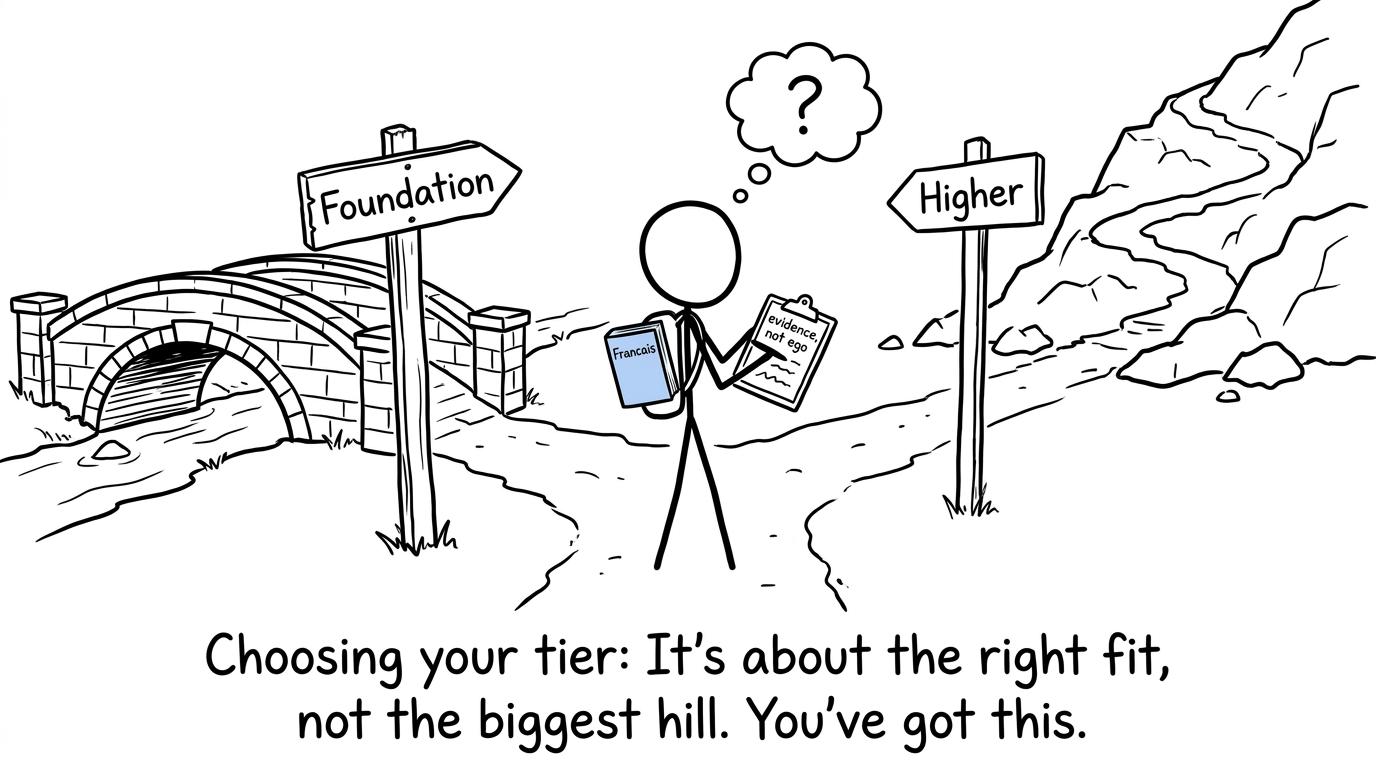 A student choosing between Foundation and Higher using evidence rather than ego
The grade range changes your possible outcome
Foundation tier has a maximum grade of 555. No matter how high your mark is, it cannot produce a grade 666 or above. Higher tier provides access to grades 444 through 999.
Higher also carries more downside risk. A candidate who falls just below the grade 444 boundary may receive an allowed grade 333, but this is only a narrow safety net. A mark below that range results in a U. Foundation provides access to grades 111 to 555, so it may be the safer assessment for someone whose performance regularly sits below grade 444 standard.
A grade 444 or 555 has the same value whichever tier produced it. The certificate does not identify the tier, and awarding arrangements are designed so that achieving an overlapping grade should not be easier on one tier than the other.
This is similar to the decision described in GCSE Foundation vs Higher Maths, although French and maths have different content and assessment structures. In both subjects, the sensible question is not, “Which paper sounds more impressive?” It is, “On which paper can I earn the grade I need reliably?”
You cannot mix Foundation and Higher components
GCSE French assesses listening, speaking, reading and writing. You must be entered at one tier across the whole qualification. You cannot take Foundation listening because it is a weakness and Higher writing because it is a strength.
That matters because language profiles are often uneven. You might write confidently when you have time to think but struggle to process a recording quickly. Alternatively, you may speak naturally but lose accuracy in translation.
Your tier decision must reflect the combined picture. One excellent skill cannot remove the risks created by three insecure ones. Equally, one weaker skill does not necessarily rule out Higher if your total performance remains comfortably within its grade range.
Higher French contains more vocabulary
Under the reformed specifications, Foundation students are expected to know approximately 1,2001,2001,200 prescribed word families or lexical items. Higher students learn those and approximately 500500500 more, bringing the Higher total to around 1,7001,7001,700.
This is not simply a larger pile of flashcards. A broader vocabulary changes what an assessment can ask you to understand and express. Higher candidates are expected to deal with a wider range of descriptions, viewpoints, actions and connections between ideas.
Both tiers may also require sensible handling of unfamiliar language. In reading, context, cognates, word families and sentence structure can help you infer meaning. Knowing the official list is therefore a foundation for comprehension, not a promise that every line will feel familiar.
For revision, separate vocabulary into three groups:
- words you can recognise but not produce;
- words you can produce slowly;
- words you can use accurately without prompting.
Only the third group is dependable in speaking and writing. Recognition alone can create false confidence because a word looks obvious on a flashcard but disappears when you need to form a sentence.
The grammar demand is genuinely different
Higher tier includes all Foundation grammar plus additional prescribed structures. It also expects students to understand and produce language with greater complexity.
At Foundation, success still requires more than memorising present-tense statements. Students need control of core features such as agreements, common verb forms, negatives, questions, opinions, time references and links between ideas. Higher then extends the range and demands more flexible application.
The important word is control. A complicated structure is not valuable if it makes the meaning unclear. Higher candidates need to choose structures appropriately, sustain accuracy and recover when a sentence does not develop as planned.
This is one place where a maths revision habit transfers well. In maths, you first secure a method and then apply it in mixed questions. The GCSE Maths Revision hub follows that progression through lessons, questions and papers. French grammar benefits from the same rhythm: learn one structure, retrieve it from memory, use it in several contexts, and test it later without notes.
The four skills become more demanding in different ways
“Higher is harder” is true but incomplete. Each skill becomes harder in its own way.
Listening
Higher listening uses more vocabulary and more complex spoken language. The assessment is also longer under the common regulatory model: 353535 minutes including reading time at Foundation and 454545 minutes at Higher. Your board may structure those minutes differently.
The challenge is not merely faster French. You may need to distinguish detail from distraction, follow changes of time or opinion, and retain information while the recording continues. The reformed assessments also include dictation, so sound-spelling knowledge matters.
Speaking
Foundation speaking lasts 777 to 999 minutes, while Higher lasts 101010 to 121212 minutes, normally after 151515 minutes of supervised preparation. Both tiers include prescribed task types such as reading aloud, role play and discussion based on visual material, although the exact sequence varies by board.
Higher candidates must sustain communication for longer and respond with greater range and spontaneity. A memorised paragraph may help with familiar content, but it cannot replace listening to the examiner and answering the question actually asked.
Reading
Higher reading texts can contain more complex language and require closer inference. You may need to track who holds an opinion, recognise whether an event is past or planned, and separate a writer’s main message from supporting detail.
Both tiers include translation from French into English. Higher translation draws on a broader vocabulary and grammatical range, so precise meaning matters more than replacing each French word mechanically with an English one.
Writing
Foundation writing generally provides more scaffolding and shorter tasks. Higher writing requires more extended, independent communication and a more demanding translation from English into French.
For example, the current AQA specification includes a photo-based sentence task and a short piece of approximately 505050 words on Foundation. Its Higher paper includes an open-ended task of approximately 150150150 words. This is an AQA illustration, not a universal template: Edexcel and Eduqas organise their questions differently.
How should your tier be chosen?
Tier decisions should come from repeated evidence, not one unusually good or bad classroom test.
Look at:
- your target grade and any sixth-form entry requirement;
- performance across all four French skills;
- recent mock and sample-paper marks;
- whether your result remains stable under timed conditions;
- your teacher’s knowledge of the specification and grade standard;
- how close you are to the grade 444 risk area on Higher.
If you need grade 666 or above, Higher is essential. If your realistic target is grade 444 or 555, either tier can produce it, so reliability and risk become more important. Ofqual’s guidance says students expected to achieve grade 444 or 555 may appropriately be entered for Foundation.
Do not compare raw percentages from Foundation and Higher as if the papers were identical. Grade boundaries are set after the assessments and can change between series. Compare performance using the correct board, specification, tier and assessment materials.
The same evidence-led approach is useful in maths. The GCSE Maths topics by board and tier guide helps you identify what your own maths papers can assess rather than revising from an assumed topic list.
A revision method that works across both subjects
French and maths reward different knowledge, but effective revision has a similar shape: attempt, mark, diagnose, repair and retest.
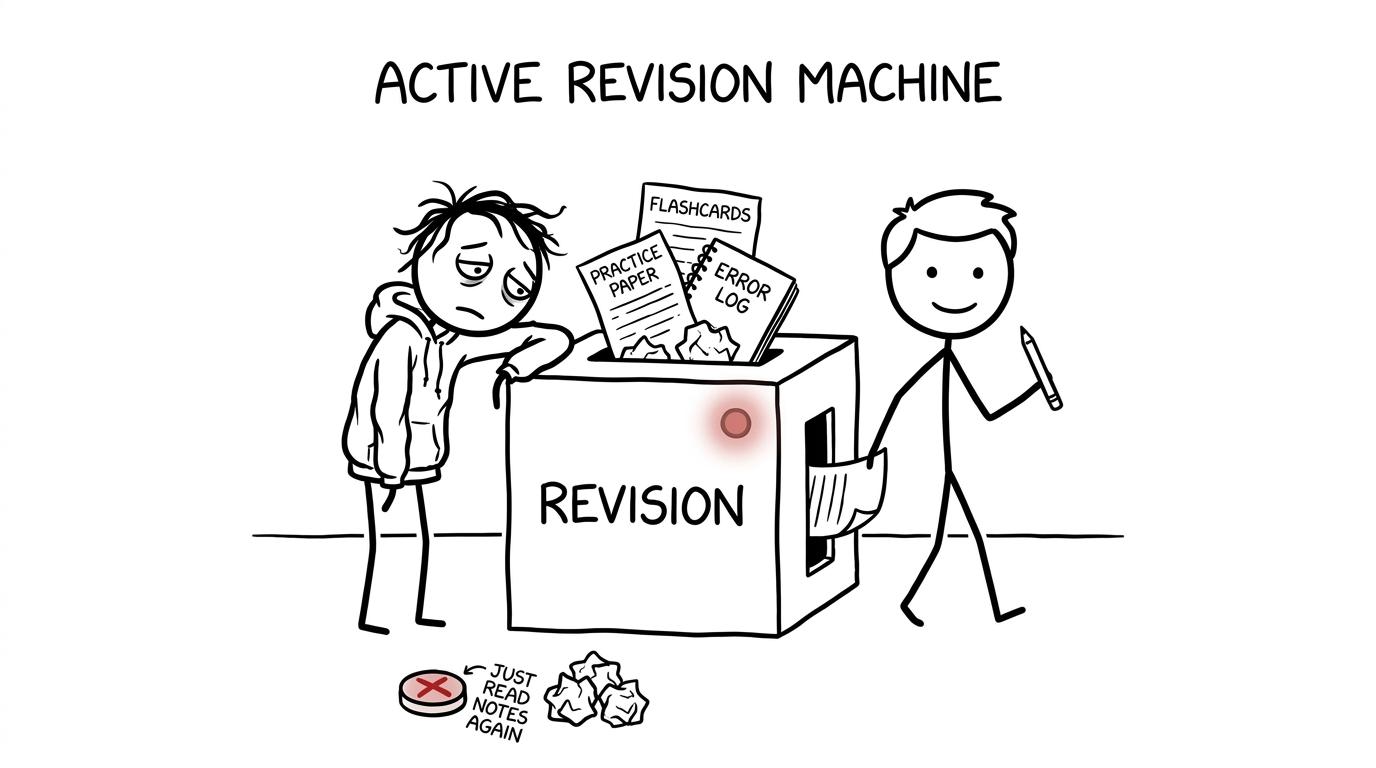 A revision machine turning active practice into calm exam readiness
Passive reading feels comfortable because nothing exposes a gap. Retrieval does. That discomfort is useful.
For maths, choose the correct tier when using Edexcel GCSE Maths past papers or AQA GCSE Maths past papers. Mark the work, identify the lost skill and return to targeted questions. If a full paper is too large, GCSE mini tests provide a shorter check.
Use the equivalent process in French with your board’s official sample and past assessment materials:
- complete one skill under realistic conditions;
- mark it against the published guidance;
- classify each error as vocabulary, grammar, comprehension or technique;
- practise the smallest repairable weakness;
- retest it without support.
Nearer the maths examinations, GCSE predicted papers can provide fresh practice after topic weaknesses have been repaired. They are most useful as a test of revision, not a substitute for it.
Common mistakes when comparing the tiers
Assuming Foundation is an easy paper
Foundation is more accessible, but earning a strong grade still requires accurate French across four separate skills. Its highest grades are not awarded simply for entering the tier.
Choosing Higher because friends are taking it
Your friends’ target grades, strengths and risk levels are not your evidence. Tier choice is individual.
Treating the vocabulary totals as the whole course
Vocabulary is essential, but marks also depend on grammar, pronunciation, comprehension, translation, communication and exam technique.
Revising only the skill you enjoy
A confident writer can still lose substantial marks through weak listening. Because all four components contribute to the qualification, revision should follow the evidence rather than personal preference.
Using old paper formats without checking
The reformed French specifications were first awarded in summer 2026. Older papers can provide extra language practice, but their tasks and assessment details may not match the current course.
Believing tier alone determines your grade
The tier sets the available grade range. Your total performance determines where you land within it.
Choose evidence over the label
Foundation and Higher are not two labels for weak and strong students. They are two assessment routes with different grade ranges, vocabulary requirements, grammar content, task demands and levels of linguistic independence.
Speak to your French teacher before any entry decision and ask which evidence supports the recommendation. Then bring the same calm logic to maths revision. Use MathsGenie’s free revision lessons and practice questions to repair individual topics, mark past papers carefully, check video solutions, use mini tests for retrieval and add predicted papers when you are ready for unseen exam practice.
A tier decision sets the route. Consistent, honest revision determines how well you travel it.