

GCSE Food and Nutrition Revision Burnout: Avoid It
GCSE food and nutrition revision burnout is avoidable. Spot the early signs, build a sustainable revision plan and protect your energy before May.
There is a particular kind of tiredness that arrives before GCSE exams. You sit down to revise food science, read the same sentence about protein denaturation three times, then realise you have absorbed none of it. Maths is still waiting. So are your other subjects. May feels uncomfortably close.
GCSE food and nutrition revision burnout is best avoided by noticing changes early, reducing the size of each task and following a routine that leaves room for sleep, movement and ordinary life. More hours are not automatically better. The useful question is whether your revision is focused enough to repeat tomorrow.
Students often use “burnout” to describe physical, mental and emotional exhaustion after sustained pressure. It is not simply having one unproductive afternoon. The warning comes when tiredness, irritability, poor concentration or avoidance begin to form a pattern.
Your anti-burnout checklist
Use this quick check before planning another long evening:
- Choose one precise Food and Nutrition topic per session.
- Use retrieval and questions rather than repeatedly reading notes.
- Stop before your concentration has completely disappeared.
- Schedule breaks as part of the plan, not as a reward for finishing everything.
- Protect a consistent sleep routine.
- Alternate demanding and lighter subjects.
- Keep one catch-up space each week.
- Tell a trusted adult if stress is affecting everyday life.
The aim is not to create the perfect timetable. It is to build one you can still follow when school has been tiring.
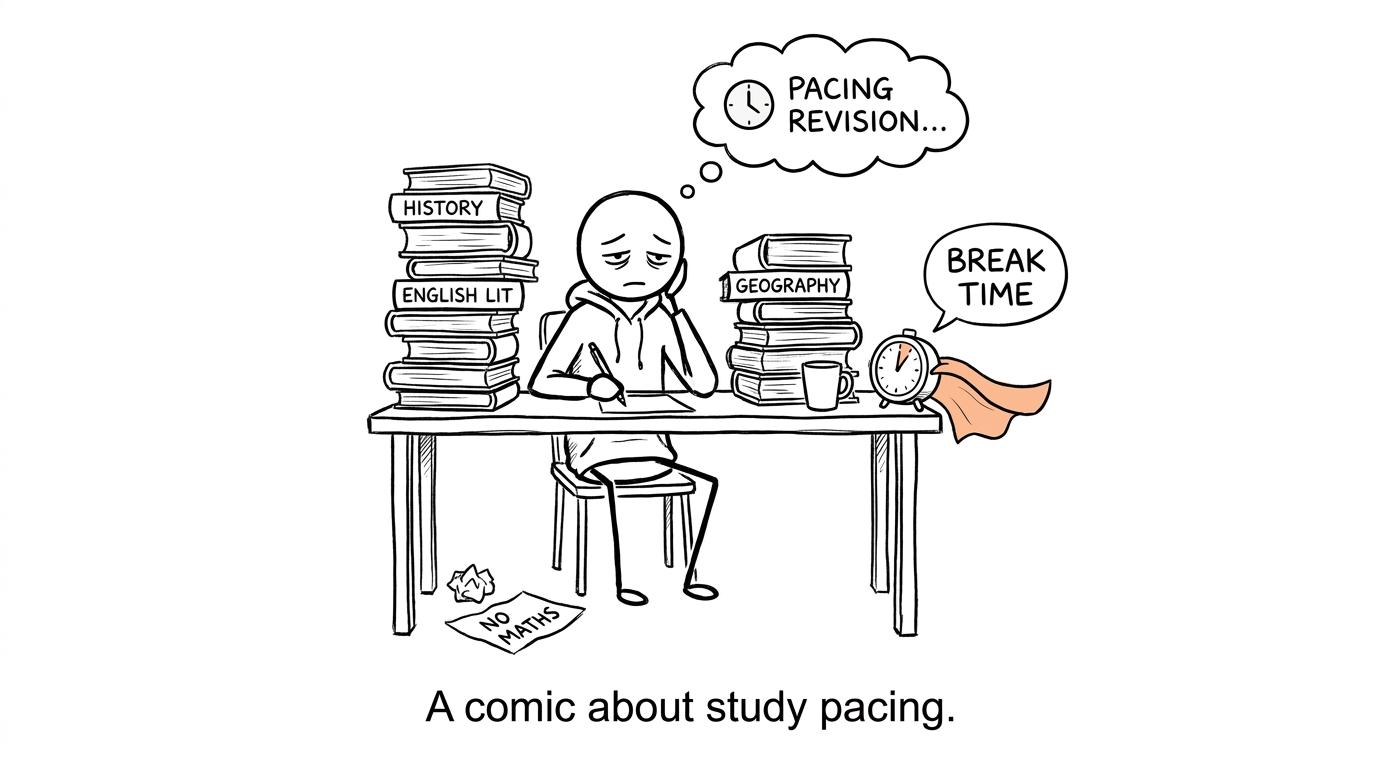 A kitchen timer rescues a tired student from an overflowing revision desk
Early signs of GCSE Food and Nutrition revision burnout
Stress does not always announce itself dramatically. It often begins with small changes that are easy to explain away.
Your concentration becomes less reliable
You may spend longer at your desk while completing less. Familiar terms suddenly feel unfamiliar, extended answers become difficult to organise, or you repeatedly switch between tabs and topics.
This matters in Food Preparation and Nutrition because the written paper requires more than isolated recall. Depending on the question, you may need to apply knowledge, analyse information or evaluate a choice. A tired hour of highlighting can look productive without preparing you to do those things.
You begin avoiding revision
Avoidance can look like laziness from the outside, but it may be a response to feeling overwhelmed. You might reorganise notes rather than test yourself, delay starting until late at night, or avoid the topics you find hardest.
Make the entry point smaller. “Revise nutrition” is vague and heavy. “Recall the functions and sources of one macronutrient, then answer two questions” is something you can begin.
Your mood, sleep or body changes
The NHS lists possible signs of exam stress in young people including irritability, low mood, headaches, stomach pains, disrupted sleep, changes in eating and losing interest in usual activities. One sign on one day does not necessarily mean burnout. A continuing combination deserves attention.
Most teenagers need around 888 to 101010 hours of sleep, according to NHS guidance. Treating sleep as spare revision time can therefore undermine the concentration you are trying to improve.
If anxiety or low mood is severe, persistent or interfering with daily life, speak to a parent, carer, teacher, school pastoral lead or health professional. A revision plan is useful, but it is not a substitute for support.
Why Food and Nutrition can feel unusually demanding
Food Preparation and Nutrition crosses several kinds of thinking. You recall nutritional knowledge, explain food science, consider safety and provenance, and connect theory with practical decisions.
For the current AQA and Eduqas specifications, the written examination lasts one hour and forty-five minutes and contributes 50%50\%50% of the qualification. Non-exam assessment contributes the other 50%50\%50%. Exact content and arrangements depend on your specification, so use the materials supplied by your school and confirm anything uncertain with your teacher.
By spring, much of the practical or NEA work may already have demanded sustained attention. The written paper then arrives alongside maths and the rest of your GCSE timetable. Burnout is often not caused by one subject. It is caused by every subject being treated as the only subject that matters.
Pace revision so you do not hit a wall in May
A marathon becomes difficult when you sprint the opening section. Revision behaves in much the same way.
Set a repeatable weekly load
Begin with fixed commitments: school, travel, meals, sleep and activities that help you recover. Place revision around them rather than creating a fantasy timetable that assumes unlimited energy.
The GCSE maths revision timetable guide explains how to prioritise weak areas while leaving space for rest and catch-up. Apply the same principle to Food and Nutrition: plan by need, not guilt.
A sustainable week might contain several short subject blocks and one longer paper session. It should also contain an intentionally empty slot. If illness, homework or tiredness interrupts the week, that slot absorbs the disruption. If nothing goes wrong, it becomes free time.
Use a minimum, target and ceiling
A daily minimum prevents an all-or-nothing mindset. It might be a short retrieval task on a difficult day. Your target is the normal session you expect to complete. Your ceiling is the point at which you stop, even if anxious thoughts suggest carrying on.
This is particularly useful when balancing Food and Nutrition with maths. The twenty-minute GCSE maths revision routine provides a compact structure for busy days. A short, completed maths session can preserve progress without consuming the evening you planned for food science.
Match the task to your energy
Not all revision requires equal concentration.
Use higher-energy periods for:
- answering extended-response questions;
- completing timed paper sections;
- analysing unfamiliar information;
- correcting a weak topic.
Use lower-energy periods for:
- brief retrieval of key terms;
- reviewing an error list;
- sorting questions by topic;
- checking a mark scheme against an answer already written.
This is not lowering your standards. It is choosing work your brain can perform properly at that moment.
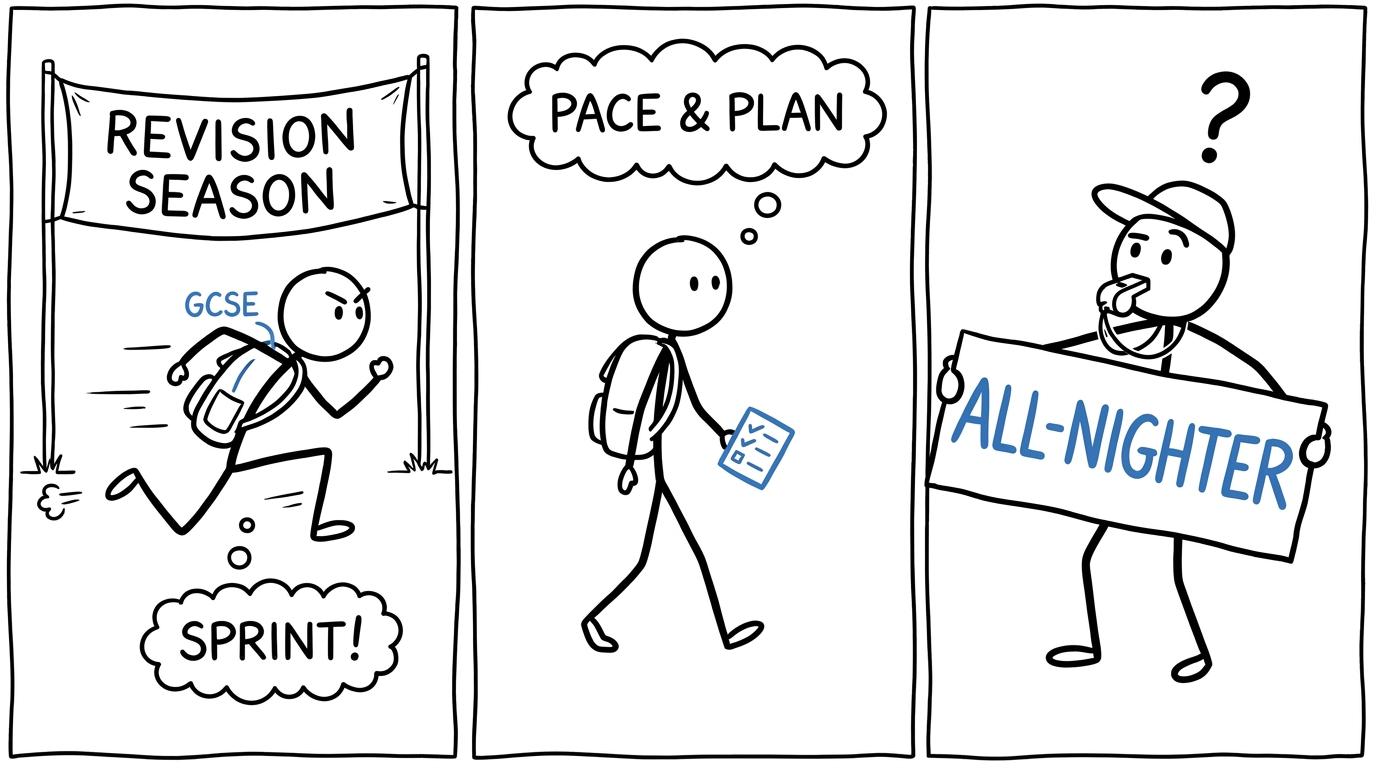 A student chooses steady revision while an all-nighter coach looks baffled
Revise actively without exhausting yourself
Burnout prevention is not only about reducing time. It is also about improving what happens inside that time.
Retrieve before reviewing
Close your notes and write what you can remember about one narrow area. Then check the specification-aligned material and add what was missing. Retrieval reveals gaps quickly; rereading can conceal them behind familiarity.
Keep the task narrow. Food safety, nutrition, food science and provenance are broad areas, not suitable targets for one short session.
Turn mistakes into the next task
After questions, record the reason for each lost mark. Was knowledge missing? Did you fail to apply it to the context? Was an explanation too vague? Did you overlook the command word?
This converts a disappointing result into a small decision. MathsGenie’s guide to finding your weakest GCSE topics uses the same evidence-led idea: diagnose, practise and retest instead of revising everything equally.
For maths, the free GCSE maths revision hub keeps lessons, question practice and papers together, reducing the mental effort of deciding where to begin. Choosing the correct exam board and foundation or higher tier also prevents wasted work.
Build paper stamina gradually
Do not move from brief notes to repeated full papers overnight. Begin with individual questions, progress to timed sections and use complete papers when you have enough energy to review them properly.
A paper without marking is only a measurement. Improvement comes from checking the mark scheme, identifying the gap and returning to it. Maths students can use Edexcel GCSE maths past papers, while the broader hub provides routes for AQA, OCR and Eduqas too.
Protect the basics before May
Breaks are not evidence that revision has failed. They are one of the conditions that allow it to continue.
Move away from the desk during a break. Drink, eat regularly, stretch, walk or speak to someone. Scrolling through revision videos can feel like rest while leaving your attention in the same pressured environment.
Set an evening stopping time and allow time to wind down. The GCSE maths night-before plan is built around short, selected practice rather than late cramming. That principle applies across your timetable: the evening before an exam is for calm preparation, not rescuing an entire course.
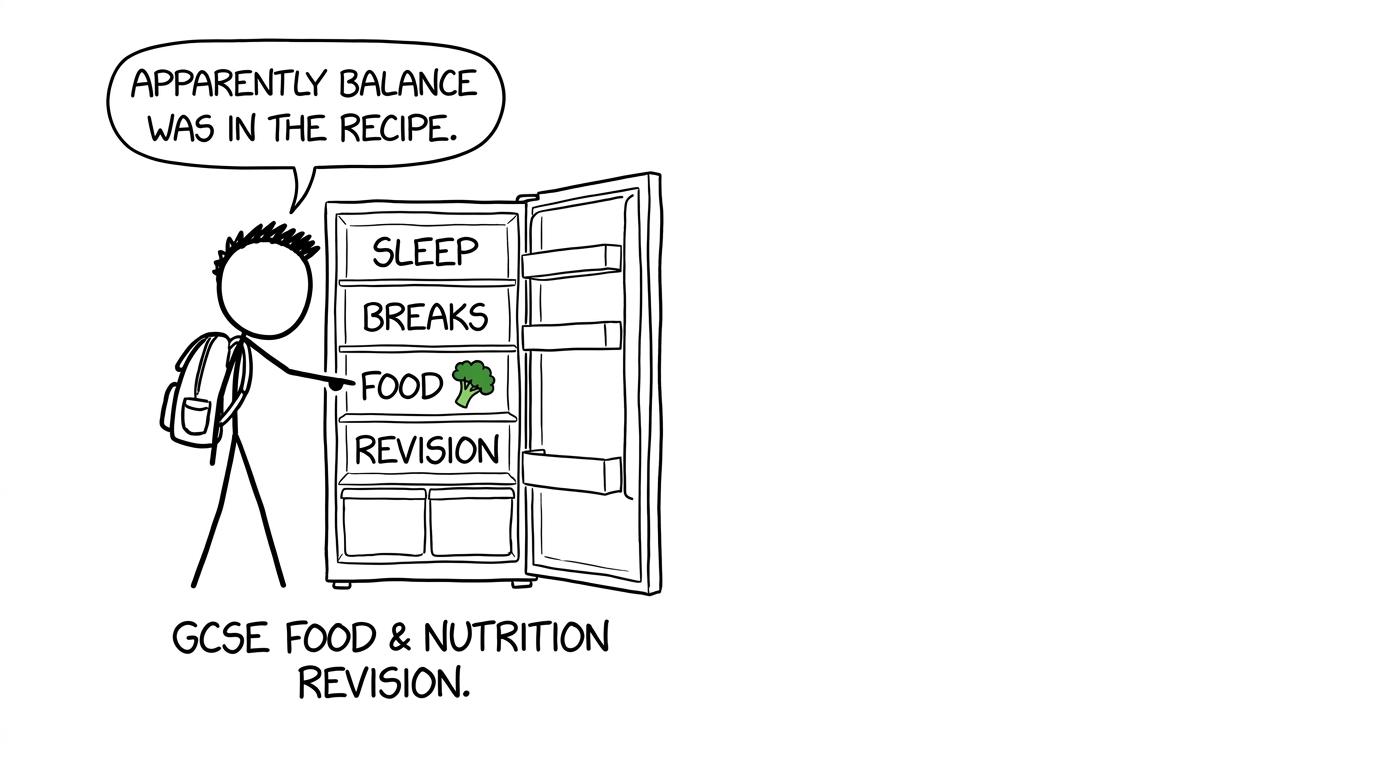 A balanced revision fridge contains shelves for sleep, breaks, food and revision
Common mistakes that increase revision burnout
Measuring effort only in hours
Time at a desk is not the same as learning. Track completed questions, recalled facts and corrected errors instead.
Planning every available minute
An overloaded timetable has no resilience. One difficult day can make the whole plan appear ruined, encouraging you to give up or compensate with an exhausting session.
Revising comfortable material repeatedly
Familiar topics feel reassuring, but weak areas remain untouched. Use evidence from questions to choose the next task. The one-month GCSE revision plan shows how diagnosis and short retrieval can shape a manageable final month.
Completing papers without reviewing them
Mark schemes are learning tools, not merely score sheets. Review command words, accepted detail and the structure rewarded by the examiner.
Comparing your timetable with someone else’s
You do not know another student’s energy, responsibilities or starting point. A smaller plan completed consistently is more valuable than an impressive plan abandoned after three days.
Waiting too long to ask for help
If revision stress is affecting sleep, eating, relationships, attendance or your ability to function normally, tell someone. Asking early gives adults more opportunity to help adjust workload and arrange appropriate support.
Finish the course with energy still available
The goal is not to reach May having revised every possible minute. It is to arrive able to read carefully, retrieve knowledge and think clearly.
For Food and Nutrition, keep sessions specific, active and linked to your own specification. For maths, let MathsGenie remove unnecessary decisions. Start with the GCSE maths revision hub, choose your board and tier, then combine free revision lessons and practice questions with mini tests, past papers and predicted papers. Use mark schemes and video solutions to turn mistakes into the next manageable action.
Steady revision rarely feels dramatic. That is its advantage. It leaves enough energy to begin again tomorrow.










