GCSE Food and Nutrition Homework Grade Impact
GCSE food and nutrition homework grade impact explained: learn what is marked, what improves results, and when maths revision should take priority for you.
The difficult thing about homework is not always doing it. It is deciding whether the next hour will genuinely improve your results.
The short answer on GCSE food and nutrition homework grade impact is this: ordinary homework is not a separate, nationally assessed part of your final GCSE grade. However, useful homework can improve the knowledge, practical judgement and evaluation skills assessed in the written exam and non-exam assessment. Work completed as part of your official NEA is different; that can contribute directly to your qualification, subject to your exam board's rules and your school's supervision.
So homework matters, but not every task matters equally. If you are balancing Food Preparation and Nutrition against GCSE maths revision, the best decision is based on deadlines, weaknesses and the purpose of the task, not guilt.
The quick homework impact checklist
Before spending an evening on a Food Preparation and Nutrition task, ask:
- Is this ordinary practice or part of my official NEA?
- Which assessment skill does it develop?
- Will my teacher provide feedback that I can use?
- Is there a fixed deadline or practical lesson depending on it?
- Am I avoiding a more urgent weakness in maths or another subject?
- Can I complete a focused version of the task rather than polishing it indefinitely?
A clear task linked to classroom learning is usually valuable. A vague task completed mechanically is less likely to move your grade.
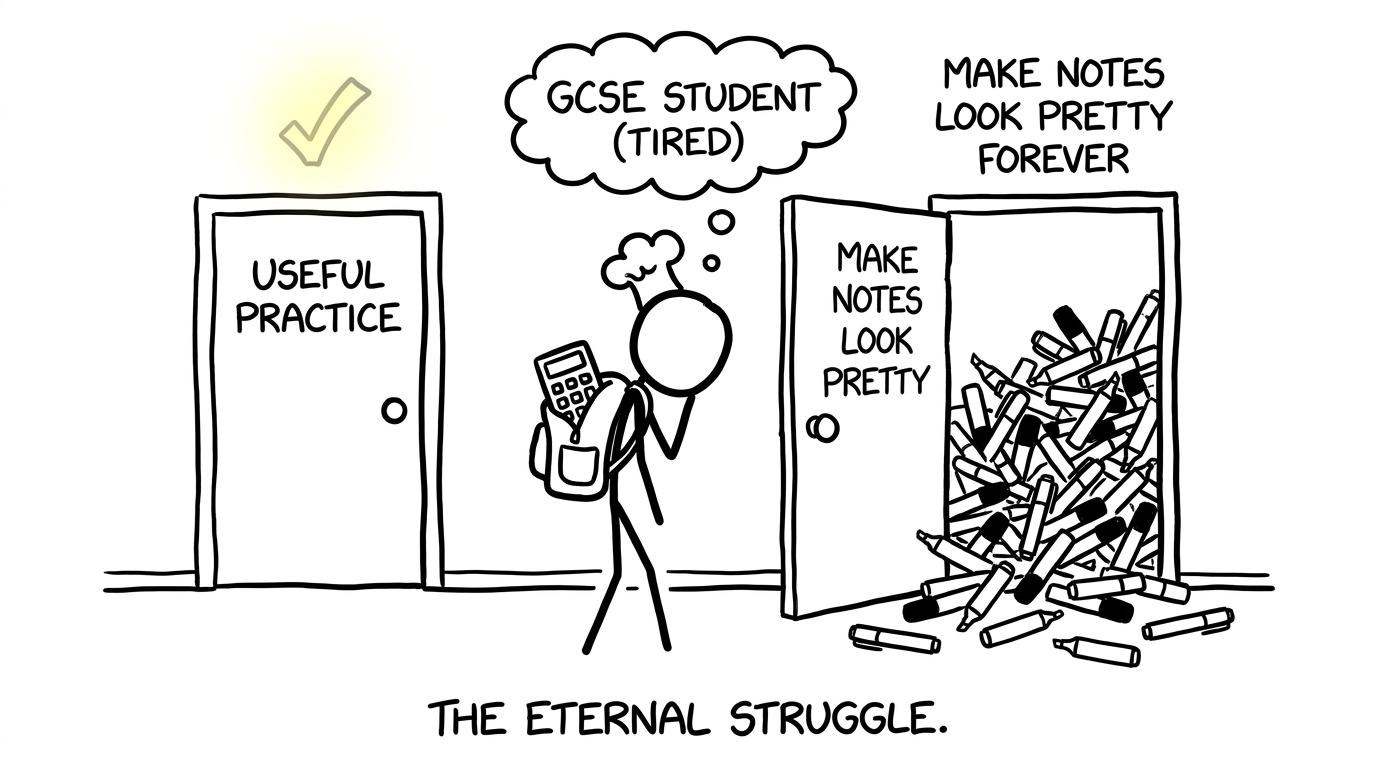 A GCSE student choosing between useful practice and an unnecessary mountain of highlighters
What actually counts towards your final grade?
The official qualification is normally called GCSE Food Preparation and Nutrition, although students often shorten this to food and nutrition.
Ofqual requires regulated GCSE Food Preparation and Nutrition qualifications in England to divide the available marks equally between examination and non-examination assessment. Across boards such as AQA, OCR and Eduqas, the broad structure is therefore:
| Assessed component | Contribution to the qualification |
|---|---|
| Written examination | 50%50\%50% |
| Non-exam assessment | 50%50\%50% |
The NEA is divided into a food investigation and a food preparation assessment. In broad weighting terms, the investigation contributes 15%15\%15% and the preparation task contributes 35%35\%35% of the qualification.
Your overall weighted mark can be represented conceptually as:
overall weighted mark=0.5(exam percentage)+0.5(NEA percentage)\text{overall weighted mark}=0.5(\text{exam percentage})+0.5(\text{NEA percentage})overall weighted mark=0.5(exam percentage)+0.5(NEA percentage)This does not calculate a guaranteed grade because grade boundaries are set after the assessments and can vary between exam series. It does show something important: ordinary homework has no extra percentage of its own.
Your school may use homework when producing progress reports, predicted grades or decisions about support. Those internal systems vary. They should not be confused with the final qualification calculation.
When homework affects your grade directly
Official NEA work
Work produced for your assessed food investigation or food preparation portfolio can contribute directly to your final mark. But NEA is not simply homework with a more important title.
Exam-board rules govern supervision, authentication and permitted assistance. Your teacher must be able to confirm that submitted work is your own. Excessive outside help, copying material without acknowledgement or allowing somebody else to rewrite your work can create malpractice or authentication problems.
Follow your teacher's instructions about where and when NEA work may be completed. Do not assume that unrestricted editing at home is allowed simply because you can access the document.
Preparation that improves NEA performance
Some homework may not be submitted, yet still prepare you for assessed work. Relevant tasks can help you:
- understand the functional and chemical properties of ingredients;
- justify choices using nutritional evidence;
- plan an achievable sequence for practical work;
- interpret investigation results;
- analyse sensory findings;
- evaluate outcomes rather than merely describe them.
This is an indirect effect, but potentially a strong one. Planning before a practical session can reduce hesitation. Reviewing feedback can prevent the same weak evaluation from appearing in assessed work.
When homework affects the written examination
The written paper accounts for 50%50\%50% of the qualification. It assesses theoretical knowledge and your ability to apply, analyse and evaluate that knowledge.
Homework is useful when it makes those processes easier. Retrieval questions can reveal whether you genuinely remember nutrients, food safety principles and food-science terminology. Exam-style responses develop the habit of matching detail to command words. Correcting an answer after feedback is often more valuable than writing another page of notes.
Evidence summarised by the Education Endowment Foundation indicates that homework tends to have a positive average effect at secondary level. It also warns that task quality matters more than sheer quantity, that homework connected to classroom learning is more effective, and that feedback strengthens its value. The evidence base has limitations, so this should not be interpreted as a promise that every completed worksheet raises a grade.
Homework works through learning. Completion alone earns no national GCSE credit.
The maths hidden inside Food Preparation and Nutrition
Food homework can also reinforce numerical skills that matter in GCSE maths. Recipe scaling involves ratio and direct proportion. Nutritional information uses fractions, decimals and percentages. Investigations may involve averages, tables, charts and comparisons. Practical planning depends on units, time and sensible estimation.
If these calculations slow you down, revisit MathsGenie's free percentage revision lesson or use the focused percentages revision guide. Edexcel students can also find printable, topic-specific practice in the GCSE maths exam booklets, while students following another specification can start from the AQA GCSE maths revision hub.
The useful principle is transfer. A proportion question in food homework and a proportion question in a maths paper may look different, but the underlying reasoning is connected.
Should food homework or maths revision come first?
There is no universal answer. A better question is: which task has the highest value tonight?
| Situation | Sensible priority |
|---|---|
| An authorised NEA session or fixed food deadline is approaching | Complete the permitted preparation first |
| A food task targets a weakness identified by feedback | Do the correction while the feedback is fresh |
| The task is optional presentation work with little learning value | Limit the time and move on |
| A maths mock is close and past papers reveal serious gaps | Prioritise targeted maths revision |
| Both subjects need attention | Give each a defined block with a clear stopping time |
Think in terms of marks at risk rather than hours spent. Ten focused minutes correcting a misconception can be worth more than an hour making headings look perfect.
A realistic GCSE maths revision timetable can help you protect time for both subjects. Use the revision planner to record immovable deadlines first, then add short revision sessions around them. Leave some unscheduled space because practical work, teacher feedback and school deadlines do not always arrive neatly.
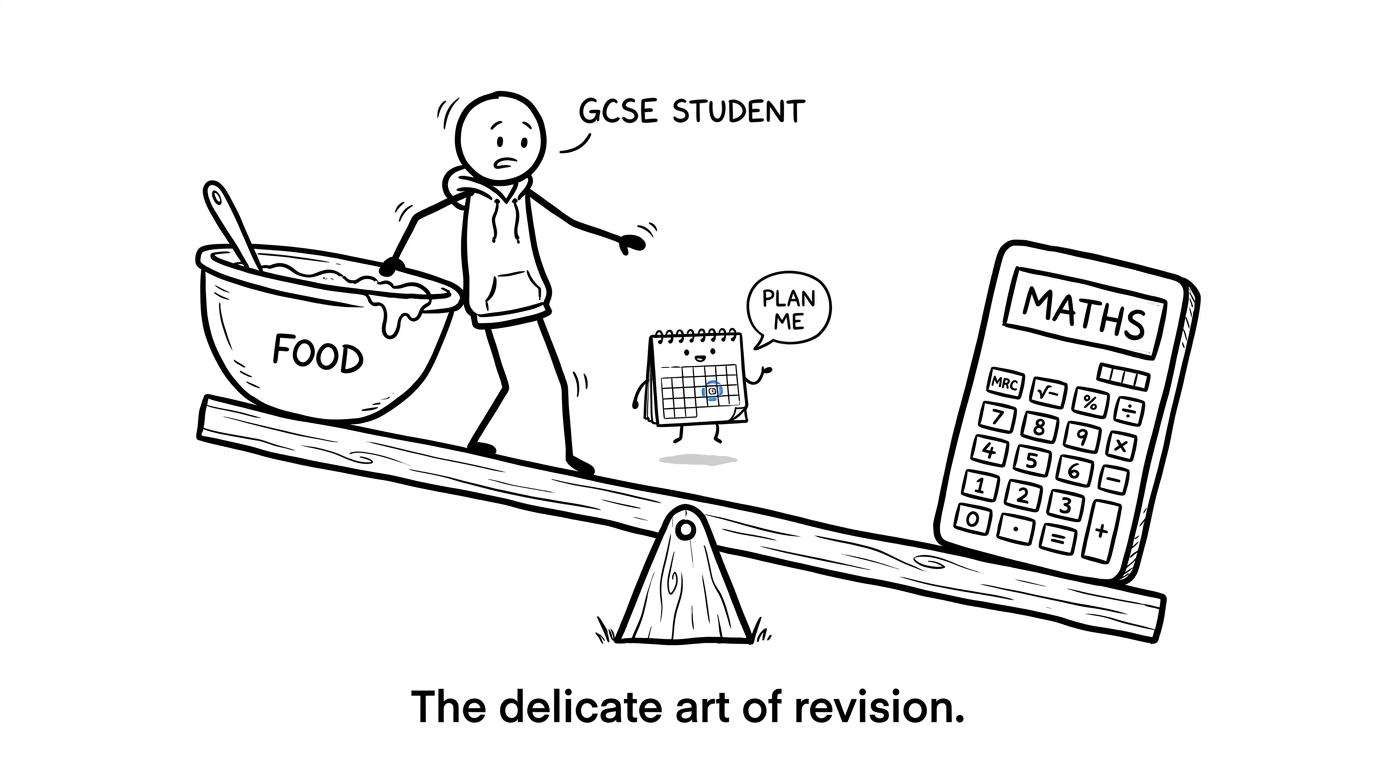 A student balancing food and maths while a calendar asks to be planned
How to make food homework worth the time
Define the purpose before starting
Write one outcome at the top of the page: remember a set of facts, improve an evaluation, prepare for a practical lesson or answer an exam question accurately. If you cannot identify the purpose, ask your teacher what the task is intended to develop.
Use feedback as the beginning, not the end
A mark tells you where you are. Feedback should tell you what to change. Reduce each useful comment to a next action, such as adding scientific reasoning, using evidence from results or linking an evaluation to the task criteria.
Then apply that action to a fresh question or paragraph. The learning occurs when your next response changes.
Set a stopping rule
Homework can expand to fill an evening because there is always another sentence to polish. Decide in advance what “finished” means. That could be completing the required questions, checking terminology and recording one uncertainty for your teacher.
Protect assessed work
Keep a clear record of sources, label your own results accurately and follow the precise NEA conditions given by your school. Never use AI, another person's writing or an online model answer as submitted work unless your teacher and exam-board rules explicitly permit the way it is being used.
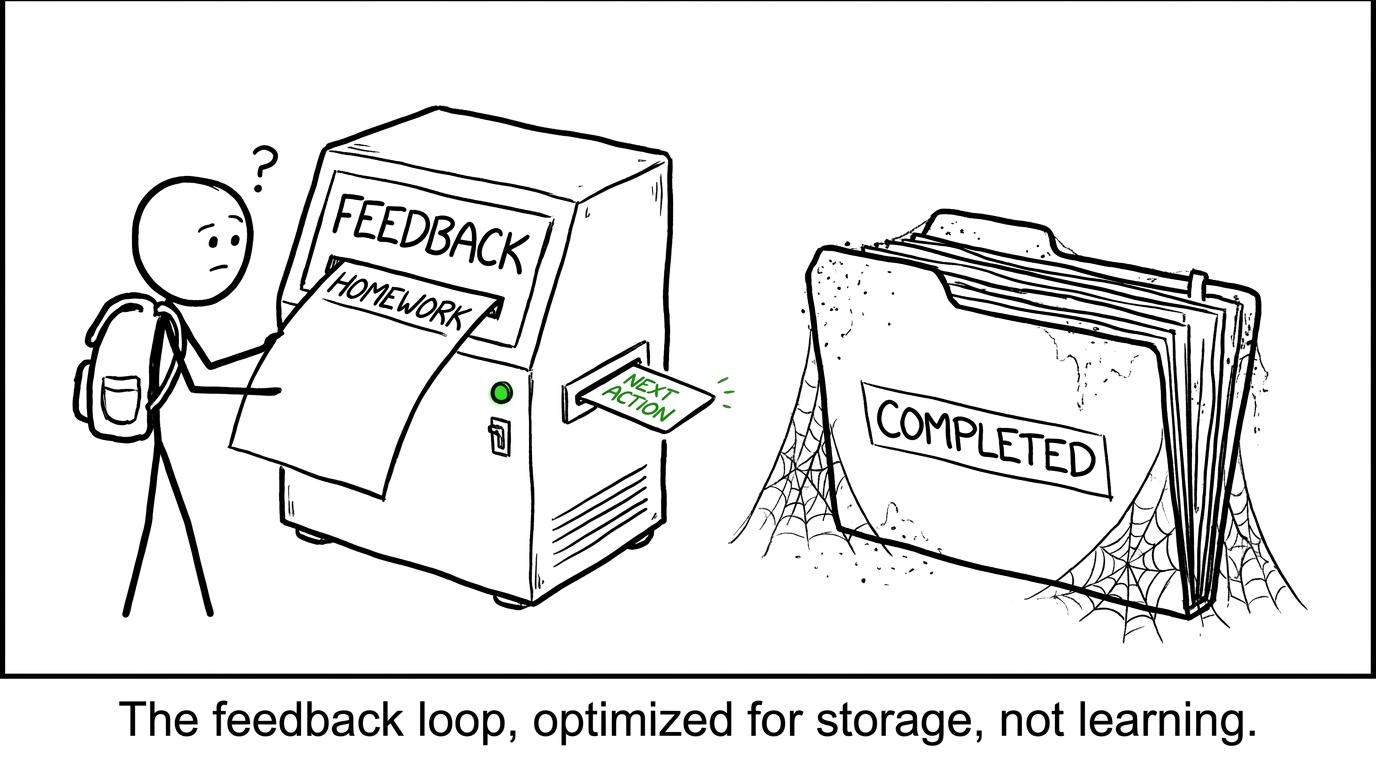 Homework passing through feedback and becoming a clear next action
Common mistakes when judging homework value
Assuming every homework mark enters the final grade
Ordinary homework marks may inform school reporting, but they are not an additional component of the national qualification. Check whether a task is practice, internal assessment or authorised NEA work.
Spending equal time on every subject
Fair does not always mean equal. Revision time should respond to upcoming assessments, current weaknesses and the size of the opportunity to improve.
Completing work without reviewing errors
A finished worksheet can create a comforting sense of progress. If errors remain unexplained, that comfort may be false. Use the same principle recommended for maths papers: mark, diagnose, practise and return. MathsGenie's guide to using GCSE maths past papers properly explains this cycle clearly.
Treating predicted papers as predictions of your grade
A predicted paper is a practice resource, not a forecast of your result. MathsGenie's Edexcel GCSE maths predicted papers are most useful when you complete them under suitable conditions, use the mark schemes and return to weak topics.
Ignoring access problems
Not every student has a quiet room, reliable internet or practical resources at home. If this affects you, tell your teacher early. A school homework club, library or adjusted arrangement may provide a fairer way to complete the task.
Make the next hour deliberate
Food Preparation and Nutrition homework can matter considerably, but its effect depends on what the task is and what you do with it. Official NEA contributes directly. Well-designed practice can strengthen examination and practical performance. Low-purpose copying or endless presentation work usually offers a smaller return.
The same lesson applies to maths: activity is not the goal; improved performance is. Start at MathsGenie's free GCSE and A Level maths revision hub, choose a lesson or practice question set, and use mark schemes and video solutions to correct what went wrong. As exams approach, add mini tests, past papers and predicted papers.
Do the work that changes your next answer. Then stop, rest and return with a clearer mind.