GCSE English Literature Tutor: Do You Need One?
GCSE English Literature tutor advice to help you decide whether tuition is worthwhile, identify the support you need and choose a safe, effective tutor.
A tutor can help, but only with the right problem
It is easy to assume that struggling with English Literature means you need more teaching. Sometimes it does. Sometimes you need better feedback, more deliberate practice or a revision plan that leaves enough time for maths and your other GCSEs.
A GCSE English Literature tutor is most likely to help when you have a specific, persistent difficulty that classroom lessons and independent revision have not resolved. This might be building an argument, analysing a writer's methods, selecting evidence or completing essays under timed conditions. A tutor is less likely to help if the real problem is irregular practice, unclear priorities or reluctance to act on feedback.
The short answer is this: do not hire a tutor simply because the exam feels difficult. First identify where marks are being lost. If targeted support would address that gap, tuition may be worthwhile.
Your quick decision checklist
Before arranging tuition, ask yourself:
- Can I name the exact skill I need to improve?
- Have I asked my English teacher for specific feedback?
- Do I understand my exam board, set texts and assessment objectives?
- Have I attempted timed responses rather than only reading notes?
- Do the same weaknesses appear in several essays?
- Would tutoring fit alongside maths, science and other revision?
- Am I willing to write between sessions and apply the feedback?
If most answers are yes, but your work is still not improving, a tutor could be useful. If several answers are no, begin by improving your revision process.
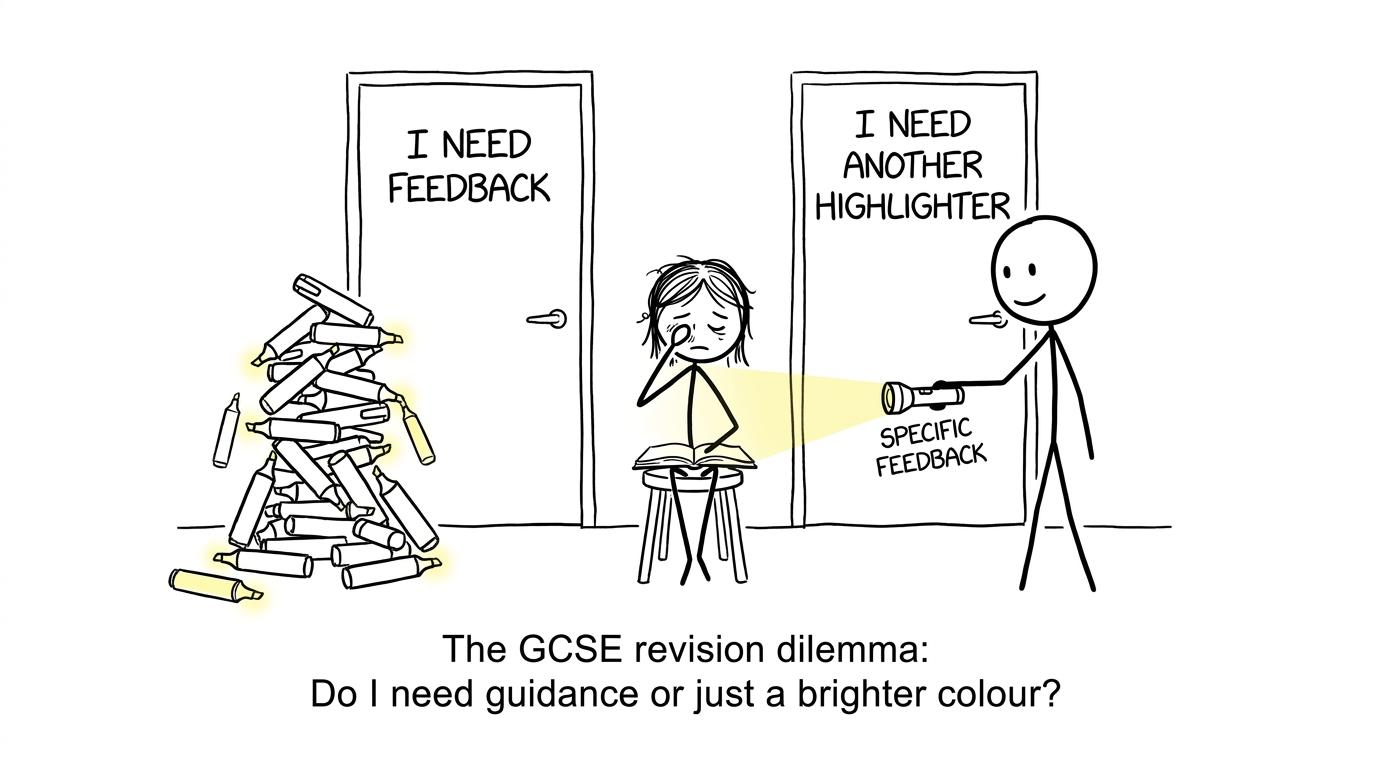 A student deciding between specific feedback and another highlighter
What GCSE English Literature actually assesses
English Literature is not primarily a test of how many quotations you can recite. Across GCSE specifications in England, the shared assessment objectives reward your ability to:
- read, understand and respond to literary texts;
- support interpretations with textual references and quotations;
- analyse language, form and structure;
- understand relationships between texts and their contexts;
- communicate clearly and accurately where written accuracy is assessed.
The exact papers, texts, timings and distribution of marks vary between AQA, Edexcel, OCR and Eduqas. English Literature is also untiered, unlike GCSE maths, so there is no foundation or higher paper. Check your own specification and school guidance rather than using advice intended for another board.
A useful tutor should translate these broad objectives into visible improvements. For example, they might notice that you understand a character but retell the plot instead of analysing the writer's choices. That diagnosis is much more valuable than simply telling you to “add more detail”.
Signs that a tutor could genuinely help
You cannot turn ideas into an argument
You may know the plot, themes and characters yet struggle to produce a focused answer. Your paragraphs contain relevant information, but they do not build a clear interpretation of the question.
A strong tutor can help you plan an argument, select evidence and make each paragraph advance the same central idea. The aim is not to impose a rigid paragraph formula. It is to make your reasoning easier for an examiner to follow.
Your feedback is not becoming action
Comments such as “analyse more” or “link to the question” can feel frustratingly broad. A tutor may help by comparing your response with the assessment objectives and identifying the precise sentence where explanation stopped too early.
This resembles effective maths revision. You do not improve merely by learning that an answer is wrong; you need to find the step that failed. MathsGenie's guide to using mark schemes as active feedback shows the same principle in another subject: attempt, diagnose, repair and retest.
Timed essays are much weaker than homework
If your homework is thoughtful but timed responses become unfinished or unfocused, the gap may be exam technique rather than literary understanding. A tutor can help you decide how long to plan, how to prioritise ideas and when to move on.
However, improvement still requires timed writing away from the lesson. Watching someone explain essay technique is not the same as producing an answer while the clock is running.
You have a gap in teaching or confidence
Absence, a change of school or difficulty accessing classroom support can leave gaps in knowledge. Focused tuition may rebuild the missing foundations without making you repeat everything you already understand.
Confidence matters too, but useful confidence grows from evidence. You should gradually become more able to plan independently, attempt unfamiliar questions and explain why a response meets the assessment objectives.
When a tutor may not be the best answer
A tutor cannot replace reading the set texts, completing essays or listening to your classroom teacher. Tuition may offer poor value when:
- you rarely complete independent practice;
- you want model answers to memorise rather than skills to apply;
- you have not used the feedback already available;
- sessions would remove time from a more urgent subject weakness;
- stress, sleep or workload is the main obstacle;
- you already understand what to do but avoid doing it.
GCSE revision always involves opportunity cost. An extra hour of English tuition is an hour unavailable for algebra, science or rest. Use a realistic GCSE maths revision timetable to see where tuition would fit before adding another weekly commitment.
If organisation is the problem, a structured one-month GCSE revision plan can help you build a repeatable routine. The subjects differ, but the rhythm transfers well: retrieve knowledge, practise under realistic conditions, check feedback and revisit weaknesses.
Try a diagnostic period before paying for tuition
Give yourself two weeks of deliberate practice before deciding. Choose one recurring weakness, such as weak introductions, limited analysis or unfinished responses.
During the two weeks:
- ask your teacher to identify one priority;
- complete two timed responses or substantial essay sections;
- use the correct exam-board materials;
- review each response against feedback or the mark scheme;
- rewrite the weakest part;
- compare the second attempt with the first.
Keep the test narrow. If you try to improve quotations, context, structure, timing and vocabulary at once, you will not know what caused any progress.
This is similar to using active recall for GCSE revision: attempting something from memory reveals more than repeatedly reading notes. If your English work improves once practice becomes consistent, you may not need a tutor. If the same obstacle remains and you cannot diagnose it alone, tuition becomes a more reasonable next step.
What to look for in a GCSE English Literature tutor
Knowledge of your board and texts
Ask whether the tutor has recent experience with your exam board and the texts you study. AQA, Edexcel, OCR and Eduqas do not organise every paper in the same way. Generic advice can be useful, but paper-specific preparation requires accurate knowledge of the relevant specification and mark scheme.
The tutor should also distinguish English Language from English Literature. Strong creative writing instruction does not automatically demonstrate expertise in Shakespeare, poetry comparison or literary analysis.
Diagnostic feedback rather than polished speeches
A good tutor should spend time examining your writing. They should be able to explain:
- what you already do well;
- which weakness matters most;
- how the weakness affects the response;
- what you should practise before the next session;
- how progress will be checked.
Be cautious if most of the lesson consists of the tutor talking while you copy notes. The student must do the difficult thinking.
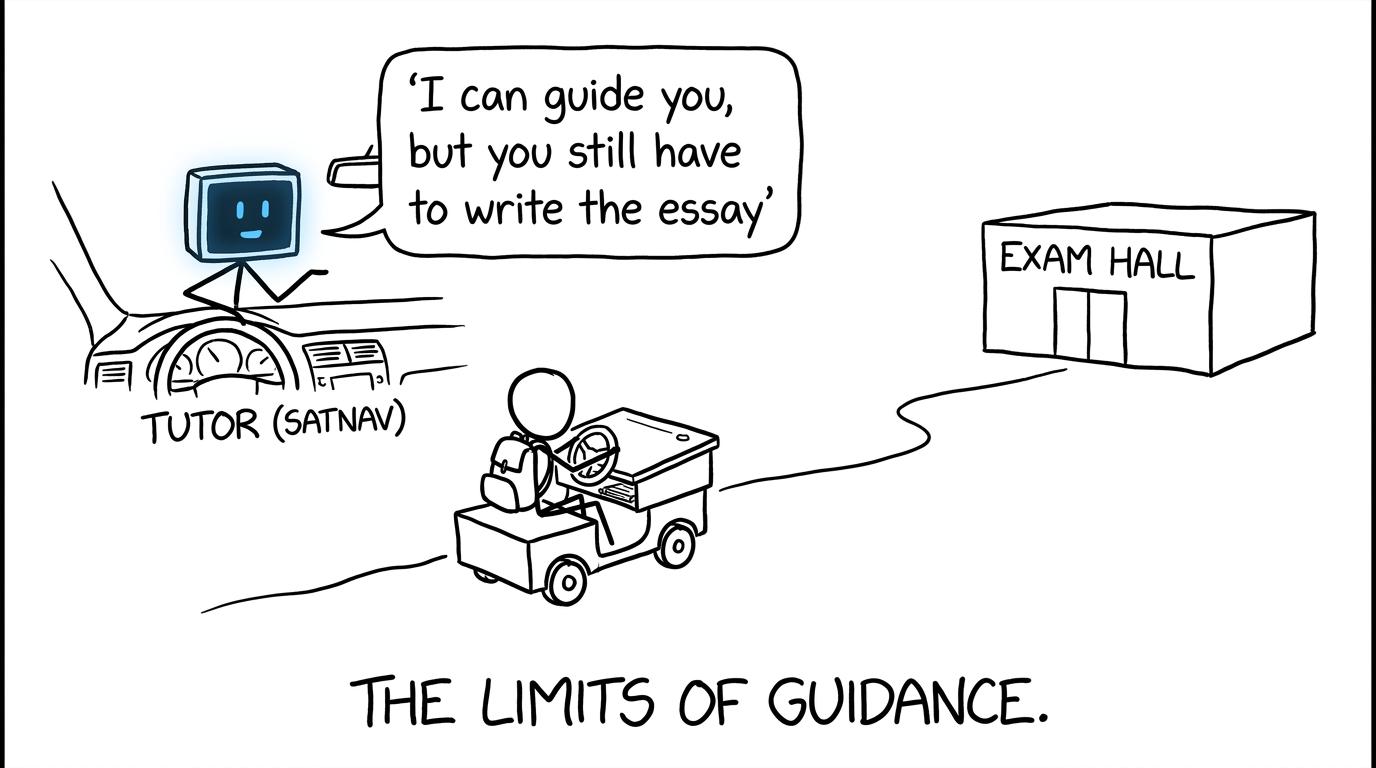 A tutor satnav reminding a student that they still have to write
Independence as the final goal
Effective tutoring should gradually make the tutor less necessary. You should become better at planning, selecting evidence, evaluating your own writing and responding to unfamiliar questions.
Ask a prospective tutor what success would look like after six sessions. A credible answer should describe observable skills, not promise a particular grade. No tutor can guarantee an exam result.
Clear safeguarding arrangements
A parent or carer should be involved in selecting and arranging a tutor. Tutoring organisations and independent tutors should take appropriate safeguarding steps, including references and relevant criminal-record checks. Parents and carers should ask what checks have been completed, see appropriate documentation, and agree boundaries for communication and lessons.
For online tuition, clarify which platform will be used, whether sessions are recorded and how messages or files will be shared. For in-person tuition, lessons should take place in an appropriate, observable setting. A certificate is useful evidence at a particular time, but it is not a substitute for references, professional boundaries and ongoing parental oversight.
A trial with clear measures
Agree a short trial rather than assuming tuition must continue until the exam. At the beginning, record two or three goals.
| Goal | Evidence of progress |
|---|---|
| Build a clear argument | Plans and essays maintain one defensible interpretation |
| Improve analysis | Comments explain how specific choices create meaning |
| Manage time | Responses are completed within the agreed limit |
| Use evidence effectively | Quotations are selected and integrated purposefully |
Review the evidence after several sessions. Feeling more comfortable is welcome, but written work should also show change.
Questions to ask before the first lesson
A short conversation can reveal whether the tutor's approach matches your needs. Ask:
- Which GCSE English Literature boards and texts do you teach?
- How will you diagnose weaknesses in my current essays?
- Will I write during lessons, between lessons or both?
- How do you use assessment objectives and mark schemes?
- How will you monitor progress?
- What qualifications, references and safeguarding checks can you provide?
- What happens if the teaching style is not a good fit?
You can also ask for a sample lesson plan or an explanation of how the tutor would respond to an anonymised piece of work. You are looking for specificity, accuracy and a calm willingness to adapt.
Common mistakes when choosing a tutor
Choosing on grade promises
A promised grade is not proof of teaching quality. Results depend on the student's starting point, attendance, practice, school support and exam performance. Choose a tutor based on their process and professional credibility.
Hiring before identifying the weakness
“Get better at English” is too vague. Begin with evidence from essays, mocks and teacher feedback. Without a diagnosis, tuition can become expensive general revision.
Treating more notes as more learning
Large folders can create the feeling of progress without improving performance. Literature requires recall, interpretation and writing. The relevant question is not how many resources you own, but what you can produce independently.
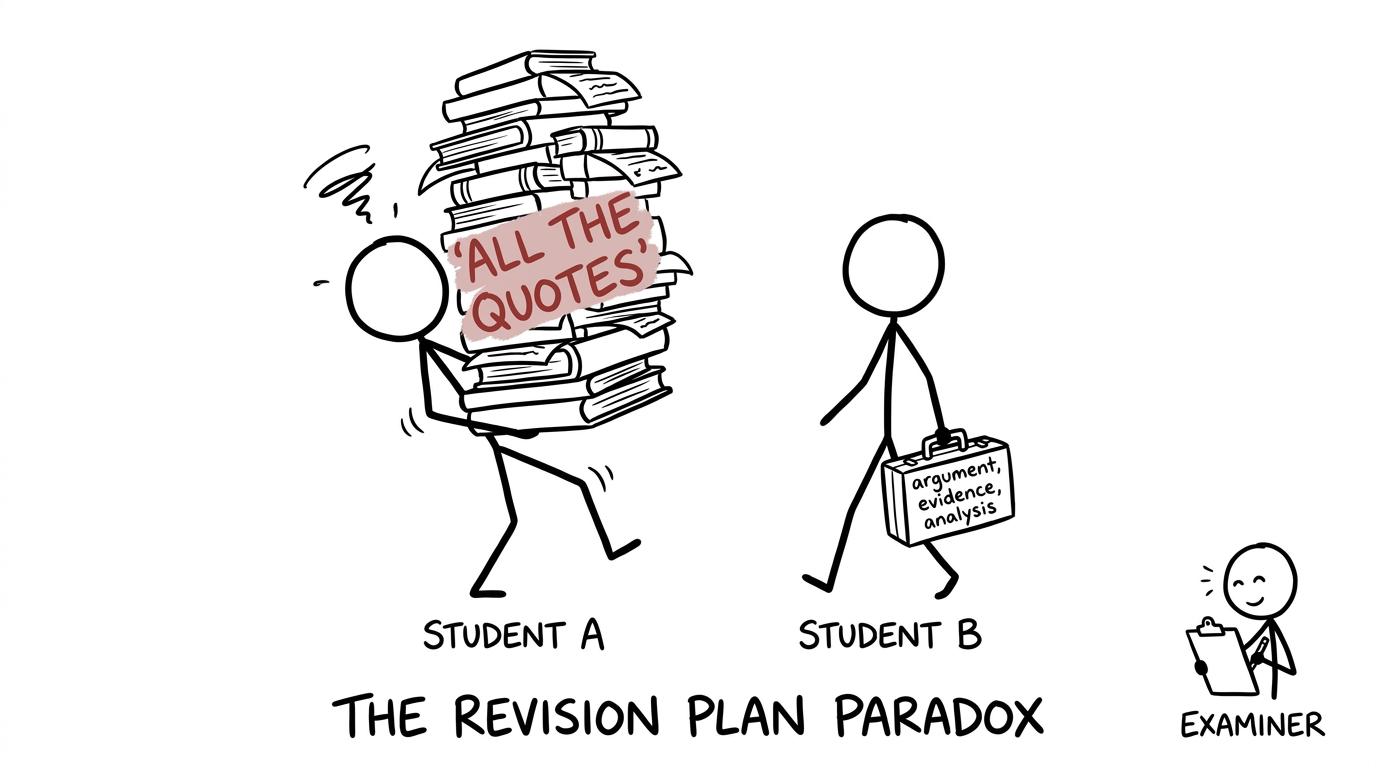 Two revision strategies: all the quotations versus a small analytical toolkit
Ignoring the rest of the revision timetable
English tuition should not destabilise your maths preparation. Keep using the GCSE maths revision hub for topic lessons and practice questions, then build exam familiarity through Edexcel GCSE maths past papers or the appropriate board section.
Nearer the exams, GCSE predicted papers can provide fresh maths practice, while the GCSE exam-week checklist can help you protect sleep, timing and sensible priorities across subjects.
Expecting the tutor to do the work
A tutor can point to the gap. They cannot close it without your participation. If you do not read, plan, write and revise between sessions, even excellent teaching will have limited effect.
Make the decision from evidence, not panic
The best reason to get a GCSE English Literature tutor is not that somebody else has one. It is that you can identify a persistent barrier, explain why ordinary revision has not removed it and see how focused tuition would help.
Start with teacher feedback and a short diagnostic period. If you choose tuition, look for exam-board knowledge, precise feedback, safeguarding, active student practice and a plan for independence. Review progress rather than continuing automatically.
Then keep the rest of your GCSE preparation balanced. MathsGenie gives you free revision lessons, practice questions, mini tests, past papers, predicted papers, mark schemes and video solutions, all organised through the GCSE maths revision centre. Choose one weak maths topic today, practise it and turn every lost mark into your next action.