GCSE English Literature Grade: Sixth Form Entry
GCSE English Literature grade sixth form entry rules vary. Learn when Literature matters, when Language matters more, and what to check before applying.
The worry often arrives when revision time already feels scarce. Your English Literature grade is uncertain, you want to study maths or science, and suddenly one result appears capable of closing every door.
If you are searching for gcse english literature grade sixth form entry guidance, the short answer is reassuring: most sixth forms and colleges do not treat English Literature as a universal standalone requirement. English Language, maths, your overall GCSE profile and the grades required for your chosen courses usually carry more weight.
But Literature is not irrelevant. It can count towards a general GCSE total, affect an average grade calculation and become important for English Literature or another essay-heavy A Level. Each institution sets its own admissions criteria, so its current prospectus is the final authority.
The quick answer: how much does Literature matter?
Use this checklist before worrying about one grade:
- Usually low weight: when applying for A Level Maths, Further Maths or many science courses, provided you meet the institution's general English requirement.
- Moderate weight: when your best GCSE grades are averaged or you need a specified number of passes.
- High weight: when applying for A Level English Literature or a course that explicitly names Literature.
- Potentially decisive: when a selective sixth form uses your complete GCSE profile to rank applicants.
- Never assume: some institutions accept English Language or Literature for general entry, while others insist on English Language.
Your task is not to discover one national rule. There is no single admissions rule covering every sixth form and college. Your task is to read the exact requirements for each place and course on your list.
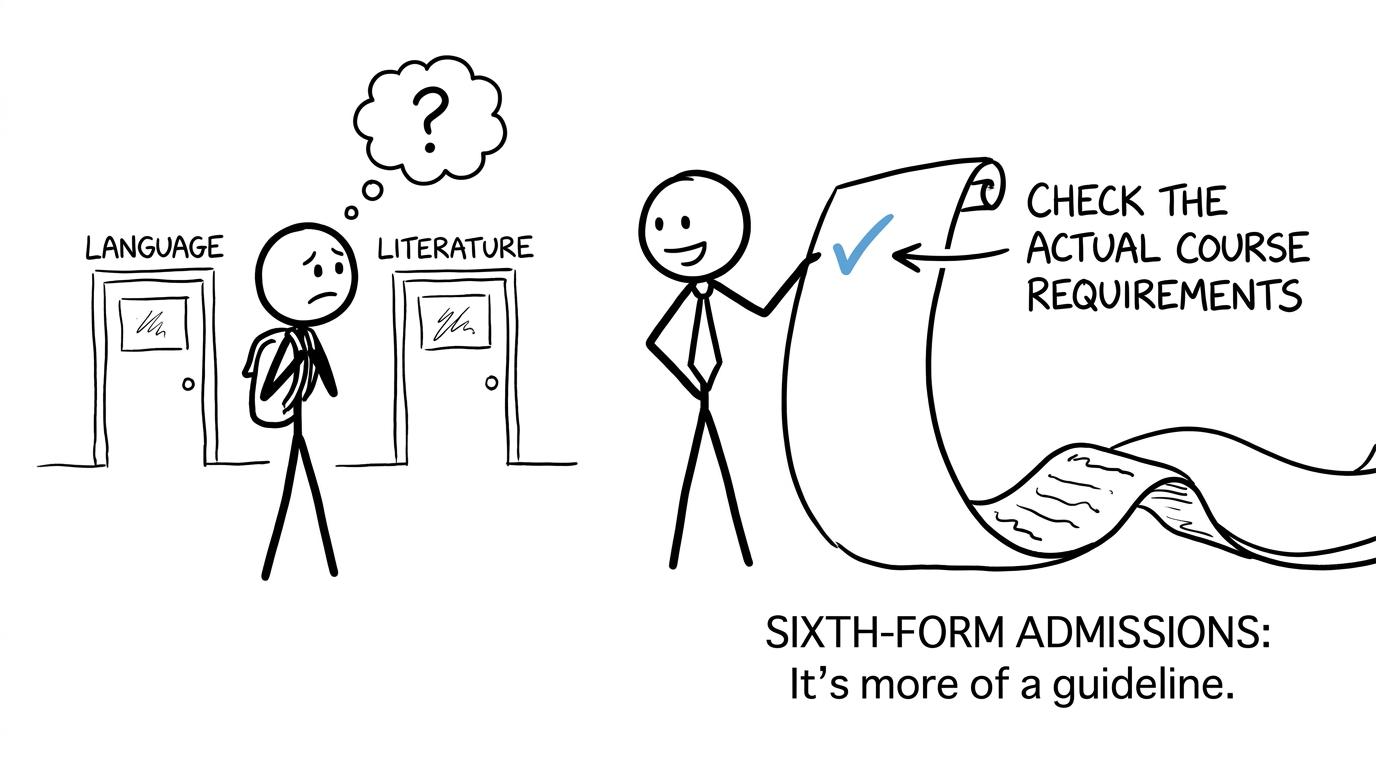 A student discovers that the actual entry requirements matter more than guessing
English Language and Literature are treated differently
Students often hear that they need to “pass English”, but that phrase can hide an important distinction.
English Language is commonly named in general sixth-form and college entry requirements because it is used as evidence of literacy. Many institutions ask for at least grade 444 or 555 in English Language, alongside a specified maths grade and a broader set of GCSE results.
English Literature is more variable. A sixth form might:
- accept Language or Literature as its general English pass;
- require Language specifically but count Literature among the other GCSEs;
- include Literature in a best-eight average;
- demand a particular Literature grade for A Level English Literature;
- use either English qualification for selected essay-based subjects.
This variation is visible in current admissions information published by UK schools and colleges. Some explicitly require English Language for Level 333 study, while others accept English Language or English Literature. Subject-specific criteria then add another layer.
The government funding rule is not an admissions rule
There is a useful distinction here. Under the Department for Education's 2025-26 maths and English condition-of-funding guidance, a student with grade 444 or above in either GCSE English Language or GCSE English Literature at Key Stage 444 meets the English element of that funding condition.
That does not force every sixth form to offer that student a place. Admissions policies remain local, and an institution may still require English Language or set higher grades for particular programmes.
Think of the funding condition as a national rule about continued English study. Think of an entry requirement as the institution's decision about readiness for its courses. They overlap, but they are not identical.
When your GCSE English Literature grade carries real weight
You want to take A Level English Literature
This is the clearest case. Many sixth forms ask for grade 555, 666 or higher in GCSE English Literature, sometimes together with a minimum English Language grade. More selective institutions may set a higher threshold.
The reasoning is straightforward: A Level Literature develops the same broad family of skills at greater depth, including close analysis, structured argument, comparison and extended writing. Your GCSE result becomes direct evidence of preparation.
Always check whether the requirement names Literature alone, both English qualifications, or either one. Similar-looking courses can have different criteria.
Literature is included in your overall GCSE profile
A lower Literature grade can matter even when it is not a named condition. Some sixth forms require a certain number of GCSEs at grades 999 to 444, 999 to 555 or above. Others calculate an average from your best seven or eight results.
Where an average is used, the basic structure is:
average grade score=sum of included grade scoresnumber of included GCSEs\text{average grade score}=\frac{\text{sum of included grade scores}}{\text{number of included GCSEs}}average grade score=number of included GCSEssum of included grade scoresWhether Literature enters that calculation depends on the admissions policy and which results are included. A strong Literature result may quietly support your application; a weaker one may have little effect if only your best grades count.
You are applying for an essay-heavy subject
Subjects such as history, politics, law, philosophy, psychology or sociology may use an English grade as evidence that you can interpret information and communicate a sustained argument. Some institutions name English Language, some accept Language or Literature, and others set no additional English criterion beyond general entry.
The course page matters more than the subject name. Never assume that every college treats an essay-based subject in the same way.
Places are oversubscribed
Meeting minimum requirements does not always guarantee admission. A published admissions policy may use average GCSE scores, subject grades or other stated oversubscription criteria to rank eligible applicants.
In that situation, Literature can matter as part of the whole profile without being a formal barrier by itself. This is one reason “they do not require Literature” and “Literature does not matter at all” are not quite the same statement.
What matters if you want to study A Level Maths?
For A Level Maths, your GCSE Maths result normally carries far more direct weight than English Literature. Current sixth-form requirements commonly set a specific maths threshold, often grade 666 or 777, while Further Maths frequently requires grade 777, 888 or higher. Exact standards vary.
You must still satisfy the institution's general entry conditions. That may include:
- a minimum English Language grade;
- English Language or Literature at a stated grade;
- a specified number of GCSE passes;
- an average score across your strongest results;
- separate requirements for a four-A-Level programme.
A disappointing Literature result is therefore unlikely to block A Level Maths on its own if your maths result is strong and you satisfy the general English rule. But do not let reassurance become an excuse to ignore the published criteria.
If A Level Maths is your aim, start with the GCSE Maths revision hub and identify the grade your preferred sixth forms actually require. Edexcel students can use the Edexcel GCSE Maths revision pathway, while the AQA GCSE Maths past papers and OCR GCSE Maths past papers keep practice aligned with the correct exam board.
How to check your sixth-form entry position
Rumours travel quickly in Year 111111. Admissions policies are less dramatic, but much more useful.
Read the general and subject-specific requirements
Check both. The general criteria tell you whether you qualify for the programme; the subject criteria tell you whether you can take your chosen courses.
Look for wording such as:
- “English Language”;
- “English Language or Literature”;
- “English”;
- “five GCSEs at grade 444 or above”;
- “best eight GCSE average”;
- “subject-specific requirements also apply”.
If “English” is not defined, ask the admissions team whether Literature is accepted. Get clarification in writing where possible.
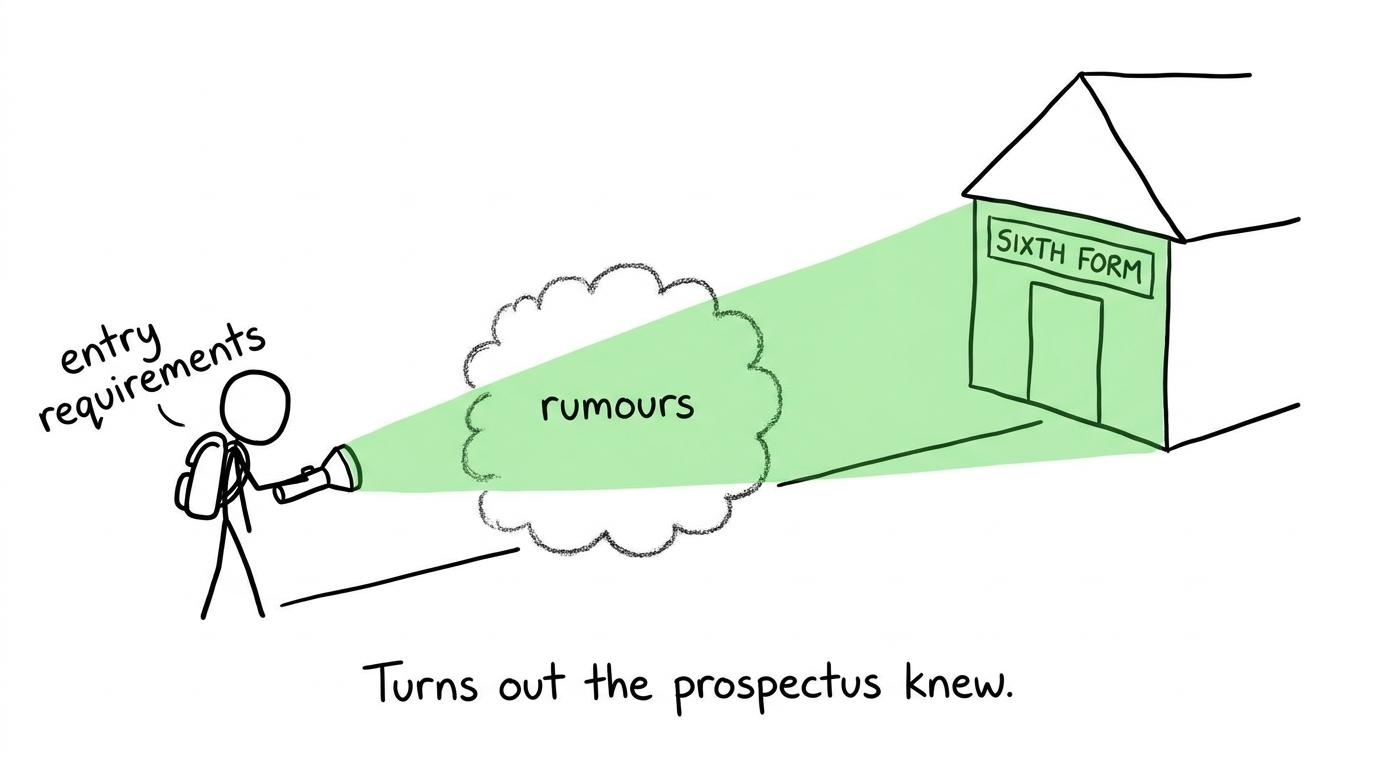 A student uses entry requirements to see through a cloud of rumours
Check the correct entry year
Entry criteria can change. Use the prospectus or admissions policy for the year in which you intend to start, not a screenshot from an older year or a requirement remembered by a former student.
Also distinguish between predicted-grade offers and final enrolment. Applications may use predicted grades, but places are commonly conditional on your eventual GCSE results and the published policy.
Compare several realistic options
One institution's rule is not the rule everywhere. Build a shortlist containing ambitious and secure choices, then record:
- the general GCSE profile required;
- the accepted English qualification;
- the GCSE Maths grade needed;
- each subject-specific threshold;
- what happens if a grade is narrowly missed;
- whom to contact for clarification.
This turns a vague fear into a finite list of conditions.
Protecting maths revision without neglecting English
The danger is not caring too much about Literature. It is allowing uncertainty about one subject to disrupt every subject.
Revision works best as a portfolio. Give time according to the marks available, your current weaknesses and the grades required for your next step. If A Level Maths needs grade 777 and your current maths work is around grade 555 or 666, that gap deserves deliberate attention. The guide to what a grade 5 in GCSE Maths means can help you plan the next move.
Use short, repeatable sessions rather than letting one anxious evening become an unfocused marathon. A realistic GCSE maths revision timetable can organise topic practice around English, science and your other subjects. If exams are close, follow a one-month GCSE Maths revision plan rather than attempting to revise everything at once.
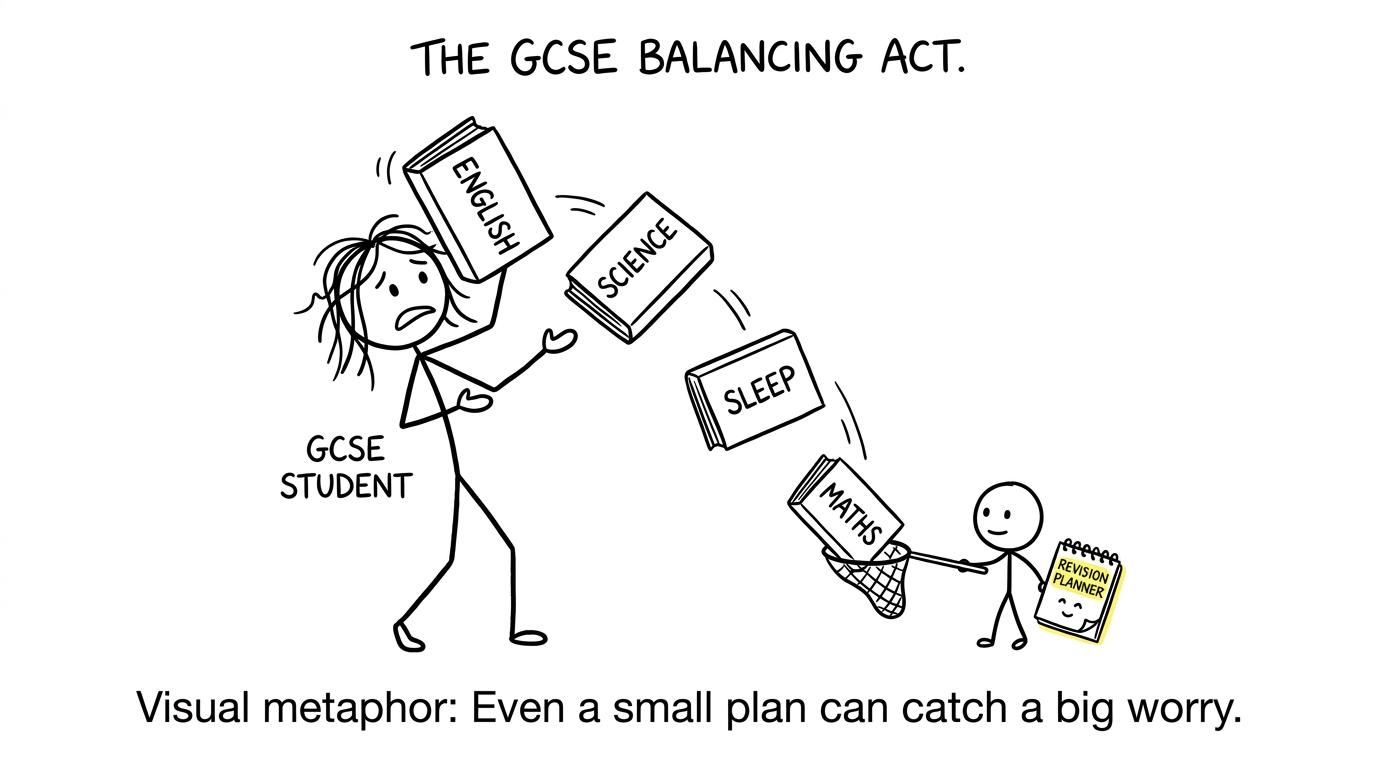 A revision planner rescues a falling maths book from an overloaded student
A sensible maths cycle is simple:
- diagnose weak topics with a mini test or paper;
- revisit the relevant revision lesson;
- complete targeted practice questions;
- mark the work using the mark scheme;
- watch a video solution where the method is unclear;
- repeat the question type later without help.
If you feel stuck around the pass threshold, use the focused advice in GCSE Maths revision when you are stuck at a pass grade. The aim is not to choose between English and maths. It is to give each subject the attention its entry requirement and your current performance justify.
Common mistakes when judging the importance of Literature
Assuming grade 444 is a universal sixth-form requirement
Grade 444 is an important benchmark, but institutions may ask for grade 555, 666 or higher. Selective programmes and individual A Levels can set considerably stronger conditions.
Treating Language and Literature as interchangeable
They are separate GCSE qualifications. Some admissions policies accept either; others explicitly require Language. Read the exact noun after “English”.
Looking only at the A Level Maths requirement
A grade 777 in GCSE Maths may satisfy the subject condition while a missing general English requirement still affects entry. Check both levels of the policy.
Believing one weaker result ruins the application
Sixth forms often consider a wider GCSE profile. A Literature grade may be one result among several, particularly where the institution counts passes or uses your strongest grades.
Revising according to panic rather than evidence
Do not abandon Literature because someone says it never matters, and do not sacrifice maths because someone says every English grade is decisive. Use the requirements, predicted grades, teacher feedback and practice-paper evidence.
Your next step
Your GCSE English Literature grade can matter, but its weight depends on context. It is usually most important for A Level English Literature, essay-heavy courses, overall grade profiles and selective admissions. For A Level Maths, your maths grade and the institution's general English condition will normally be more direct factors.
Check the latest policy for every sixth form or college you are considering. Then return your attention to the part you can control: the work in front of you.
MathsGenie gives you that structure for free. Choose your board and tier, use revision lessons and practice questions to repair weak topics, then test yourself with mini tests, past papers and predicted papers. Mark every attempt carefully with the mark schemes and video solutions. If A Level Maths is the destination, you can later continue with the Edexcel A Level Maths past papers.
An entry requirement is not a verdict. It is a target, and clear targets make better revision possible.