GCSE English Literature Grade Boundaries Explained
GCSE English Literature grade boundaries explained: discover why raw marks change yearly, how grades are set and how to interpret past boundaries.
A mark can feel wonderfully definite. You earned it, wrote it at the top of the paper and perhaps converted it into a percentage. Yet the grade beside that mark can change from one exam series to another.
Here are GCSE English Literature grade boundaries explained simply: your raw marks are added together, then compared with boundaries set for your exact exam board, specification and series. Those boundaries are finalised after the papers have been taken and marking is nearly complete. They can move because the difficulty of the assessment can vary, even when the standard represented by each grade is intended to remain stable.
So a percentage is useful information. It is not, by itself, a GCSE grade.
The short checklist
When interpreting an English Literature mark, check:
- your exam board, such as AQA, Pearson Edexcel, OCR or Eduqas;
- the correct specification code;
- the exact exam series and year;
- your total qualification mark, not just one paper;
- the official subject-level boundary;
- whether any paper-level figures are only notional boundaries;
- how far your mark sits above or below the relevant threshold.
The same principles apply when you check maths results. MathsGenie's guide to how GCSE grade boundaries work explains the wider system across GCSE subjects.
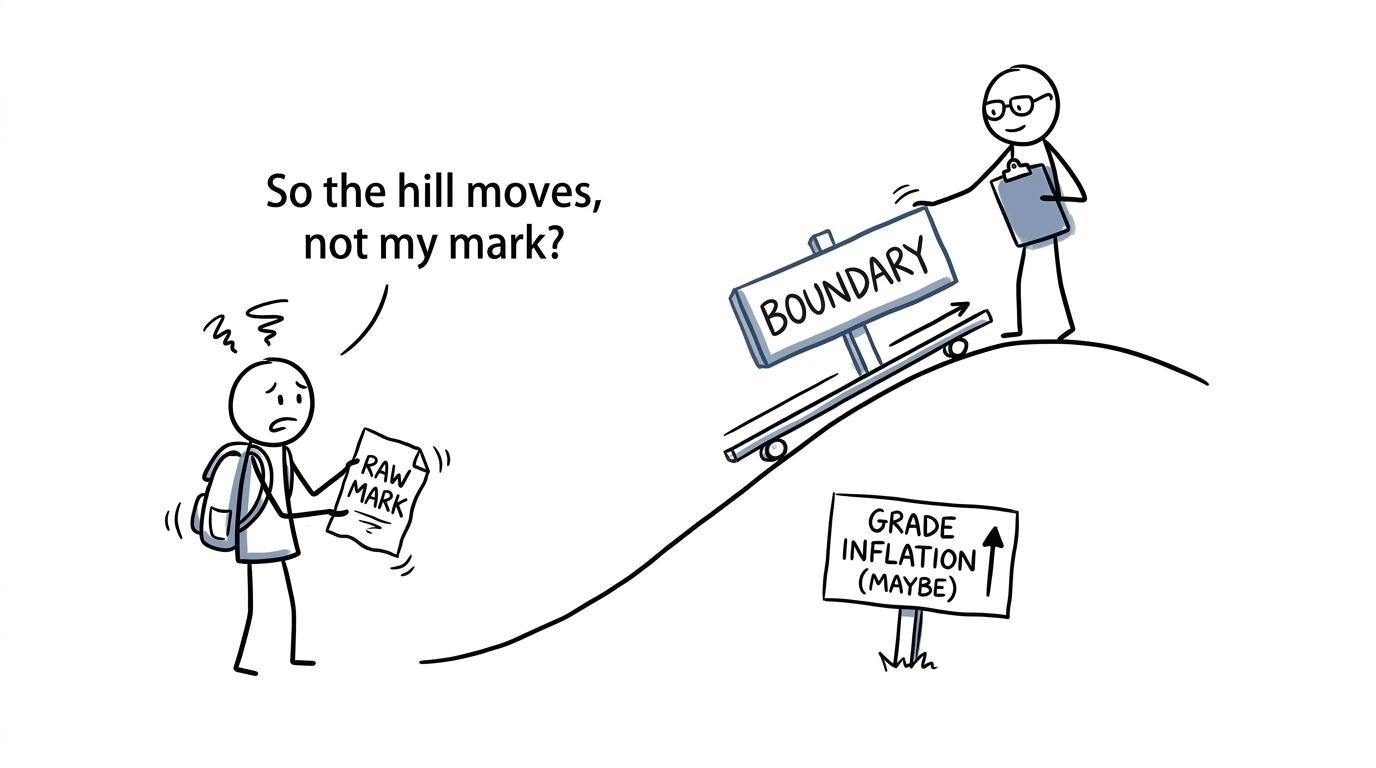 A student discovers that the grade boundary moves while the raw mark stays still
What is a raw mark?
A raw mark is the number of marks awarded by examiners using the mark scheme. If a response earns 181818 marks, its raw mark is 181818. Across a linear GCSE, the relevant component marks are combined, with scaling applied where a specification requires it, to produce the overall subject mark.
A percentage simply expresses that mark as a proportion of the available marks:
Percentage mark=raw markmaximum mark×100\text{Percentage mark}=\frac{\text{raw mark}}{\text{maximum mark}}\times 100Percentage mark=maximum markraw mark×100That conversion does not decide the grade. There is no universal rule saying that a particular percentage always equals grade 444, 777 or 999 in GCSE English Literature.
Instead, a grade boundary is the minimum total mark required for a grade in one particular assessment series. If your total reaches that boundary, you receive that grade. If it falls one mark short, it sits in the grade below unless a review changes the mark.
Why English Literature boundaries change each year
Exam boards design papers to be comparable in demand, but no two sets of questions behave identically. One paper might contain an extract that students find unusually accessible. Another may produce weaker responses because its wording, text selection or combination of tasks is more demanding.
Fixing the boundaries permanently would ignore those differences. If a paper proved harder but the same raw threshold remained, students would need to demonstrate a higher standard of work to receive the same grade. If it proved easier, the opposite could happen.
Boundaries therefore move to help maintain the meaning of the grade over time. In broad terms:
- a more demanding assessment may lead to lower raw-mark boundaries;
- a less demanding assessment may lead to higher boundaries;
- the direction and size of any movement are decided from evidence, not rumours about how the paper felt.
This does not mean an exam board simply chooses a percentage of students who must receive each grade. Ofqual's approach is intended to maintain standards. Statistical predictions provide a starting point, but senior examiners also examine the quality of actual student work around likely boundaries.
The practical lesson is modest but important: last year's boundary is evidence, not a promise. You can explore how figures have moved in MathsGenie's history of GCSE English Literature grade boundaries.
How exam boards set the boundaries
Grade boundaries are not normally finalised before students sit the examination. Once marking is nearly complete, awarding organisations consider several forms of evidence.
Statistical evidence
Exam boards analyse the distribution of marks and compare the performance of the current cohort with previous cohorts. Prior-attainment information can help indicate whether the group taking the qualification is broadly similar in ability to earlier groups.
This information is used at cohort level. It does not assign a predicted grade to an individual student, and it does not override the marks that student earned.
Examiner judgement
Senior examiners review samples of completed scripts around possible key boundaries. They compare the quality of the current work with evidence representing the expected standard from previous years.
The mark scheme, the question paper, marking data and the scripts all matter. A boundary is consequently an awarding judgement supported by evidence, rather than a percentage selected in advance.
Regulatory oversight
GCSEs offered in England are regulated qualifications. Exam boards must be able to justify their awarding decisions and show that standards have been maintained appropriately. Boundaries are then published on results day.
This process is why online boundary predictions should be treated cautiously. Before results day, nobody outside the awarding process can know the final thresholds.
What the latest completed boundaries show
As of August 2026, the latest completed summer series with published results is June 2025. The official tables show a useful contrast between AQA English Literature specification 8702 and Pearson Edexcel specification 1ET0. Both had a maximum qualification mark of 160160160, but their thresholds were not identical.
| Grade | AQA June 2025 | Pearson Edexcel June 2025 |
|---|---|---|
| 999 | 136136136 | 135135135 |
| 777 | 108108108 | 115115115 |
| 555 | 777777 | 878787 |
| 444 | 626262 | 737373 |
These figures should not be used to claim that one board was automatically easier. The boards use different papers, questions, mark schemes and assessment structures. The boundary only makes sense within its own specification and series.
The table also reveals why a bare percentage can mislead. A grade 444 did not correspond to one fixed percentage across both specifications. Even where two qualifications share the same maximum mark, their raw thresholds can differ.
 Two students discover that different exam papers can be different routes to the same standard
Overall boundaries and notional paper boundaries
GCSE English Literature is generally a linear qualification. Your certificate reports one subject grade based on the overall qualification mark.
Exam boards may also publish notional component boundaries for individual papers. These can help teachers understand performance, but they are illustrative. You do not receive a separate official GCSE grade for each English Literature paper.
This matters when your performance is uneven. A paper that appears to be around grade 666 using notional figures and another around grade 444 do not automatically combine into grade 555. Your component marks must first be combined correctly and compared with the overall qualification boundary.
Use the same discipline in maths. Add the marks across the required papers before checking the correct overall boundary. MathsGenie's comparison of Edexcel and AQA GCSE Maths boundaries shows why the exact board, tier and series matter.
How to use past boundaries without being misled
Past boundaries are most useful as a range for planning. They can show roughly where previous thresholds fell and help you interpret a completed past paper. They cannot tell you the boundary for an unseen future series.
A sensible approach is to aim above the highest recent boundary for your target grade rather than building a revision plan around scraping one historical threshold. The gap gives you some protection against normal boundary movement, marking mistakes and an unexpectedly difficult topic.
For maths revision, follow a repeatable cycle:
- complete the correct board and tier under timed conditions;
- mark it carefully with the official mark scheme;
- total all required papers before consulting the matching boundary;
- identify the topics responsible for lost marks;
- revisit a revision lesson and complete focused practice questions;
- retest the skill with a mini test or another paper.
MathsGenie's guide to using GCSE past papers properly develops this process. You can then practise with Edexcel GCSE Maths past papers, including mark schemes and solutions where available.
The timing matters too. The article on when to start GCSE past papers explains how to move from short diagnostic work to full timed papers. Nearer the examinations, use predicted material as fresh practice rather than as a guarantee of what will appear. MathsGenie's guide to GCSE predicted topics shows how to do that without guessing your way through revision.
Common mistakes when reading grade boundaries
Treating a percentage as a fixed grade
A percentage describes the proportion of marks earned. The published boundary converts the overall mark into a grade. Without the correct boundary table, the percentage does not settle the result.
Checking the wrong board or year
An AQA boundary cannot be applied to an Edexcel mark. A June boundary may also differ from a boundary in another series. Match the board, specification and date exactly.
Using one paper as the final grade
Paper-level boundaries may be notional. The official subject grade normally comes from the combined qualification mark.
Assuming a lower boundary means an easier standard
A lower raw boundary can reflect a more demanding assessment. Its purpose is not to make the qualification easier, but to maintain the expected standard of performance.
Predicting future boundaries too confidently
Comments after an examination reveal how some students felt, not the full national evidence. Final boundaries require completed marking, statistical analysis and expert review.
Turn uncertainty into useful revision
Grade boundaries feel mysterious when they are treated as predictions. They become more useful when treated as historical measuring lines.
Your raw mark records what happened on one paper. The boundary explains how that performance was classified in one series. Neither tells you that your next result is fixed.
For maths, the productive response is to build marks rather than repeatedly calculate the grade you hope they might become. Start at MathsGenie's free GCSE and A Level maths revision hub, choose your board and tier, and combine revision lessons with practice questions. Then use past papers, predicted papers, mini tests, mark schemes and video solutions to find weaknesses and correct them.
A boundary can move. Stronger methods, better checking and purposeful practice move your mark, and that is the movement you can control.