

GCSE Maths Results Day: Edexcel vs AQA Boundaries
GCSE maths Edexcel vs AQA grade boundaries compared using 2025 marks, with tier guidance, results-day context and smart revision advice for 2026.
Results day has a habit of making one number feel like the whole story. Yet when students search for GCSE maths Edexcel vs AQA grade boundaries, the most important answer is easily missed: a lower boundary does not mean an exam board is easier.
The latest complete summer comparison is from June 2025. Edexcel and AQA each awarded GCSE Maths from a total of 240240240 marks, but their boundaries differed because their papers differed. The 2026 boundaries will not be confirmed until results day on Thursday 20 August 2026.
The comparison at a glance
- Both qualifications had three papers worth 808080 marks each.
- Paper 1 was non-calculator; Papers 2 and 3 allowed calculators.
- Foundation tier offered grades 111 to 555.
- Higher tier offered grades 444 to 999, with an allowed grade 333 below the grade 444 boundary.
- Boundaries apply to the total across all three papers, not to each paper separately.
- June 2025 boundaries can guide revision, but they cannot predict 2026 results.
You can check every available series through the MathsGenie GCSE grade boundaries hub.
Edexcel vs AQA grade boundaries for June 2025
The table shows the minimum total raw mark needed for each grade. Every figure is out of 240240240.
| Exam board and tier | Grade 999 | Grade 888 | Grade 777 | Grade 666 | Grade 555 | Grade 444 | Grade 333 | Grade 222 | Grade 111 |
|---|---|---|---|---|---|---|---|---|---|
| Edexcel Higher | 217217217 | 186186186 | 156156156 | 121121121 | 878787 | 535353 | 363636 | N/A | N/A |
| AQA Higher | 219219219 | 191191191 | 164164164 | 130130130 | 969696 | 636363 | 464646 | N/A | N/A |
| Edexcel Foundation | N/A | N/A | N/A | N/A | 175175175 | 144144144 | 105105105 | 676767 | 292929 |
| AQA Foundation | N/A | N/A | N/A | N/A | 188188188 | 160160160 | 119119119 | 797979 | 393939 |
For the full historical records, visit the board-specific Edexcel GCSE grade boundaries and AQA GCSE grade boundaries.
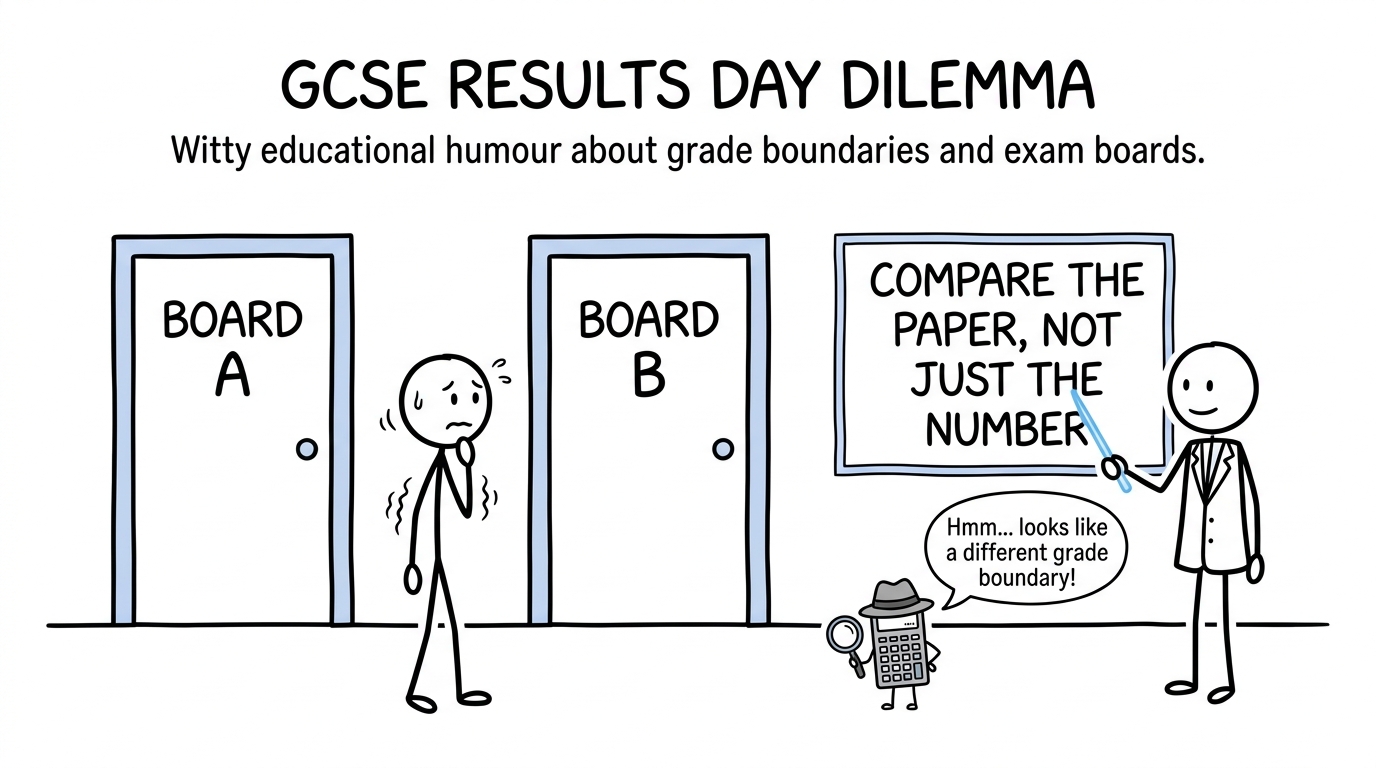 A student comparing exam boards while a calculator plays detective
What the differences actually mean
In 2025, AQA boundaries were higher at every comparable grade. On Higher tier, the AQA grade 777 boundary was 164164164, compared with 156156156 for Edexcel. On Foundation tier, grade 444 required 160160160 with AQA and 144144144 with Edexcel.
That does not prove AQA was harder to pass or Edexcel was more generous. Ofqual explains that boundaries vary to reflect how demanding students found the particular papers. If a paper proves more accessible, its boundary may rise; if it proves more demanding, the boundary may fall. Exam boards must cover regulated subject content and assessment objectives, while grading standards are intended to remain comparable.
A boundary is therefore a balancing mechanism, not a verdict on which board is best. Comparing the threshold without comparing the paper is like comparing finishing times from two different running routes.
How GCSE maths results are calculated
Your raw marks from the three papers are added together:
Total mark=Paper 1 mark+Paper 2 mark+Paper 3 mark.\text{Total mark}=\text{Paper 1 mark}+\text{Paper 2 mark}+\text{Paper 3 mark}.Total mark=Paper 1 mark+Paper 2 mark+Paper 3 mark.That total is matched against the overall qualification boundaries. Published paper-level boundaries are sometimes described as notional: they help with analysis, but they do not create three separate paper grades.
This matters on GCSE maths results day. A difficult Paper 1 does not independently cap your result. Stronger performances on Papers 2 and 3 can compensate because the final grade comes from the combined total.
What to expect on GCSE maths results day 2026
GCSE results may be released to candidates from 8 am8\text{ am}8 am on Thursday 20 August 2026, although your school or college will tell you its collection arrangements. Grade boundaries are published on results day after marking and awarding have been completed.
When you receive your result:
- confirm the exam board and tier;
- check the final grade before comparing marks online;
- use the boundary for the correct exam series;
- speak to your school if the result is unexpected;
- ask about available post-results options rather than relying on social-media estimates.
Being one mark below a boundary can feel enormous. Administratively, however, it does not mean a review will automatically add a mark. Your school should consider the marked work, the likelihood of a change and the possibility that marks can move down as well as up.
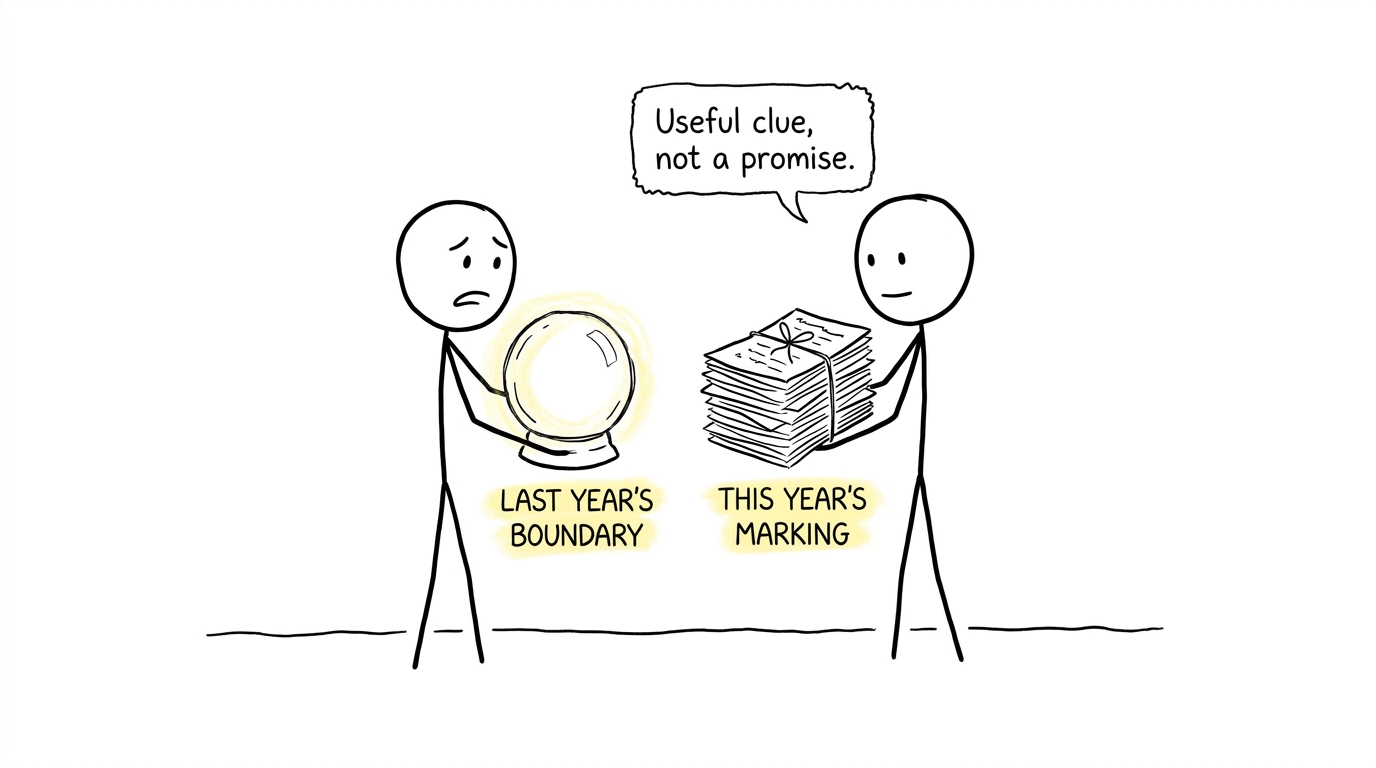 A student discovering that last year's boundary is a clue rather than a crystal-ball prediction
How to use boundaries during revision
Grade boundaries are useful for interpreting timed-paper results, but they make poor revision targets. Aiming for the exact historical threshold leaves no room for normal variation in paper difficulty, marking or performance.
Instead, complete papers from your actual specification. MathsGenie has dedicated Edexcel GCSE Maths revision and AQA GCSE Maths revision areas with lessons and practice questions for both tiers.
Then use this cycle:
- Sit an Edexcel GCSE Maths past paper or AQA GCSE Maths past paper under timed conditions.
- Mark all three papers with the correct mark schemes.
- Add the marks before consulting the boundary for that exact series.
- Record topics where marks were lost.
- Relearn those methods and retest them with GCSE Maths mini tests.
Past boundaries show where an earlier cohort’s grades fell. Your error log shows what you can improve next.
Common grade-boundary mistakes
Comparing different maximum marks
Edexcel and AQA were directly comparable in 2025 because both totals were out of 240240240. This is not true for every board or qualification, so always check the maximum mark.
Treating last year’s figures as predictions
Boundaries are set after papers have been marked. Historical ranges offer context, not a guaranteed target for the next series.
Looking at the wrong tier
Foundation and Higher have separate boundaries and grade ranges. A Foundation grade 555 threshold cannot be applied to a Higher paper score.
Adding notional paper grades
The qualification is awarded from the combined raw mark. Do not assign each paper a grade and average those grades.
Choosing a board because its boundaries look lower
A lower threshold normally reflects the demand of that board’s papers in that series. It is not evidence of an easier route to the same grade.
The takeaway
The 2025 figures show higher AQA thresholds than Edexcel thresholds, but the fair conclusion is not that one board was easier. Different papers require different boundaries so that grades represent comparable standards.
Before results day, focus on the part you can still influence: secure methods, careful working and repeated exam practice. Start with your board-specific MathsGenie revision area, complete past and predicted papers, use mark schemes and video solutions, then repair weak topics with practice questions and mini tests. The boundary is decided later. The marks are built now.











