

GCSE English Literature February Half-Term Revision
GCSE English Literature February half-term revision plan: sharpen quotes, essays and unseen poetry while protecting time for maths, sleep and a proper break.
February half-term can feel less like a holiday and more like a room full of competing demands. Shakespeare needs quotations. Poetry needs comparisons. Maths needs practice. Somewhere in the middle, you would also like a break.
A sensible GCSE English Literature February half-term revision plan does not attempt to finish the entire course in one week. Its purpose is narrower: identify the areas most likely to cost you marks, strengthen a small bank of textual evidence, practise planning and writing, and leave enough space for maths and rest.
By the end of half-term, aim to have:
- checked the exact texts and paper structure for your exam board;
- reviewed your principal characters and themes;
- built a manageable bank of short, flexible quotations;
- completed at least one timed response or substantial essay section;
- practised anthology comparison and unseen poetry;
- preserved several sessions for GCSE maths;
- decided what you will revisit after the holiday.
The week is a checkpoint, not your only revision window.
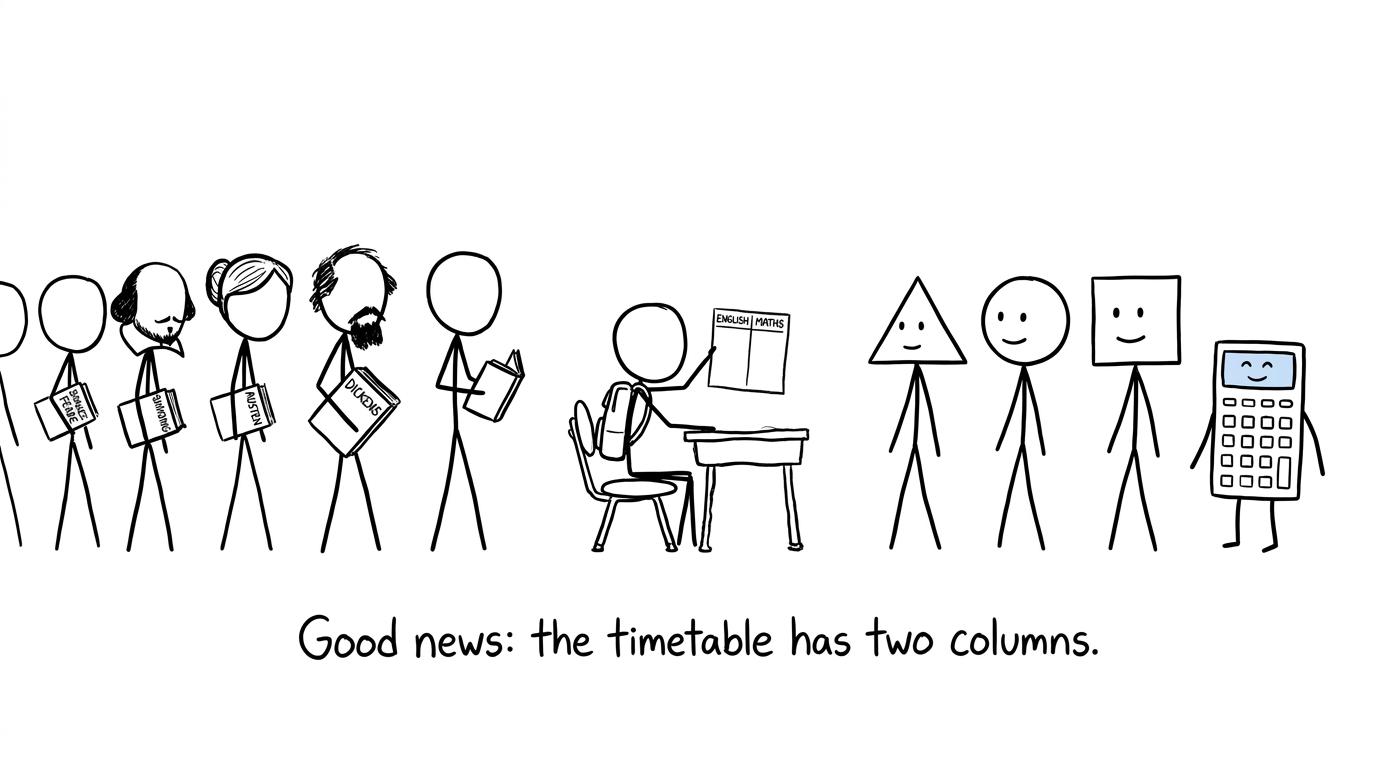 A student negotiates a balanced timetable between literature and maths revision
Start with your real English Literature course
GCSE English Literature is not identical across AQA, Edexcel, OCR and Eduqas. Paper lengths, question formats, set-text choices and the placement of assessment objectives vary. Before making flashcards, check your school’s exam board, specification and set texts.
Across GCSE English Literature specifications in England, students study substantial whole texts covering Shakespeare, a nineteenth-century novel, poetry and British fiction or drama from the twentieth century onwards. Examinations also include unseen material. The shared assessment objectives reward four broad abilities:
- AO1: understanding texts, developing an informed response and supporting ideas with textual references;
- AO2: analysing how language, form and structure create meaning and effects;
- AO3: understanding relationships between texts and their contexts;
- AO4: writing clearly and accurately where it is assessed.
That matters because quotation recall alone is not enough. A remembered line becomes valuable when it supports an interpretation and gives you something precise to analyse.
Check current instructions for your board rather than relying on advice written for another specification. For example, AQA currently uses two compulsory closed-book papers, while each board organises its components differently. Your teacher and official specification should determine what you practise.
The focused half-term plan
A useful week has three phases: diagnose, repair and test. This is the same logic that makes finding your weakest GCSE topics more effective than revising whatever feels comfortable.
At the beginning: diagnose before making notes
Spend the first session gathering evidence. Look at your latest mock, teacher feedback and marked essays. Make a short list under these headings:
- knowledge of plot, character and theme;
- quotation recall;
- analysis of language, form and structure;
- contextual understanding;
- comparison;
- essay organisation;
- timing and accuracy.
Choose no more than three priorities. “Revise Macbeth” is too broad. “Select evidence for changes in Macbeth’s character” is usable. “Improve poetry” is vague. “Plan comparisons between poems connected by conflict” gives you a task you can complete.
If you have no recent marked work, plan a response to an unused question without notes. Give yourself a short time limit, then compare the plan with your class materials and mark scheme. The parts you could not develop reveal where to begin.
In the middle: repair knowledge and writing
Use the central days for focused sessions rather than whole-day marathons. A productive literature block can contain:
- brief retrieval of quotations and key events;
- review of one character, theme or poem pairing;
- planning one exam question;
- writing one analytical paragraph or timed section;
- checking it against the relevant assessment objectives;
- recording one change for next time.
Alternate your set texts. One session might cover Shakespeare, followed later by the nineteenth-century novel. Another can pair the modern text with poetry. This reduces the risk of spending the entire holiday perfecting one text while ignoring the rest of the course.
The goal is not beautiful notes. It is faster access to useful ideas when a question appears.
Near the end: test what now works
Finish the week with one timed task. Depending on your weakest area, this might be a full essay, a substantial section of a response, an anthology comparison or an unseen-poetry task.
Marking matters more than simply reaching the final sentence. Ask:
- Did I answer the exact question throughout?
- Did each paragraph present an interpretation?
- Was my evidence concise and relevant?
- Did I analyse specific choices rather than retell the story?
- Did context illuminate the text rather than interrupt the argument?
- Did I leave enough time to reread the response?
Write two actions for the next attempt. Keep them observable, such as “analyse a structural choice” or “link every paragraph explicitly to the question”. This turns the task into preparation rather than judgement.
Build a quotation bank you can actually remember
Trying to memorise every impressive line is usually a poor use of half-term. Select short quotations that can support several themes, characters or relationships. Include evidence from different points in each text so that you can discuss development and structure.
For each quotation, record:
- who says it or where it appears;
- the theme or character it can support;
- one significant word, image or structural feature;
- how its meaning might change in another part of the text;
- a relevant contextual connection, where useful.
Retrieve before rereading. Cover the quotation, write what you remember, check it and return to it later. If exact wording will not stick, secure the key word and a precise reference to the moment. Assessment objectives ask for textual references, including quotations; they do not reward a page of memorised language with no argument.
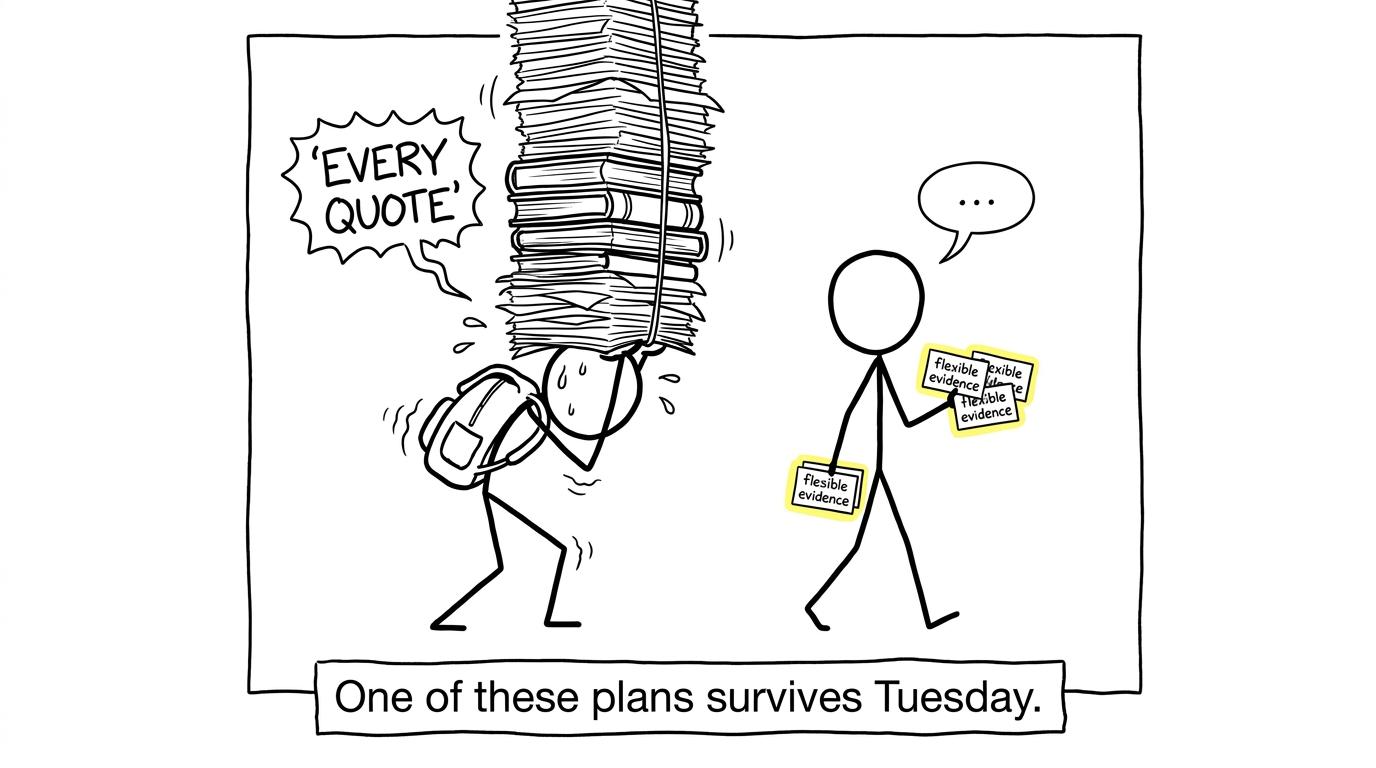 A huge quotation pile competes with five practical evidence cards
Practise essays without writing endless essays
Full responses are important, but they are not the only useful form of practice. Planning several questions can expose gaps more quickly than repeatedly writing about the same familiar theme.
For each plan, decide:
- your central argument;
- how the idea develops across the whole text;
- which moments provide the strongest evidence;
- which methods deserve analysis;
- where context genuinely changes the interpretation;
- how each paragraph will return to the question.
Then choose one plan to write under timed conditions. This combination gives you breadth without losing the depth of proper exam practice.
For poetry, organise comparisons around ideas and methods rather than learning one fixed partner for every poem. Your exam may name a poem you did not expect. You need a network of possible connections: shared themes, contrasting attitudes, different voices, structural decisions and alternative endings.
Unseen poetry deserves its own session because it tests transferable reading rather than memory. Practise forming an interpretation, selecting evidence and analysing patterns. Do not begin by hunting for the longest possible list of techniques. Meaning comes first; terminology helps you explain how that meaning is made.
Protect maths revision during an English-focused week
Half-term revision often fails because one urgent subject expands into every available hour. If maths is one of your priorities, reserve its sessions before English Literature fills the timetable.
Start with the GCSE Maths revision hub, select your exam board and work at the correct foundation or higher tier. A balanced pattern could include three English Literature blocks, three shorter maths blocks, one timed English task and one longer break across the week. Adjust the pattern around family plans, school work and your current needs.
For maths, keep the process compact:
- choose one weak skill;
- use a revision lesson to recover the method;
- complete focused practice questions;
- mark them immediately;
- record the error;
- retest the skill later.
The twenty-minute GCSE maths routine is useful when English has taken most of your concentration. If you have more time, use Edexcel GCSE Maths mini tests or the equivalent resources available through the main hub.
Do not complete a paper merely to say that you finished it. The guide to using GCSE past papers properly explains the valuable cycle: attempt, mark, diagnose, repair and retest. Save GCSE predicted papers for purposeful exam practice rather than treating predictions as a substitute for the specification.
If balancing subjects remains difficult, adapt the structure in the GCSE maths revision timetable. Fixed stopping times are particularly useful. They prevent one difficult English essay from quietly consuming the maths session that was meant to follow it.
Common mistakes during February half-term revision
Attempting to cover everything
A week is long enough to create momentum but too short to perfect every text. Choose the weaknesses that affect several questions, such as thin evidence, weak analysis or poor timing.
Producing notes without retrieval
Colourful summaries can feel productive because they are easy to continue. Close the book and test yourself. Revision becomes useful when knowledge can be recalled without the page in front of you.
Memorising quotations without interpretations
A quotation is evidence, not an argument. Attach each line to possible ideas, methods and moments elsewhere in the text.
Forcing context into every paragraph
Context should sharpen your reading. Avoid detached historical facts that do not explain the writer’s choices, ideas or likely concerns.
Ignoring unseen poetry
Set-text knowledge feels safer, so unseen work is easy to postpone. One focused session can establish a repeatable reading and planning process.
Letting English replace every other subject
An intensive week should not create a larger maths problem for March. Keep short, protected maths sessions and use MathsGenie’s one-month revision plan to connect half-term with the weeks that follow.
Revising until the work becomes unproductive
Rest is not a reward for completing the entire specification. It helps make tomorrow’s session possible. Decide when each block ends, take proper breaks and protect sleep.
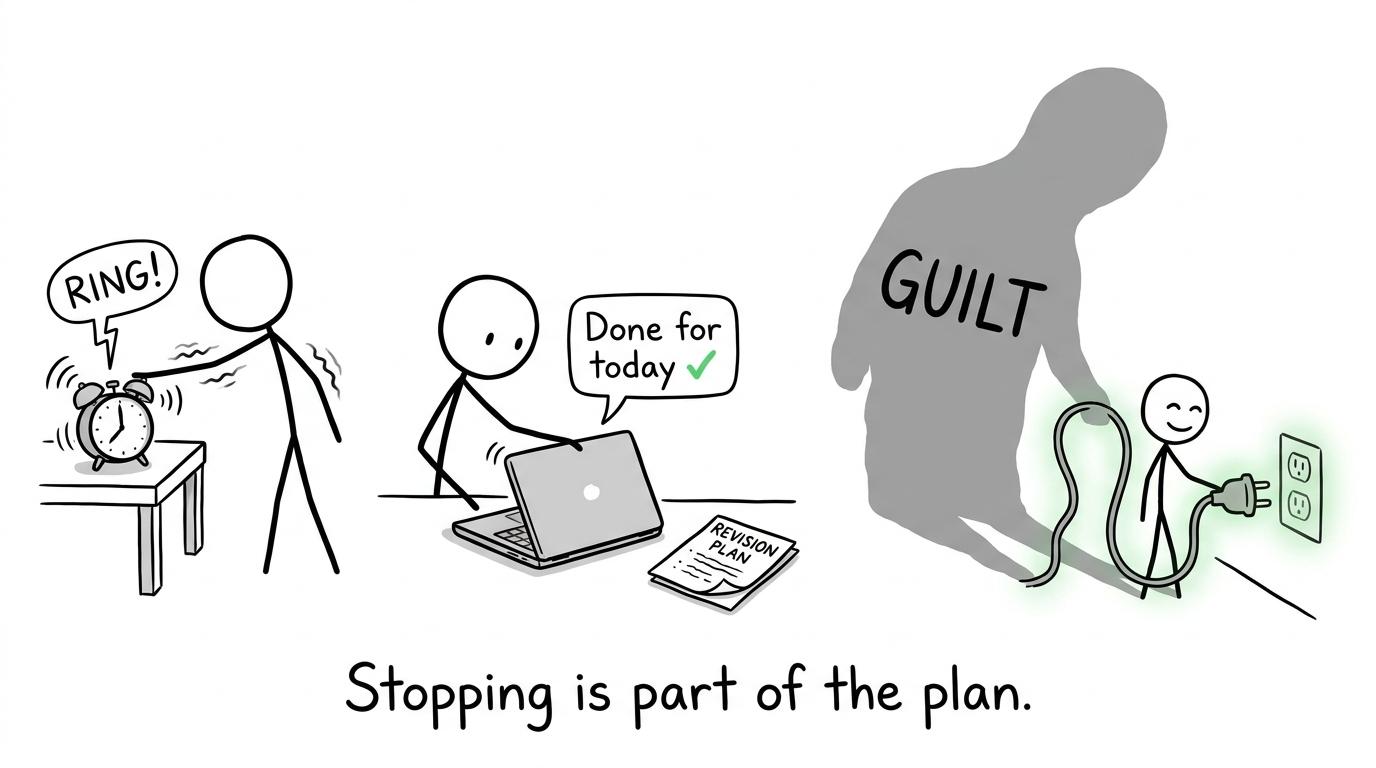 A revision plan switches off guilt at the end of the day
Make half-term the beginning of a repeatable system
The best outcome is not a folder that looks complete on Sunday evening. It is a smaller set of ideas you can retrieve, analyse and use under pressure, plus a clear list of what comes next.
After half-term, continue with one literature retrieval session, one planning or writing session and one poetry session each week where your timetable permits. Keep maths moving too. Use MathsGenie’s free revision lessons and practice questions to repair topics, mini tests to check progress, and past papers, mark schemes and video solutions to build exam technique. Closer to the examinations, predicted papers can add focused rehearsal.
February does not need to carry the weight of the whole exam season. Give the week a defined job, finish that job calmly, and let MathsGenie keep the maths side of your revision organised while you strengthen English Literature one deliberate session at a time.










