GCSE English Literature Exam Start Time Explained
GCSE English Literature exam start time explained: learn why 9.00 am is published, when to arrive and what happens before writing begins on the day.
A timetable can say “morning”, your school can ask you to arrive at 8.30 am, and your friend can insist the paper starts at 9.15 am. Suddenly, something as simple as the GCSE English Literature exam start time feels uncertain.
Here is the direct answer: for AQA, Pearson Edexcel, OCR and Eduqas examinations, the published start time for a morning session is normally 9.00 am. However, schools can start an examination up to 30 minutes earlier or later under JCQ rules. Your personal timetable and your school’s instructions therefore determine when you must arrive and when you will actually begin writing.
Most students should expect to arrive well before 9.00 am, enter the room, complete the formal checks and start writing only when the invigilator tells them to begin.
The exam start-time checklist
Before the morning of your English Literature paper, confirm all of the following:
- the examination date and whether it is Paper 1, Paper 2 or a component
- your exam board and paper code
- the arrival time stated by your school
- the room or seating location
- the scheduled duration of your particular paper
- any approved access arrangements
- whether you have another examination in the same session
- what your school requires you to do with your phone, watch and bag
Do not rely on a timetable screenshot from another school. Their centre may use a different exam board, specification or local start time.
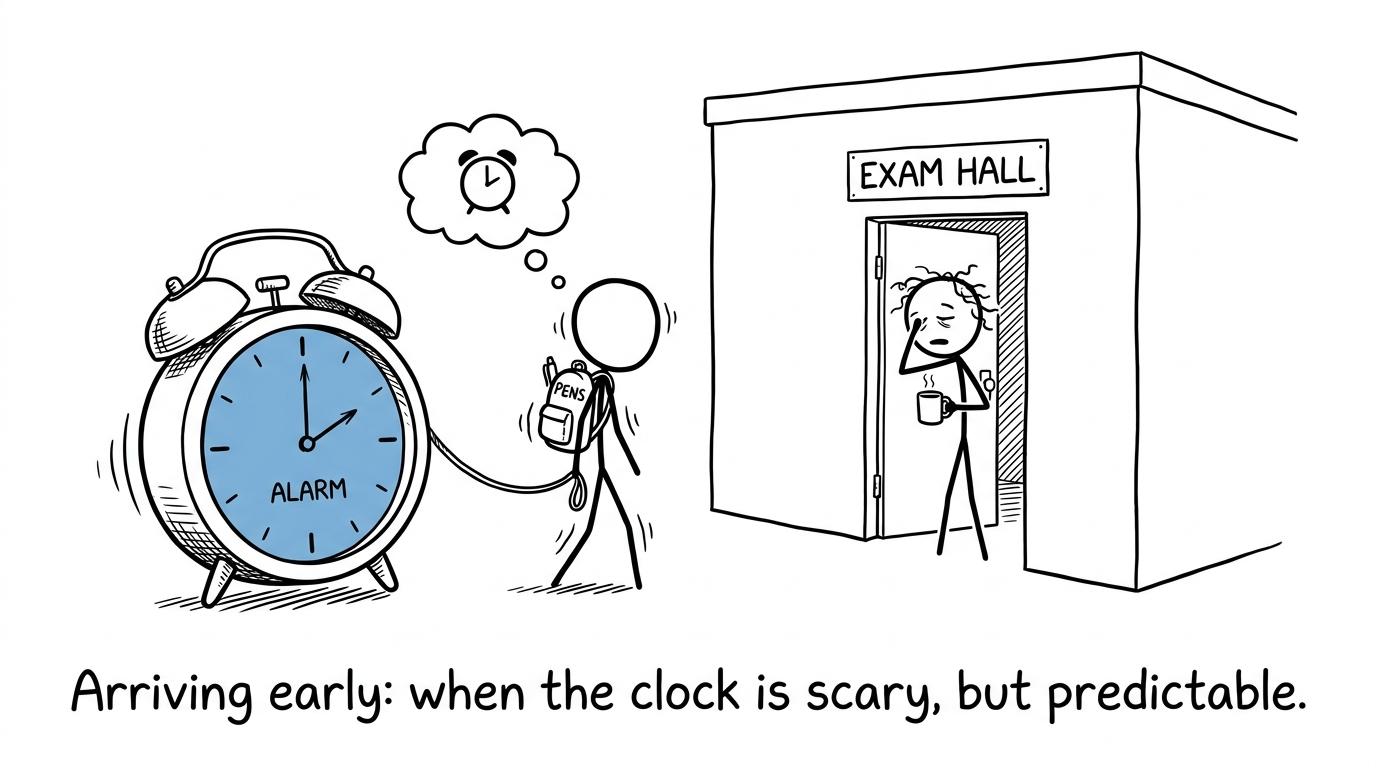 A GCSE student arrives early with an enormous alarm clock
What time is the GCSE English Literature exam?
The JCQ published session times for the 2025-26 examination year were:
| Session | Published start time | Permitted normal starting window |
|---|---|---|
| Morning | 9.00 am | 8.30 am to 9.30 am |
| Afternoon | 1.30 pm | 1.00 pm to 2.00 pm |
These are UK times. The separate published morning time for CCEA examinations is normally 9.15 am, with its corresponding permitted window beginning and ending 15 minutes later.
A school does not need prior permission simply to move a 9.00 am examination to 8.45 am or 9.15 am. That is why the official timetable might say “morning” while your candidate timetable gives a more specific instruction.
For the summer 2026 series, the final timetables for AQA, Edexcel, OCR and Eduqas placed their main GCSE English Literature papers or components in morning sessions on Monday 11 May and Tuesday 19 May. Durations differed by board: AQA and Edexcel listed durations of 1 hour 45 minutes and 2 hours 15 minutes, OCR listed two 2-hour papers, while Eduqas listed components of 2 hours and 2 hours 30 minutes.
Those details illustrate an important rule: the subject name alone is not enough. Check the current final timetable for your examination year, then match the board, specification and paper code against the timetable issued by your centre.
Published time, arrival time and writing time are different
Students often use “start time” to mean three separate moments.
Your arrival time
This is when your school expects you to report to the examination area. It may be 20 or 30 minutes before the paper’s scheduled start so staff can register candidates, resolve seating questions and deal with unexpected problems.
If your timetable says “arrive at 8.30 am”, treat 8.30 am as a firm deadline. It does not necessarily mean you open the paper then.
Your scheduled session time
This is the official or centre-adjusted time allocated to the paper. For a standard morning examination, 9.00 am is the published JCQ time, but your centre may choose a time within the permitted window.
The moment you start writing
You begin only after the room has settled, the required information has been checked and the invigilator has told candidates to start. The actual start and finish times should be displayed in the room, and you must receive the full examination duration shown in the awarding body’s timetable.
A delay while students enter does not silently remove writing time. If the examination officially starts later, its recorded finishing time moves accordingly, subject to any individual access arrangements or clash arrangements.
A realistic walkthrough of the morning
Imagine that your school has told candidates to arrive at 8.30 am for a paper scheduled to begin at 9.00 am. This is an illustrative sequence rather than a universal timetable; follow your own centre’s instructions.
Before arrival
Eat something familiar, check your route and leave enough time for ordinary delays. Bring the equipment your school has requested, usually black pens and permitted stationery in a clear case.
English Literature may not require the same equipment as a calculator maths paper, but exam-day organisation is transferable. The routine in the GCSE maths exam-week checklist can help you pack once rather than renegotiate every item at breakfast.
Around the stated arrival time
Report to the correct place and check the seating information. Staff may confirm your identity or direct you to a row and seat number. If anything looks wrong, your name, paper, access arrangement or room; tell a member of staff immediately.
Do not disappear to revise one final quotation after the required arrival time. The final few minutes are more valuable as a buffer than as a frantic memory test.
Entering the examination room
Formal examination conditions apply from the moment you enter. JCQ instructions state that candidates must not talk, attempt to communicate with or disturb other candidates once inside.
Follow the centre’s rules for phones, watches, bags and revision materials. Sit in the allocated seat and check that the paper information displayed at the front matches the subject and component you expect to take.
The invigilator’s checks
Before writing begins, the invigilator will complete the required announcements and checks. You may be asked to enter candidate details on the answer booklet, but you must not open the question paper until instructed.
The board, flip chart or whiteboard should show information including the centre number, subject, paper number, date and actual starting and finishing times. This is the useful clock information. A vague memory of what happened in a mock is not.
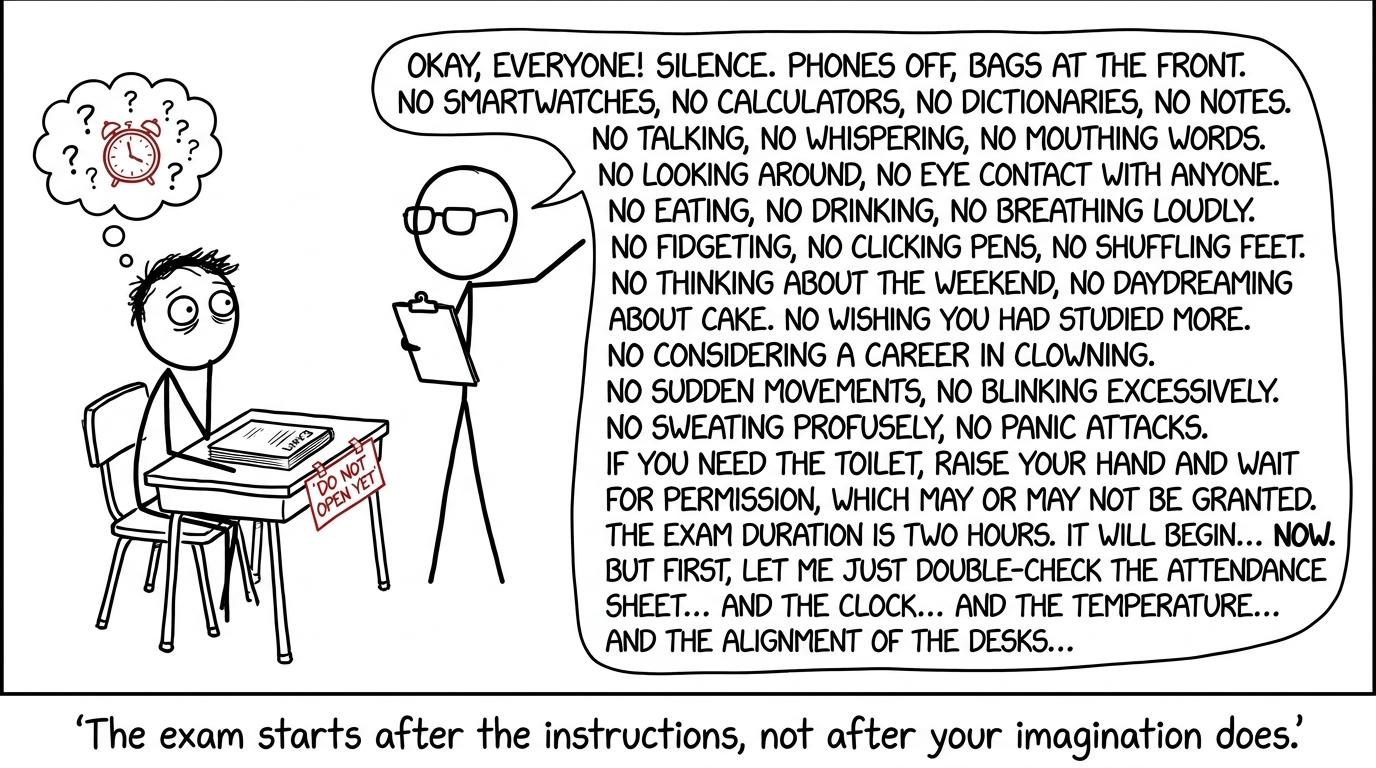 An invigilator completes the checklist beside an unopened paper
When writing actually begins
The invigilator will announce that you may start. That instruction, rather than the moment you sit down or write your candidate number, marks the beginning of the timed paper.
If you have approved extra time, supervised rest breaks or another access arrangement, your finish time may differ from the main room’s finish. The exams officer should organise this in advance; ask your school before exam day if you are unsure.
What if the paper does not start at exactly 9.00 am?
A start at 8.45 am, 9.15 am or another time within the permitted morning window is not automatically a mistake. Centres are allowed limited flexibility while maintaining paper security and giving every candidate the full duration.
There may also be exceptional arrangements for timetable clashes, disabilities or other approved circumstances. If two examinations fall in the same session and their combined duration is no more than three hours, JCQ guidance normally requires them to be taken consecutively, with the centre deciding their order. A supervised break of no more than 20 minutes may be permitted between them under formal examination conditions.
Do not attempt to arrange your own later start. Speak to the exams officer as soon as you identify a clash or concern.
If you are running late
Contact the school or examination centre immediately and follow its directions. Do not decide that being late means you should stay at home.
JCQ has specific procedures for late and very late candidates. Whether a script can be accepted may depend on the arrival time, paper duration, supervision and whether examination security could have been compromised. The centre must manage this process; a student cannot guarantee acceptance by simply arriving before other candidates leave.
The safer strategy is deliberately unexciting: check transport, set more than one alarm and aim to arrive at the school’s stated time rather than the published start time.
How English Literature fits around maths revision
An English paper in the morning can create a strange temptation: either abandon maths revision completely or try to complete an exhausting maths paper as soon as you get home. Neither response is especially helpful.
Use a small, pre-decided task. The 20-minute GCSE maths revision routine is suitable for a busy examination day. On less crowded days, build a sustainable schedule using the GCSE maths revision timetable or the one-month maths revision plan.
A useful rhythm is simple:
- before the English examination, protect sleep and prepare your equipment
- after the paper, take a genuine break
- complete one short maths task chosen in advance
- mark it and record one specific correction
- stop at the planned time
MathsGenie’s free GCSE maths revision hub lets you select resources for boards including Edexcel, AQA, OCR, Eduqas, WJEC and CCEA. You can then move from a revision lesson to practice questions without spending your limited energy searching for material.
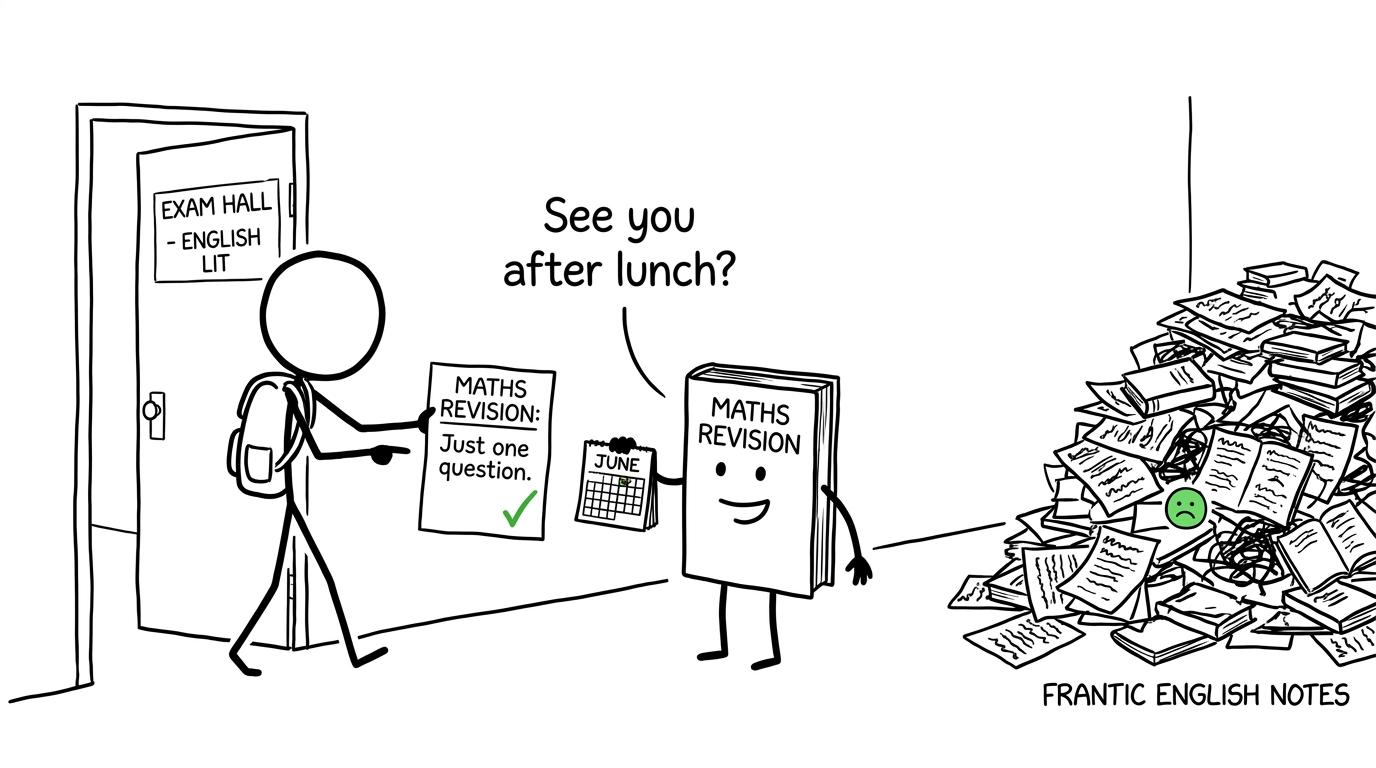 A student calmly switches from English to one short maths task
Common mistakes with examination timing
Treating “morning” as a precise arrival time
“Morning” describes the session, not when you should walk through the school gate. Use the arrival time issued by your centre.
Assuming every school begins at 9.00 am
The published time is normally 9.00 am for the main JCQ boards, but centres have a permitted 30-minute adjustment. CCEA also publishes a different morning time.
Checking the subject but not the paper code
English Language and English Literature are different qualifications. Paper numbers, component titles and durations also vary between boards. Match every detail on your candidate timetable.
Opening the paper before being told
You may complete permitted front-page details when instructed, but do not open the question paper early. Wait for the invigilator’s clear announcement.
Letting one exam disrupt the entire revision plan
English Literature is one part of a crowded GCSE season. Avoid compensating with an unfocused late-night maths session. The GCSE maths night-before plan prioritises preparation, focused practice and sleep.
Revising without learning from lost marks
Once the day is over, return to evidence rather than panic. Use MathsGenie’s guide to finding your weakest GCSE topics, then practise those gaps before attempting another full paper.
The calm answer to the start-time question
The standard published GCSE English Literature morning session starts at 9.00 am for AQA, Edexcel, OCR and Eduqas, while CCEA’s published morning time is normally 9.15 am. But your centre can adjust the time within JCQ rules, so the instruction on your personal timetable is the one to follow.
Arrive when your school tells you. Enter quietly. Check the displayed paper details. Start writing only when instructed. That sequence removes most of the uncertainty.
Then bring the same calm structure to maths. Open the MathsGenie GCSE predicted papers, choose material matching your tier and exam board, and combine it with revision lessons, past papers, practice questions, mini tests, mark schemes and video solutions. Exam season becomes more manageable when the next action is already decided.