

GCSE English Literature Busy Schedule Survival Guide
GCSE English literature busy schedule? Use a focused survival plan to revise texts, quotations and essays around sport, work and demanding subjects too.
There is a particular kind of panic that arrives when English Literature is approaching, your quotation list is unfinished, and every evening already belongs to training, a shift at work, maths homework or another subject.
If you are managing a GCSE English Literature busy schedule, the answer is not to create an ambitious timetable that collapses by Wednesday. It is to reduce revision to a few high-value tasks: understand each text, retrieve a small bank of flexible quotations, practise planning arguments and occasionally write under time pressure.
You do not need unlimited evenings. You need a system that still works on difficult ones.
Your survival checklist
When time is scarce, concentrate on these priorities:
- confirm your exam board, set texts and paper structure
- identify the themes, characters and poems you understand least
- learn short, flexible quotations rather than entire speeches
- practise retrieving knowledge without looking at your notes
- plan more essays than you write in full
- complete occasional timed responses
- use teacher feedback and official mark schemes to decide what to improve
- protect maths time by making both subjects more efficient
The goal is not to cover everything equally. It is to make the next available revision session count.
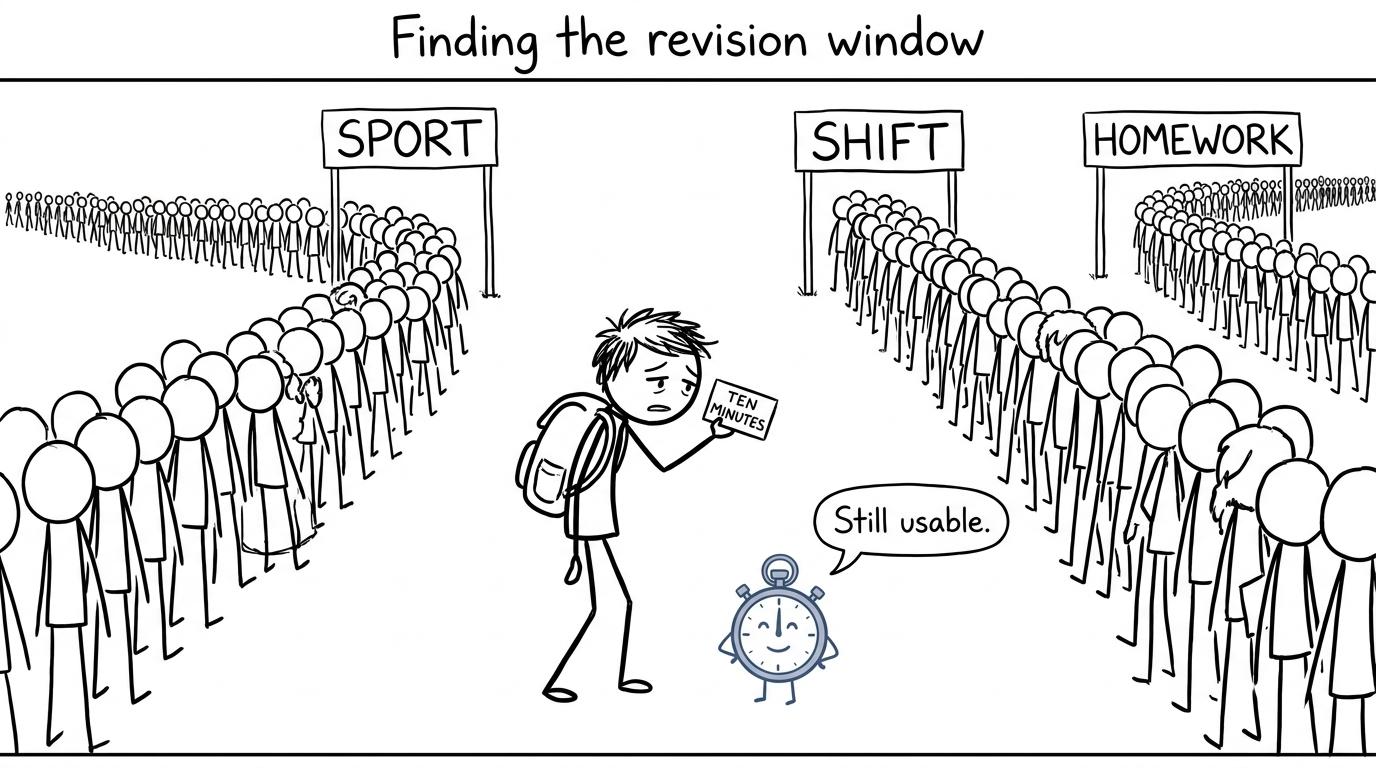 A student finding a usable ten-minute revision window between sport, work and homework
Start with your actual English Literature specification
GCSE English Literature is untiered, unlike foundation and higher tier maths. However, the precise papers, timings, set texts and question arrangements depend on whether you take AQA, Edexcel, OCR or Eduqas. Check your exam board rather than borrowing a revision plan from somebody whose course is different.
Across the regulated GCSE specifications, the central assessment objectives reward four broad abilities:
- AO1: understanding and responding to texts, supported by textual references
- AO2: analysing how writers use language, form and structure
- AO3: understanding relationships between texts and their contexts
- AO4: writing clearly and accurately where it is assessed
Official requirements also include substantial study of Shakespeare, a nineteenth-century novel, poetry and modern British fiction or drama. Yet the way these appear in papers varies. AQA, for example, uses two closed-book papers and provides required stimulus material in the examination. OCR describes its papers as closed text. Never assume that another board's paper format applies to you.
Write one page containing your papers, sections, texts and question types. That page becomes the boundary of your revision. Anything outside it is noise.
Build a minimum viable revision routine
A minimum viable routine is the smallest routine that produces genuine progress. For a busy student, that might mean four short sessions and one longer session across a week.
Use short sessions for retrieval
A ten-minute session can be useful if it has a precise purpose. Choose one of these:
- recall quotations for one character or theme
- sketch the sequence of a text from memory
- match anthology poems by theme
- plan three points for an essay question
- annotate a short unseen poem
- review one piece of teacher feedback
Do not spend the session making notes look attractive. Close the book, retrieve what you know, check it and record what was missing.
This is the same principle behind MathsGenie's twenty-minute GCSE maths revision routine: a small, repeatable process is more dependable than waiting for a perfect evening.
Reserve longer sessions for exam performance
Use a weekend or your least crowded evening for an essay plan, timed paragraph or complete response. Planning is efficient because it lets you rehearse interpretation, evidence and structure without writing every sentence.
Full essays still matter. They reveal whether you can sustain an argument, select evidence and manage the clock. You simply do not need to write one every night. Ask your teacher which question types deserve full practice first.
Make quotations earn their place
Trying to memorise dozens of long quotations from every text is a common reaction to feeling behind. It also creates a mountain too large to climb.
Instead, build a compact quotation bank. Each quotation should ideally support several themes, characters or interpretations. Learn the shortest wording that preserves the important language. For each quotation, know:
- who says or narrates it
- where it appears in the text
- which themes it can support
- one or two significant words or structural features
- how its meaning connects to the writer's wider purpose
Retrieval matters more than rereading. Cover the quotation and reconstruct it. Say it while walking to training. Put prompts on cards and test yourself during a journey. If exact wording will not return, practise using a precise textual reference instead of inventing a quotation. AO1 permits textual references, including quotations; evidence must support an interpretation, not decorate the paragraph.
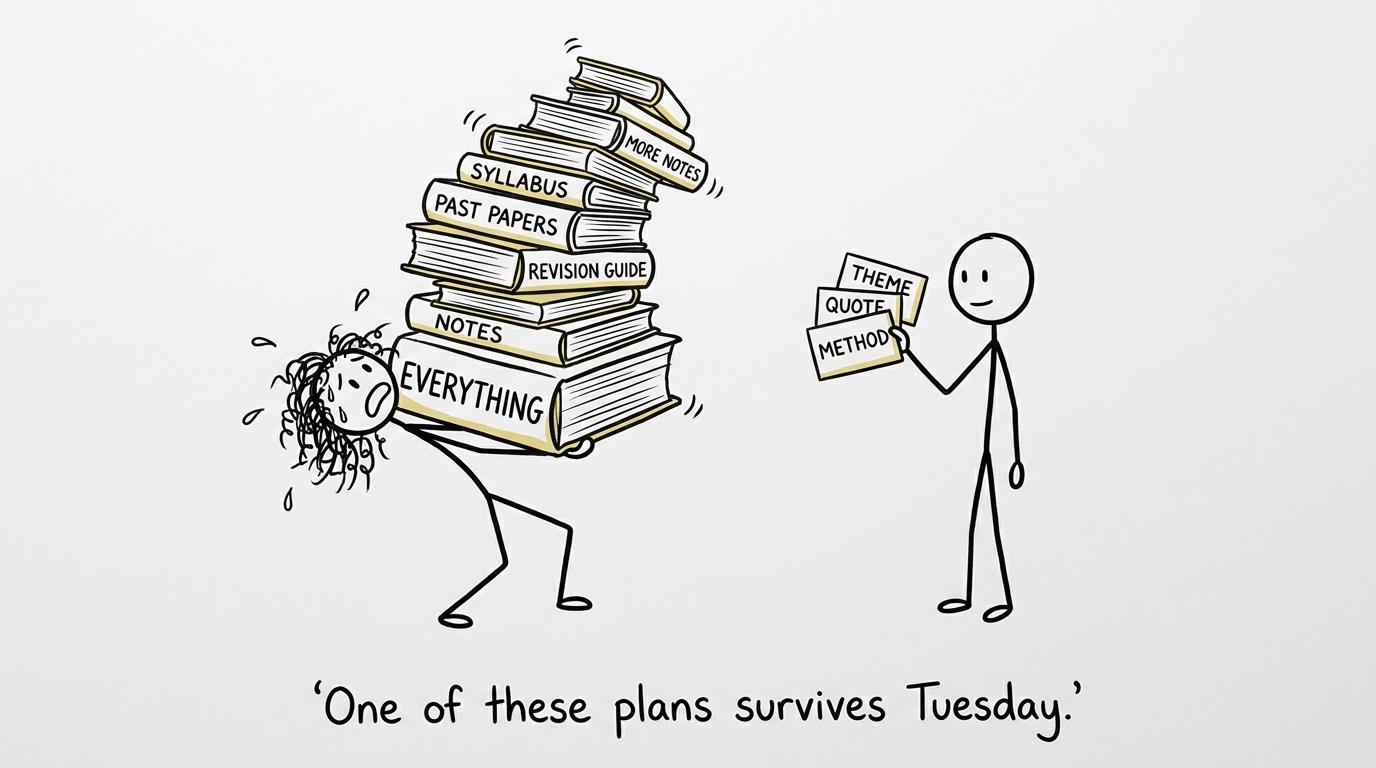 One student carrying everything while another carries three useful revision cards
Revise relationships, not isolated facts
Strong Literature revision is a network. A theme connects to characters; characters connect to turning points; turning points connect to language, structure and context.
For each set text, create a single-page map containing:
- the central conflict
- the most important character changes
- four or five major themes
- pivotal moments from the beginning, middle and end
- flexible evidence for each theme
- relevant context that genuinely affects interpretation
Context should illuminate the text. A detached paragraph of historical facts rarely helps as much as a concise explanation of how an audience, social belief or literary convention shapes meaning.
Poetry needs relationships too. Group anthology poems by themes such as power, memory, conflict, identity or nature. Then note meaningful similarities and differences in viewpoint, imagery, voice, form and structure. This creates flexible comparison routes without requiring a separate essay plan for every possible pairing.
Protect both English and maths
When several subjects compete for the same evening, the solution is not to revise whichever feels loudest. Give each subject a defined job.
You might use a short English retrieval task before training, then complete targeted maths questions afterwards. On another day, English receives the longer timed session while maths becomes a mini test. The balance can change as examination dates approach.
MathsGenie's GCSE maths revision hub keeps revision lessons, practice materials and papers together, reducing the time spent hunting for resources. If your timetable feels chaotic, use the GCSE maths revision timetable guide to organise realistic sessions around school and other commitments.
For maths, diagnose before revising. The guide to finding your weakest GCSE topics helps you direct limited time towards actual lost marks. Apply the same logic to Literature: use marked work, mock results and teacher feedback to identify whether your weakness is textual knowledge, analysis, comparison, organisation or timing.
Adapt the plan around sport, work and family commitments
A timetable should reflect reality rather than argue with it.
If sport dominates your evenings
Place retrieval before school, at lunch or during travel where appropriate. Use the evening after late training for a light task, not a demanding full essay. Put your timed writing on a rest day or weekend.
If you have a part-time job
Plan from your rota. On working days, use brief quotation or essay-planning sessions. Protect one non-working block for deeper practice. If shifts change, keep a list of tasks arranged by duration so you can use unexpected gaps immediately.
If other subjects are taking over
Separate urgent deadlines from important revision. Maths paper practice may require a larger block, while English quotation retrieval can fit around it. MathsGenie's guide to when to start GCSE past papers explains how to progress from shorter tasks towards complete papers rather than doing everything at once.
When you are ready for maths paper practice, use Edexcel GCSE Maths past papers if that is your board, or select the correct board through the main revision hub. Nearer the examinations, GCSE predicted papers can provide additional timed practice. Predicted papers are training resources, not promises about what will appear.
Common mistakes when revision time is limited
Spending the whole session organising
Colour coding and reorganising folders can feel productive because they create order. Set up a simple system once, then spend most of your time recalling, planning or writing.
Learning quotations without interpretations
A remembered line is only useful when you can connect it to the question and analyse the writer's choices. Attach every quotation to possible arguments.
Writing context as a separate history paragraph
Use context selectively to deepen an interpretation. Avoid forcing memorised facts into an answer when they do not explain the text.
Revising only favourite texts and poems
Comfort can hide risk. Use your weakest area as the starting point, just as you would repair a maths topic exposed by a mini test.
Waiting for a large empty evening
Busy weeks rarely provide one. Ten focused minutes today are more valuable than an imaginary four-hour session at the weekend.
Treating exhaustion as a discipline problem
If work, training and school have left you depleted, choose a smaller task or rest. A sustainable plan includes sleep and recovery. Exhausted rereading is not automatically effective revision.
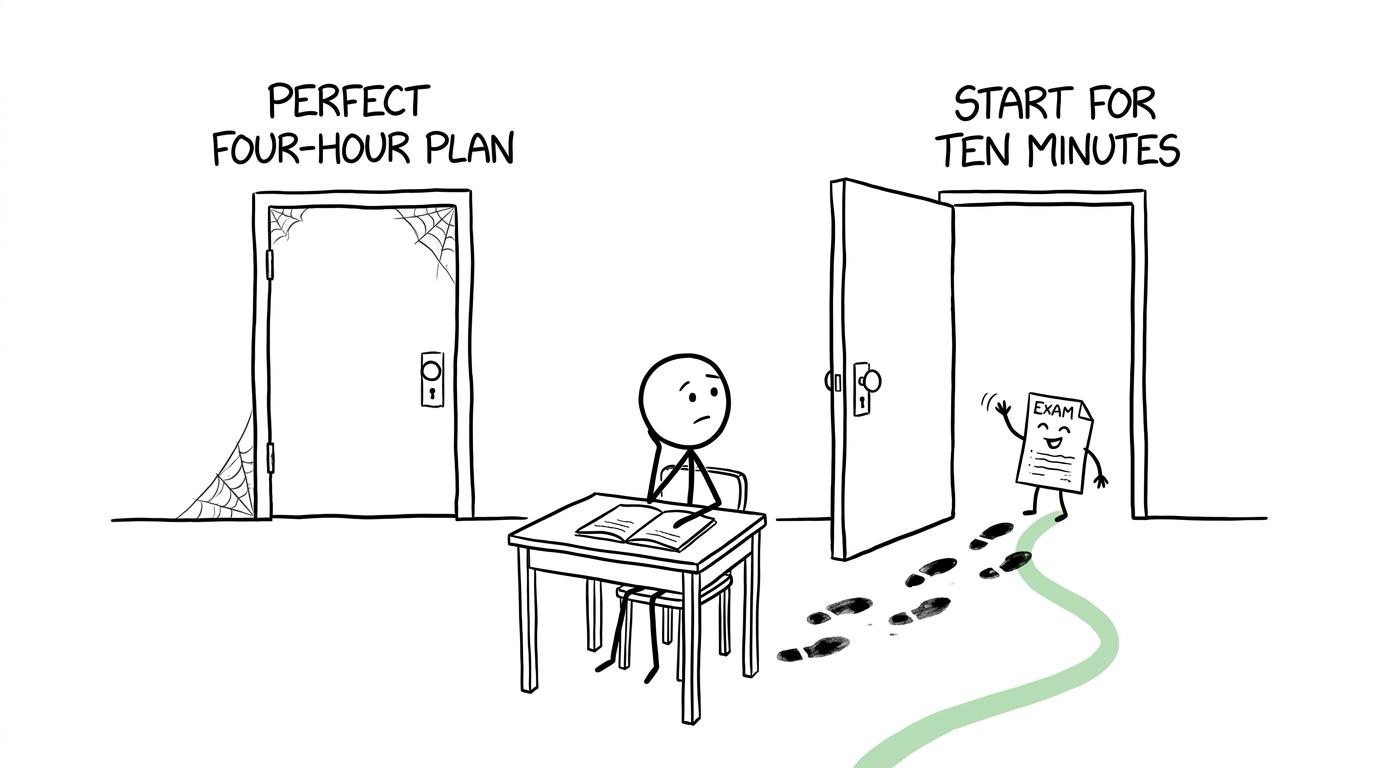 A well-used ten-minute revision door beside an abandoned perfect plan
Turn a crowded schedule into a repeatable system
Having little revision time does not mean doing nothing, and it does not require doing everything at once. Know your specification. Build a compact evidence bank. Retrieve knowledge in short gaps. Plan arguments frequently and use occasional timed writing to test whether those ideas survive under pressure.
Then give maths the same clarity. Use MathsGenie's free revision lessons and practice questions to repair individual topics, mini tests to check recall, and past papers, predicted papers, mark schemes and video solutions to develop exam performance. The GCSE maths topics by board and tier guide can help you choose the right starting point.
Your schedule may remain busy. The difference is that it no longer has to be vague. Choose one small English task and one targeted MathsGenie resource today, complete them, and let consistency carry what spare time cannot.










