

GCSE English Language to A-Level Jump: The Reality
GCSE English Language to A-level jump explained: discover how linguistic analysis, theory, data and independent research reshape the subject.
A subject can keep the same name while quietly changing its identity. That is what surprises many students about the GCSE English Language to A-level jump. The short answer is that A-level English Language is not simply GCSE with longer extracts and harder questions. It becomes a more systematic study of linguistics: how language works, varies, develops and shapes meaning.
You still analyse texts and write for different audiences. But you also study spoken language, grammar, language change, identity, child language development and debates about how English is used. You are expected to apply precise terminology, engage with ideas and research, and become a more independent investigator.
For students currently balancing English choices with GCSE maths exams, understanding that difference matters. Choosing an A-level is not just choosing a subject you can pass. It is choosing the kind of thinking you are willing to practise for two years.
The jump at a glance
Before looking at the detail, here is the practical comparison:
| GCSE English Language | A-level English Language |
|---|---|
| Reading and responding to unseen texts | Analysing spoken, written, electronic and multimodal language data |
| Explaining writers’ language and structural choices | Applying systematic linguistic frameworks and terminology |
| Comparing ideas, perspectives and methods | Exploring connections through concepts, context and research |
| Creative, persuasive or transactional writing | Original writing, analytical commentary and discursive argument |
| Closely guided examination questions | Greater independence in essays, investigation and revision |
| Focus on producing effective English | Focus on English as both communication and an object of study |
The central shift is from asking, “What effect does this writer create?” to asking, “What patterns are present, how can linguistic methods describe them, and what does context help us conclude?”
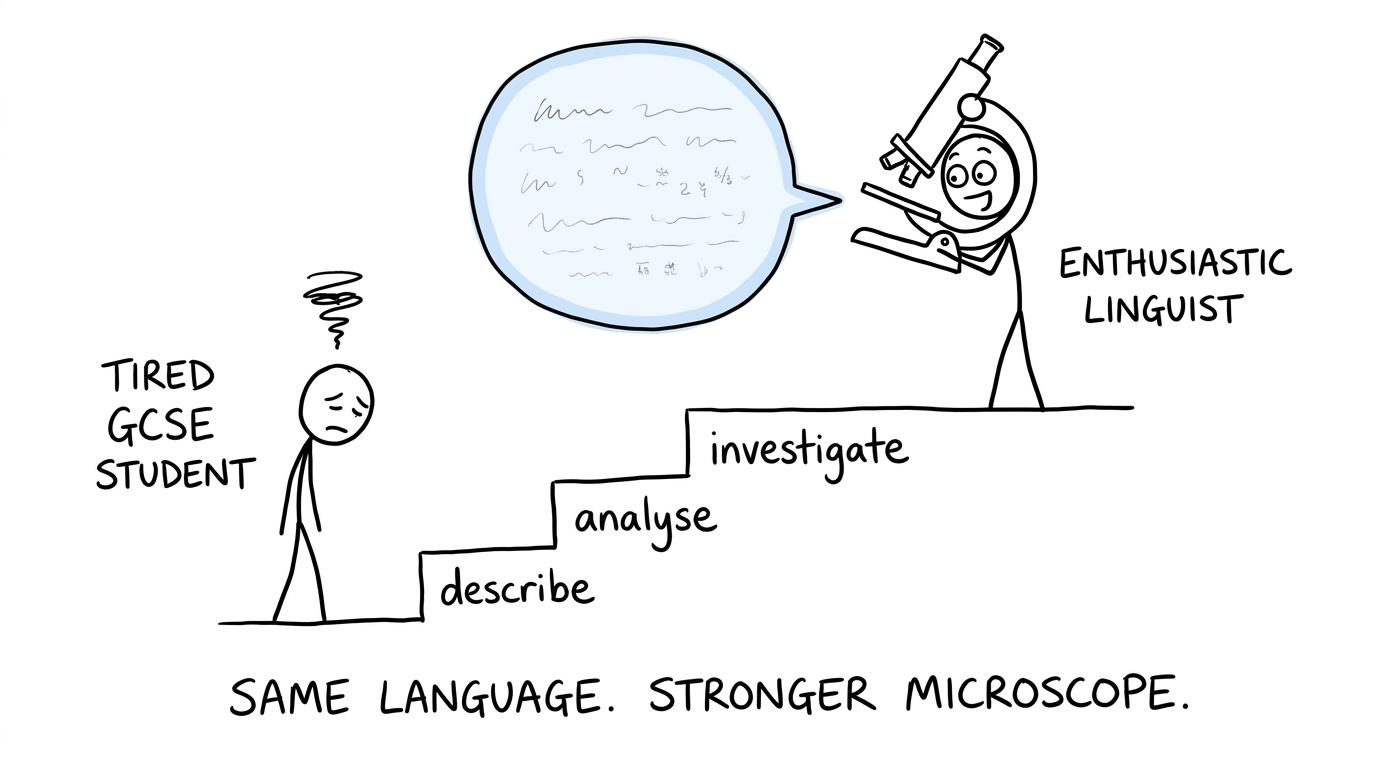 A student sees language through a much stronger analytical microscope
GCSE English Language is mainly skills-based
At GCSE in England, English Language develops critical reading and effective writing. Students interpret explicit and implicit information, analyse language and structure, compare perspectives, evaluate texts and produce writing suited to an audience and purpose.
The Ofqual assessment objectives divide the weighted qualification equally between reading and writing. Accuracy matters substantially too: spelling, punctuation, vocabulary and sentence control account for 20%20\%20% of the qualification through AO6. Spoken Language is reported separately and does not contribute to the numerical GCSE grade.
The exact paper structure depends on the exam board. For example, the current AQA specification uses two examinations, each worth 50%50\%50%, combining unseen reading with creative or viewpoint writing. Edexcel, OCR and Eduqas organise tasks differently, so students should always check their own specification rather than assuming every paper follows the same pattern.
GCSE success often depends on performing familiar skills under pressure. You learn what a comparison question requires, how to select evidence and how to organise an extended response. The texts are unseen, but the broad task types become recognisable.
That familiarity is useful. It is not, however, the whole foundation for A-level.
How A-level English Language actually feels different
Language becomes the thing you investigate
At GCSE, language is often the tool used by a writer. At A-level, language itself becomes the evidence.
The national A-level subject content requires the study of language levels including phonetics, phonology and prosodics; lexis and semantics; grammar and morphology; pragmatics; and discourse. In ordinary terms, that means investigating sounds, vocabulary, meanings, sentence structures, implied meanings and patterns across whole conversations or texts.
You may analyse a transcript, an online exchange, an advertisement, a historical document or language produced by a child. Features such as pauses, turn-taking and pronunciation can matter alongside written grammar. The material can therefore feel closer to data analysis than traditional literary criticism.
This is one reason students who enjoy both language and analytical subjects may find the course appealing. You notice patterns, classify evidence and test interpretations against context. There is rarely a single numerical answer, but unsupported impressions are not enough.
Terminology becomes a working toolkit
At GCSE, identifying a metaphor or short sentence can support a useful explanation. At A-level, terminology reaches much further and must be applied accurately.
You may need to identify word classes, clause structures, semantic fields, deixis, adjacency pairs or phonological features. Listing labels earns little by itself. The real task is to use terminology to explain how language constructs meaning, identity, relationships or representation.
The adjustment is similar to moving from recognising a graph to interpreting all its important features. Vocabulary is not decoration. It makes more precise thinking possible.
Context becomes more complex
GCSE students already consider audience, purpose and form. A-level broadens context to include social groups, occupations, regions, historical periods, technologies and individual identity.
You might explore why English changes, how attitudes towards accents develop, how children acquire language or how institutions communicate authority. A claim must normally connect close language evidence with a wider concept or debate.
This makes essays less formulaic. A paragraph structure can still help, but it cannot replace judgement. You must decide which evidence is significant and how confidently it supports a conclusion.
You work with theories and research
Another genuine jump is the expectation that students understand concepts and issues relevant to language use. Instead of relying entirely on personal reaction, you evaluate viewpoints, research findings and competing explanations.
That does not mean filling every paragraph with remembered names. Strong responses use knowledge selectively and critically. A theory is useful when it illuminates the data; it is not a substitute for analysing the data in front of you.
This aspect often feels difficult at first because revision is no longer just learning a list of devices. You are building a connected model of how language operates.
Assessment is broader and more independent
Assessment varies significantly between AQA, Edexcel, OCR and Eduqas, but current specifications commonly combine extended examinations with non-exam assessment, usually called NEA.
For example, AQA currently has two examinations worth 40%40\%40% each and an NEA component worth 20%20\%20%. Its content includes textual variation, children’s language development, language diversity and change, language discourses, an investigation, and original writing. OCR also allocates 40%40\%40% to each of two examinations and 20%20\%20% to independent language research.
The important point is not to memorise those figures before choosing the course. It is to recognise the change in responsibility. Depending on your board, you may collect language data, devise a question, choose analytical methods, produce original writing or evaluate your own decisions.
GCSE questions usually establish the territory for you. At A-level, part of the challenge is deciding what territory is worth exploring.
Is the subject simply harder?
It is harder, but “harder” is too vague to be useful. The real difference has four parts:
- Breadth: you encounter more forms of language, including spoken and digital material.
- Precision: analysis requires a larger and more technical vocabulary.
- Depth: context, concepts and evidence must be connected rather than mentioned separately.
- Independence: you organise more of your reading, argument, research and revision.
The volume of written work may also increase. Extended answers need sustained reasoning rather than a sequence of disconnected observations. Feedback can initially feel less definite because improvement depends on the quality of your judgement, not simply whether you remembered a method.
Yet the course is not reserved for students who already speak like linguists. It is designed to build on GCSE knowledge. The best preparation is curiosity plus a willingness to become precise.
Who is likely to enjoy A-level English Language?
The subject may suit you if you enjoy noticing how people communicate and asking why language differs between situations. It helps to be interested in real speech, social debates, changing vocabulary, online communication and the relationship between language and identity.
You should also be comfortable with regular reading and extended writing. Creative ability helps in some components, but A-level English Language is not primarily a creative-writing course. Nor is it the same as English Literature: its core focus is linguistic analysis and language in use.
Entry requirements are set by individual schools and colleges, so check them directly. More importantly, read the specification used by your prospective centre. Two courses with the same qualification title can feel different because exam boards organise content and assessment differently.
Preparing for the jump without neglecting GCSE maths
A future A-level choice should not consume the revision time needed for the exams directly ahead of you. Your immediate priority is still securing the strongest GCSE results you can.
Start by separating exploration from revision. Spend a short, defined period reading your prospective English specification or looking at sample material. Then return to a structured maths routine through the GCSE Maths revision hub.
A useful weekly pattern is:
- read briefly about one A-level English Language topic;
- continue targeted GCSE maths revision by board and tier;
- complete a short test or paper section;
- mark it and record the exact reason for each lost mark;
- revisit the weak skill rather than rereading everything.
The 20-minute GCSE maths revision routine is useful when English work is heavy. If you need a longer structure, follow the one-month GCSE maths revision plan.
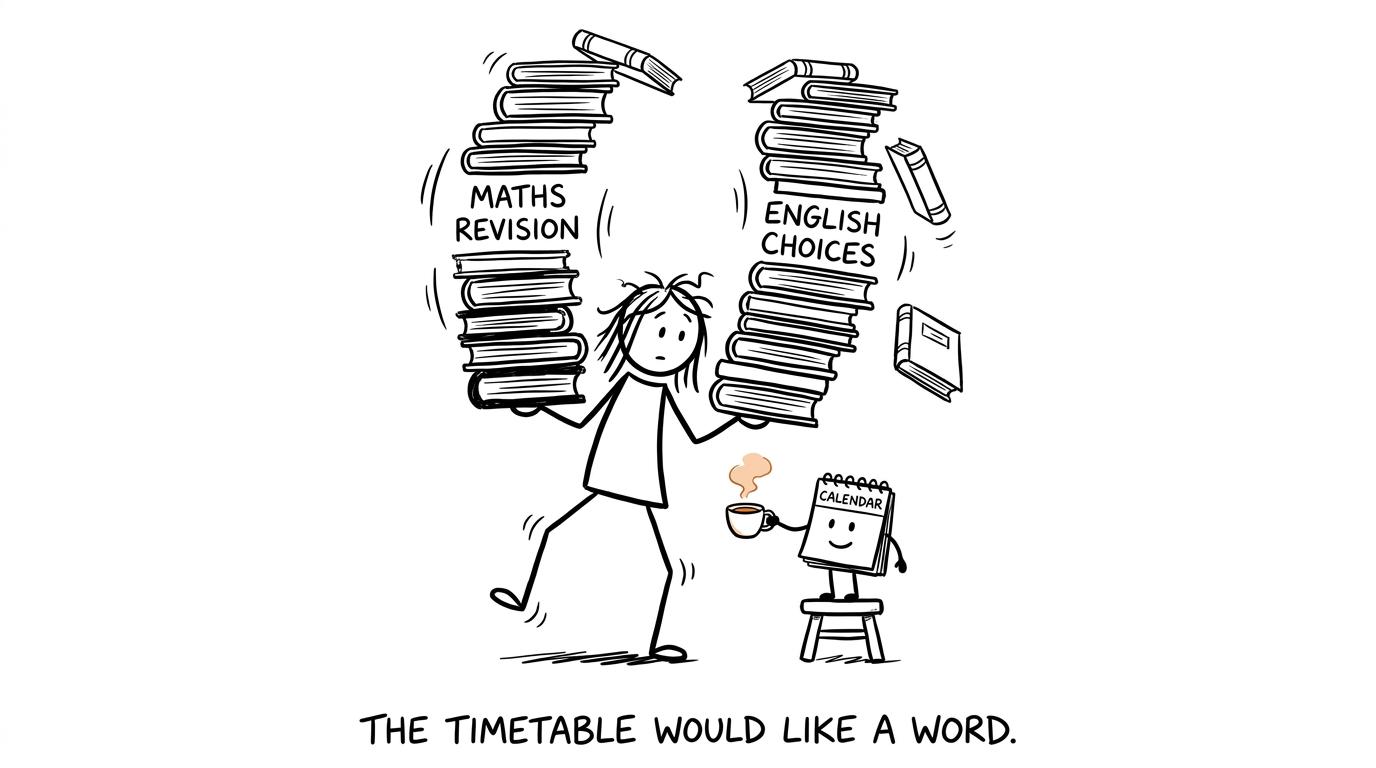 A calendar attempts to mediate between English choices and maths revision
The same habit supports both subjects: turn vague concern into visible evidence. In English, that means analysing actual language data. In maths, it means using a marked test to identify the next topic. MathsGenie’s guide to finding your weakest GCSE topics explains how to make that diagnosis useful.
Common mistakes when judging the jump
Assuming a high GCSE grade guarantees an easy transition
A strong GCSE result is valuable, but A-level introduces new content and methods. Expecting instant fluency can make normal early difficulty feel like failure. Treat terminology and linguistic frameworks as skills to be built gradually.
Choosing it because there are “no books to learn”
English Language may not centre on set literary texts, but it still demands substantial knowledge. You will learn concepts, terminology, research and relevant examples while becoming more adept at analysing unfamiliar data.
Treating every text like a GCSE extract
Feature spotting followed by a general comment about “impact on the reader” will not carry an A-level response. Analysis must be systematic, contextualised and supported by accurate terminology.
Ignoring the exam board
AQA, Edexcel, OCR and Eduqas share national subject expectations, but their components, questions and NEA arrangements differ. Compare the actual specification offered by your school or college.
Letting future choices disrupt current revision
Researching A-levels feels productive, which makes it an attractive form of procrastination. Protect your present timetable. Use Edexcel GCSE Maths mini tests, Edexcel GCSE Maths past papers or AQA GCSE Maths past papers to keep current performance visible.
The real jump is a change of viewpoint
The GCSE English Language to A-level jump is substantial because the subject changes perspective. At GCSE, you mainly demonstrate that you can read critically and communicate effectively. At A-level, you begin to investigate English using the concepts and methods of linguistics.
That change can be demanding. It can also be fascinating. Everyday conversations, headlines and online messages stop looking ordinary once you have the tools to see their patterns.
For now, make an informed choice without losing sight of the next exam. Check the specification, look honestly at the kind of work you enjoy, and keep your GCSE maths preparation consistent. Use MathsGenie’s free revision lessons and practice questions to repair individual gaps, then build confidence with mini tests, mark schemes, video solutions, past papers and predicted papers. If A-level Maths is also part of your plan, you can later explore the Edexcel A-level Maths past papers.
The next stage becomes less intimidating when the current one is handled well. Choose carefully, revise deliberately, and let evidence, not anxiety, tell you what to do next.










