

GCSE English Language Revision: Silence or Noise?
GCSE English Language revision silence or noise? See what research says about lyrics, instrumental music and the best sound for focused practice.
The room is quiet, but your attention is not. A song might make revision feel easier to begin. Silence might feel more serious. The difficult question is whether either one helps you read more accurately and write more effectively.
For GCSE English Language revision, silence or noise is not an entirely personal choice. The best available evidence points towards a practical answer: use silence for demanding reading and writing whenever possible, and avoid music with lyrics or audible speech. Quiet instrumental sound may be acceptable if it helps you settle, but research does not show a reliable academic advantage over silence.
That matters particularly in English Language. You are processing words while analysing words, holding quotations in mind and shaping sentences. Background lyrics and conversations compete for some of the same attention.
The short answer: what should you choose?
Use this checklist before your next session:
- Choose silence for close reading, textual analysis, proofreading and timed writing.
- Avoid music with lyrics, podcasts, television and nearby conversations.
- If silence makes starting difficult, try quiet, familiar instrumental sound.
- Keep the volume low enough that the sound does not demand attention.
- Test your choice using comparable tasks and marks, not mood alone.
- Complete some practice in exam-like silence so the real paper feels familiar.
- If your home is noisy, reduce intelligible speech first; that is usually more distracting than a steady, non-verbal sound.
The important distinction is not simply silence versus music. It is between sound that carries meaning and sound that does not.
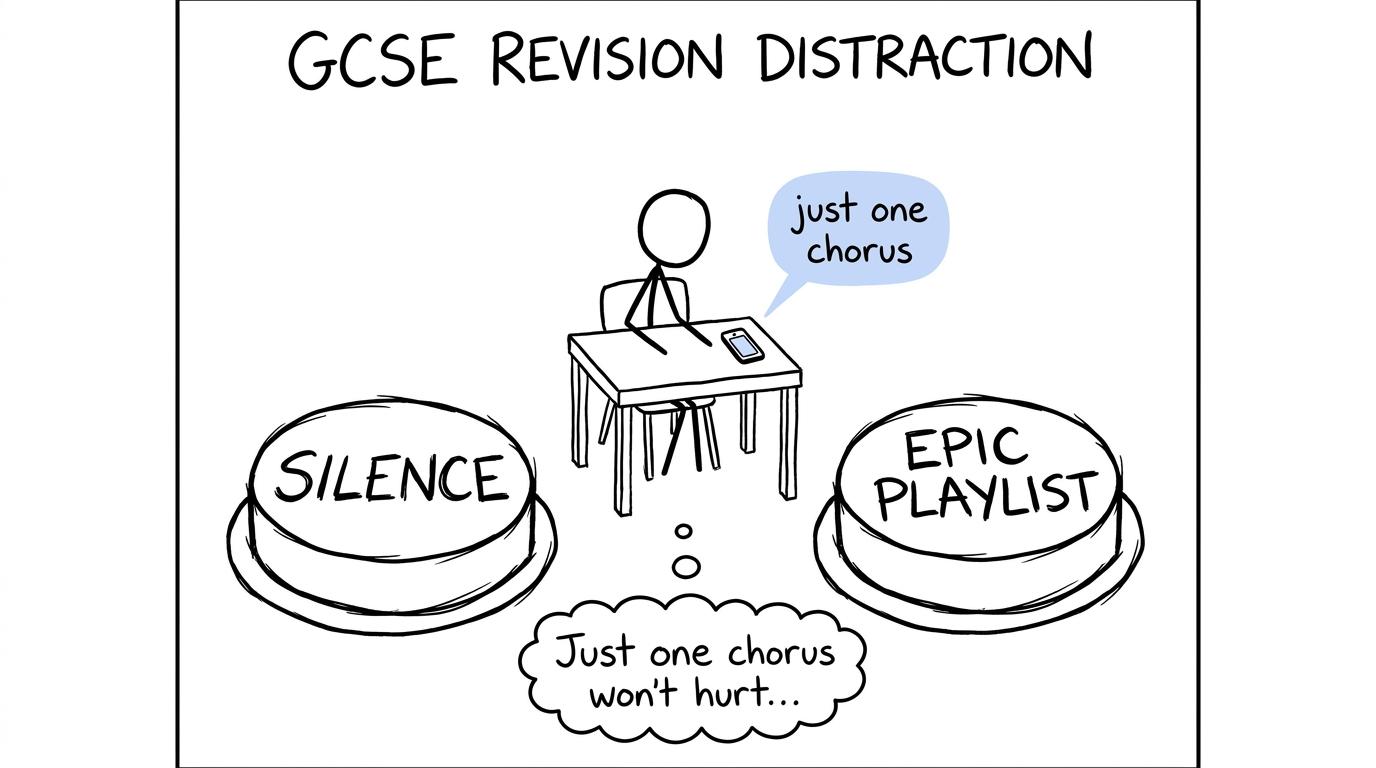 A student choosing between silence and an epic revision playlist
What the evidence says about silence and background noise
Research in this area is not perfectly uniform. Studies use different tasks, types of music, sound levels and age groups. That makes sweeping statements unhelpful. Still, several consistent patterns emerge.
A major meta-analysis of auditory distraction during reading found that background sound had a small but reliable negative effect on reading performance overall. Intelligible speech and lyrical music produced the greatest distraction. The effects were generally small, but the direction was clear enough to make silence the safer default for comprehension.
A later systematic review covering memory, language, attention and reasoning reached a similarly careful conclusion. Background music did not damage every kind of performance in every study, but it tended to hinder memory and language-related tasks. Music with lyrics was more consistently disruptive than instrumental music.
Experimental research has also compared silence, instrumental lo-fi music and lyrical music directly. Performance was generally strongest in silence, followed by instrumental music, then lyrical music. Instrumental music did not reliably improve results, even when participants felt that it helped.
That final point is important. Enjoying a revision condition is not the same as learning more effectively in it. Music can make time pass pleasantly while quietly reducing the accuracy of what you remember.
Why English Language is especially vulnerable to verbal noise
GCSE English Language requires sustained verbal processing. Across Edexcel, AQA, OCR and Eduqas, students must work with unseen material and demonstrate reading and writing skills. Exact paper structures vary by board, so you should always follow your current specification and your teacher's guidance.
AQA, for example, assesses skills including identifying information, analysing language and structure, comparing perspectives, evaluating texts and writing accurately for purpose and audience. These are not passive tasks. They require you to hold one phrase in mind while connecting it with another.
Now add a song lyric.
Your attention may begin processing the singer's words automatically, even if you are trying not to listen. A nearby conversation can do the same. The sound is meaningful, so the brain keeps checking it. That creates competition when you are:
- inferring an unstated idea;
- selecting evidence from a source;
- analysing the effect of a word;
- comparing two viewpoints;
- planning a coherent response;
- checking spelling, punctuation and grammar.
This does not mean the mind has a tiny, fixed storage box that music simply fills. Attention and working memory are more complicated than that. But it explains the broad research pattern: verbal distraction is a poor companion for verbal work.
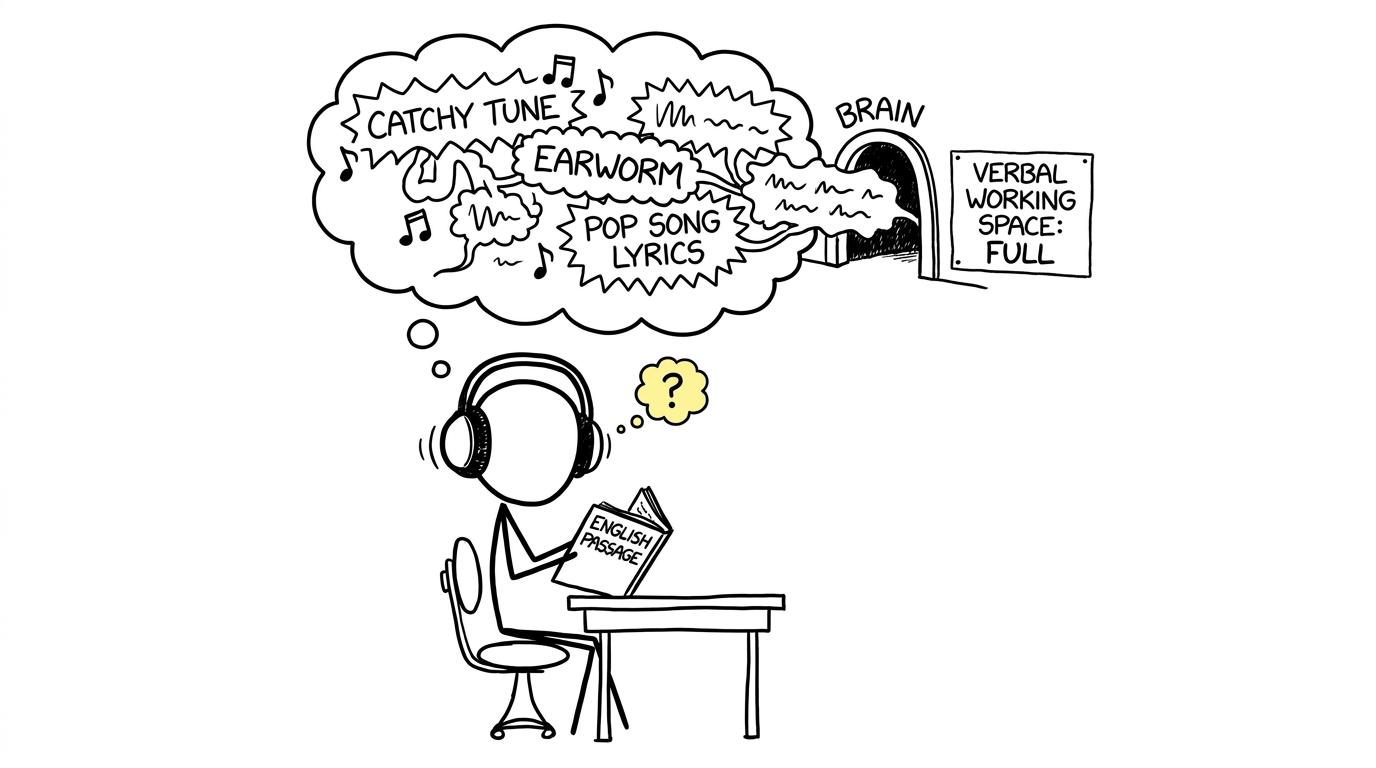 Song lyrics queuing to enter a student's busy working memory
Is instrumental music acceptable for revision?
Possibly. The evidence is more forgiving towards instrumental music than lyrical music, but it does not establish instrumental sound as a revision tool that improves English marks.
Quiet instrumental music may be useful when the alternative is not productive silence but an unpredictable environment. It might mask conversations elsewhere in the house, make a revision space feel less uncomfortable or help you begin a task you have been avoiding.
Those are practical benefits, not proof of better comprehension.
If you use instrumental sound, choose something:
- familiar rather than novel;
- steady rather than dramatically changing;
- quiet rather than immersive;
- without lyrics, spoken samples or adverts;
- easy to stop when the task becomes demanding.
Film scores can be surprisingly distracting because they are designed to guide emotion and build tension. A track without lyrics is not automatically neutral.
What about white noise, rain sounds or café noise?
Steady non-speech sounds usually present less verbal competition than songs, podcasts or television. However, they are not guaranteed concentration enhancers.
Research on white noise is mixed and depends on the task and the learner. Some findings suggest possible benefits for particular people or attentional profiles, while other studies have found poorer reading efficiency than in silence. Café recordings are especially risky when conversations are understandable.
Treat these sounds as environmental tools rather than learning hacks. Rain noise may cover a barking dog. A fan may soften traffic sound. Neither replaces active revision.
The useful hierarchy is:
- first choice: comfortable silence;
- second choice: quiet, steady non-verbal sound;
- greater risk: changing environmental noise;
- highest risk: intelligible speech, podcasts and lyrical music.
Match the sound to the English Language task
Not every revision activity demands the same depth of concentration.
Close reading and annotation
Use silence. You need to notice connotations, shifts in tone, structural decisions and implicit meanings. Music with words creates avoidable competition.
Planning and extended writing
Silence is again the strongest default. Writing asks you to retrieve vocabulary, control sentence structure and keep the whole response coherent. If instrumental sound helps you begin, switch it off once your plan is moving.
Proofreading
Proofreading needs deliberate attention. Read slowly in silence and, where appropriate, hear the sentence internally. Background speech can make errors easier to miss.
Organising notes
Low instrumental sound is less likely to matter during simple administrative tasks such as arranging folders or creating a revision timetable. Do not confuse organising revision with doing revision, though.
This principle transfers directly to maths. Watching a lesson or tidying notes places different demands on attention from solving an unfamiliar multi-step problem. On the GCSE Maths revision hub, use silence for the questions that require your full reasoning, then check the available solutions carefully.
Run a fair test on your own concentration
Individual differences exist, but preference alone is weak evidence. Test your environment using performance.
Choose two comparable English Language tasks. Complete one in silence and another with your usual background sound on a different day at a similar time. Keep the working period and difficulty as consistent as possible.
Record:
- how much you completed;
- how often you reread the source;
- how many times you checked your phone or changed track;
- the marks awarded using the relevant mark scheme;
- what you could recall later without looking.
Repeat the comparison before deciding. One unusually easy passage or tired afternoon can distort the result.
The same method works when planning maths revision. A structured GCSE maths revision timetable gives you repeatable sessions, while the twenty-minute GCSE revision routine makes it easier to compare concentration without relying on a vague impression.
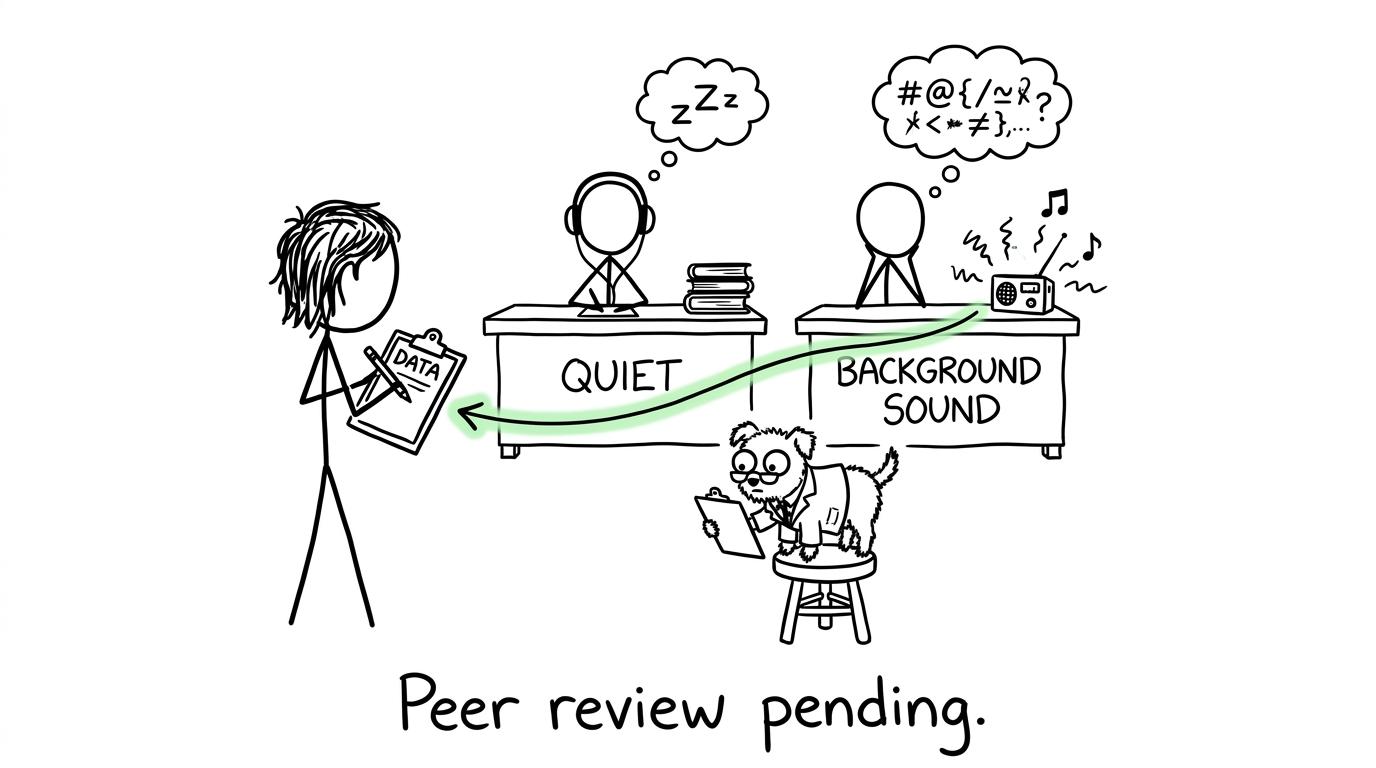 A student conducting a highly serious home revision experiment
Build exam-condition silence gradually
Even if you prefer background sound, some of your revision should resemble the examination. You will not have a playlist during an English Language paper. Silence can feel distracting in its own way if you have never practised in it.
Begin with a short timed response in silence. Build towards a complete section, then a full paper under the conditions required by your exam board. Put your phone out of reach and do not pause the timer.
This is the same reason maths students should move from topic practice to realistic papers. Edexcel GCSE Maths mini tests can provide a manageable starting point, while the guide to when to start GCSE past papers explains how timed practice can develop towards full exam conditions.
When time is short, structure matters even more. A one-week GCSE maths revision plan can reduce daily decisions, while a one-month revision plan allows more time for diagnosis, practice and review.
Common mistakes when choosing a revision sound
Assuming enjoyment proves effectiveness
A playlist may improve your mood without improving comprehension. Judge it by completed work, recall and marks.
Choosing familiar songs with lyrics
Familiar lyrics may be more tempting to follow because your mind predicts the next line. Knowing the song does not remove its language.
Revising beside the television
Television combines intelligible speech, changing volume and visual movement. It is one of the least suitable backgrounds for close reading or writing.
Spending longer choosing music than revising
Constantly searching, skipping tracks or adjusting volume fragments attention before the real work has begun.
Never practising in exam conditions
Music can become a cue that feels necessary for concentration. Regular silent practice prevents that dependence.
Ignoring unavoidable noise
Not every student has access to a silent room. Reduce what you can, move away from conversations and use a steady non-verbal sound to mask disruption if necessary. The goal is a better environment, not a perfect one.
Make silence support active revision
Silence by itself does not produce progress. A quiet hour spent rereading notes may achieve less than a focused session built around retrieval, timed writing and honest marking.
For English Language, practise analysing unseen passages, planning responses and writing against the clock. Use the mark scheme for your board to identify which assessment objective cost you marks.
For maths, MathsGenie gives that process a clear home. Start with free revision lessons and practice questions, check your methods using solutions and mark schemes, and use GCSE predicted papers after building the underlying skills. Predicted papers are practice tools, not promises about exact questions.
The evidence does not say that every sound ruins every task. It says something more useful: language-rich noise creates an unnecessary risk during language-rich revision. Start with silence. If that is impractical, choose quiet non-verbal sound and test it honestly.
Then put the environment in its proper place. It should help you do the work, not become the work. Open MathsGenie's free revision lessons, practise the questions, mark what you complete and build towards mini tests, past papers and predicted papers under calm exam conditions.










