GCSE English Language Revision Environment: Does It Matter?
GCSE English language revision environment advice: cut distractions, practise actively and build a realistic space that helps reading and writing stick.
Revision advice can make a desk sound like laboratory equipment. The right lamp, the right playlist, the right arrangement of highlighters, and supposedly everything will stick.
The truth about your GCSE English language revision environment is less dramatic. Where you revise genuinely matters when it changes your attention, comfort or ability to practise properly. But an ordinary kitchen table where you complete timed answers will usually beat a beautiful desk where you mostly reorganise notes.
Environment helps by removing friction. It cannot replace active revision. For English Language, that means reading unfamiliar texts, planning responses, writing under time pressure and reviewing your work against clear criteria. The same principle applies when you return to GCSE maths revision: the room supports the work, but the work creates the learning.
The quick revision environment checklist
Before changing your entire room, check these essentials:
- Put your phone out of sight and preferably out of reach.
- Keep only the materials needed for the current task on the desk.
- Find a sound level that lets you read closely and write accurately.
- Use a chair and surface that remain comfortable for a focused session.
- Make water, pens and paper available before you begin.
- Decide on one specific task rather than vaguely planning to “do English”.
- Include regular timed practice in conditions resembling the exam.
- Review the quality of your work, not merely the time spent at the desk.
If those conditions are in place, your environment is probably good enough. You do not need a showroom.
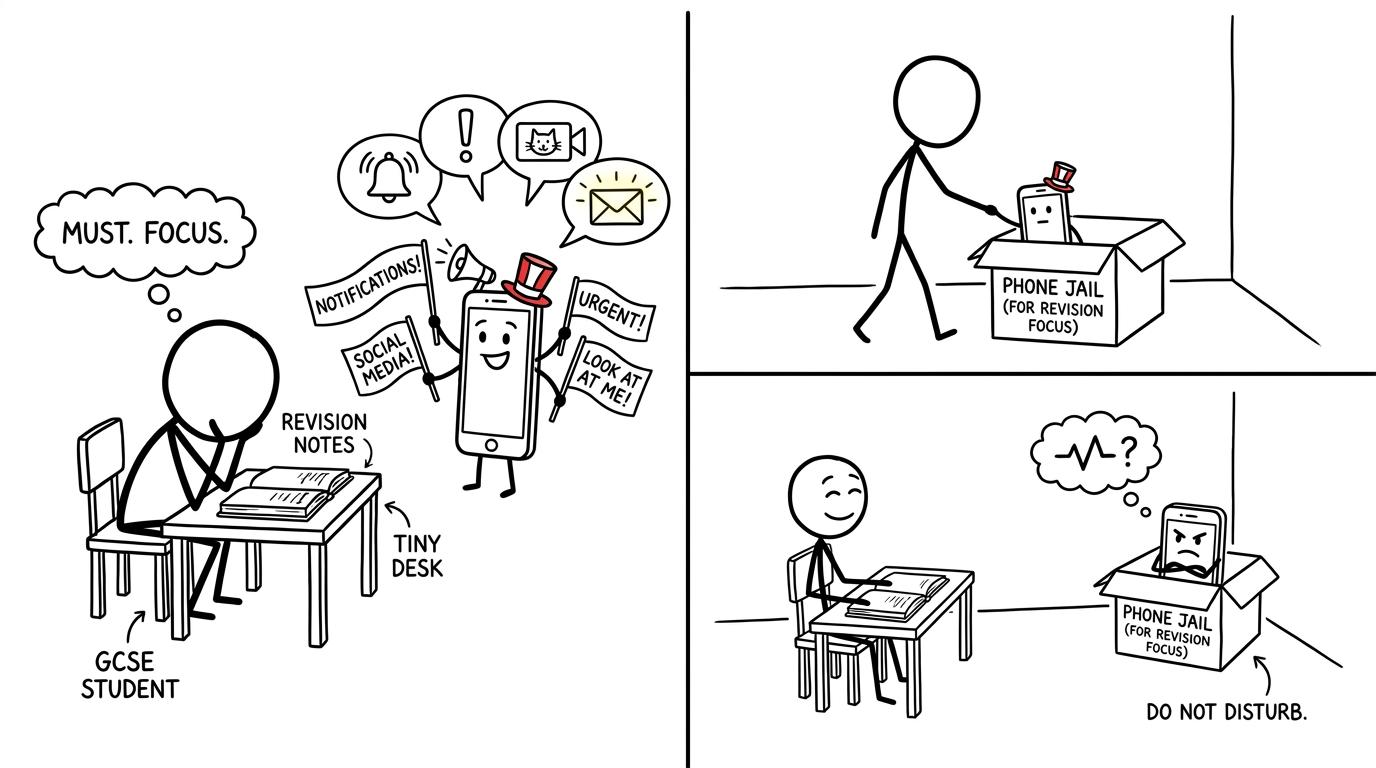 A phone tries to distract a student before being placed across the room
Why the place you revise can affect what sticks
Attention is limited. Reading an unseen extract, tracing a writer’s argument or choosing precise evidence all require you to hold several ideas in mind. Every notification, conversation or unnecessary browser tab competes with that task.
Research on learning environments consistently suggests that intrusive noise can interfere with attention, comprehension and language learning. Evidence concerning blanket phone bans is more mixed, so it would be misleading to claim that removing a phone automatically raises grades. The practical conclusion is narrower and more useful: if your phone repeatedly interrupts your work, increasing the distance between you and the device is sensible.
Your environment also shapes behaviour through small cues. A cleared table with a paper, pen and timer makes the next action obvious. A bed, television and open group chat invite several competing actions. None of this means that bedrooms are always bad or libraries are always good. It means that a useful space makes starting easier and distraction less convenient.
Comfort matters, but perfection does not
A room that is extremely hot, cold, dark or uncomfortable can make concentration harder. Correct the obvious problems where you can: use suitable lighting, sit in a supported position and keep the space ventilated.
Then stop adjusting and begin.
There is a point at which “improving the environment” becomes procrastination wearing sensible clothes. Buying stationery, colour-coding folders and moving furniture may feel productive because each task has a clear finish. Analysing an unfamiliar text feels less comfortable because it exposes what you cannot yet do. That discomfort is often where useful revision begins.
The revision method matters more than the room
A quiet room does not turn passive reading into effective learning. Evidence for retrieval practice and self-regulated learning supports activities in which students plan, attempt, check and evaluate their work. These approaches are strongest when connected to a specific subject task rather than treated as generic memory tricks.
For GCSE English Language, active revision may include:
- recalling the purpose of each assessment objective without notes;
- annotating a fresh extract and selecting evidence;
- planning a comparison before checking what was missed;
- writing one paragraph under a time limit;
- completing a longer reading or writing response;
- using a mark scheme or teacher feedback to identify one precise improvement;
- rewriting a weak section rather than merely reading the comments.
Across AQA, Pearson Edexcel, OCR and Eduqas, paper structures differ, but the regulated assessment objectives cover reading, analysis, comparison, evaluation and effective, accurate writing. Your first reference should therefore be the specification and guidance for your own board.
For a practical feedback cycle, read MathsGenie’s guide to using AQA English Language past papers properly. It treats a completed paper as the beginning of revision rather than the end.
Build a space around the task
The best environment can change during a single week because different tasks require different conditions.
For close reading and writing
Choose your quietest realistic location. Silence is especially useful when language matters because music with lyrics may compete with the words you are reading or composing. If silence is impossible, steady low-level background sound may be less disruptive than unpredictable conversations.
Keep the extract, question and writing materials visible. Remove unrelated books and tabs. You are not trying to create emptiness for its own sake; you are making the current task visually obvious.
For recall and planning
A less formal setting may work perfectly well for recalling assessment objectives, planning possible structures or testing vocabulary. The important feature is that you retrieve ideas before looking at your notes.
Short sessions can be valuable on busy school days. Maths students can use the same structure described in the twenty-minute maths revision routine: choose one narrow task, attempt it, check it and record the next action. For English, the narrow task might be planning one response or improving one paragraph.
For timed paper practice
Make the environment less comfortable and more realistic. Sit at a clear table, use the correct time limit, remove your phone and avoid pausing for hints. You do not need to simulate an exam hall every evening, but regular rehearsal reduces the gap between revision conditions and exam conditions.
This is also how students should approach GCSE maths past papers. Completing some work under genuine constraints reveals difficulties that relaxed practice can hide: slow decisions, fading concentration and careless reading.
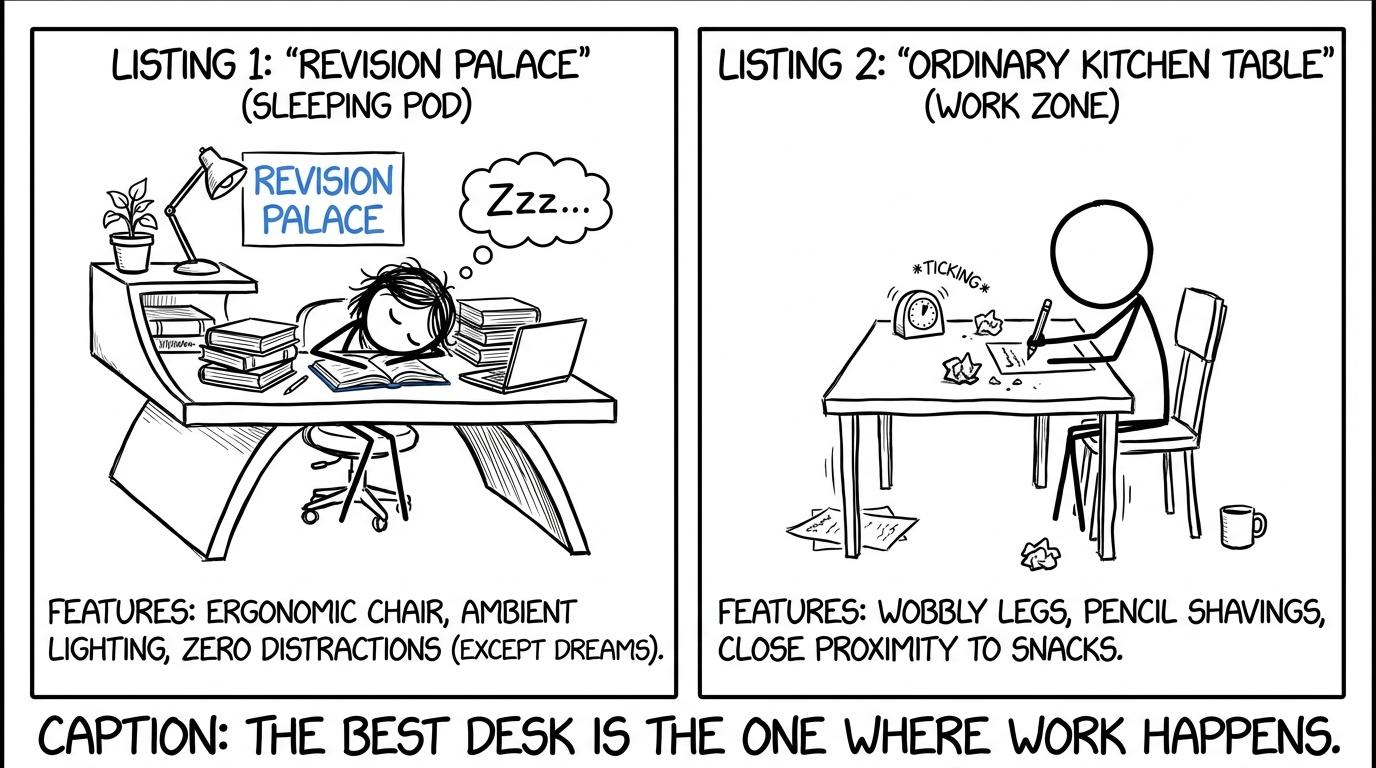 An ordinary kitchen table outperforms an unused revision palace
What if home is noisy or crowded?
Advice about perfect revision spaces can quietly assume that every student has a private room. Many do not. A shared bedroom, a busy household or caring responsibilities can limit your choices. That is a practical constraint, not a lack of commitment.
Look for workable improvements rather than an ideal solution:
- ask whether a school classroom or library is available before or after lessons;
- agree a short quiet period with people at home;
- use headphones to reduce unpredictable noise, without playing distracting audio;
- prepare a portable revision pack so you can use any available table;
- download or print materials in advance if internet access is unreliable;
- split practice into smaller blocks when uninterrupted time is scarce.
Consistency can compensate for glamour. A repeatable half-hour in a modest space is more useful than waiting for a perfect afternoon that rarely arrives.
A plan also reduces the energy spent deciding what to do. The principles in MathsGenie’s GCSE maths revision timetable transfer well: identify weaknesses, schedule specific tasks and include opportunities to check whether improvement has happened.
Run a simple environment test
Do not decide whether music, location or time of day works based only on how revision feels. Comfortable work can create confidence without producing better recall.
Test your environment over several comparable sessions:
- Choose the same type of English Language task.
- Keep the time available broadly consistent.
- Change one factor, such as music or phone location.
- Record whether you finished, how often you became distracted and what the review revealed.
- Retest the skill later without notes.
This is metacognition in practical form: plan, monitor and evaluate. If instrumental music helps you begin but damages reading accuracy, use it before the session or during a break. If the library looks productive but you spend the journey avoiding revision, a home table may be the stronger choice.
Use outcomes, not aesthetics, to judge the space.
Protect sleep as part of the environment
Revision environment is not only the desk. It includes the schedule around it.
Research involving adolescents links sleep with attention, memory and learning. Studies of vocabulary learning have also found that restricted sleep can make crammed material more vulnerable to forgetting, while spacing learning across days offers protection. Staying awake to complete another practice answer may therefore be a poor trade if it leaves you unable to think clearly the next day.
Set a stopping time. Pack away your materials and leave tomorrow’s first task ready. A sustainable revision routine should protect sleep rather than treating exhaustion as evidence of effort.
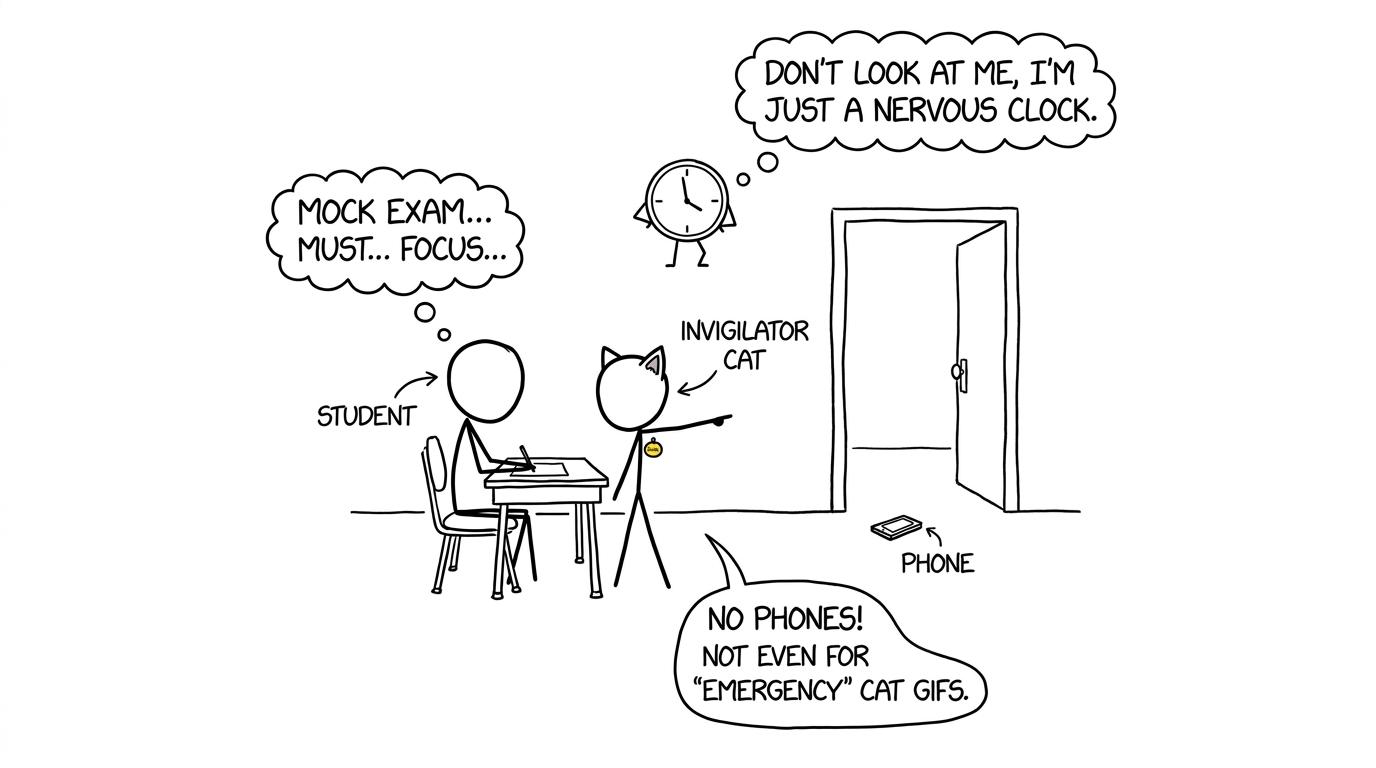 A cat invigilator supervises realistic revision conditions
Common revision environment mistakes
Making the phone slightly less visible
Turning a phone face down does not remove the temptation to check it. If it repeatedly breaks your concentration, place it across the room, use focus settings or give it to someone during the session.
Revising on the bed by default
A bed encourages rest and makes writing full responses awkward. If it is your only private space, sit upright and use a firm surface. Where possible, reserve the bed itself for sleep.
Assuming music always helps concentration
Music may improve mood without improving comprehension. Lyrics are particularly capable of competing with language tasks. Compare your accuracy and output in different conditions rather than relying on preference alone.
Spending longer preparing than practising
A perfect title page earns no marks. Give setup a short limit, then move into an unseen extract, plan or timed answer.
Never practising under exam conditions
Relaxed revision can build knowledge, but it does not fully test pace and stamina. Include quiet, timed sessions with no hints. Maths students can follow the same paper-review cycle in how to use past papers properly.
Measuring revision by hours
Time is an input, not proof of learning. Record completed tasks, mistakes corrected and skills retested. When revising maths alongside English, Edexcel GCSE Maths mini tests provide a manageable way to generate that evidence without completing another full paper.
Your environment should make good revision easier
So, does your GCSE English Language revision environment matter? Yes, but mainly because it can protect attention, reduce friction and support realistic practice. It is not a secret ingredient, and it does not need to be expensive or impressive.
Choose the best workable space. Remove the distractions you can control. Practise actively, review honestly and occasionally reproduce exam conditions. Then use the same habits across your GCSE subjects.
For maths, MathsGenie keeps the next action clear. Open the free revision resources hub, learn through revision lessons, apply the method with practice questions and mini tests, then test yourself using past papers and predicted papers. Mark schemes and video solutions turn mistakes into specific improvements, which is what effective revision, in any environment, is ultimately for.