

GCSE English Language Revision Burnout: Avoid It
GCSE English Language revision burnout: spot warning signs, pace practice sensibly, and protect your sleep, focus and confidence before the May exam season.
A revision plan can look perfectly reasonable on Sunday evening. By Wednesday, every unfinished task feels like evidence that you are falling behind. English Language answers become harder to start, maths questions take longer than usual, and resting creates more guilt than relief.
That is how GCSE English Language revision burnout can begin: not with one dramatic collapse, but with tiredness, pressure and an overloaded timetable gradually making effective work harder. The practical answer is to reduce the size of each task, use active practice instead of endless hours, protect sleep and breaks, and tell someone early if stress is affecting everyday life.
This matters particularly when English Language sits beside maths and several other GCSEs. Your aim is not to spend every available hour revising English. It is to reach the May exam period with enough knowledge, confidence and energy to perform across your subjects.
A quick anti-burnout checklist
Use this checklist before adding anything else to your timetable:
- Choose one specific English Language skill for each session.
- Alternate demanding tasks with lighter review.
- Include maths without trying to cover every topic at once.
- Practise exam questions, then review the feedback.
- Schedule breaks and a firm finishing time.
- Protect regular sleep, meals, movement and time away from revision.
- Keep one catch-up space in your week.
- Speak to a trusted adult if stress is persistent or disrupting daily life.
The principle is simple. A plan should be repeatable when you are slightly tired, not merely possible when you feel unusually motivated.
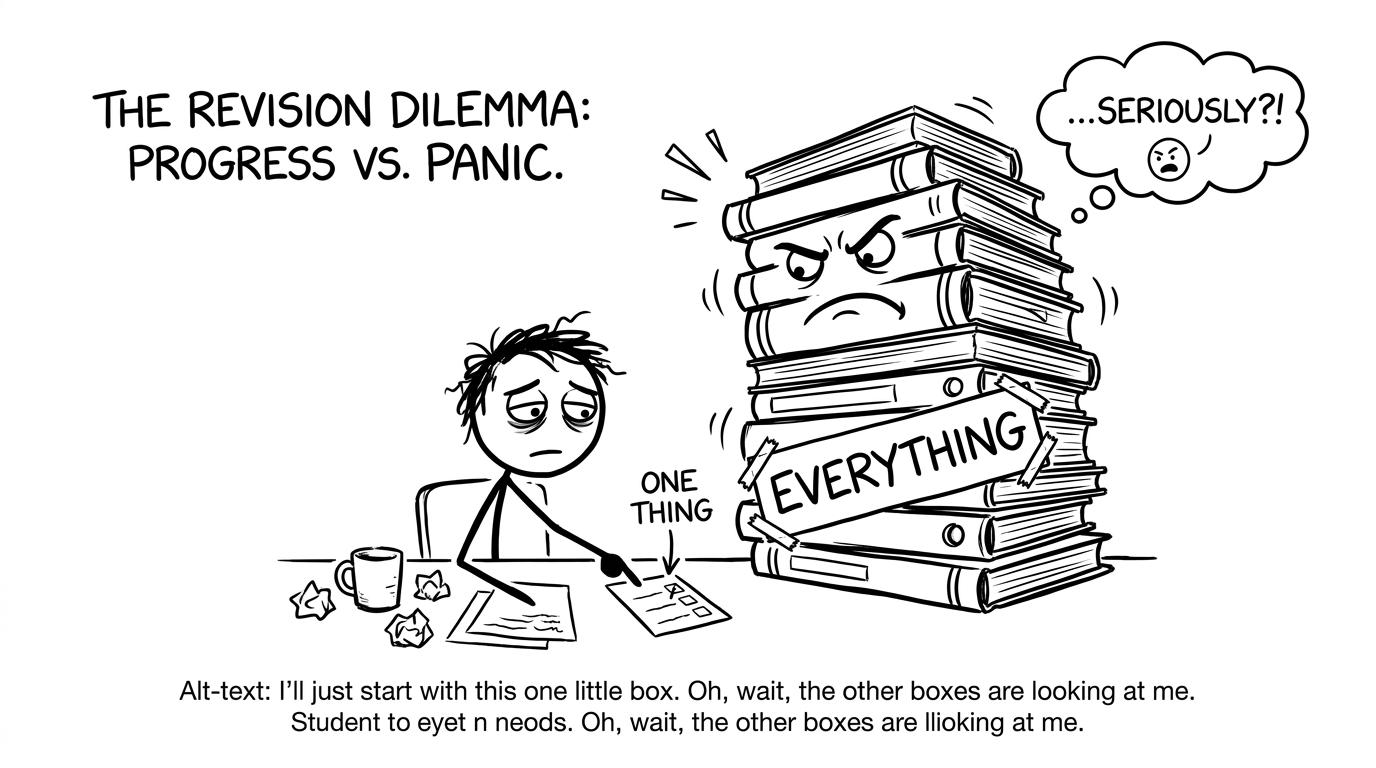 A student choosing one manageable revision task instead of an enormous pile labelled everything
Early signs of GCSE English Language revision burnout
One difficult afternoon is not automatically burnout. You may simply need food, sleep, movement or a change of task. The more useful warning sign is a pattern that continues and begins to affect your work or ordinary life.
Your concentration changes
You read the same extract several times without taking it in. You spend a long time choosing a question but never begin. In maths, familiar methods suddenly feel unusually difficult to retrieve.
This does not necessarily mean that you have forgotten everything. Stress, tiredness and poor sleep can interfere with concentration. Treat the change as information rather than proof that you are incapable.
Revision starts to feel emotionally heavy
Irritability, low mood, persistent worry, feeling overwhelmed or losing motivation can all accompany exam stress. You might avoid English because extended answers feel intimidating, then feel guilty for avoiding it. That guilt makes the next session harder to begin.
The first repair is to shrink the task. Analyse one paragraph, plan one writing response or review one marked answer. Starting with a defined action is usually more useful than writing “revise English” across an entire evening.
Your body is asking for recovery
Exam stress can be associated with sleep problems, headaches, stomach discomfort, changes in appetite and physical tension. These signs deserve attention, especially when they persist.
Most teenagers need substantial, regular sleep, and official NHS guidance emphasises that sleep supports thinking and concentration. An all-night revision session is therefore a poor trade: it purchases more desk time by borrowing from tomorrow’s attention.
You stop enjoying everything else
If hobbies, exercise and conversations disappear because every free moment feels as though it should contain revision, your timetable has become too narrow. Rest is not a prize reserved for students who have completed an impossible list. It is part of the system that allows the next useful session to happen.
If low mood, anxiety or physical symptoms are severe, persistent or interfering with everyday life, speak to a parent, carer, teacher, pastoral lead, school counsellor or GP. Revision advice should not replace appropriate support.
Why English Language can create hidden overload
English Language revision can feel limitless. There is always another extract to annotate, another technique to remember and another answer to improve. Unlike learning one short fact, analytical reading and extended writing demand sustained attention.
Yet the subject becomes more manageable when you think in skills. Across GCSE English Language specifications, reading and writing each carry significant weight. Reading objectives include retrieving information, analysing language and structure, comparing viewpoints and evaluating texts. Writing rewards communication, organisation, vocabulary, sentence control, spelling and punctuation.
You are not revising “all of English”. You are practising one of those skills.
This distinction also protects maths time. Start your wider plan with the free MathsGenie revision planner, then assign each block a precise purpose. For maths, the GCSE Maths revision hub lets you choose resources for your exam board and tier rather than searching aimlessly.
Pace revision so you do not hit a wall in May
Burnout prevention is mostly an exercise in pacing. The closer exams get, the temptation is to lengthen every session. Often, a better response is to make each session more selective.
Give every session a finish line
A useful English Language target might be:
- plan one response to a comparison question;
- write one analytical paragraph;
- improve the opening of one transactional writing task;
- mark one timed answer and identify two changes;
- practise one reading question under a short time limit.
The target describes an action you can complete. “Do English for the whole evening” describes captivity.
Use the same logic for maths. A session can focus on one weak topic, one mini test or one marked paper section. MathsGenie’s guide to building a GCSE maths revision timetable shows how targeted topic work, timed practice and review can sit together without consuming every evening.
Match the task to your energy
Do the most demanding work when you are generally most alert. That might mean a timed English response after school and a lighter review later, or maths problem-solving first and English planning second.
Low-energy work can still be purposeful: organise feedback, review an error log, choose tomorrow’s question or reread a model structure. However, repeatedly replacing active practice with highlighting is not recovery. It is simply less effective revision.
Build a minimum, not a perfect day
A sustainable plan needs a small version for busy or difficult days. Your minimum might be one English paragraph and one short set of maths questions. Completing that minimum maintains continuity without turning tiredness into a crisis.
For maths, Edexcel GCSE Maths mini tests provide a shorter alternative to a full paper. Students taking AQA, OCR or Eduqas should use resources aligned with their own board, but the principle remains the same: shorten the task before abandoning the routine.
Leave space for disruption
Schoolwork expands. Family plans change. Some topics take longer than expected. A timetable packed to capacity has no way to absorb ordinary life, so every delay becomes a source of panic.
Keep a catch-up block free. If nothing needs catching up, use it for rest or brief recall. The empty space is not wasted. It is what makes the rest of the plan believable.
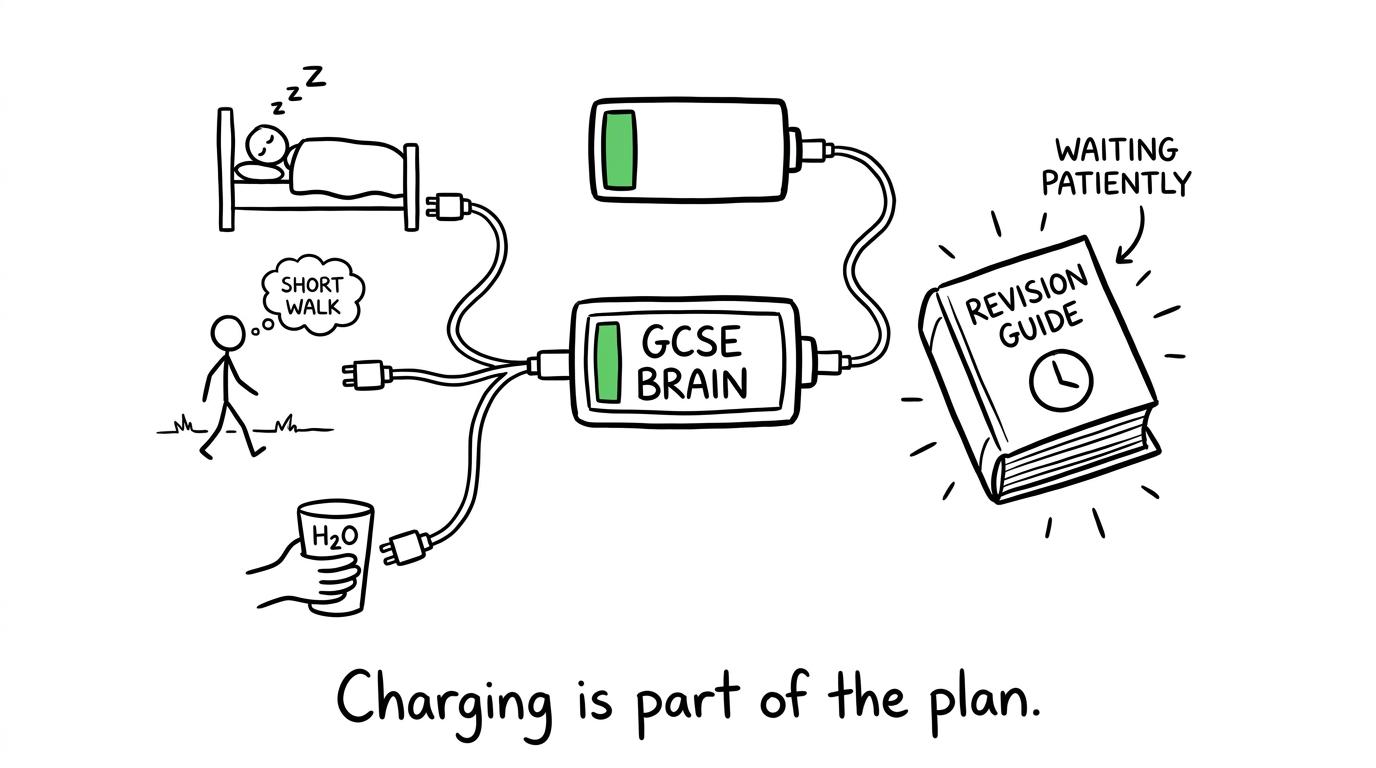 A brain battery charging from sleep, water and a short walk while revision waits
Make English revision active but contained
English Language improves through doing, checking and adjusting. Reading notes about language analysis may feel productive, but the exam requires you to apply that understanding to unseen material.
Use a contained cycle:
- Choose one assessment skill.
- Attempt a relevant question or paragraph.
- Compare your work with teacher feedback or an official mark scheme.
- Write one specific improvement.
- Revisit that improvement in a later session.
Do not rewrite every answer until it feels perfect. That can consume hours while teaching very little. Improvement should be focused: stronger evidence, clearer explanation, more deliberate structure or more accurate punctuation.
The same cycle works in maths: attempt, mark, identify the exact error, repair the topic and retest it. The MathsGenie guide to finding your weakest GCSE topics helps turn lost marks into a short list of useful next actions.
Balance English Language with GCSE maths
Students preparing for maths exams cannot allow one anxious subject to occupy the whole timetable. Balance does not mean giving every subject identical time. It means allocating time according to need while keeping all important subjects active.
A sensible week might contain:
- short English skill sessions rather than repeated full papers;
- focused maths lessons and practice questions;
- one longer timed task when you have the energy to review it properly;
- lighter recall between demanding sessions;
- protected evenings or periods with no revision.
For maths, choose your board and tier before practising. Use topic lessons to rebuild understanding, then add questions and marking. When you need exam realism, the MathsGenie past papers library brings papers and official mark schemes together, with worked or video solutions available for selected papers.
A full paper is not automatically better than a short session. If you are already exhausted, an unreviewed paper may merely confirm that you are exhausted. Shorter, carefully marked practice can produce more useful information.
What to change as May approaches
The final run-up should become more specific, not more frantic. Replace broad subject labels with the exact skills still costing you marks.
For English Language, use teacher feedback and marked practice to choose a small set of priorities. For maths, use mini tests and past papers to locate recurring gaps. The GCSE one-month maths revision plan offers a structured route from diagnosis to targeted practice and timed papers.
As exams begin:
- reduce unnecessary decision-making;
- prepare equipment and materials early;
- avoid comparing revision hours with friends;
- stop heavy revision at a planned time;
- review completed work rather than staring at everything left;
- keep sleep and meals steady.
Confidence often comes from familiarity, not from feeling completely ready. You need enough practice to recognise the task and begin calmly. You do not need to eliminate every weakness before entering the exam hall.
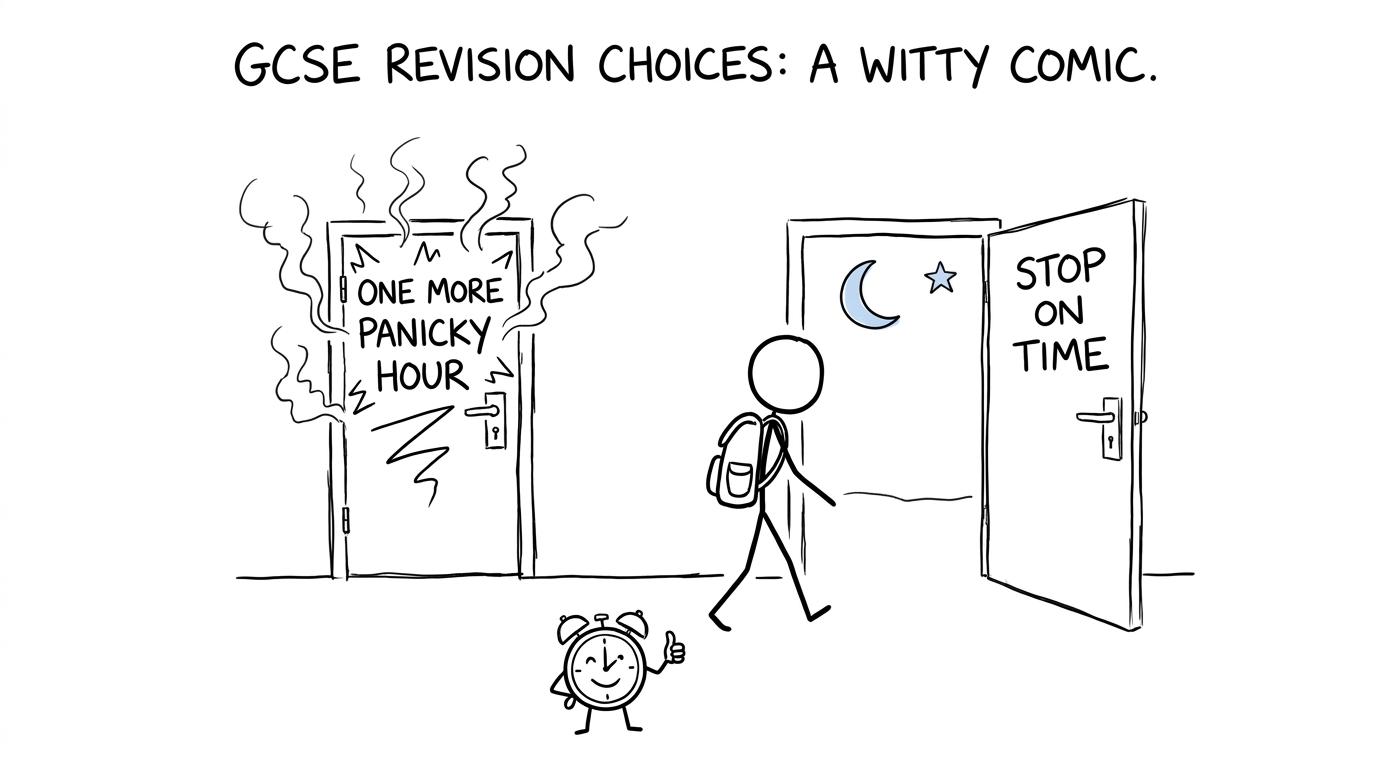 A student choosing the stop-on-time door instead of one more panicky hour
Common revision mistakes that increase burnout
Measuring effort only in hours
Long sessions can contain distraction, rereading and indecision. Track completed actions and corrected errors instead. A short, focused session can be more valuable than an evening spent beside an open book.
Attempting full papers too frequently
Timed papers build stamina, but they also require concentration and careful review. Alternate them with targeted questions. A paper should produce a repair plan, not merely a score.
Treating breaks as failure
A proper break means leaving the task, moving, eating, drinking or doing something restorative. Scrolling through revision content while worrying about work is not much of a break.
Copying somebody else’s timetable
Another student’s plan reflects their subjects, confidence, responsibilities and energy. Build yours from your own feedback and available time.
Ignoring warning signs until the weekend
Do not keep extending the week in the hope that Sunday will repair everything. Reduce the workload as soon as sleep, concentration or mood begins to deteriorate. Ask for support early.
Reach May with something left in the tank
Revision works through repetition. That means the best plan is not the most impressive one; it is the one you can return to tomorrow.
Keep English Language practice active and specific. Give demanding writing tasks clear limits. Balance them with targeted maths revision, genuine breaks and a finishing time you respect. If stress begins affecting daily life, tell someone rather than trying to solve it by adding more work.
MathsGenie can remove much of the decision-making from your maths preparation. Start with the free GCSE Maths revision hub, use revision lessons and practice questions to repair individual topics, and then build towards mini tests, past papers, predicted papers, mark schemes and video solutions. The goal is not to arrive in May having revised every minute. It is to arrive able to think.










