

GCSE English Language Remark: Results Day Guide
GCSE English Language remark guide explaining reviews of marking, deadlines, risks, costs and when challenging your results may be worthwhile.
Results day can reduce months of work to one uncomfortable question: what if the mark is wrong? If you are considering a GCSE English Language remark, speak to your English teacher and exams officer immediately. Check how far you are from the next grade boundary, request access to your marked scripts where possible, and ask a teacher to look for evidence of a genuine marking error.
The official service is called a review of marking, not a re-mark. Your school or college normally submits the request, you must give written consent, and your mark can rise, remain unchanged or fall.
Your results-day decision checklist
Before requesting a review, work through these questions:
- Which exam board did you take: AQA, Pearson Edexcel, OCR, Eduqas or WJEC?
- What was your total mark and the relevant grade boundary?
- How many additional marks would change your overall grade?
- Which paper appears weaker than expected?
- Can your teacher inspect the script before the deadline?
- Can your teacher identify a possible failure to apply the mark scheme correctly?
- Does your sixth-form, college or course place depend on the grade?
- Do you understand that your mark and grade can go down?
- What are your school's deadline, fee and consent arrangements?
Being close to a boundary is a reason to investigate. It is not, by itself, proof that the marking was wrong.
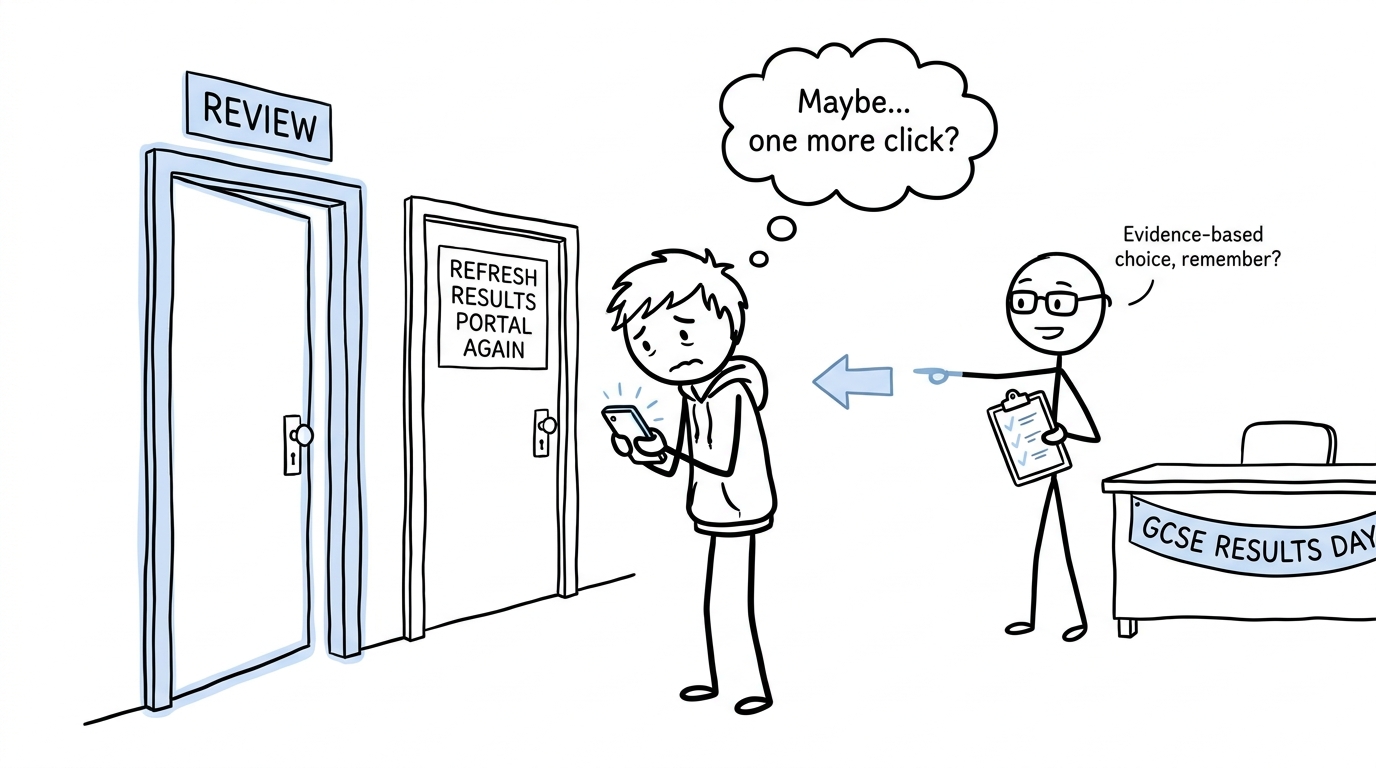 A student choosing between an evidence-based review and repeatedly refreshing the results portal
Step one: check the correct grade boundary
Grade boundaries are set for each exam series, so do not compare your result with an earlier year's figures. Start with the GCSE grade boundaries hub, then select your board and examination series.
MathsGenie provides dedicated pages for:
- AQA GCSE English Language grade boundaries
- Edexcel GCSE English Language grade boundaries
- Eduqas GCSE English Language grade boundaries
- WJEC GCSE English Language grade boundaries
Ask your exams officer for your total qualification mark and, where available, the mark for each component. A result one mark below the next boundary deserves careful attention, but the question remains whether a marking error can be identified.
Step two: understand the GCSE English Language re-mark process
The phrase “re-mark” suggests that a second examiner starts again and awards whatever mark they personally prefer. That is not how the regulated process works.
A Service 2 review of marking checks whether the original marker applied the mark scheme correctly and exercised academic judgement reasonably. It also includes clerical checks, such as confirming that responses were marked and marks were totalled correctly. A reasonable original mark is not replaced merely because another examiner might have awarded a slightly different one.
That distinction matters particularly in English Language. Extended reading and writing responses require academic judgement. A reviewer can correct marking that is unduly harsh, unduly lenient or unsupported by the response and mark scheme, but a review is not a second chance to seek a more generous interpretation.
You can learn more about how assessment criteria work in MathsGenie's guide to using GCSE mark schemes effectively.
Step three: ask for the script to be checked
Where timing and exam-board arrangements allow, ask your school to obtain the marked script before deciding. Candidate consent is normally required for access to scripts.
An English teacher can then look for specific concerns, including:
- a response or page that appears unmarked;
- marks that do not appear to have been counted;
- an assessment-objective level that seems inconsistent with the examiner's annotations;
- creditworthy analysis that may have been overlooked;
- writing marked in a way that appears incompatible with the published descriptors.
The strongest request is based on evidence from the paper. “I usually get a higher grade” provides useful context, but mock results and teacher predictions do not prove an error in the live examination.
Step four: contact your exams officer quickly
For the June 2026 series, GCSE results are released to candidates on Thursday 20 August 2026. The JCQ deadline for standard reviews of results is 24 September 2026, but schools usually impose an earlier internal deadline so they can collect consent, payment and supporting information.
Only Pearson currently offers a priority review for GCSE qualifications. Priority arrangements and deadlines are much earlier, so tell your school immediately if a sixth-form or college place depends on the outcome.
Fees vary by board, component and school policy. They are generally charged per paper rather than for the whole subject. Exam boards commonly waive or refund relevant review fees when the overall qualification grade changes, but you should confirm the current rule with your exams officer before applying.
Step five: give informed consent and await the outcome
Your school must obtain your written consent after results have been published. This is necessary because there is no grade protection for an individual review of marking.
The reviewed component mark can:
- increase;
- stay the same; or
- decrease.
If the corrected component mark changes your overall qualification grade, the new grade is issued. A standard review should normally be completed within 20 calendar days of the exam board receiving it, although your school must communicate the outcome to you.
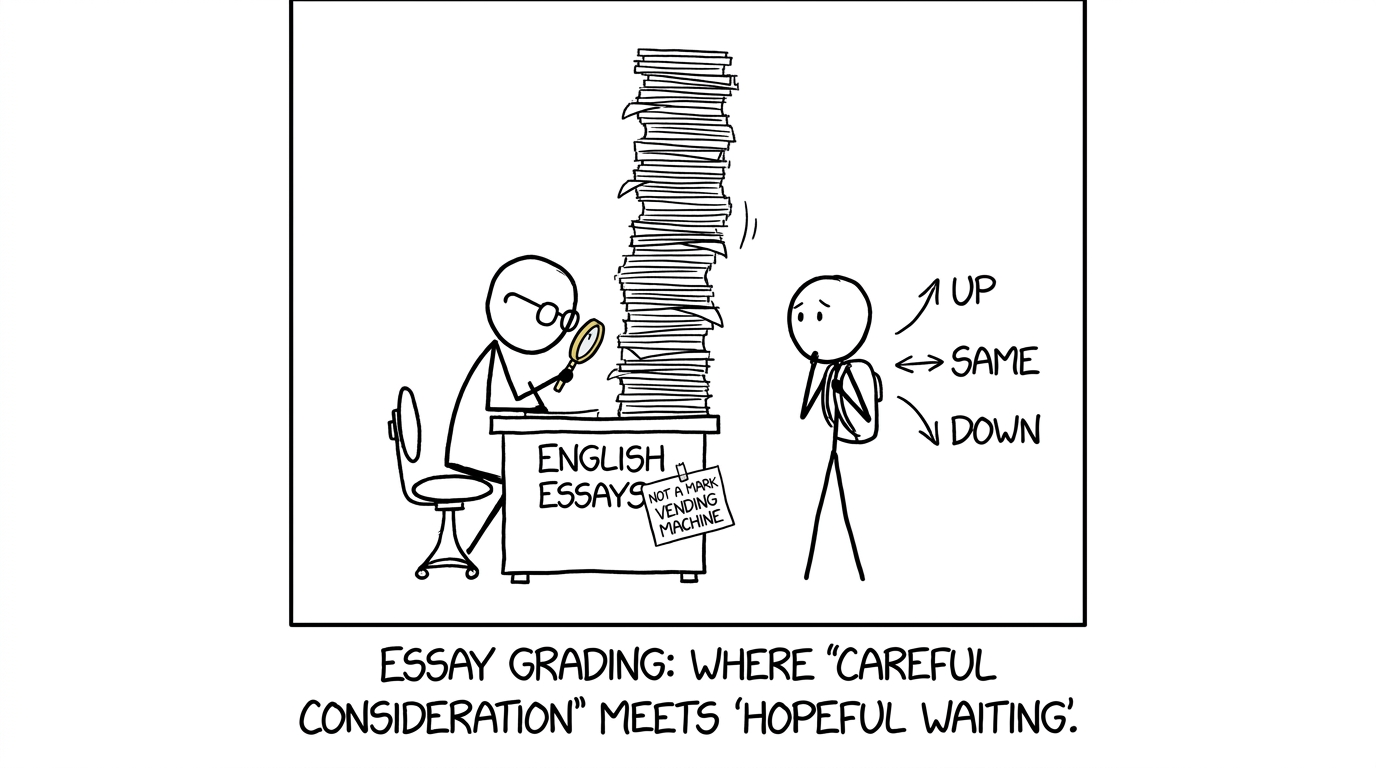 An examiner carefully reviewing essays while marks may move up, stay the same or move down
When requesting a review makes sense
A review is worth serious consideration when you are close to a decisive boundary and a teacher can identify plausible marking concerns. It may also be important when moving from Grade 3 to Grade 4, securing a required Grade 5 or meeting a course entry condition.
Be more cautious when you need a large mark increase, the script appears consistently and reasonably marked, or you are relying only on surprise. English marking involves judgement, but judgement does not make every disappointing result incorrect.
Ofqual's summer 2025 statistics found that most challenged GCSE grades did not change. That does not tell you what will happen to your paper. It does show why evidence should guide the decision rather than the hope that every review produces extra marks.
Appealing a GCSE English Language grade
Appealing a GCSE English Language grade is a later stage, not another name for the initial review. Your school must normally complete the appropriate review of marking before it can appeal.
An appeal may be possible where the school believes a marking error remained uncorrected or the exam board did not follow its procedures properly and fairly. Simply disagreeing with a reasonable academic judgement is not enough. Speak to your exams officer because appeals have separate grounds, fees and deadlines.
Common mistakes to avoid
Waiting for the official deadline
Your school's internal deadline may be considerably earlier. Contact the exams officer on results day or as soon as possible afterwards.
Reviewing every paper automatically
Charges usually apply per component. Ask a teacher which paper contains the clearest concern and whether reviewing that paper could realistically affect the qualification grade.
Assuming marks cannot fall
Written consent exists because marks and grades may be lowered. Read the consent information carefully before agreeing.
Treating a review as guaranteed extra marks
A reviewer corrects errors; they do not award a more favourable mark simply because the result is close to a boundary.
Stopping all revision while waiting
If a resit or another qualification remains part of your plan, keep moving. Maths students can return to the free GCSE Maths revision hub for revision lessons, practice questions, past papers, mark schemes and video solutions, or use GCSE predicted papers for structured exam practice.
Make the decision with evidence, not panic
A disappointing grade can feel final in the first few minutes of results day. It is not always final, but the next step should be calm and precise: check the boundary, obtain your component marks, ask for expert scrutiny and meet your school's deadline.
Start by opening the MathsGenie English Language grade-boundary page for AQA, Edexcel, Eduqas or WJEC. Then speak to your teacher and exams officer before your centre's deadline.
Once the decision is made, let evidence do its work. MathsGenie will be ready for the next stage with free revision lessons, practice questions, mini tests, past papers, predicted papers, mark schemes and video solutions.











