GCSE English Revision Timetable: Is It Worth It?
GCSE English language and literature revision timetable worth it? See when planning helps, when flexibility wins, and how to protect maths revision time.
A revision timetable can look reassuring. Every hour has a colour, every subject has a box, and the week appears safely under control. Then Tuesday changes, one task takes longer than expected, and the whole design begins to feel like evidence that you are behind.
So, is a GCSE English language and literature revision timetable worth it? Usually, yes, but only if it helps you choose useful tasks, revisit them over time and protect revision for other subjects such as maths. A timetable does not improve grades by itself. The revision completed inside it does.
Flexible revision can work just as well when it still includes clear priorities, active practice, feedback and regular review. The best approach for many students is therefore a flexible written plan: enough structure to prevent drift, but enough space to respond to schoolwork, tiredness and what your latest practice reveals.
The short answer: what makes a timetable worthwhile?
A useful GCSE English revision plan should:
- separate English Language from English Literature;
- name a specific task rather than simply saying “English”;
- include active work such as planning, writing, recalling and self-marking;
- revisit important skills and texts across several weeks;
- leave spare capacity for unfinished work and unexpected changes;
- protect regular maths practice rather than allowing English to consume every evening;
- change when practice exposes a more urgent weakness.
If your timetable does those things, it is probably worth making. If creating and maintaining it takes longer than the revision, simplify it.
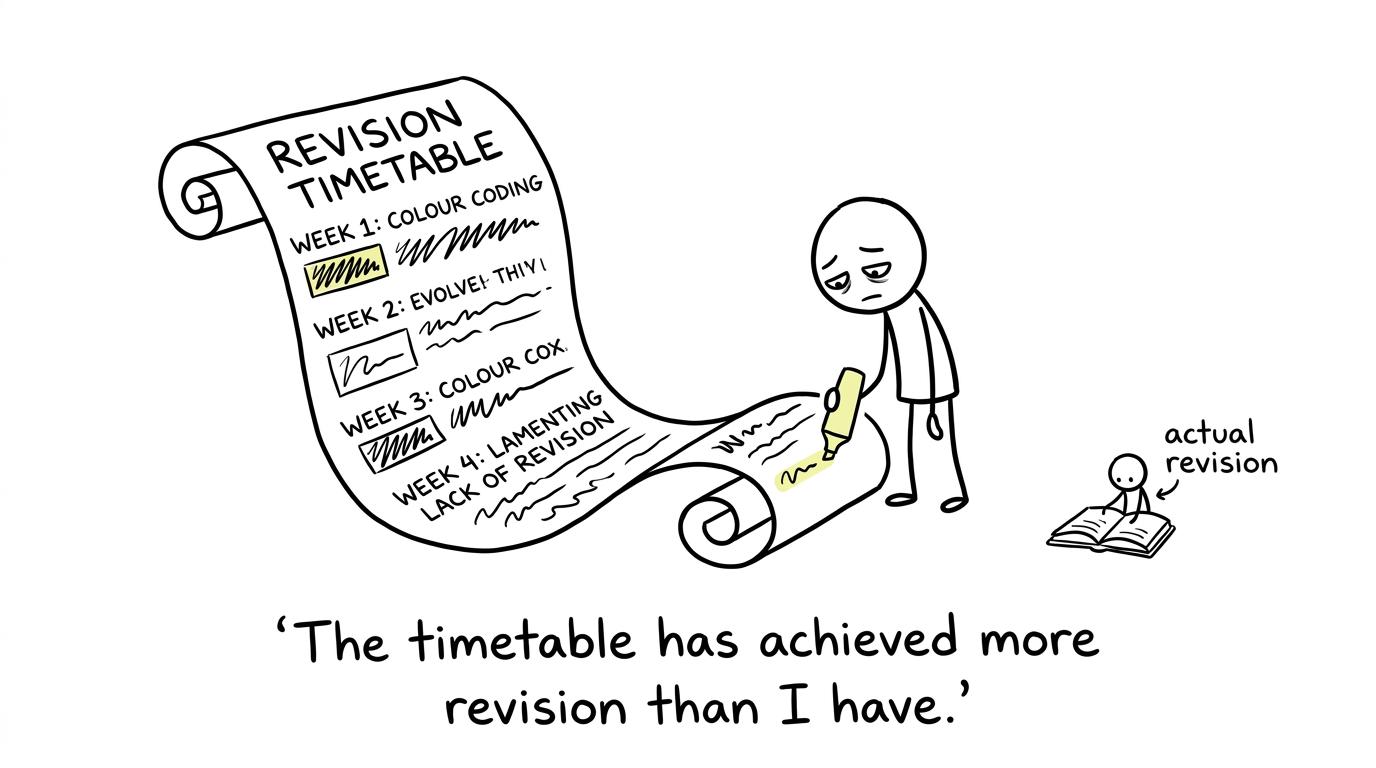 A student discovers that making an enormous timetable is not the same as revising
What the evidence supports and what it does not
Research into metacognition and self-regulated learning supports teaching students to plan, monitor and evaluate their learning. Those three actions matter because effective revision is not one decision made at the beginning of term. It is a loop:
- Plan: decide what needs attention and choose an appropriate task.
- Monitor: check whether you can remember, explain or apply it.
- Evaluate: use feedback to decide what happens next.
This supports the principle behind a revision timetable, but it does not prove that a beautifully written weekly grid directly raises an individual student's grade. The plan is only the planning stage. It must lead to subject-specific practice and be adjusted in response to evidence.
Spacing revision across days and weeks can support retention, while retrieval practice can reveal what is secure and what is fragile. However, neither idea means that every minute must be fixed far in advance. A flexible system can still space practice and prompt retrieval.
That distinction matters. The real choice is not “written timetable or chaos”. It is between a system that produces deliberate practice and one that does not.
English Language and Literature need different revision
One reason vague timetables fail is that they treat English as a single task. The two GCSEs overlap, but they demand different preparation.
Planning for GCSE English Language
English Language largely assesses reading and writing skills applied to material you may not have seen before. Across boards such as AQA, Edexcel, OCR and Eduqas, precise paper structures and timings vary, so use your own specification and teacher guidance.
Useful Language sessions might include:
- answering one reading question under timed conditions;
- identifying explicit and implicit information;
- analysing how language or structure creates an effect;
- comparing viewpoints where your paper requires it;
- planning a transactional, persuasive, descriptive or narrative response;
- writing one section and checking spelling, punctuation and grammar;
- reviewing feedback and rewriting a weak paragraph.
“Revise Language” gives you no starting instruction. “Complete one comparison question, mark it and rewrite the weakest paragraph” does.
Planning for GCSE English Literature
English Literature requires secure knowledge of your prescribed texts alongside interpretation, analysis and essay writing. The exact texts and paper combinations depend on your board and school.
A balanced Literature plan may rotate between:
- recalling quotations from memory;
- reviewing character development and themes;
- connecting evidence to an argument;
- analysing language, form and structure;
- revisiting relevant contextual knowledge;
- planning comparative responses;
- answering extract, essay or unseen poetry questions;
- improving an answer using teacher feedback or assessment criteria.
English Literature is untiered under the main specifications used in England. Do not confuse this with GCSE Maths, where foundation and higher tier affect the papers and grades available.
A flexible timetable is often better than a rigid one
A rigid timetable assumes that you can predict the future precisely. A useful timetable accepts that revision generates new information.
You might discover that quotation recall is already secure but timed Language writing is weak. In maths, a mini test for focused Edexcel practice might show that algebra needs more attention than the geometry session you originally planned. A sensible plan changes.
Try dividing your available revision capacity into roughly:
- 60%60\%60% planned core sessions;
- 20%20\%20% flexible sessions chosen from current weaknesses;
- 20%20\%20% spare capacity for catch-up, rest or approaching assessments.
These proportions are a starting framework, not a scientific rule. The important feature is the spare capacity. A plan scheduled at 100%100\%100% assumes that nothing will go wrong. Real weeks are rarely so obedient.
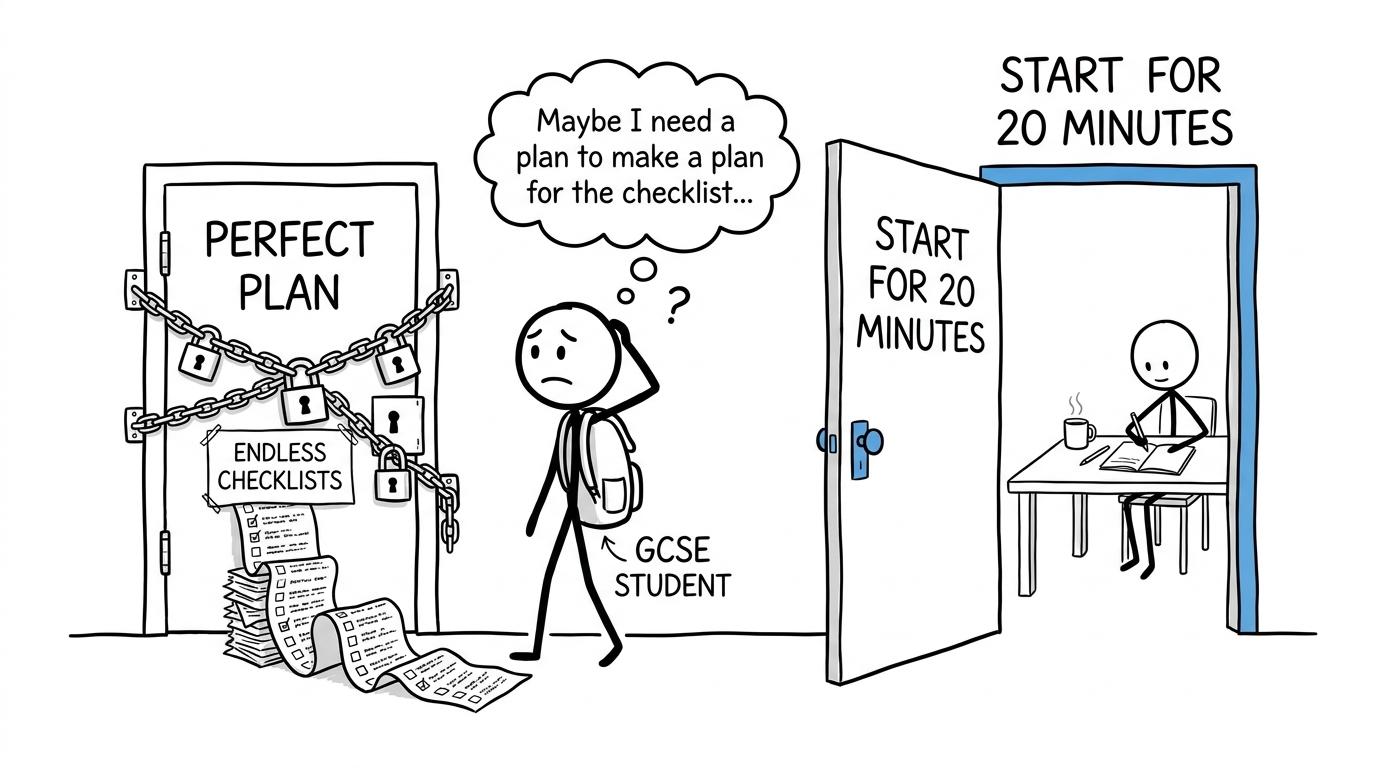 A student chooses the open door marked start for twenty minutes instead of waiting for a perfect plan
How to build a timetable you will actually use
Start with commitments, not subjects
Mark school hours, homework deadlines, travel, meals, sleep and genuine breaks first. Revision must fit around a human life. A plan that depends on constant exhaustion is not ambitious; it is inaccurate.
Next, confirm which specifications and papers you are taking. Exam boards share broad assessment objectives, but question formats, set texts and paper arrangements differ. Use the personalised information supplied by your school rather than copying somebody else's online calendar.
Turn weaknesses into named tasks
List a small number of current priorities for English Language, English Literature and maths. Base them on recent assessments, teacher feedback and practice rather than anxiety.
For maths, the free GCSE Maths revision hub brings together board-specific revision lessons, questions, papers and solutions. If you are unsure where to begin, one diagnostic task is more informative than trying to schedule the entire course.
Each timetable entry should contain a verb and an output:
- recall quotations, then check them;
- plan one essay and refine the thesis;
- answer one timed reading question;
- complete a maths mini test and log errors;
- mark a paper section and choose two repair topics.
Use minimum and stretch versions
Energy varies. Give each session a minimum version that preserves the habit and an optional stretch version for stronger days.
For example, the minimum might be one paragraph or one quotation-recall test. The stretch version might add a timed plan and self-assessment. For maths, the twenty-minute GCSE maths revision routine offers a useful model for turning a small window into active practice.
This is not lowering expectations. It prevents an imperfect day from becoming a completely lost day.
Review the plan every week
At the end of the week, ask:
- What did I actually complete?
- Which task improved my performance?
- What still feels difficult without notes?
- Which mistake appeared more than once?
- Does next week reflect the evidence?
A timetable should behave more like a revision planner than a contract. Move unfinished tasks deliberately; do not copy every missed box into an ever-growing backlog.
Protect maths revision while preparing for English
Students often give the next deadline all their attention. This is understandable, but it can create long gaps in maths practice. Maths methods become more reliable through repeated application, correction and retesting.
Keep at least a few maths touchpoints across the week. These might be a revision lesson, a topic question set, a mini test and part of a paper. The guide to when you should start GCSE past papers explains how to move gradually from targeted questions to timed papers.
When you do use a full paper, do not treat its total mark as the end of the process. Follow the approach in how to use GCSE past papers properly: attempt, mark, diagnose, repair and retest. AQA students can find board-specific practice in the AQA GCSE Maths past-paper collection.
English and maths revision can share the same underlying rhythm:
- attempt something without support;
- compare it with reliable feedback;
- identify the precise weakness;
- practise the missing skill;
- return to it later.
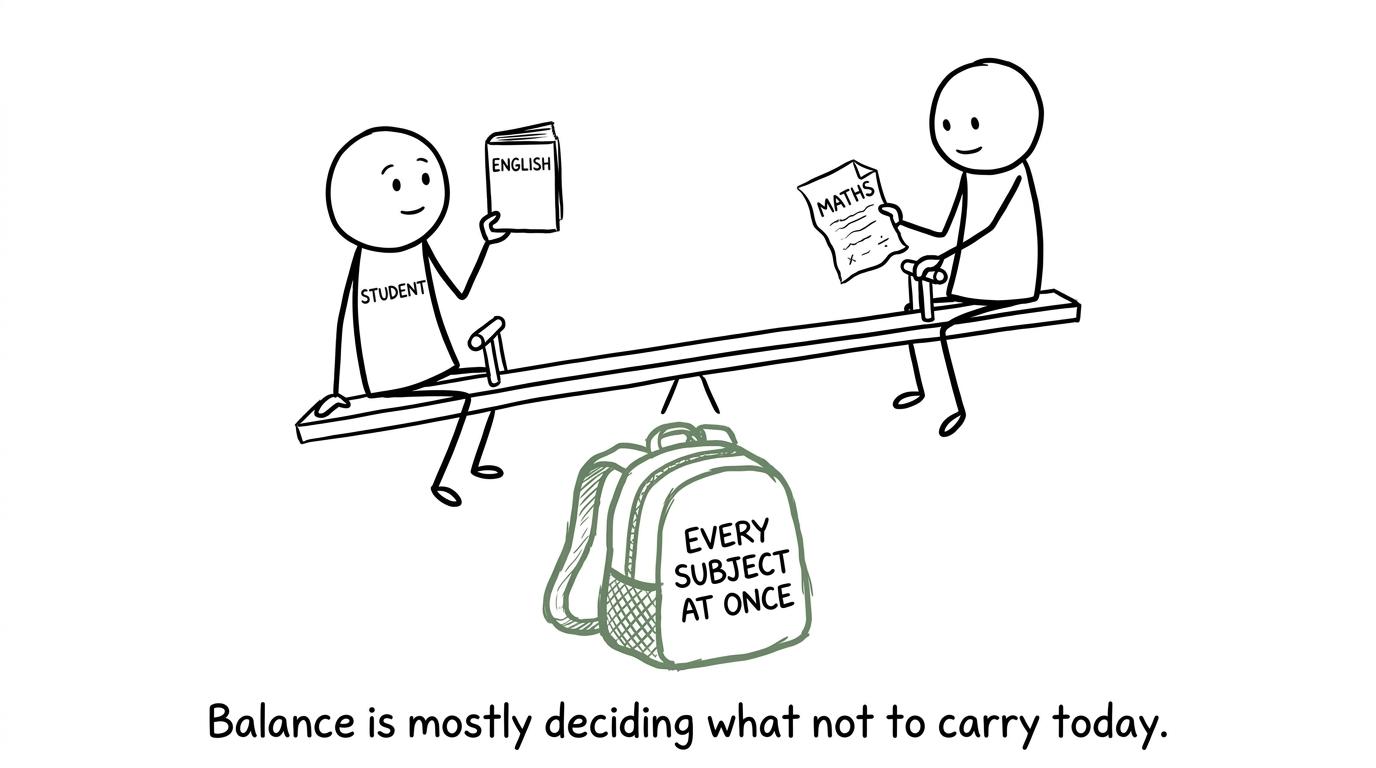 A calm student balances English and maths while leaving the everything at once backpack behind
When flexible revision works just as well
You may not need a detailed weekly grid if you reliably use a shorter system. A flexible task list can work when it contains:
- a fixed number of sessions for each subject;
- a priority list based on evidence;
- clear definitions of what “done” means;
- regular review and rescheduling;
- some method of spacing important topics;
- a record of errors and next actions.
For instance, you might select each day's task from three categories: urgent assessment work, weak-skill repair and spaced review. That gives you freedom without requiring a new decision from an unlimited list.
Flexible revision is less likely to work if “I will choose later” repeatedly becomes “I will start tomorrow”. In that case, give sessions a fixed starting time while keeping the exact task adjustable.
Common mistakes with GCSE revision timetables
Designing instead of revising
Colour-coding can make uncertainty feel manageable, but it is not retrieval, writing or problem-solving. Set a short limit for planning, then begin the first task immediately.
Scheduling subjects rather than actions
“English”, “maths” and “poetry” are labels, not instructions. Name the question, skill, text or resource you will use.
Filling every available hour
A timetable without breaks or spare capacity is fragile. One disrupted evening can make the rest of the week feel ruined.
Treating missed sessions as failure
A missed box is information. Reschedule the task if it remains important, shorten it or replace it with a higher priority. Do not abandon the entire plan.
Revising only what feels comfortable
Rereading familiar notes may feel fluent without proving that you can produce an answer. Include closed-book recall, timed responses, exam questions and honest marking.
Ignoring feedback
The timetable should change after practice. MathsGenie's one-week maths revision plan shows how diagnosis, targeted repair and papers can work together when time is limited.
A timetable should reduce decisions, not create guilt
A GCSE English Language and Literature revision timetable is worth making when it turns intention into specific, repeated practice. It is not valuable merely because it is written down, and flexible revision is not inferior when it still includes planning, monitoring, feedback and review.
Build a light structure. Separate Language skills from Literature knowledge and analysis. Leave room to adapt. Most importantly, protect the maths sessions that keep methods active between assessments.
Use the MathsGenie GCSE revision hub as your free maths base: learn through revision lessons, practise with topic questions and mini tests, then build exam confidence with past papers, predicted papers, mark schemes and video solutions. Add those tasks to your planner, begin with one manageable session, and let the results shape what you do next.