GCSE English Language and Literature November Resit
GCSE English Language and Literature November resit rules explained: see which subject is available, who can enter and when waiting is wiser for you.
Results day has a peculiar way of making two years of work feel like one number on a screen. If English has not gone as planned, the natural question is whether you can put it right quickly. The short answer to the GCSE English Language and Literature November resit question is clear: you can resit GCSE English Language in November, provided you meet the age rule, but standard GCSE English Literature is not available in that series. Literature normally has to wait until the following summer.
English Language and English Literature are separate qualifications. You do not resit them as a combined package, even if your school taught them side by side. That distinction matters because it changes both your timetable and your next decision.
The November resit checklist
Before building a revision plan, confirm these points with your school, college or examination centre:
- Subject: November is available for GCSE English Language, not standard GCSE English Literature.
- Age: you must be at least 161616 on 313131 August in the year of the November examination.
- Entry: a registered examination centre must enter you; you cannot book directly with an exam board as an individual.
- Exam board: check whether you are taking AQA, Pearson Edexcel, OCR or Eduqas and whether your centre will use the same specification as before.
- Components: ask whether a previous Spoken Language endorsement can be carried forward under your board's rules.
- Deadline: centres often impose internal entry deadlines before the exam board's final deadline.
- Purpose: decide whether November gives you enough time to improve, rather than choosing it simply because it is the earliest date.
If English is not your only resit, confirm your maths board and tier at the same time. The MathsGenie GCSE maths revision hub brings together board-specific lessons, questions and papers for Edexcel, AQA, OCR and Eduqas.
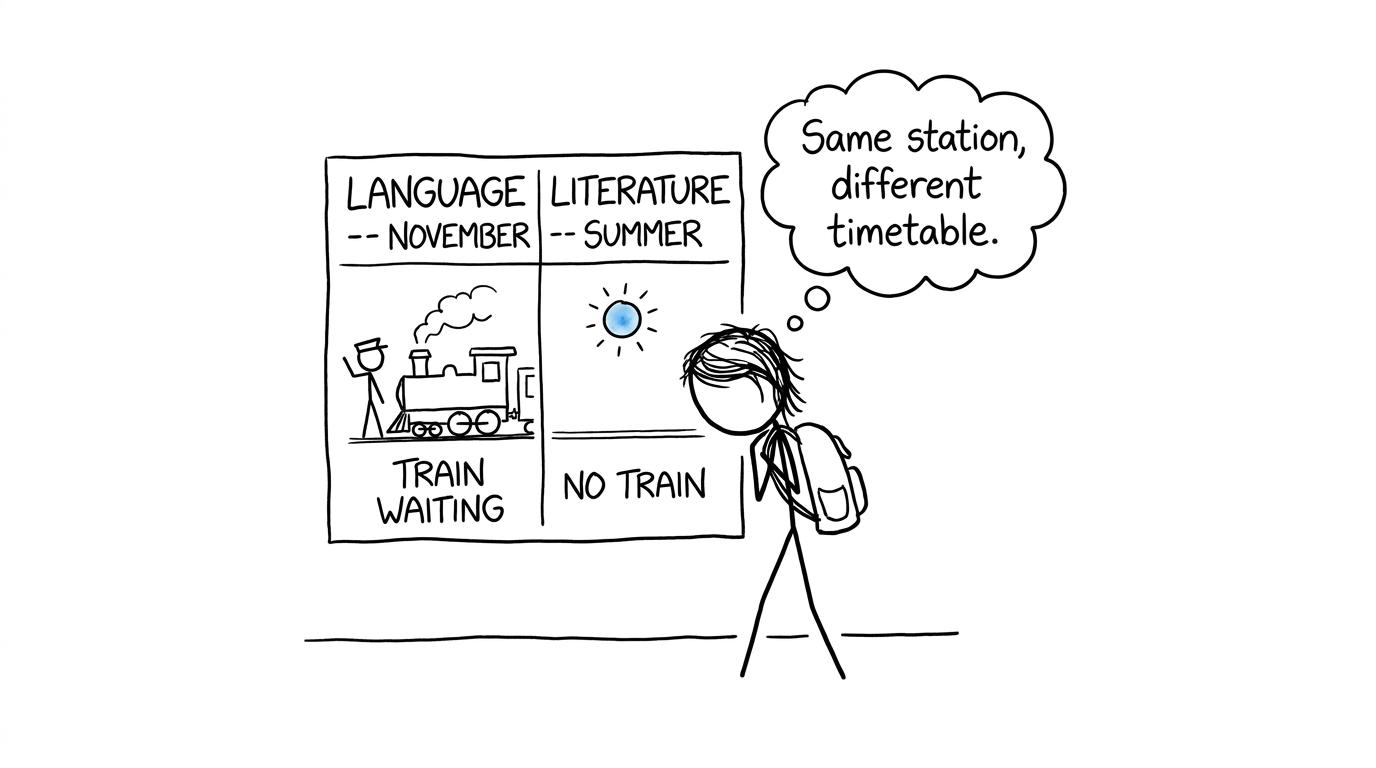 A student discovers that English Language and Literature leave from different exam-series platforms
Can you resit both English Language and Literature in November?
No. Under the standard GCSE arrangements used in England, the November series includes GCSE English Language and GCSE Mathematics. GCSE English Literature is normally assessed only in the summer series.
For example, current AQA and Pearson information confirms November availability for English Language, subject to the age restriction, while listing English Literature for the summer. OCR and Eduqas candidates should still confirm the precise specification and entry arrangements with their centre.
This means your options usually look like this:
| Result or objective | Normal next opportunity |
|---|---|
| Resit GCSE English Language | November or the following summer |
| Resit GCSE English Literature | Following summer |
| Resit both qualifications | Language may be taken in November; Literature waits until summer |
| Improve an existing pass voluntarily | Subject availability and centre agreement still apply |
International GCSE timetables can be different, and qualifications in Wales and Northern Ireland do not always follow the same structure as Ofqual-regulated GCSEs in England. Check the exact qualification title and code on your statement of results rather than relying on the word “GCSE” alone.
Who can take a November English Language resit?
The formal November age rule is straightforward: candidates must have been aged at least 161616 on the preceding 313131 August. In practice, this makes the series suitable for students who have completed Year 111111, as well as older learners and private candidates.
You need an approved centre to make the entry. This may be:
- the school where you took your original GCSE;
- your new sixth form or further education college;
- a training provider that arranges examinations; or
- a private-candidate centre willing to accept your specification.
Do not assume that your entry is automatic. Ask who is entering you, which board you will take, where the papers will be sat and whether there is a fee. A college may organise a required resit, while a voluntary attempt to improve an existing pass may be handled differently.
Do you have to resit English if you received below grade 4?
For students on relevant state-funded post-161616 programmes in England, the current condition of funding requires providers to support students who do not hold grade 444 or above in maths and English.
There is an important detail that is often missed: for the English condition, a grade 444 or above in either GCSE English Language or GCSE English Literature can satisfy the requirement. Therefore, a student with a grade 444 in Literature but a grade 333 in Language is not automatically required by that funding condition to continue English. A course, employer or university may still specify English Language, so individual entry requirements matter.
Where a student has no qualifying English pass, current guidance distinguishes between prior attainment levels. A full-time student with grade 333 is generally expected to study towards GCSE English. With grade 222 or below, an approved stepping-stone route such as Functional Skills Level 222 may be possible, depending on the programme and provider.
This is a funding rule for institutions, not a universal statement that every person must keep resitting indefinitely. Your college should explain how it applies to your programme and circumstances.
Is a November English Language resit realistic for you?
November offers a quick second opportunity, but speed is only useful when it matches the problem.
November may be sensible when
You narrowly missed the grade you need, can begin promptly after results day and understand where marks were lost. It is also more realistic when your new school or college provides regular lessons, feedback on writing and an organised examination entry.
The best candidates for an early resit are not necessarily the most confident. They are the students with a specific diagnosis: weak timing, incomplete responses, underdeveloped analysis or technical errors in writing. A precise weakness can be practised. “I am bad at English” cannot.
November can also help when a future application specifically requires English Language and a January result would arrive usefully early. However, confirm the receiving institution's requirements and deadlines rather than assuming the new result will be accepted in time.
Waiting until summer may be wiser when
A summer sitting may be more realistic if there is a substantial gap between your current performance and target grade, if you had significant gaps in teaching, or if you cannot access regular marking and feedback before November.
Waiting is not the same as giving up. An extra examination series is valuable only if the extra months contain deliberate practice. The principle is familiar from maths: another paper does not change the result by itself; correcting the reasons behind lost marks does.
For maths resit students, the GCSE maths resit results-day plan explains how to turn a disappointing result into a focused sequence of diagnosis, topic repair and timed practice.
How to organise English and maths resit revision together
Two resits can create the illusion that every evening must become a marathon. Usually, the better plan is a repeatable week with separate purposes.
For English Language, prioritise timed reading responses, planned writing, teacher feedback and short rewrites. Use papers from your actual exam board because question wording, assessment objectives and timings vary.
For maths, begin with evidence. A short assessment can reveal more than rereading an entire revision guide. GCSE mini tests are useful for finding focused gaps before you commit to full papers.
A balanced weekly structure could include:
- two English sessions focused on one reading or writing skill;
- two maths sessions repairing specific topics;
- one timed English section;
- one timed maths paper or paper section; and
- one short review session for correcting mistakes from both subjects.
The division does not need to be perfectly equal. Give more time to the qualification with the larger or more urgent gap, then review the balance each week.
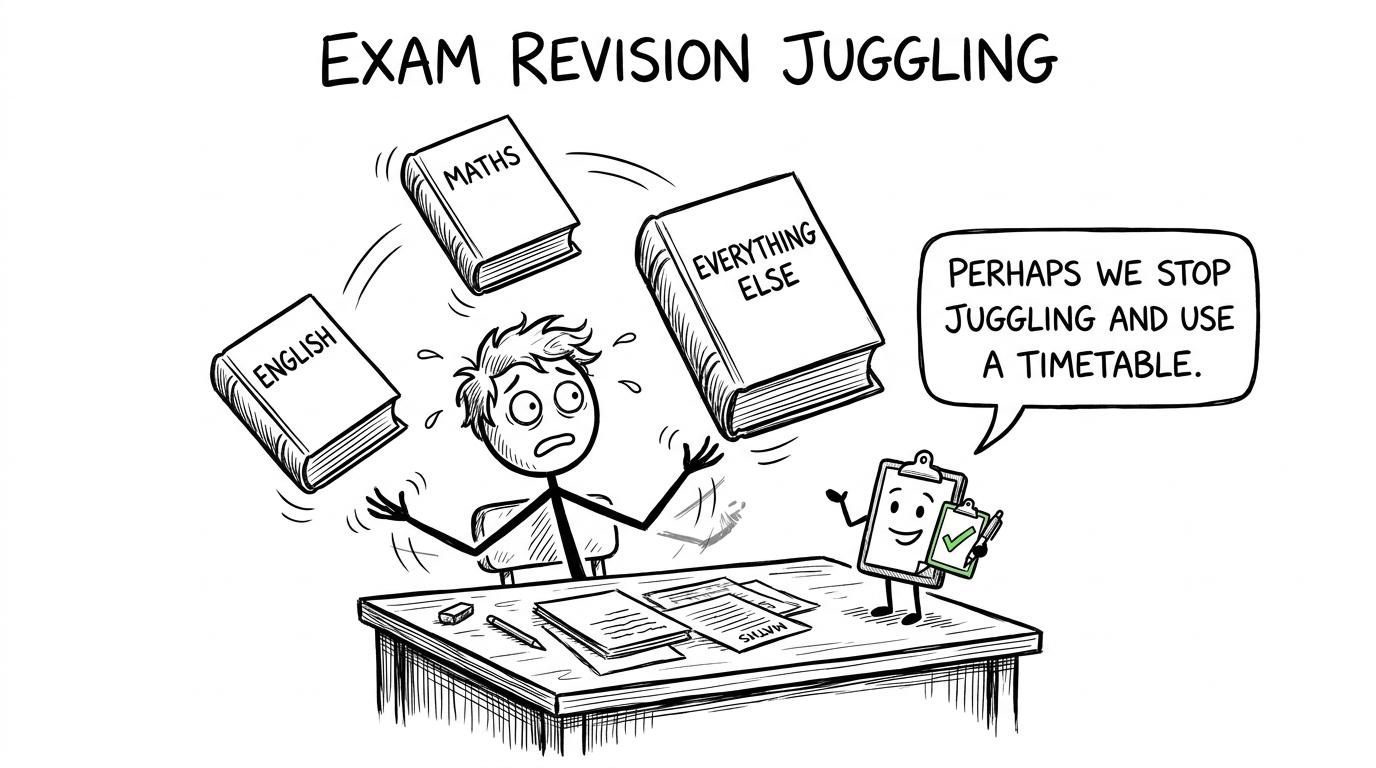 A revision planner persuades a student to stop juggling every subject at once
Use papers to diagnose, not merely to produce scores
A paper is most valuable after you finish it. In English, identify whether marks were lost through misunderstanding the question, thin evidence, limited explanation, poor organisation, weak technical accuracy or unfinished answers. In maths, classify each error as missing knowledge, incorrect application, an accuracy slip or a timing problem.
Then repair the smallest useful skill. MathsGenie provides Edexcel GCSE maths past papers and AQA GCSE maths past papers, with mark schemes and worked support where available. OCR students can use the OCR GCSE maths revision hub for board-aligned lessons, questions and papers.
Do not rush into predicted papers before rebuilding weak skills. Nearer the examination, Edexcel GCSE maths predicted papers can provide fresh timed practice, but they should complement official past papers rather than replace them. The guide to when to start GCSE past papers can help you phase this work sensibly.
Common mistakes when arranging a November resit
Assuming Literature is included
English Language and Literature are separate GCSEs. A November Language entry does not retake or improve your Literature grade.
Missing the centre's deadline
The date advertised by an exam board is not necessarily your personal deadline. Schools and colleges often close entries earlier so that they can complete administration and arrange access requirements.
Changing exam board without checking
A different centre may use a different specification. The broad skills overlap, but paper structure, texts, timings and question styles can change. Confirm the board before practising.
Treating November as an easier series
A resit paper is not designed as an easier route to grade 444. Grade boundaries are set for the particular series, and you must demonstrate the required standard again.
Repeating the same revision method
More time spent rereading notes will not necessarily fix weak timing or incomplete answers. Practise the task that costs marks, obtain feedback, correct it and attempt a similar task again.
Neglecting maths while concentrating on English
If you are resitting both subjects, postponing maths until English is “finished” creates another problem later. Keep a small, consistent maths routine running, even when English temporarily receives more attention.
Make the next examination a different experience
The central answer is simple: GCSE English Language can be taken in November by eligible candidates, but standard GCSE English Literature cannot. Whether Language should be taken then is a more personal decision. It depends on your age, centre, current grade, target, available support and the amount of useful preparation time ahead.
Confirm the entry first. Diagnose the marks second. Then build a plan small enough to repeat.
For the maths side of that plan, start with MathsGenie's free GCSE revision resources. Use revision lessons and practice questions to repair individual topics, mini tests to check progress, and past papers, predicted papers, mark schemes and video solutions to prepare for the real examination. A resit is not a return to the beginning; it is a chance to revise with better information.