

GCSE English Language and Literature Exam Season Results
GCSE English language and literature exam season results explained: why summer and November outcomes differ, and how to choose the right sitting.
A November pass rate can look lower than a summer pass rate. It is tempting to see that difference and conclude that the autumn exam must be harder. But headline figures rarely tell the whole story.
The short answer on GCSE English language and literature exam season results is this: the season itself should not make a particular grade easier or harder to achieve. Ofqual requires exam boards to maintain comparable standards between series. However, the students entering each series, their preparation time and the pressures surrounding the exam can be very different.
There is also an important distinction. In England, GCSE English Language is available in summer and November, subject to November entry restrictions. GCSE English Literature is normally available only in the summer series. So, where people compare “winter” with summer English results, they are usually talking about English Language resits.
The answer at a glance
- GCSE English Language can be taken in summer or November in England.
- November candidates must normally have been aged at least 161616 on 31 August of that year.
- GCSE English Literature is generally assessed only in the summer series.
- Exam boards maintain the same grade standard across different series.
- Grade boundaries can move because papers vary in difficulty.
- Overall summer and November pass rates should not be compared as if the candidates were equivalent groups.
- The best sitting depends on readiness, preparation time and practical entry arrangements, not on trying to find an easier season.
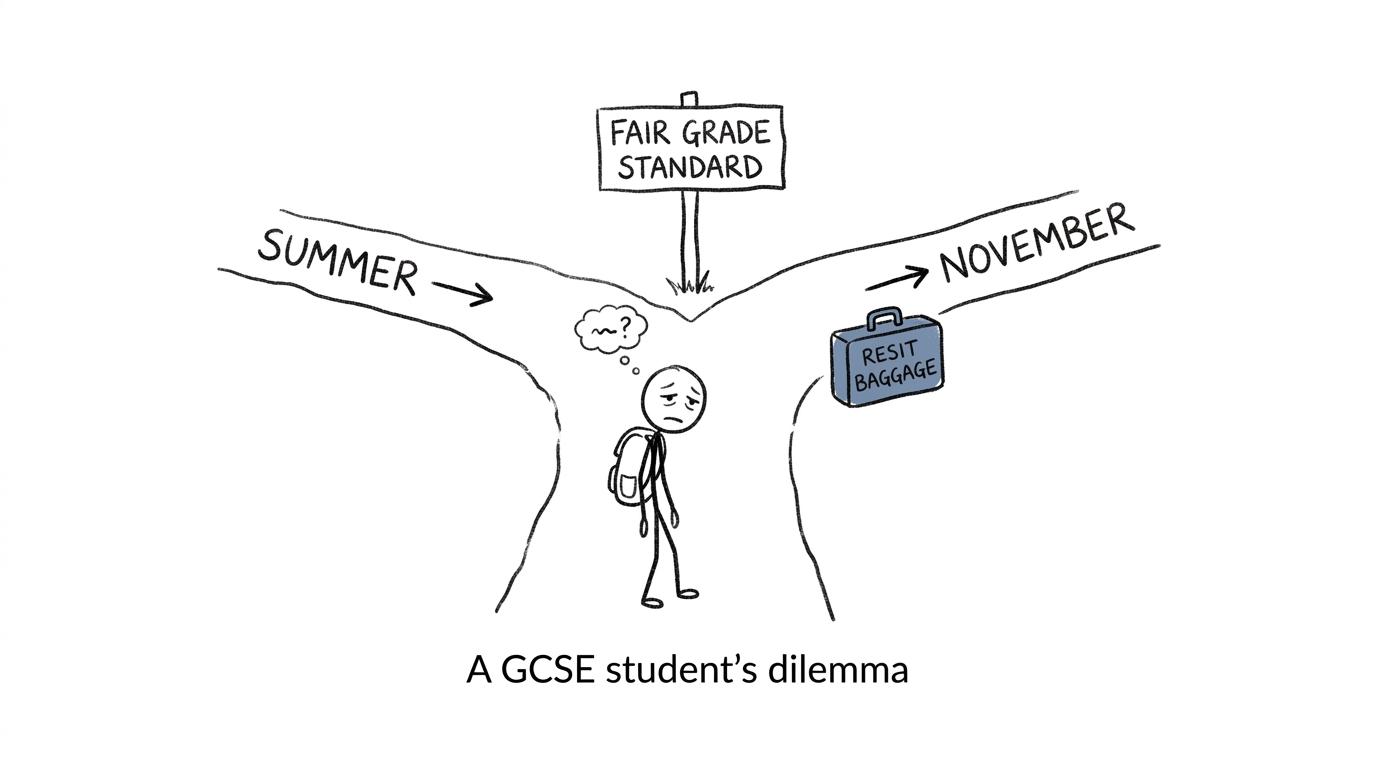 A student choosing between summer and November paths that lead towards the same grade standard
Which English GCSEs are available in November?
In England, the routine November GCSE series includes English Language and Mathematics. It is mainly used by post-161616 students resitting qualifications, although adult learners and eligible students who missed the summer series may also enter.
November entry for English Language is normally restricted to candidates who were aged at least 161616 on 31 August immediately before the series. Schools, colleges and examination centres manage entries, so students should confirm eligibility, deadlines and fees directly with their examination officer.
English Literature is different. It does not normally have a November series under the current specifications used by AQA, Pearson Edexcel, OCR and Eduqas. A student wishing to improve an English Literature grade usually has to wait for the next summer series.
That means there is no normal summer-versus-November English Literature dataset from which to judge the effect of season. The meaningful comparison concerns English Language.
Arrangements can differ outside England, particularly because Wales and Northern Ireland operate different qualification systems and grading structures. Always check the rules for your qualification, nation and exam board rather than assuming that every GCSE follows the same timetable.
Is GCSE English Language harder in November?
Not by design. Ofqual states that standards are maintained in each exam series. A grade 444 in November is intended to represent the same standard of work as a grade 444 in summer.
This does not mean the question papers are identical or that their grade boundaries will match. Each series has a new paper. One paper may prove slightly more accessible than another, so exam boards set boundaries after marking and reviewing evidence about how the assessment performed.
If a paper is more demanding, the grade boundary may be lower. If it is more accessible, the boundary may be higher. A lower boundary does not automatically make a series easier, just as a higher boundary does not make it unfairly difficult.
Senior examiners review candidate work, statistical evidence and standards from previous series. Ofqual monitors the awarding process. The aim is comparable achievement, not identical raw marks.
 A student discovering that different grade boundaries can reflect different paper difficulty
Why November and summer outcomes can look different
The largest difference is usually the group of students taking the examination.
Summer contains the main Year 11 cohort
Most Year 111111 students sit GCSE English Language and Literature in May and June. This is a broad national cohort, including students across the full grades 999 to 111 range and candidates taking the qualification for the first time.
November is largely a resit cohort
Most November entrants are older students seeking to improve an earlier result. Many are working towards grade 444 while also beginning college courses, apprenticeships or other post-161616 programmes.
This creates selection bias. The November group contains a much greater concentration of students who previously found English Language difficult. Comparing its overall grade distribution with the summer distribution is therefore not a fair test of whether November papers are harder.
Ofqual explicitly warns against treating differences in overall outcomes as evidence that one series is easier. The cohorts differ in prior attainment, age, entry history and reasons for sitting the qualification.
It is similar to comparing the average score from an entire football league with the average score from a group selected because they lost their previous match. The second group may produce a lower average, but the calendar did not cause it.
How the season can affect an individual student
The formal grade standard remains comparable, but the timing can still influence the circumstances in which you perform.
November offers a quick second attempt
A student who narrowly missed a required grade in August may still remember much of the course. With focused feedback and several weeks of deliberate practice, November can provide a useful opportunity to improve without waiting a full academic year.
The interval is short, though. If the original result reflected significant gaps in reading, writing or examination technique, a few weeks may not be enough to rebuild those skills securely.
Summer provides more preparation time
Waiting until summer gives a student longer to practise extended writing, analyse unseen texts and respond under timed conditions. The cost is delay. English revision must also compete with other courses and, for some students, another summer examination timetable.
Your workload matters more than the weather
A November candidate might be adapting to sixth form or college while revising English and perhaps resitting maths. A summer candidate may face a crowded timetable across several subjects. Neither season is automatically calmer.
For students balancing both resits, the MathsGenie GCSE maths resit plan gives a practical process for diagnosing lost marks before committing time to full papers.
How to decide between November and summer
If both English Language sittings are available to you, ask four questions.
How close was the previous result?
A near miss may be repairable through focused work on a small number of recurring weaknesses. A result showing broader gaps may point towards the longer preparation window before summer. Your teacher or college should help interpret your script and question-level performance.
Can you practise consistently before November?
Count realistic sessions, not hopeful ones. Include your maths revision, coursework, travel and other responsibilities. A sustainable timetable is more valuable than a plan built around daily cramming.
The same principle applies to maths. The GCSE maths revision timetable guide shows how to combine targeted learning, timed practice and review without allowing one subject to consume the entire week. If time is short, the one-month GCSE maths revision plan offers a more compact structure.
What does your next step require?
In England, the current post-161616 funding condition treats grade 444 or above in either GCSE English Language or English Literature as meeting the English requirement. However, individual sixth forms, universities, apprenticeships and employers may specify English Language or set a higher grade requirement. Check the exact entry criteria that apply to you.
Is the correct examination centre available?
Confirm the exam board, specification, entry deadline and spoken-language endorsement arrangements. Do not assume that your previous school will enter you automatically. Private candidates may need to locate an approved centre and pay its fees.
Protecting maths revision while preparing for English
Students resitting English Language often resit maths in the same November series. The danger is not that the subjects are incompatible. It is that revision becomes reactive: English feels urgent one evening, maths feels urgent the next, and neither receives enough focused practice.
Use separate, visible targets. For English, that might mean one timed reading response and one writing task. For maths, it might mean one topic lesson followed by exam-style questions and immediate marking.
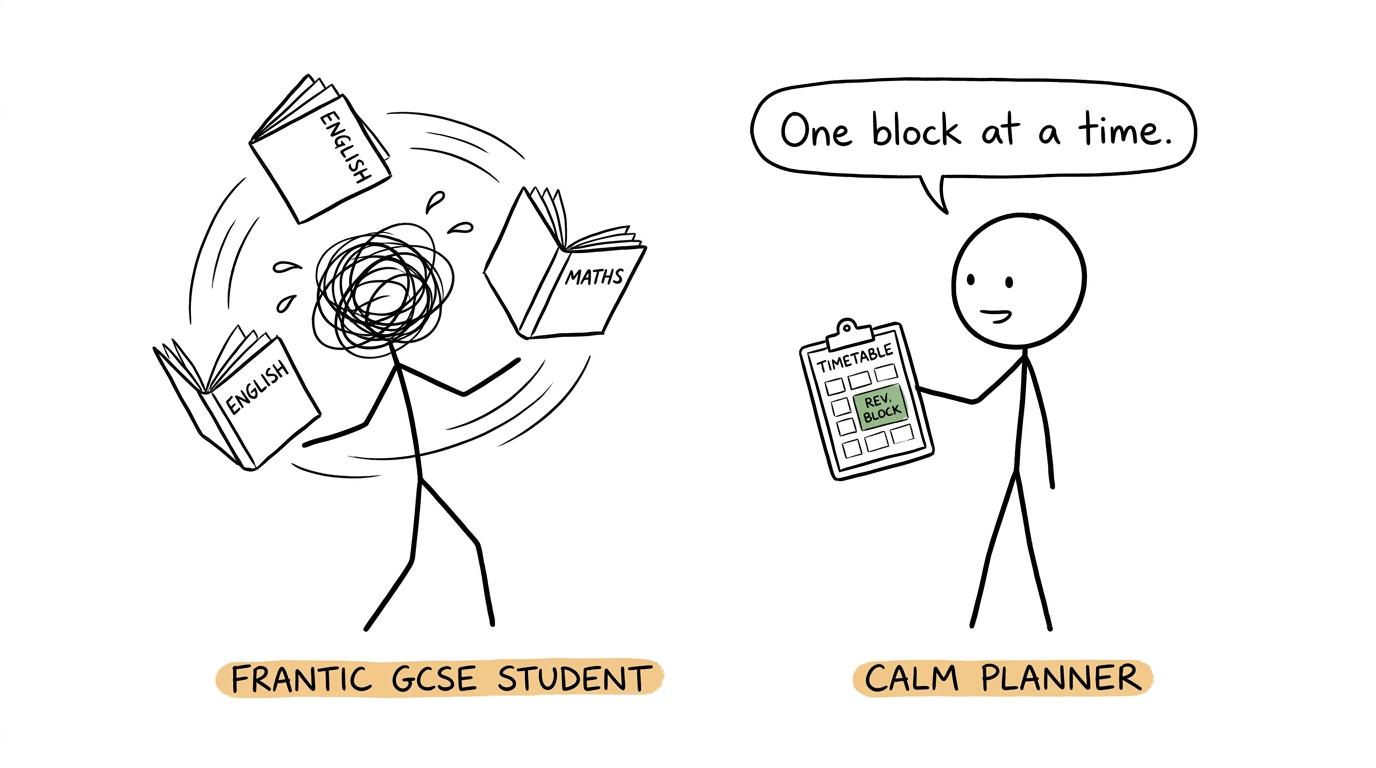 A student juggling English and maths while a revision planner recommends one block at a time
Start maths planning from the GCSE maths revision hub, where resources are organised by exam board. Use the MathsGenie resources collection for mini tests, practice papers and predicted papers.
A reliable revision cycle is:
- attempt a suitable question set under timed conditions;
- mark it accurately;
- identify the precise reason for each lost mark;
- revisit the relevant lesson;
- practise the skill again;
- retest it after a short gap.
The guide to using GCSE past papers properly explains why marking and repair matter more than simply completing more papers. If you are unsure where to begin, use the process for finding your weakest GCSE topics rather than revising comfortable material repeatedly.
Common mistakes when comparing exam seasons
Treating the pass rate as the difficulty rate
A lower proportion achieving grade 444 in November does not prove that the November paper was harder. The entrants are mainly resit students and are not representative of the summer cohort.
Comparing raw grade boundaries alone
Boundaries respond to the difficulty of each paper. They need context. The standard of work required for a grade is more important than the raw boundary itself.
Assuming English Literature has a November resit
Under the usual GCSE arrangements in England, November is available for English Language, not English Literature. Literature candidates normally wait until summer.
Choosing the earliest sitting without checking readiness
Speed can be valuable, particularly after a near miss. But an early resit without enough targeted preparation may repeat the same problems. Choose the earliest sitting for which you can be properly ready.
Letting English revision erase maths revision
Both subjects may affect progression. Allocate recurring sessions to each and use evidence from marked work to decide what to revise. The twenty-minute maths revision routine is useful when English preparation makes the week feel crowded.
The season matters less than the preparation
Summer and November English Language examinations are intended to uphold comparable grade standards. Different headline outcomes mainly reflect different candidates, not a seasonal advantage. For English Literature, the choice is simpler because the qualification is normally available only in summer.
Your real decision is whether you have enough time, support and accurate feedback to improve before the next available sitting. Confirm the rules with your school, college or exam centre, then build a plan around the evidence in your previous work.
While you prepare for English, keep maths moving through small, repeatable steps. Visit the MathsGenie GCSE maths revision hub for free revision lessons, practice questions, past papers, predicted papers, mark schemes, mini tests and video solutions. Choose your exam board and tier, identify the marks you are losing, and turn each mistake into the next useful revision task.










