GCSE English Language Grade 9 Meaning Explained
GCSE English Language grade 9 meaning explained: understand the ability it represents, how it compares with A*, and what grade boundaries really show.
There is a strange moment in GCSE revision when a target grade stops feeling like a number and starts feeling like a judgement. A grade 999 can seem to mean flawless writing, effortless analysis and never misplacing a comma. It does not.
The GCSE English Language grade 9 meaning is simpler: it is the highest grade available in England and represents exceptional performance across the assessed reading and writing skills. It sits above the standard represented by the old A*, although there is no exact one-to-one conversion. You do not need a perfect paper, and there is no fixed mark that guarantees it every year.
For a maths student, that distinction matters. Grades measure performance against an assessment standard, not your intelligence or potential. The same principle applies when you use MathsGenie's GCSE maths revision resources to move from understanding a topic to performing accurately under exam conditions.
The quick answer
A grade 999 in GCSE English Language means that a student has produced work at the very top of the GCSE performance scale. In practical terms, this usually involves:
- perceptive and convincing interpretation of unseen texts;
- detailed analysis of language and structure;
- critical evaluation supported by carefully selected evidence;
- effective comparison of ideas and perspectives;
- ambitious, coherent writing adapted to purpose and audience;
- precise vocabulary and varied sentence structures;
- consistently strong spelling, punctuation and grammar;
- effective decisions under timed examination conditions.
It does not mean that every sentence is perfect. Nor does it mean that a student must be a novelist or already working at A Level standard. It means that the overall collection of marks across the qualification reaches the grade 999 boundary set for that exam series.
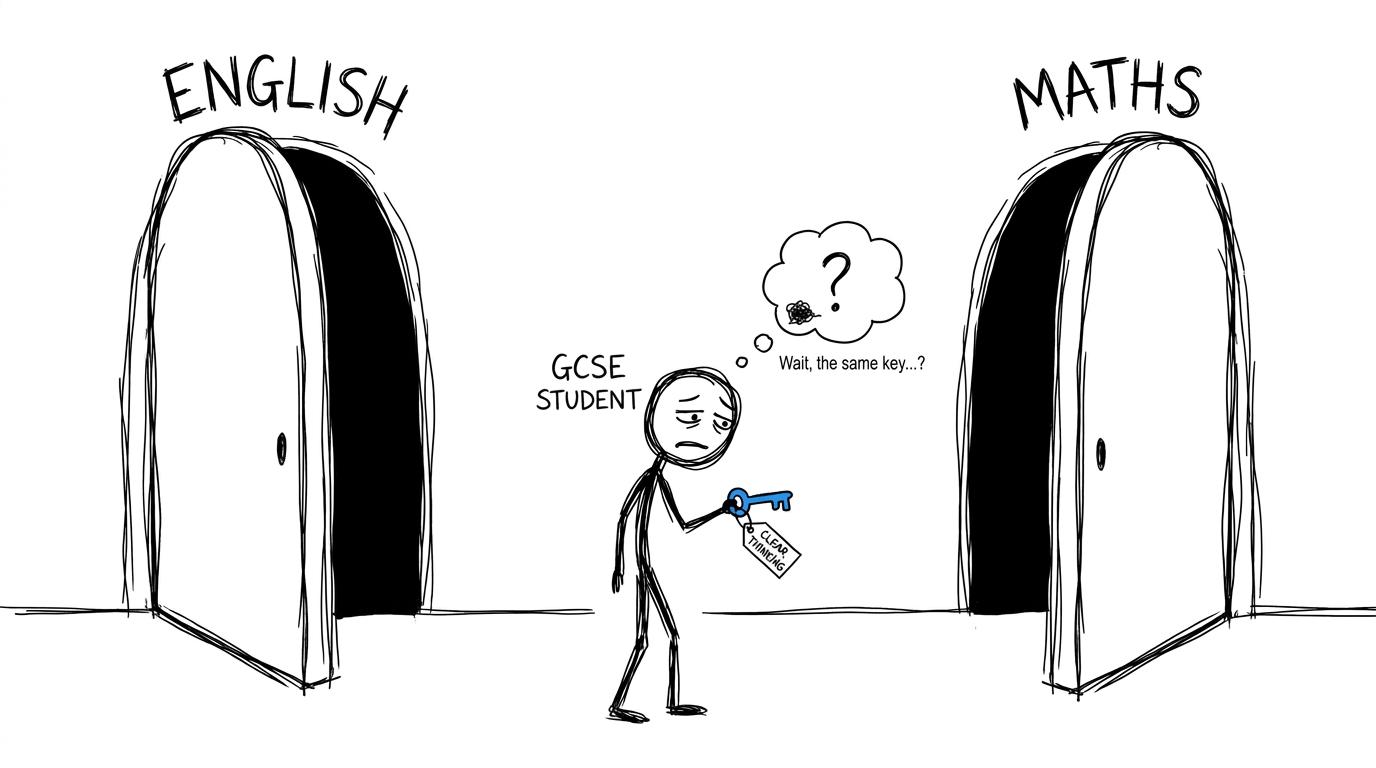 A student discovers that clear thinking opens both English and maths doors
What a grade 9 represents in terms of ability
GCSE English Language assesses reading and writing rather than knowledge of a set collection of novels or plays. Although AQA, Edexcel, OCR and Eduqas organise their papers differently, the regulated assessment objectives cover the same broad abilities.
Reading accounts for 50%50\%50% of the qualification. Students must interpret explicit and implicit information, analyse language and structure, compare perspectives and evaluate texts critically. Writing supplies the other 50%50\%50%, including communication, organisation, vocabulary, sentence control, spelling and punctuation.
Technical accuracy under AO6 accounts for 20%20\%20% of the qualification as a whole. That makes accuracy important, but a grade 999 cannot be reduced to error-free punctuation. A technically accurate response with thin ideas is not automatically top-level work. Equally, an imaginative response can lose marks if its structure, register or control becomes uncertain.
Perceptive reading rather than feature spotting
At the highest level, a student does more than identify a metaphor or label a short sentence. They explain how choices work together, what those choices suggest and how they shape the reader's response.
The difference is depth. A basic answer may correctly identify a technique. A stronger answer explores its effect in context. Exceptional work develops an interpretation, tests it against the text and supports it with precise references.
This is similar to mathematical reasoning. Naming a theorem is not the same as applying it coherently. The mark comes from showing why the evidence supports the conclusion.
Controlled and purposeful writing
Top-band writing is not simply writing with the longest words available. It is writing in which choices feel deliberate.
A grade 999 performance is likely to show a secure sense of audience and purpose, an effective overall structure, well-managed paragraphs and vocabulary chosen for precision rather than display. Sentence length and form are varied because the writing requires variation, not because a checklist demands it.
Control matters more than decoration. One accurate, well-positioned image can be more effective than a paragraph crowded with figurative language.
Consistency across the papers
A grade is awarded from the total subject mark, not from a separate grade on each question or paper. This means a student does not have to produce a grade 999 response every time they put pen to paper.
A weaker answer can be balanced by stronger work elsewhere. However, because the highest boundary is demanding, there is less room for repeated unfinished responses, misunderstood questions or avoidable timing losses.
That is why the grade represents more than raw ability. It also reflects selection, control and decision-making under pressure.
How grade 9 compares with the old letter grades
England replaced the old A* to G GCSE scale with grades 999 to 111. English Language, English Literature and maths were among the first reformed qualifications awarded on the numerical scale in 2017.
The two scales do not convert exactly. Officially, their clearest comparison points are:
| Current GCSE scale | Comparison with the old scale |
|---|---|
| Bottom of grade 777 | Comparable with the bottom of grade A |
| Bottom of grade 444 | Comparable with the bottom of grade C |
| Bottom of grade 111 | Comparable with the bottom of grade G |
Grades 777, 888 and 999 together cover the territory previously occupied by grades A and A*. Grade 999 was created to provide greater differentiation among the strongest performances, and fewer grade 999s are awarded than A*s were under the old system.
It is therefore reasonable to describe grade 999 as being above the old A* standard, but “grade 999 equals A*” is too crude. An A* covered a wider range of top-level attainment. The numerical system separates that upper range more finely.
Why there is no single grade 9 mark
Students often search for one reassuring number: the percentage needed for a grade 999. Unfortunately, that number is not fixed.
Grade boundaries are set after papers have been marked. Exam boards consider the difficulty of that year's assessments, statistical evidence and expert judgement so that the standard remains comparable from one series to another. A harder paper may have a lower boundary; an easier paper may have a higher one.
Boundaries also differ between exam boards because their papers, mark totals and question structures differ. AQA, Edexcel and OCR results cannot be compared responsibly by looking at raw marks alone. MathsGenie's guide to GCSE English Language marks per grade shows why the board and exam series must always be identified.
The useful lesson is not to build revision around a rumoured percentage. Build enough security that reasonable movement in the boundary does not control your result.
Grade boundaries are thresholds, not ability descriptions
Crossing a boundary by one mark gives the higher grade; missing it by one mark gives the lower grade. Yet those two scripts may be extremely similar in quality.
A grade is a useful summary of assessed performance. It is not a complete portrait of a student's reading, creativity or future ability. This is worth remembering on results day, especially when a number feels more personal than it really is.
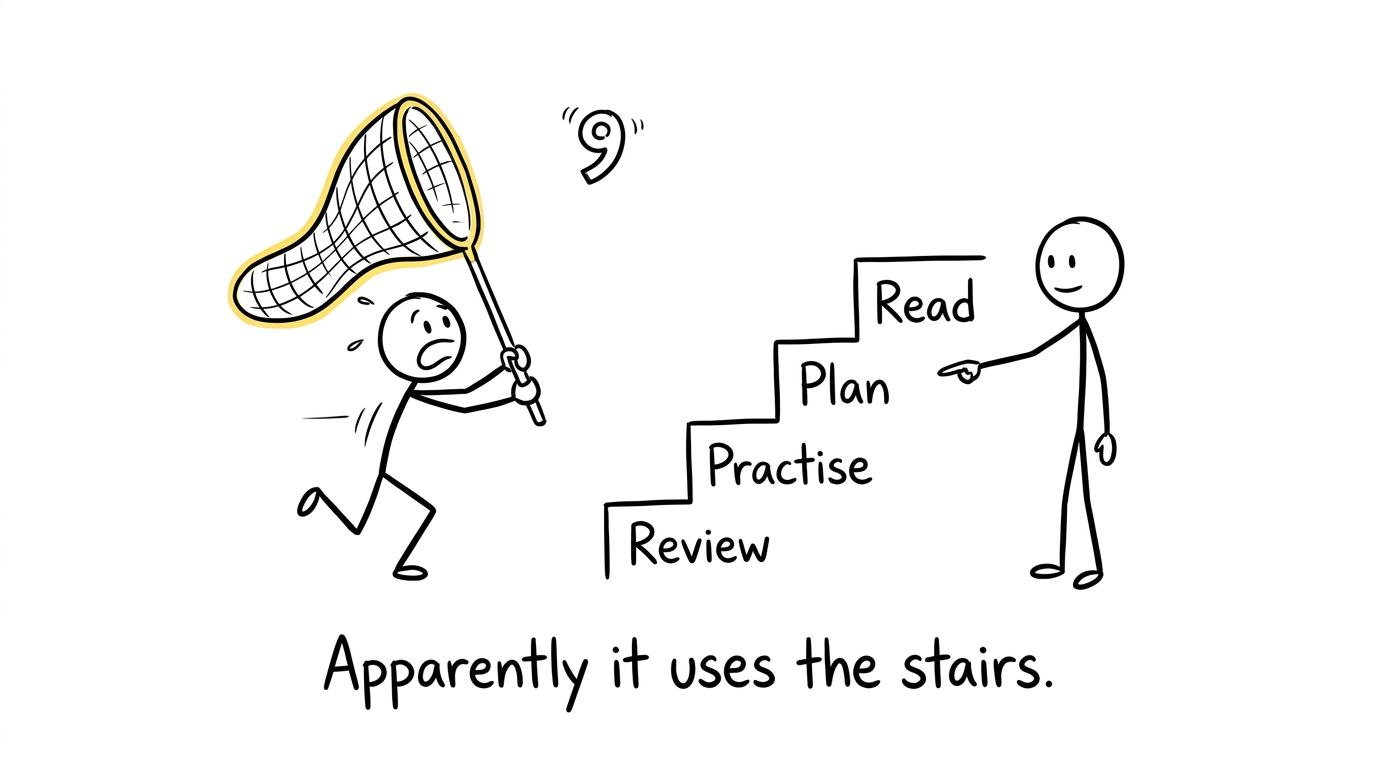 A student learns that a grade nine uses the revision staircase
Is there an official grade 9 descriptor?
Not exactly. The published national English Language grade descriptors provide broad illustrations of performance at grades 222, 555 and 888. They are intended to indicate likely performance, not to function as mark schemes or automatic awarding rules.
The grade 888 descriptor gives the closest official picture of very high attainment. It refers to detailed and perceptive understanding, insightful analysis, convincing comparisons, accomplished writing, precise vocabulary and virtually error-free technical accuracy.
A grade 999 sits above grade 888 in the final awarding scale, but examiners do not simply hold a response beside a special grade 999 checklist. They apply the question-specific mark scheme, the marks are totalled, and the overall grade boundary is then used.
This distinction prevents a common misunderstanding: individual paragraphs are not “given a 999”. Marks are awarded for how well each response satisfies the assessment criteria.
What maths students can learn from the grade 9 standard
English Language and maths look different on the timetable, but top-level performance in both depends on making thinking visible.
In English, an interpretation needs textual evidence and explanation. In maths, an answer often needs a traceable method, correct notation and a justified conclusion. In both subjects, reading the exact instruction matters. “Compare”, “evaluate”, “show” and “prove” are not interchangeable commands.
A practical revision cycle works across both subjects:
- complete a timed question or paper section;
- mark it against the published criteria;
- identify the precise reason each mark was lost;
- practise that weakness in isolation;
- return to timed work and check whether the change survives pressure.
For maths, you can apply this through Edexcel GCSE Maths revision lessons, AQA GCSE Maths past papers or OCR GCSE Maths past papers. The board changes, but the feedback loop does not.
A realistic checklist for aiming high
A grade 999 target becomes more useful when it is translated into actions you can control.
Know your specification
Check whether you study AQA, Edexcel, OCR or Eduqas. English Language is untiered, unlike GCSE maths, where foundation and higher tier papers offer different grade ranges. Learn your paper structure, question types, mark allocations and timings from your own exam board's materials.
Practise complete responses
Planning endlessly can feel productive while avoiding the difficult part. Complete responses reveal whether you can sustain analysis, structure writing and finish within the available time.
Review decisions, not only errors
After marking, ask why a response underperformed. Perhaps the quotation was too broad, the analysis repeated one idea, the comparison arrived too late or the final writing task was rushed. A useful diagnosis is specific enough to change the next attempt.
Protect your wider revision balance
English matters, but so does the rest of your GCSE timetable. MathsGenie's guide to starting GCSE past papers can help you phase exam practice rather than attempting everything at once. If time is short, the one-month GCSE maths revision plan provides a focused structure.
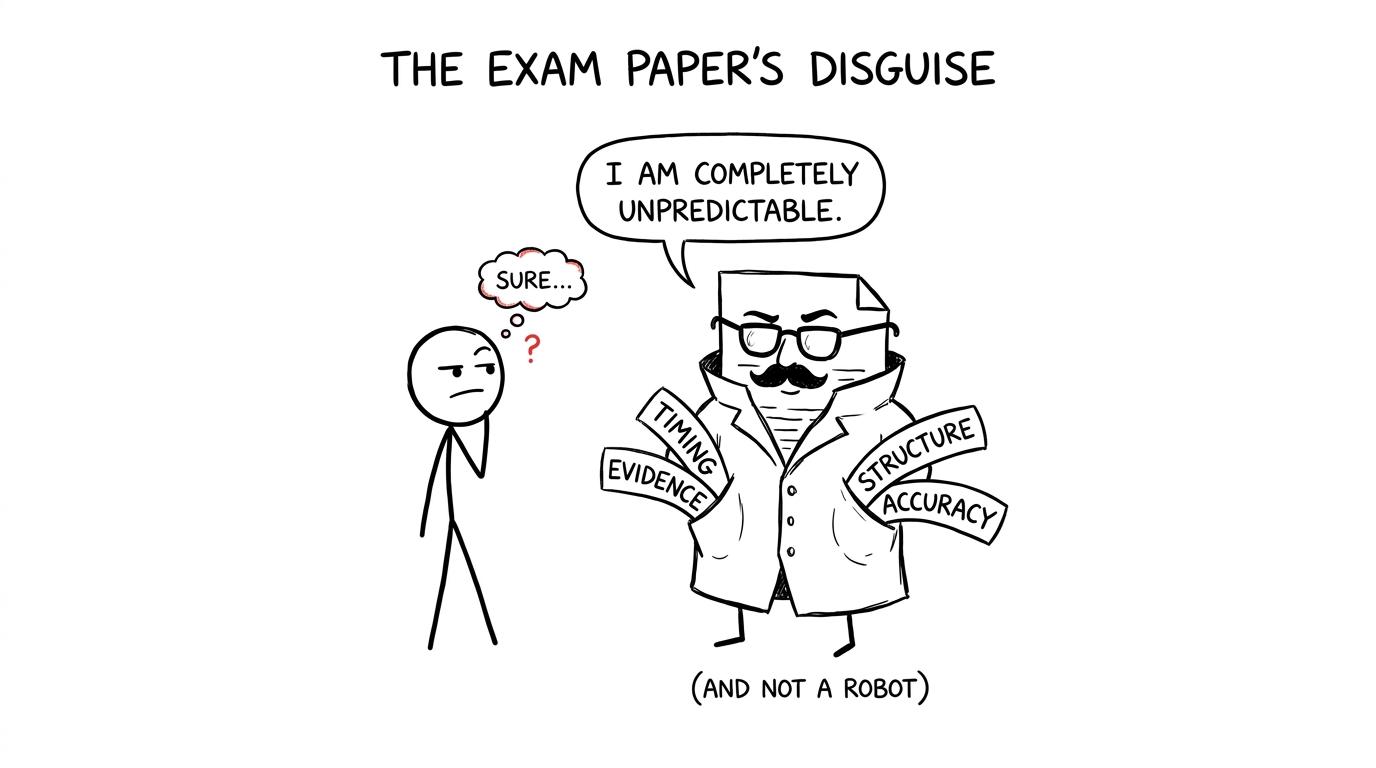 An exam paper fails to disguise its predictable assessment priorities
Common mistakes when interpreting a grade 9
Treating it as a perfect score
A grade 999 does not normally require every available mark. It requires a total at or above the grade boundary for that board and series.
Calling it an exact A* equivalent
Grade 999 is part of a more finely divided upper range. Grades 777 to 999 collectively cover the old A and A* territory, while grade 999 identifies the most exceptional performance within the new scale.
Assuming there is a fixed percentage
Past boundaries are evidence, not promises. Use them to understand historical standards, but do not treat last year's threshold as this year's guaranteed requirement.
Believing sophisticated vocabulary guarantees the grade
Vocabulary earns its place by improving meaning and effect. Forced synonyms, memorised openings and overloaded imagery can reduce clarity rather than increase it.
Ignoring timing and accuracy
Insight that never reaches the page cannot earn marks. Strong candidates still need a plan for completing every section and leaving enough attention for spelling, punctuation and grammar.
The grade is a result, not a revision method
The clearest GCSE English Language grade 999 meaning is exceptional assessed performance across reading and writing. It signals perceptive interpretation, critical analysis, purposeful communication and sustained technical control. It is above the old A* standard at the top of the scale, but it is neither a perfect score nor an exact letter-grade conversion.
The healthier target is not to “be a grade 999 student”. It is to make the next response more precise, more convincing and better controlled than the last.
Use the same principle in maths. Begin with free GCSE maths revision lessons and practice questions, test yourself with board-specific past papers, and add Edexcel predicted papers nearer the exam. Mark schemes and video solutions then turn lost marks into clear next steps.
A top grade is never produced by staring at the number. It is built by repeatedly improving the work underneath it.