

GCSE English Language Grade 8 Meaning Explained
GCSE English Language grade 8 meaning explained: ability, old A/A* comparisons, grade boundaries and what this excellent result means for students in England.
A results slip can turn years of work into a single digit. That digit looks precise, but it does not explain itself.
The GCSE English Language grade 8 meaning is straightforward: it is an excellent result, one grade below the highest available grade in England. It indicates perceptive reading, convincing analysis and ambitious, controlled writing. Compared with the former letter system, it sits within the broad territory previously covered by grades A and A*, but it is not officially identical to either one.
That distinction matters. A grade describes the standard of your performance across the qualification. It is not a permanent label for your intelligence, nor does it mean that every response you wrote was flawless.
Grade 8 at a glance
A grade 8 in GCSE English Language means that you have typically demonstrated:
- detailed and perceptive understanding of texts
- insight into explicit and implicit meanings
- confident analysis of language, grammar and structure
- well-chosen evidence supporting a clear interpretation
- convincing comparisons between texts and viewpoints
- ambitious, effectively structured writing
- precise vocabulary and varied sentence structures
- spelling, punctuation and grammar that are virtually error-free
These points reflect the official grade 8 descriptor used for GCSE English Language in England. The descriptor indicates the likely standard of performance across the qualification; it is not a checklist that must appear perfectly in every answer.
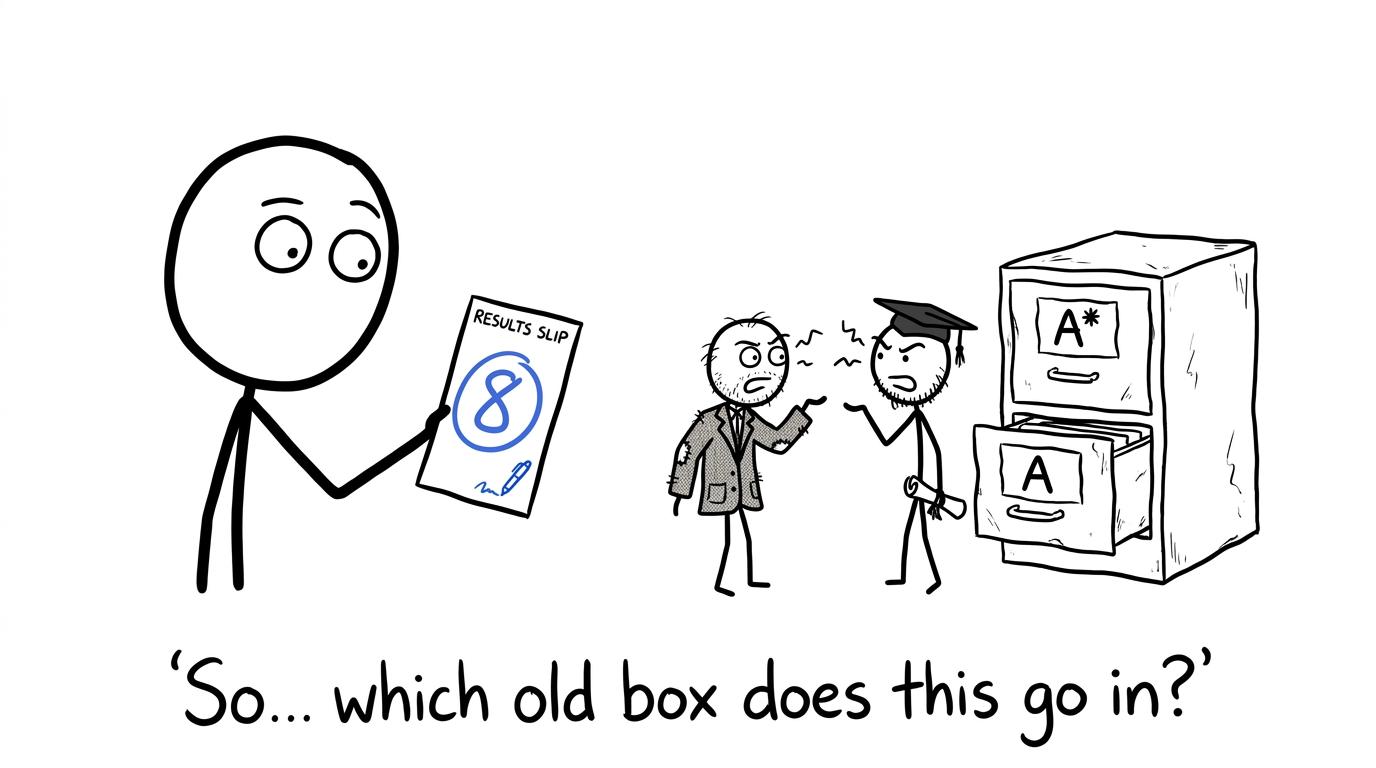 A student tries to fit a grade 8 into the old letter-grade filing cabinet
Is a grade 8 equivalent to an A or an A*?
The careful answer is that there is no exact one-to-one conversion.
When England moved from grades A* to G to grades 9-1, Ofqual established several points of comparison:
- the bottom of grade 7 aligns with the bottom of the former grade A
- the bottom of grade 4 aligns with the bottom of the former grade C
- the bottom of grade 1 aligns with the bottom of the former grade G
Grades 7, 8 and 9 collectively provide more differentiation across the performance previously represented by A and A*. Consequently, grade 8 is often informally described as being around a high A or lower A*, but that wording is only a rough explanation. It is not an official direct equivalence.
The safest description is this: grade 8 is above the standard represented by the lower boundary of the old grade A and belongs within the modern system's top three grades.
Grade 9 was introduced to distinguish the very highest performances more clearly. Receiving an 8 therefore does not mean you narrowly missed the old A*. The grading scales divide performance differently.
What ability does a grade 8 actually represent?
A strong English Language result is not mainly about memorising impressive words. It reflects control: knowing what a text is doing, explaining how it does it and shaping your own writing for a particular reader.
Perceptive reading rather than feature spotting
At grade 8, analysis usually moves beyond identifying a metaphor or naming a sentence type. You are expected to explain how a writer's choices develop meaning, shape tone or influence the reader.
The important word is perceptive. A perceptive response notices relevant details and draws convincing conclusions without forcing an interpretation that the text cannot support.
It may also recognise that language and structure work together. A change in focus, pace or perspective can be as significant as an individual word.
Secure use of evidence
A grade 8 response does not simply add quotations after making a claim. Evidence is selected because it helps prove a precise point.
This involves judgement. The longest quotation is rarely the most useful, just as the longest method is not automatically the best method in GCSE maths. Strong candidates choose evidence efficiently, examine it closely and connect it to the question.
Comparison with a clear purpose
Where a paper asks you to compare texts, grade 8 performance involves more than alternating between two summaries. The comparison should reveal meaningful similarities or differences in ideas, perspectives and methods.
Links need to be apt and convincing. That means comparing features that genuinely illuminate the writers' purposes rather than joining unrelated observations with a connective.
Writing that has impact and control
For writing tasks, grade 8 represents communication with influence. The response should suit its form, audience and purpose while remaining coherent.
Ambition is valuable, but control matters more. Effective structure, deliberate shifts in tone, precise vocabulary and varied sentences should help the reader. They should not exist merely to look sophisticated.
Technical accuracy also carries substantial weight. Across GCSE English Language specifications, accurate spelling, punctuation and grammar account for 20%20\%20% of the qualification's written examination marks. Virtually error-free writing does not require every sentence to be long or elaborate. Often, clarity is the more advanced choice.
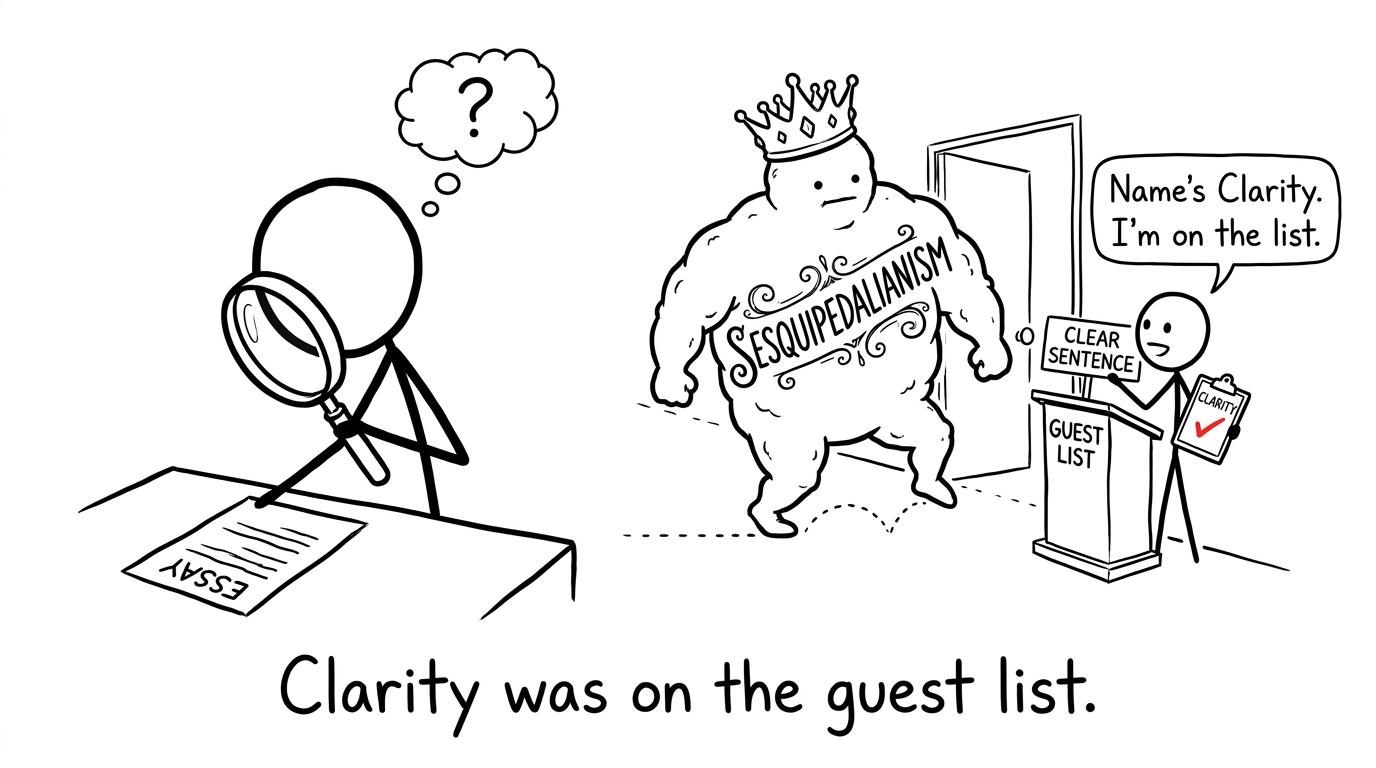 A giant thesaurus word discovers that clarity was invited instead
A grade is not a fixed percentage
It is tempting to ask, "What percentage is a grade 8?" There is no permanent answer.
A grade boundary is the minimum total mark needed for a grade in one exam series. Exam boards set boundaries after papers have been marked, considering evidence about paper difficulty and the quality of students' work. Boundaries can therefore change between years and specifications.
They also differ across AQA, Pearson Edexcel, OCR and Eduqas because the papers and total marks are not identical. You can explore how this works in the guide to GCSE English Language marks per grade and check the Edexcel English Language grade boundaries.
Historical boundaries are useful for interpreting a practice-paper score, but they are not promises about a future series. The broader guide to how GCSE grade boundaries work explains why the required mark can move while the intended standard remains comparable.
Unlike GCSE maths, GCSE English Language is untiered under the current specifications used in England. Students do not choose between foundation and higher tier papers, so grade 8 remains available through the same assessment route as the other grades. The Spoken Language assessment is reported separately and does not contribute to the numerical qualification grade.
What a grade 8 does and does not tell you
A grade 8 tells a sixth form, college or employer that your assessed reading and writing met a very high GCSE standard in that exam series. It suggests that you can interpret demanding material, build an argument and communicate accurately.
It does not prove that every piece of your writing is perfect. Nor does it guarantee that A Level English Language will feel easy. A Level work introduces different demands, and course entry requirements are set by individual schools and colleges. The guide to English Language grades and sixth-form entry provides more context.
Most importantly, an 8 is not "basically a 9" or "a disappointing near miss". It is its own excellent grade. A boundary separates two reported outcomes, but the difference between a student just below and just above that boundary may be only a small number of marks.
Why this matters when you are revising maths
English and maths are separate qualifications, yet some examination habits travel well between them.
Careful reading helps you notice command words and restrictions in a maths question. Concise written reasoning helps with proof, interpretation and questions requiring justification. Checking that a conclusion answers the question is valuable in both subjects.
Still, a strong English grade cannot replace mathematical knowledge. If your maths assessment is approaching, use the result as evidence that disciplined revision can work, then apply that discipline to the correct material.
Start at the GCSE Maths revision hub, where you can select your exam board and work through revision lessons and practice questions. Follow targeted revision with Edexcel GCSE Maths past papers or AQA GCSE Maths past papers, depending on your specification.
The useful principle is the same in both subjects: do not confuse recognising a good answer with being able to produce one. Retrieval, timed practice and careful review turn understanding into examination performance.
 A student discovers that the revision timetable is the main character
Common mistakes when interpreting grade 8
Calling it an exact A*
Grade 8 overlaps broadly with the old A/A* range, but there is no official exact conversion. Describe it as an excellent top-end grade rather than forcing it into one former letter category.
Treating the boundary as a permanent target
Previous boundaries show what happened in earlier series. They cannot confirm the mark required in a future examination. The official boundary is established only after marking is nearly complete.
Assuming sophisticated writing means complicated writing
Grade 8 writing is ambitious and accomplished, but it is also controlled. Unfamiliar vocabulary, excessive punctuation or very long sentences can weaken communication when they are used without purpose.
Believing one result defines every ability
A grade reports performance in a particular qualification. It cannot measure your entire vocabulary, creativity, confidence or future potential. It also cannot tell you which individual reading or writing skills still need improvement.
Letting one subject consume the whole revision timetable
Students aiming high can keep polishing their strongest subject because success feels reassuring. A balanced plan is usually more productive. Diagnose your weakest maths topics, schedule focused practice and use the MathsGenie resources collection for mini tests, predicted papers and shorter revision materials.
Turn the grade into a useful next step
The meaning of a grade 8 is not hidden inside a perfect letter-grade conversion. It represents high-level reading and writing: perceptive interpretation, convincing evidence, purposeful structure and accurate communication.
If you achieved it, take the result seriously. It is excellent. Then look beyond the digit. Identify the habits that helped you earn it, consistent practice, attention to feedback and the willingness to improve an imperfect response, and carry those habits into maths.
MathsGenie gives you a clear place to begin. Choose a revision lesson, complete the practice questions, check the mark scheme and use video solutions to repair mistakes. Move on to mini tests, past papers and predicted papers when you are ready to test the skill under pressure.
One grade records what happened. Your next revision session influences what happens next.










