GCSE English Language February Half-Term Revision
GCSE English Language February half-term revision plan covering reading, writing and timing, while protecting time for maths, other subjects and rest.
Half-term can create a strange kind of pressure. A free week looks enormous from a distance, so it is tempting to imagine that you will revise everything. Then Monday arrives, the list feels too long, and starting becomes the hardest task.
A useful GCSE English Language February half-term revision plan is much smaller: diagnose your weakest exam skills, complete focused reading and writing practice, mark the work carefully, and leave with a routine you can continue after the holiday. Half-term should create momentum. It should not become your only revision window, nor should English Language consume the time needed for maths and other subjects.
The goal is not to master the entire course in seven days. It is to make the next stage of revision more deliberate.
Your half-term revision checklist
By the end of the week, aim to have:
- confirmed your exam board and exact specification;
- identified two reading weaknesses and two writing weaknesses;
- completed at least one timed reading section;
- planned and written at least one extended response;
- marked your work using the relevant mark scheme;
- created a short error log;
- scheduled the next English Language session after half-term;
- protected separate time for GCSE maths, other subjects and rest.
This is a focused plan, not an endurance contest. If your wider timetable still feels unclear, MathsGenie’s guide to building a GCSE maths revision timetable can help you divide your available time without allowing one subject to take over.
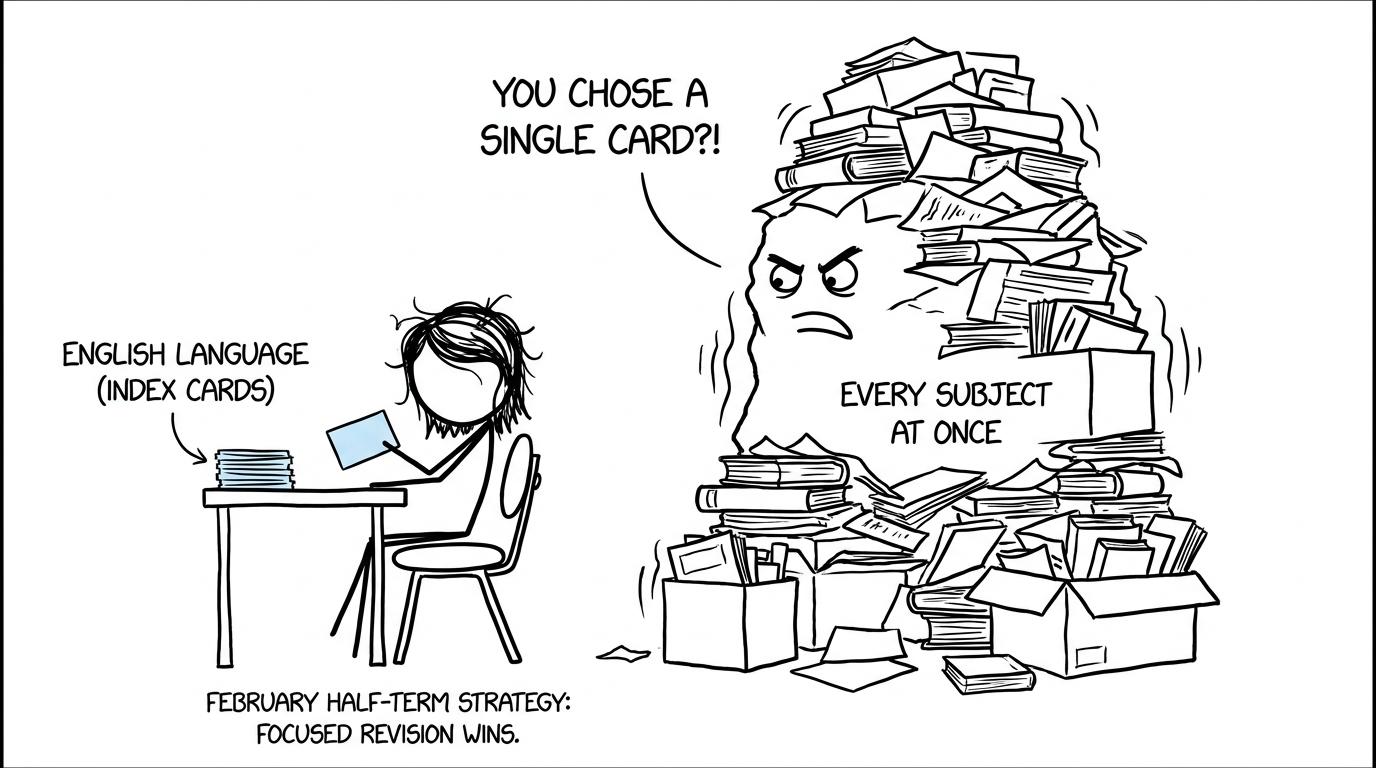 A student chooses one manageable revision task while an enormous pile labelled every subject at once looks offended
Start with your actual English Language paper
GCSE English Language is skills-based, but the papers are not identical across AQA, Pearson Edexcel, OCR and Eduqas. Paper names, timings, question sequences and mark totals vary. Do not borrow a timing plan from a friend until you know that you are taking the same specification.
Check the front of a paper supplied by your school or ask your teacher to confirm:
- your exam board;
- the qualification or specification code;
- the names and lengths of the papers;
- the reading and writing tasks on each paper;
- how many marks each question carries.
For GCSE English Language specifications in England, the national subject requirements divide the written assessment equally between reading and writing. Written technical accuracy, including vocabulary, sentence structures, spelling and punctuation, forms an important part of the assessment. The examinations use unseen texts, so revision should develop transferable skills rather than attempt to predict a particular extract.
English Language is also untiered in England. Unlike GCSE maths, there is no separate foundation or higher paper. Everyone sits the same assessment for their specification, although the precise structure depends on the board.
For example, AQA uses two papers weighted equally, with reading and writing in each. Pearson Edexcel’s established GCSE English Language qualification uses Fiction and Imaginative Writing for Paper 1, followed by Non-fiction and Transactional Writing for Paper 2. OCR also assesses reading and writing across two examined components. Eduqas has its own combination of reading and writing tasks. Your board’s current specification and school guidance should always settle the details.
Diagnose before you revise
A student can spend an afternoon highlighting model answers and still have no clearer idea what to improve. The better starting point is evidence.
Choose a recent practice paper, mock response or teacher-marked task. Review where marks were lost and classify each problem:
- Comprehension: you misunderstood or overlooked part of the text.
- Evidence: your quotation or reference was missing, too long or poorly selected.
- Analysis: you identified a method without explaining its effect.
- Comparison: you discussed texts separately without building clear connections.
- Evaluation: your judgement was vague or insufficiently supported.
- Writing: the response lacked control of purpose, audience, form or structure.
- Accuracy: spelling, punctuation or sentence construction weakened the answer.
- Timing: you rushed, overwrote or left a task unfinished.
Turn that diagnosis into a four-item fix list. Keep it specific. “Get better at English” is impossible to schedule. “Choose shorter evidence” or “leave time to check sentence boundaries” gives you something you can practise.
This is the same evidence-led principle used in MathsGenie’s guide to finding your weakest GCSE topics. In either subject, the work you have already completed is often the clearest map of what to do next.
A focused half-term plan
The week below uses compact sessions so English Language improves without becoming your entire holiday. Move the days if necessary. The sequence matters more than the labels.
| Day | Main English Language task | Purpose |
|---|---|---|
| Monday | Check your board and analyse a previous response | Identify the precise skills costing marks |
| Tuesday | Complete a short reading practice set | Improve retrieval, inference and evidence selection |
| Wednesday | Practise language, structure or comparison | Develop one analytical skill in depth |
| Thursday | Plan and write an extended response | Improve purpose, organisation and technical control |
| Friday | Complete a timed paper section | Test decisions under realistic pressure |
| Saturday | Mark, correct and reattempt weak parts | Convert feedback into better performance |
| Sunday | Review the error log and schedule the next session | Carry the progress beyond half-term |
Most sessions can fit into approximately 454545 to 606060 minutes. A simple structure is:
- 555 minutes to retrieve the question method from memory;
- 252525 to 353535 minutes of active writing;
- 101010 to 151515 minutes for marking and correction.
If you are tired or balancing several subjects, shorten the task rather than abandoning it. MathsGenie’s 20-minute GCSE revision routine offers a useful model for keeping a small daily minimum.
Reading practice that produces evidence
Reading revision should involve written answers. Select an unseen extract and practise the question skill your diagnosis identified. Work without notes first, then use the mark scheme or teacher guidance.
Your review should ask:
- Did I answer the precise question?
- Did I choose evidence that directly supported my point?
- Did I explain meaning and effect rather than merely name a technique?
- Did I consider the text as a whole when structure mattered?
- Did the depth of my answer match the available marks?
Do not force terminology into every sentence. A correctly named technique is useful only when it helps you explain how the writing works. Clear interpretation supported by relevant textual evidence remains central.
Writing practice with a deliberate target
For creative, imaginative, persuasive or transactional writing, choose one improvement target before you begin. It might be paragraph control, adapting tone for the audience, varying sentence structures, sustaining a viewpoint or checking punctuation.
Plan briefly. Decide the purpose, audience, form and overall direction before drafting. Then reserve a final checking period. This is especially important because technical accuracy contributes materially to GCSE English Language assessment.
Do not try to memorise an entire story or article and force it onto any prompt. Prepare flexible techniques and habits instead: controlled openings, purposeful paragraphing, precise vocabulary and an ending that fulfils the task.
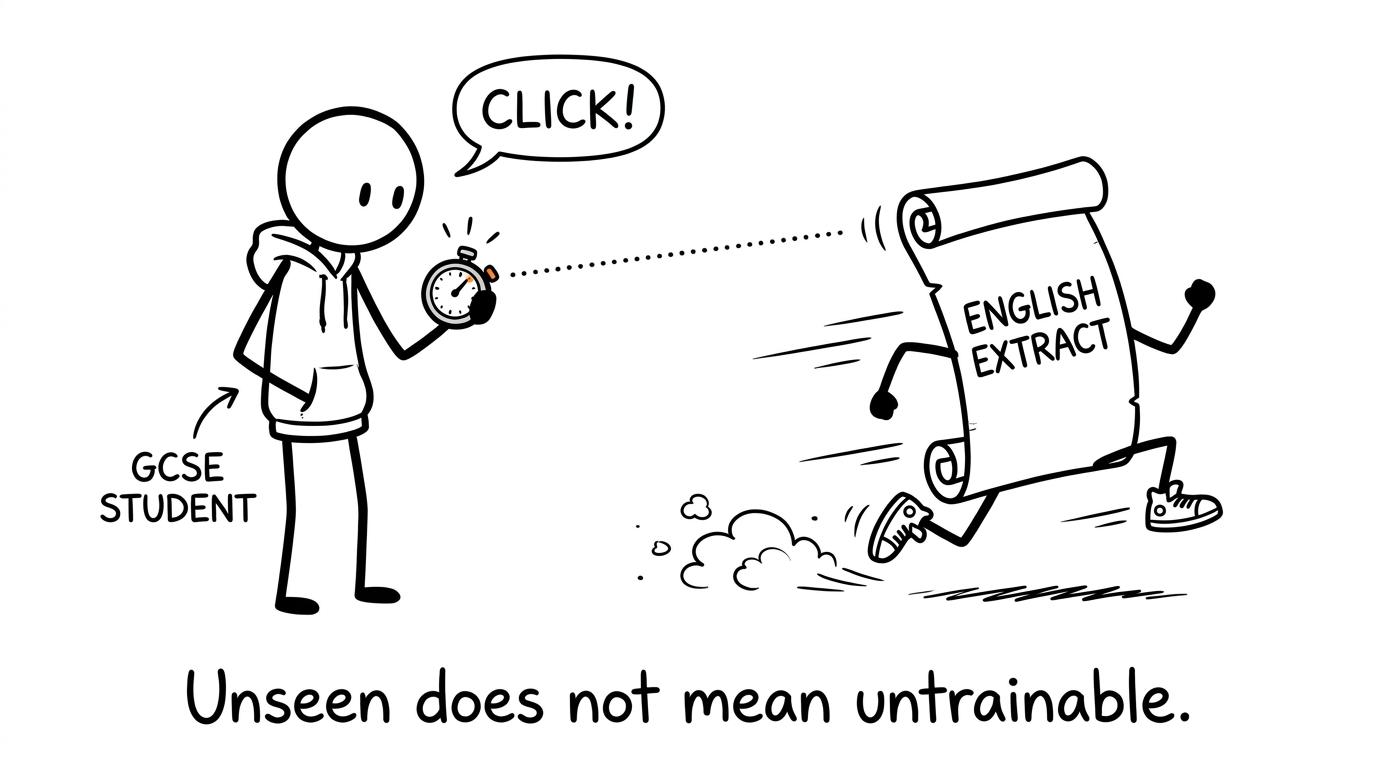 An unseen English extract wearing trainers races a student holding a stopwatch
Use marking as part of the revision
Completing a response feels productive. Marking it is where much of the learning begins.
Compare your answer with the official mark scheme for your board, any model material provided by your teacher and the assessment objectives attached to the question. Do not reduce the review to a guessed total. Record one strength, one repeated weakness and one action for the next attempt.
A useful error note is precise:
- “I selected evidence but did not explain its implication.”
- “My comparison appeared only in the final paragraph.”
- “The tone became informal despite the stated audience.”
- “I spent too long on a lower-mark question.”
Then rewrite the weakest paragraph or reattempt the troublesome part without copying a model response. Feedback becomes valuable when it changes what you can produce independently.
Maths students may recognise this rhythm. MathsGenie recommends the same broad cycle in its guide to using GCSE past papers properly: attempt, mark, identify the gap, repair it and retest. The subject changes, but the logic of improvement does not.
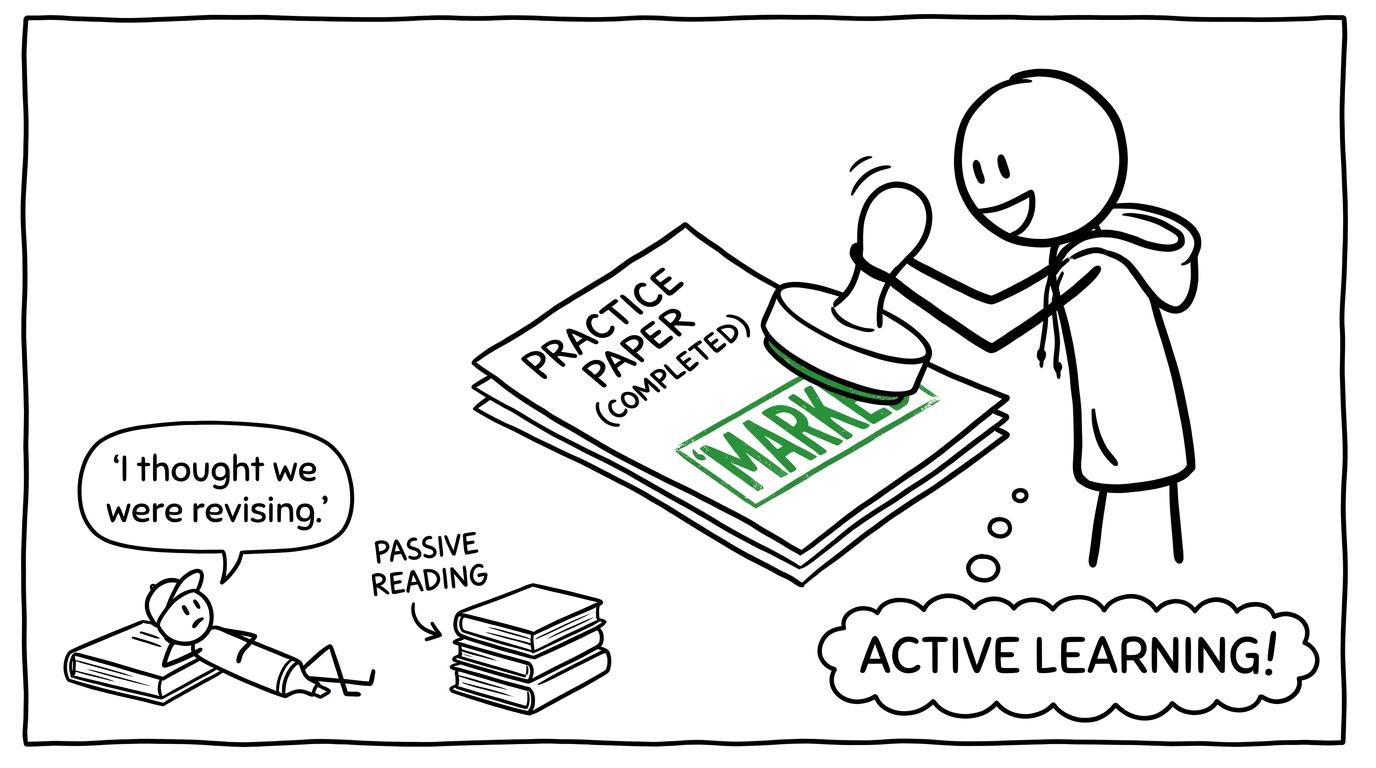 A student stamps a completed answer as marked while an abandoned highlighter watches from the corner
Keep maths and other subjects moving
English Language should receive focused attention during half-term, but not exclusive attention. If maths is one of your priority subjects, place its sessions in separate blocks rather than switching repeatedly between an English response and algebra questions.
Start with the GCSE maths revision hub, where you can choose resources for Edexcel, AQA, OCR, Eduqas, WJEC or CCEA. A short maths session could combine a revision lesson, targeted practice questions and immediate checking.
If you need quick evidence about a weak skill, use Edexcel GCSE maths mini tests where relevant to your entry. For longer practice, choose the correct board and tier before attempting a paper. MathsGenie’s Edexcel GCSE maths past papers, for example, place papers and mark schemes together.
A sensible half-term day might contain one English block and one maths or science block, separated by a proper break. Rest, exercise and time away from a screen are not evidence that the plan has failed. They make the plan repeatable.
Common half-term revision mistakes
Trying to complete several full papers immediately
A full paper can diagnose weaknesses, but repeated papers without repair simply reproduce the same mistakes. Alternate timed practice with focused correction.
Revising question labels from the wrong board
Advice for AQA may not match an Edexcel, OCR or Eduqas question sequence. Learn the assessment objectives, but practise through the exact papers used by your specification.
Reading model answers without writing
Model responses can reveal useful decisions, but recognition is not production. Close the model and write your own paragraph under time pressure.
Counting hours instead of outcomes
A long session is not automatically effective. Record completed responses, corrected weaknesses and successful reattempts. Those are better signs of progress.
Letting half-term become the whole plan
Revision fades when it is not revisited. Before the holiday ends, schedule the next English Language task. Even one weekly timed section followed by careful marking can continue the cycle.
Finish half-term with a plan you can repeat
The best outcome from February is not exhaustion. It is clarity. You should know your board, recognise the skills costing you marks and have a short process for improving them: attempt, mark, correct and return.
Keep English Language in the wider GCSE picture. Protect time for other subjects, and use MathsGenie as your free home for maths revision lessons, practice questions, mini tests, past papers, predicted papers, mark schemes and video solutions. If you need a broader structure for the weeks ahead, follow the GCSE one-month maths revision plan and adapt its focused, evidence-led rhythm across your timetable.
Start with one English response and one maths task. Mark both properly. Half-term does not need to solve everything. It only needs to make the next step obvious.