GCSE Engineering Coursework vs Exam Marks
GCSE engineering coursework vs exam marks explained: compare weightings, common mark losses, maths errors and practical revision tactics for better results.
A finished prototype can look impressive on the bench. A written answer can look convincing on the page. Yet neither earns marks simply by looking right.
The short answer to gcse engineering coursework vs exam marks is that there is no universal winner. The weighting depends on the qualification, while the location of lost marks depends on the student. In AQA GCSE Engineering, the written paper carries 60%60\%60% and non-exam assessment carries 40%40\%40%. Some Level 1/Level 2 engineering technical awards use different structures, including larger internally assessed components.
For many students, the written exam creates the sharper mark loss because it combines recall, application, mathematical accuracy, command words and time pressure. Coursework, officially called non-exam assessment or NEA, tends to lose marks more gradually through missing evidence, weak development, inaccurate manufacture and superficial evaluation.
The most useful question is therefore not simply Which part is harder? It is How does each part leak marks, and what can I still change?
The essential comparison
Before planning revision, confirm the exact qualification and specification with your teacher. AQA GCSE Engineering is not assessed in the same way as every engineering-related technical award, and the word “coursework” is often used informally for several different forms of controlled assessment or NEA.
| Assessment area | Typical source of lost marks | Best response |
|---|---|---|
| Written examination | Weak recall, misread command words, incomplete explanations, calculation errors and poor timing | Timed questions, topic revision and careful marking |
| Engineering NEA | Missing evidence, limited iteration, inaccurate practical work and weak evaluation | Match every decision and piece of evidence to the assessment criteria |
| Maths within engineering | Incorrect formula selection, unit errors, premature rounding and unexplained working | Practise calculations separately, then apply them in engineering contexts |
Your first checklist should be simple:
- identify your awarding body and specification code;
- write down the official weighting of each component;
- obtain the assessment criteria for your NEA;
- review a written paper and its mark scheme;
- separate knowledge gaps from mathematical and exam-technique errors;
- prioritise the component where recoverable marks remain.
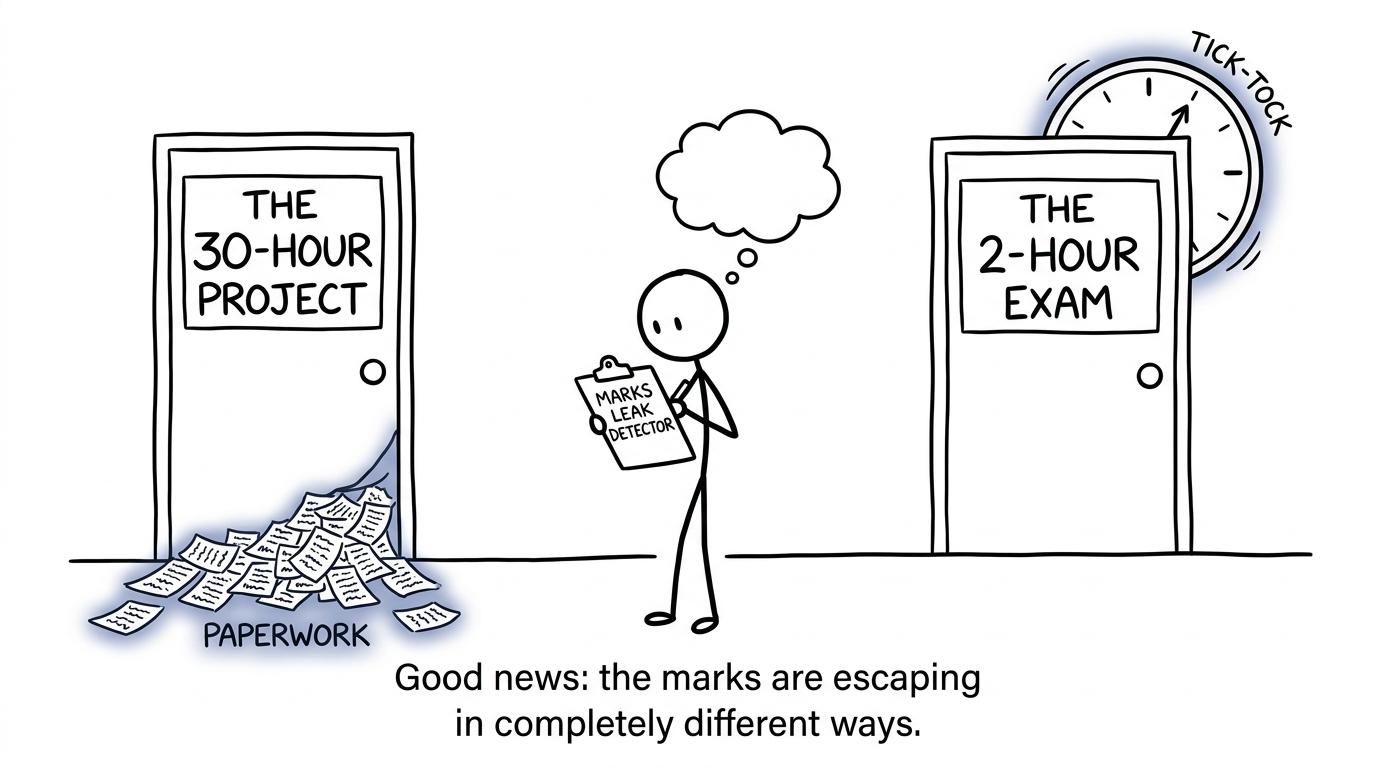 A student choosing between the long project and the timed examination
So where do students lose the most marks?
If the question means the greatest number of marks available to lose, the written paper matters more on AQA GCSE Engineering because it is worth 120120120 raw marks and 60%60\%60% of the qualification. The NEA is worth 808080 raw marks and 40%40\%40%.
That does not prove that every student performs worse in the examination. There is no single reliable national rule saying all engineering students lose more marks in one component. Performance varies by cohort, task and specification.
Recent examiner feedback does, however, reveal recognisable patterns. Written responses are weakened when candidates misinterpret command words, leave sections unanswered, repeat information from the question or describe an idea when evaluation is required. Applying technical knowledge to unfamiliar situations is another recurring difficulty.
In the NEA, the problem is often not a complete absence of work. It is the gap between doing and proving. A student may have selected a sensible process, adjusted a design or manufactured a successful component, but marks depend on recorded, assessable evidence.
The practical conclusion is:
- the exam usually produces faster, more visible losses through blanks, timing and incorrect answers;
- the NEA produces slower, less obvious losses when evidence does not meet the wording of the criteria;
- for AQA students, exam weaknesses have greater overall leverage because the paper has the larger weighting.
Why the written exam can become the bigger risk
Knowing a fact is not the same as applying it
Engineering examinations do not test recall in isolation. A question may present an unfamiliar product, process, drawing or manufacturing problem and ask you to apply what you know.
This is where revision based only on reading becomes fragile. Familiar notes create a feeling of recognition, but the paper requires retrieval and judgement. Practise identifying what information is relevant, what principle applies and what evidence supports the conclusion.
Command words also define the depth needed. State usually asks for a concise fact. Explain needs a linked reason or consequence. Analyse requires relationships to be examined. Evaluate asks for a supported judgement, often considering strengths, limitations or alternatives.
Writing more does not automatically answer a stronger command word.
Time pressure magnifies small weaknesses
A difficult NEA decision can sometimes be reconsidered within the permitted assessment process. In an examination, an uncertain formula, unread drawing or forgotten property can consume several minutes.
Unattempted questions are especially costly because they cannot collect method marks, partial credit or marks for a valid technical point. Timed practice should train three habits: start what you can, show useful working and return to difficult items later.
MathsGenie’s guide to using GCSE past papers properly explains the paper, mark, diagnose, repair cycle. Although the papers discussed are for maths, the method transfers directly to engineering revision.
Mathematical errors can affect several topics
Engineering brings together measures, formulae, graphs, scale, tolerances, area, volume and rates. A student may understand the engineering principle but lose the mark through the calculation used to express it.
Commonly useful relationships include:
density=massvolume\text{density}=\frac{\text{mass}}{\text{volume}}density=volumemass speed=distancetime\text{speed}=\frac{\text{distance}}{\text{time}}speed=timedistance percentage error=∣measured value−accepted value∣accepted value×100%\text{percentage error}=\frac{|\text{measured value}-\text{accepted value}|}{\text{accepted value}}\times 100\%percentage error=accepted value∣measured value−accepted value∣×100%The main danger is not always difficult algebra. It may be converting millimetres to metres, confusing area and volume conversion factors, omitting units or rounding before the final step. Strengthen these skills through MathsGenie’s conversions and units revision guide and its collection of shape, area and volume revision resources.
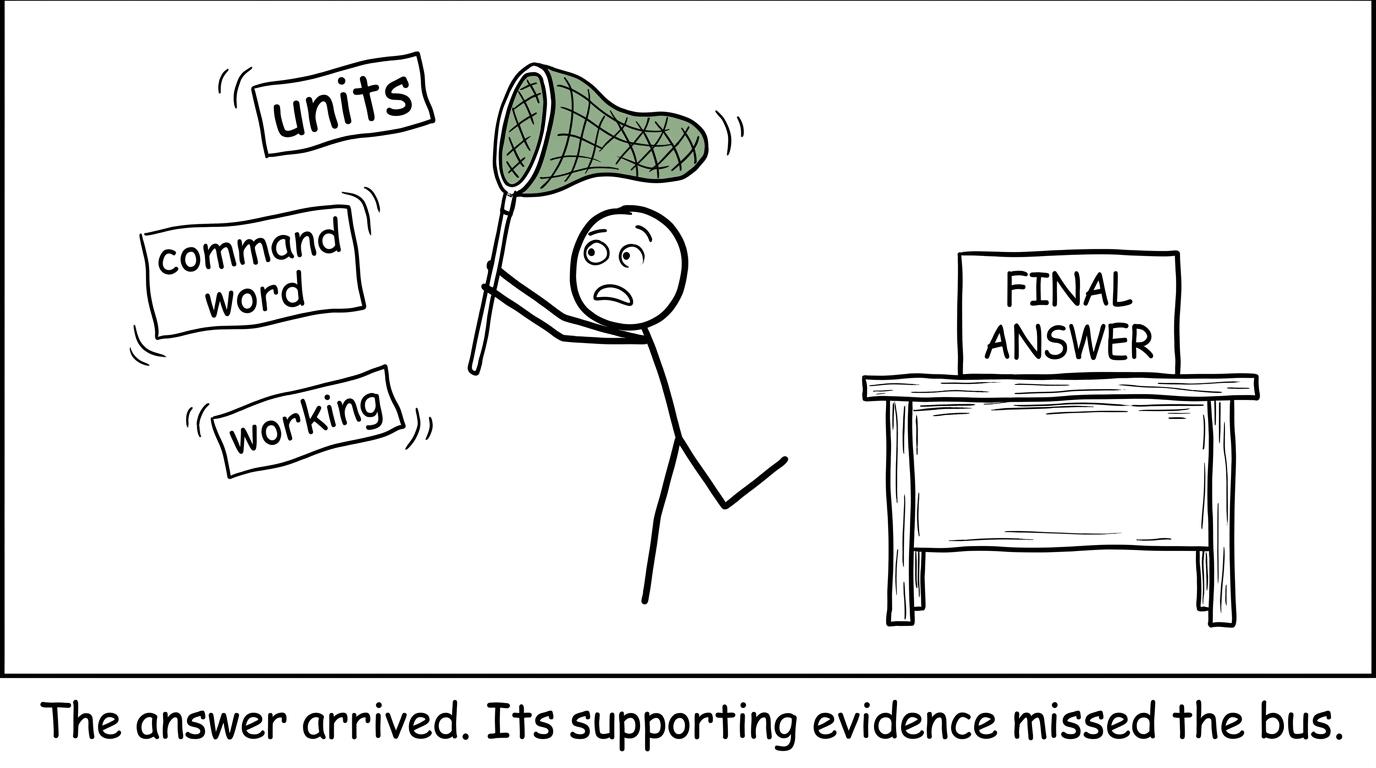 A student trying to catch units, command words and working during an exam
Why coursework marks disappear quietly
The assessor can only reward available evidence
A strong physical outcome is important, but it is not the whole assessment. The portfolio and supporting evidence must show how the student investigated, planned, designed, manufactured, tested and evaluated, according to the relevant criteria.
A claim such as “the product worked well” is rarely enough by itself. Stronger evidence identifies the test, records the result, compares it with a measurable requirement and explains the consequence for the design.
This is not about making the folder longer. Volume and quality are different things. Ten pages of description may reveal less than one carefully annotated test linked to a specification point.
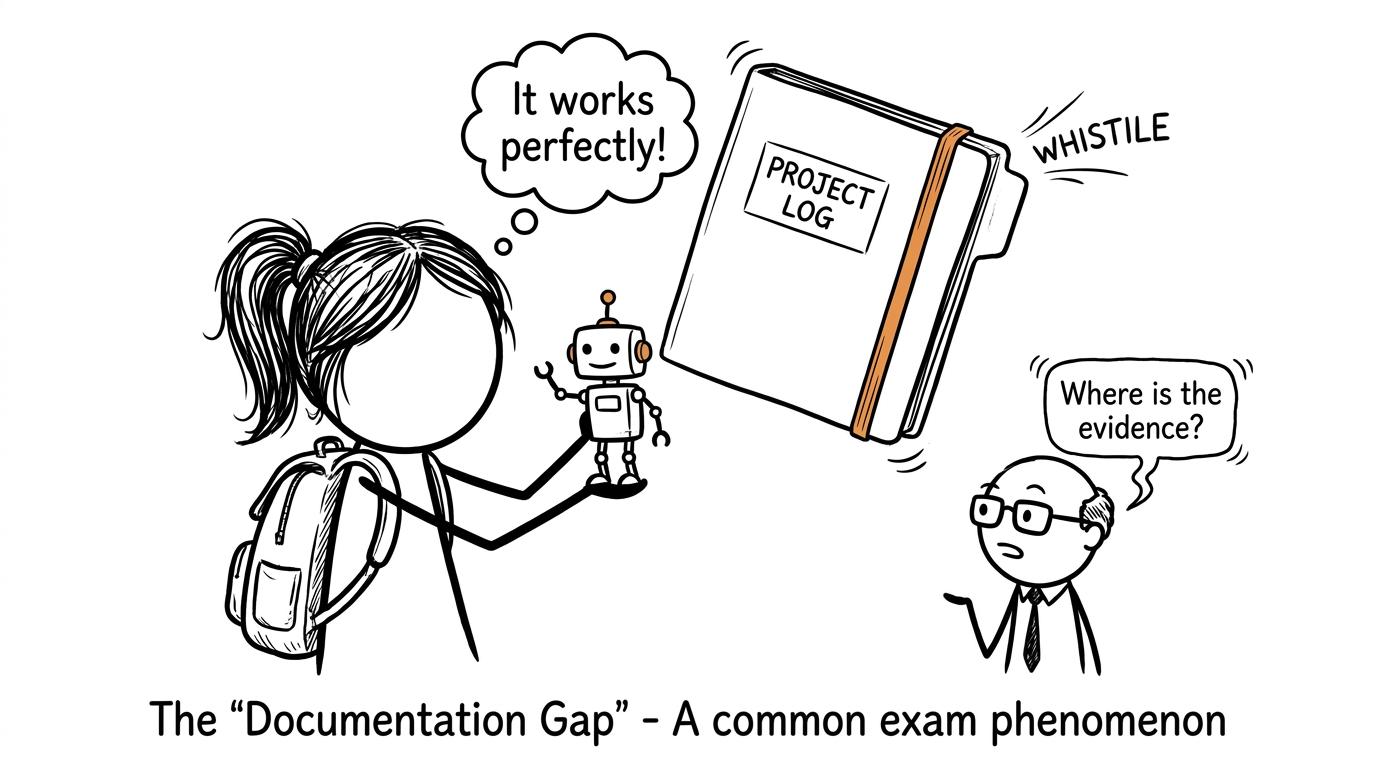 A proud prototype meets an examiner looking for evidence
Iteration must be visible
Engineering is a process of decisions under constraints. Development evidence should make that process understandable: what changed, why it changed and what information justified the change.
Students lose marks when different ideas appear without comparison, or when the final design arrives with no traceable route from research and testing. Screenshots, drawings and photographs need purposeful annotation. They should reveal reasoning rather than merely confirm that an activity happened.
Evaluation is often too general
Evaluation should return to the design requirements. If a specification includes dimensions, function, safety, material choice, cost or accuracy, the final evaluation should use evidence to judge those requirements.
A balanced judgement can acknowledge both success and limitation. Pretending that every feature is perfect removes opportunities to demonstrate analysis. Equally, listing vague improvements without evidence does not show why those changes matter.
The maths skills with the highest engineering value
Your engineering specification should determine the exact content you revise, but several GCSE maths areas repeatedly support technical work:
- unit conversion, including squared and cubed units;
- substitution into formulae;
- rearranging formulae;
- ratio, scale drawings and proportion;
- percentages and percentage change;
- perimeter, area, surface area and volume;
- interpreting tables, charts and graphs;
- standard form and sensible rounding;
- checking whether an answer is reasonable.
These are not exclusively Higher-tier skills. Foundation and Higher students both benefit from secure number work, units and proportional reasoning. What changes is the complexity and combination of the questions.
Use the GCSE Maths revision hub to choose your exam board and locate lessons, practice questions, worksheets and past papers. If you are uncertain where to begin, the GCSE self-assessment resources can help turn a broad concern such as “engineering calculations” into a specific list of skills.
A revision plan for protecting both components
Audit the marks before revising
For the exam, complete a timed set and classify every lost mark as one of the following:
- missing technical knowledge;
- weak application;
- mathematical error;
- command-word error;
- unclear written communication;
- time-management problem.
For the NEA, use the official criteria rather than your memory of the project. Highlight where each requirement is evidenced. A criterion without a clear location deserves attention, subject to your teacher’s instructions and the assessment rules.
Repair one leak at a time
A useful maths session has a narrow target. Review the method, answer questions without notes, mark them immediately and record the exact reason for each error. MathsGenie’s GCSE revision timetable guide shows how to combine short topic sessions with timed practice.
Then return the skill to an engineering context. The goal is not merely to perform a calculation when its topic is announced. You need to recognise when that calculation is useful inside a technical problem.
Use predicted papers carefully
Predicted papers provide fresh practice, not guaranteed forecasts. They are most valuable after topic revision because they reveal whether you can select methods under pressure. The guide to GCSE predicted topics explains how to combine predictions with past papers rather than treating them as substitutes.
Common mistakes that cost avoidable marks
- Assuming every engineering course has the same weighting. Confirm whether you study AQA GCSE Engineering, WJEC Engineering, an OCR Cambridge National or another qualification.
- Calling all controlled work “coursework”. Use the assessment rules and terminology for your specification, particularly where supervision and authentication apply.
- Leaving calculations without units. A correct number may be incomplete if the required unit is absent.
- Rounding intermediate values too early. Keep sufficient calculator precision and round the final answer as requested.
- Giving description instead of explanation or evaluation. Follow the command word, not the number of lines available.
- Presenting photographs without annotation. Evidence should communicate process, accuracy, decisions or testing.
- Treating a polished prototype as proof of every criterion. Practical quality matters, but marks must be supported by evidence matched to the assessment grid.
- Revising only engineering facts. Formula use, proportion, graphs and measures can decide whether technical understanding becomes an awarded mark.
Turn hidden mark losses into a visible plan
Students rarely lose engineering marks for one dramatic reason. The exam exposes small weaknesses quickly. The NEA stores them quietly in missing tests, unsupported choices and incomplete evaluation.
For AQA GCSE Engineering, the written examination deserves substantial attention because it contributes 60%60\%60% of the final mark. But the best strategy is not to abandon the NEA. Protect coursework marks through precise evidence, then prepare for the paper through retrieval, timed questions and accurate maths.
Start at the MathsGenie GCSE Maths hub. Choose the skills behind your engineering errors, use free revision lessons and practice questions, and check your methods with mark schemes and video solutions. Then build pressure gradually with mini tests, past papers and predicted papers.
A mark that keeps disappearing is not bad luck. Once you can name the leak, you can repair it.