GCSE Economics Weekend Revision Routine
GCSE economics weekend revision made manageable: plan active recall, exam questions, quantitative skills, marking and rest across Saturday and Sunday.
The final weekends before an Economics exam can feel strangely valuable. There is enough time to make progress, but also enough time to waste an afternoon rewriting notes you already understand.
A productive GCSE economics weekend revision routine is simpler: retrieve key knowledge, answer exam questions, mark them carefully, repair specific weaknesses and revisit them the next day. Divide the weekend into short sessions rather than attempting one exhausting revision marathon.
This matters because GCSE Economics tests more than memory. Across the current AQA and OCR specifications, the assessment objectives broadly reward knowledge and understanding, application to context, and analysis and evaluation. Quantitative skills also account for at least 10%10\%10% of the marks. Your routine therefore needs to cover economic ideas, written responses and the maths behind data, percentages, costs and graphs.
Your weekend revision checklist
Before Saturday morning, gather:
- your exam board specification and topic checklist
- an Economics past paper or selected exam questions
- the corresponding mark scheme
- class notes or a trusted revision guide
- flashcards or blank paper for retrieval
- a calculator, ruler and pens
- an error log for recording lost marks
- a timer and a planned stopping time
Confirm whether you study AQA, OCR or another specification. GCSE Economics is not divided into foundation and higher tier, so the board and paper content, rather than a maths tier, should guide your choices.
Use the MathsGenie revision planner to protect time for your other subjects too. Economics should receive focused attention without quietly consuming the entire weekend.
The Saturday routine: diagnose, repair and apply
Saturday should reveal what you genuinely know. It should not begin with an hour of reading, because familiar-looking notes can create confidence without proving recall.
Start with closed-book retrieval
Spend about 202020 minutes recalling one microeconomic topic and one macroeconomic topic without looking at your materials. Depending on your specification, suitable areas might include market failure, price determination, government objectives, fiscal policy or international trade.
For each topic, write down:
- essential definitions
- causes and consequences
- relevant stakeholders
- one diagram or data relationship
- possible advantages and disadvantages
- conditions affecting a final judgement
Now check your notes. Add missing material in another colour, but do not copy entire pages. The gap between what you recalled and what the course requires is your first useful piece of evidence.
Retrieval works because it asks your memory to produce information rather than merely recognise it. It should also be followed by feedback: check what was missing or inaccurate before the misconception settles in.
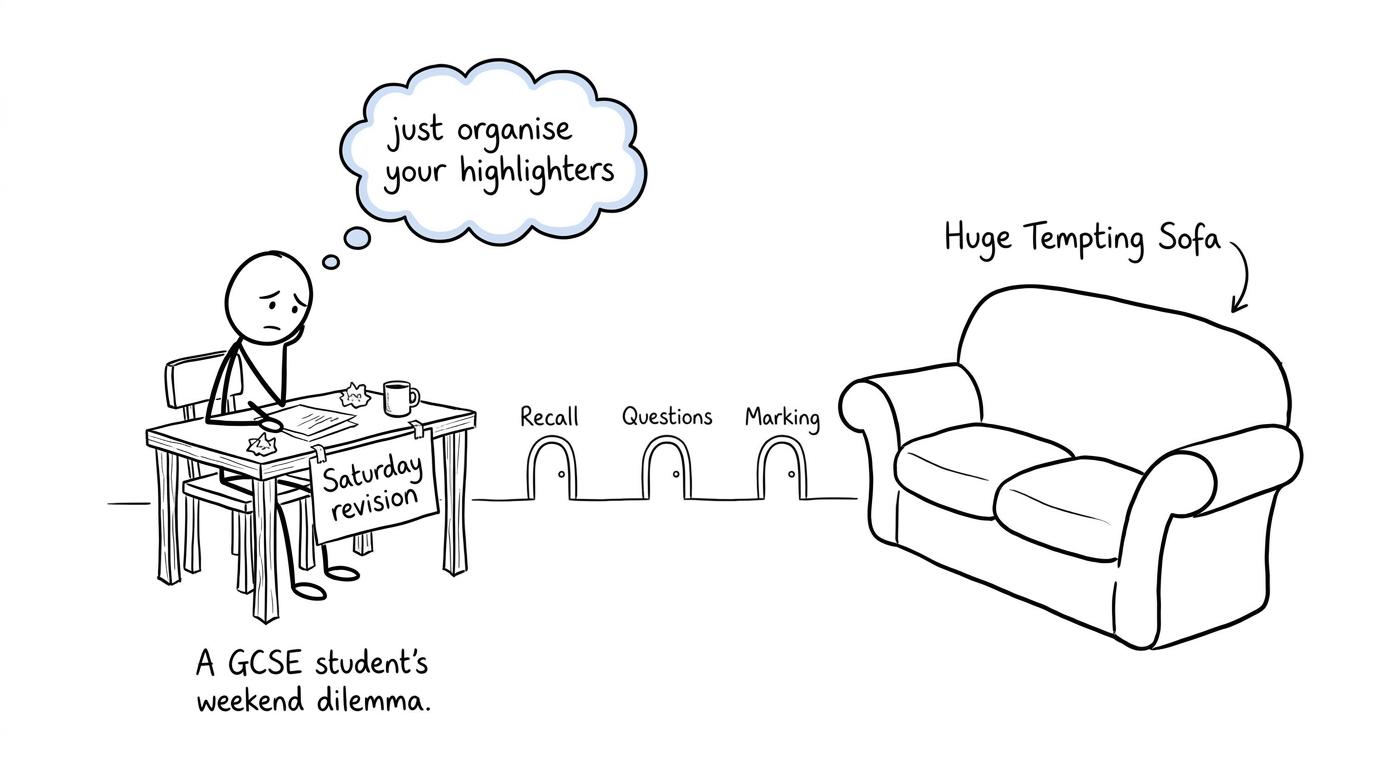 A student choosing between useful revision and organising highlighters
Build a precise weakness list
Avoid labels such as “macroeconomics” or “graphs”. They are too broad to tell you what to do next. Write targets such as:
- distinguish economic growth from development
- explain how higher interest rates may affect consumption
- apply demand and supply analysis to a stated market
- develop a chain of reasoning beyond the first effect
- calculate percentage change accurately
- reach a contextual judgement in an extended response
Limit the list to three priorities. A long list feels comprehensive but usually divides attention too thinly. The method in MathsGenie’s guide to finding your weakest GCSE topics can also help you turn lost marks into specific actions.
Repair the weakest content area
Use a focused block of approximately 353535 minutes. Review only the material needed for your first weakness, then close the resource and explain the idea from memory.
A strong economic explanation usually needs a chain:
- identify the change
- explain the immediate effect
- connect it to households, firms, workers or government
- develop the likely consequence
- recognise why the outcome could differ
Words such as “therefore” and “because” help only when each sentence adds a genuine economic link. A longer answer is not automatically a more analytical answer.
Practise quantitative Economics
Set aside another 303030 to 404040 minutes for calculations and data interpretation. AQA and OCR both require quantitative skills in an economic context, including percentages, averages, totals and information presented in graphs or charts.
Useful relationships to recall include:
Percentage change=new value−original valueoriginal value×100\text{Percentage change}=\frac{\text{new value}-\text{original value}}{\text{original value}}\times 100Percentage change=original valuenew value−original value×100 Total revenue=price×quantity sold\text{Total revenue}=\text{price}\times\text{quantity sold}Total revenue=price×quantity sold Profit=total revenue−total cost\text{Profit}=\text{total revenue}-\text{total cost}Profit=total revenue−total costDo not only memorise each relationship. Check that you can select it from the wording of a question, substitute the correct data, show your working and interpret the result economically.
If percentages are unreliable, use the free AQA GCSE percentages questions. The GCSE Statistics revision hub is also useful for strengthening data handling and graph interpretation. These are maths resources rather than Economics papers, but they support skills that Economics examiners assess.
Complete and mark an exam section
After a proper break, complete one past-paper section under timed conditions. Select a paper from your own Economics exam board and follow its instructions. AQA and OCR use different paper timings and question structures, so do not borrow a routine designed for another specification.
Mark your work on the same day. For each lost mark, record one cause:
- missing knowledge
- weak application to the case or data
- incomplete analysis
- unsupported evaluation
- calculation error
- misread command word
- poor time management
The total mark tells you where you are. The reason tells you what to do next. MathsGenie’s explanation of when to begin past-paper practice applies equally well as a general revision principle: papers are most valuable while there is still time to respond to what they reveal.
The Sunday routine: retest and strengthen
Sunday is not simply Saturday repeated. Its purpose is to test whether yesterday’s corrections survived overnight and then strengthen a different part of the paper.
Revisit Saturday’s three weaknesses
Begin with a 151515-minute closed-book check. Redefine the terms you missed, reconstruct the analytical chain and retry any calculation that caused difficulty.
Do not copy yesterday’s corrected answer. Retrieval after a delay is the point. If you still cannot produce the idea independently, return it to your weakness list for a later session.
Train application and evaluation
Economics answers often become generic when students know a theory but do not use the context provided. Choose two short case-study questions and underline details that could affect the outcome: the type of market, the scale of a firm, the period considered, consumer income, elasticity, government priorities or conditions in the wider economy.
For evaluation, ask:
- Is the effect likely in the short run, the long run or both?
- Which stakeholder gains, and who may lose?
- How large might the effect be?
- What does the result depend on?
- Which argument is strongest in this particular context?
A judgement should follow from the analysis. It should not appear as an isolated final sentence saying that the answer “depends”. State what it depends on and explain why that factor matters.
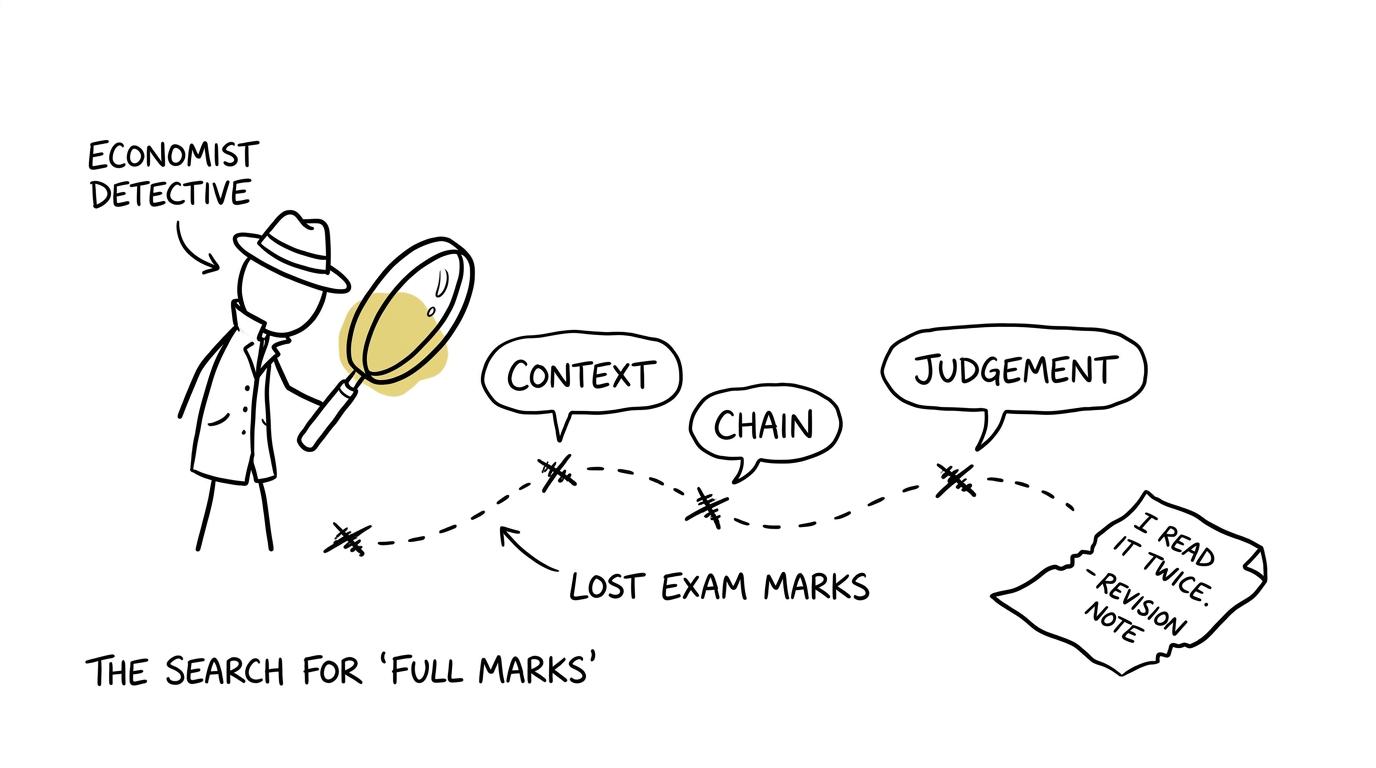 An economist detective investigating lost exam marks
Use a timed mixed set
Complete a 303030- to 454545-minute mixture of multiple-choice, calculation, short-response and extended-response questions where your board uses them. This change of pace matters. In the real exam, you must move between recalling a definition, analysing numerical data and constructing an argument.
Mark immediately and compare Sunday’s errors with Saturday’s. Improvement means more than receiving a higher total. Look for evidence that you:
- used the case material more precisely
- extended causal chains further
- showed calculation steps
- responded to command words
- made a supported judgement
- managed time more calmly
Finish with a next-week plan
Use your error log to schedule two brief weekday sessions. One should revisit the weakest knowledge area; the other should retest an exam skill. The MathsGenie GCSE self-assessment sheet can help identify any underlying maths gaps, while the planner can stop those repairs being forgotten.
Keep the tasks small and observable. “Revise Economics” is vague. “Retrieve monetary policy, answer two application questions and mark them” is actionable.
How to balance Economics with maths revision
For students preparing for several GCSE exams, opportunity cost is not merely an Economics definition. Every extra hour spent polishing one subject is an hour unavailable elsewhere.
After completing your Economics priority, keep maths active with a mini test, one revision lesson or a short set of practice questions. Near the maths exams, GCSE predicted papers can support timed practice, while mark schemes and video solutions show where methods earn marks.
The two subjects overlap more than they first appear. Percentages support inflation, interest and changes in economic data. Averages help with costs and income. Graph skills support the interpretation of trends and market diagrams. Strong numerical fluency leaves more mental space for economic reasoning.
Common GCSE Economics weekend revision mistakes
Spending the weekend making perfect notes
Neat notes can support learning, but creating them is not proof that you can retrieve or apply the content. Put a strict limit on note-making and move quickly to closed-book recall and questions.
Completing papers without reviewing them
An unmarked paper is an unfinished revision task. Mark it, classify each error and repair at least one weakness before attempting another paper.
Memorising model answers word for word
The context changes. Learn the structure of strong reasoning, but practise adapting economic knowledge to unfamiliar markets, firms and policy situations.
Ignoring quantitative skills
At least 10%10\%10% of marks on the AQA and OCR GCSE Economics qualifications assess quantitative skills. Show calculations clearly and explain what numerical results mean in context.
Treating evaluation as a vague counterargument
Effective evaluation weighs significance, timescale, stakeholders and conditions. A balanced answer still needs a reasoned conclusion.
Revising until late on Sunday night
Fatigue makes Monday harder and can turn a sustainable plan into a one-off effort. Decide the stopping time before you begin.
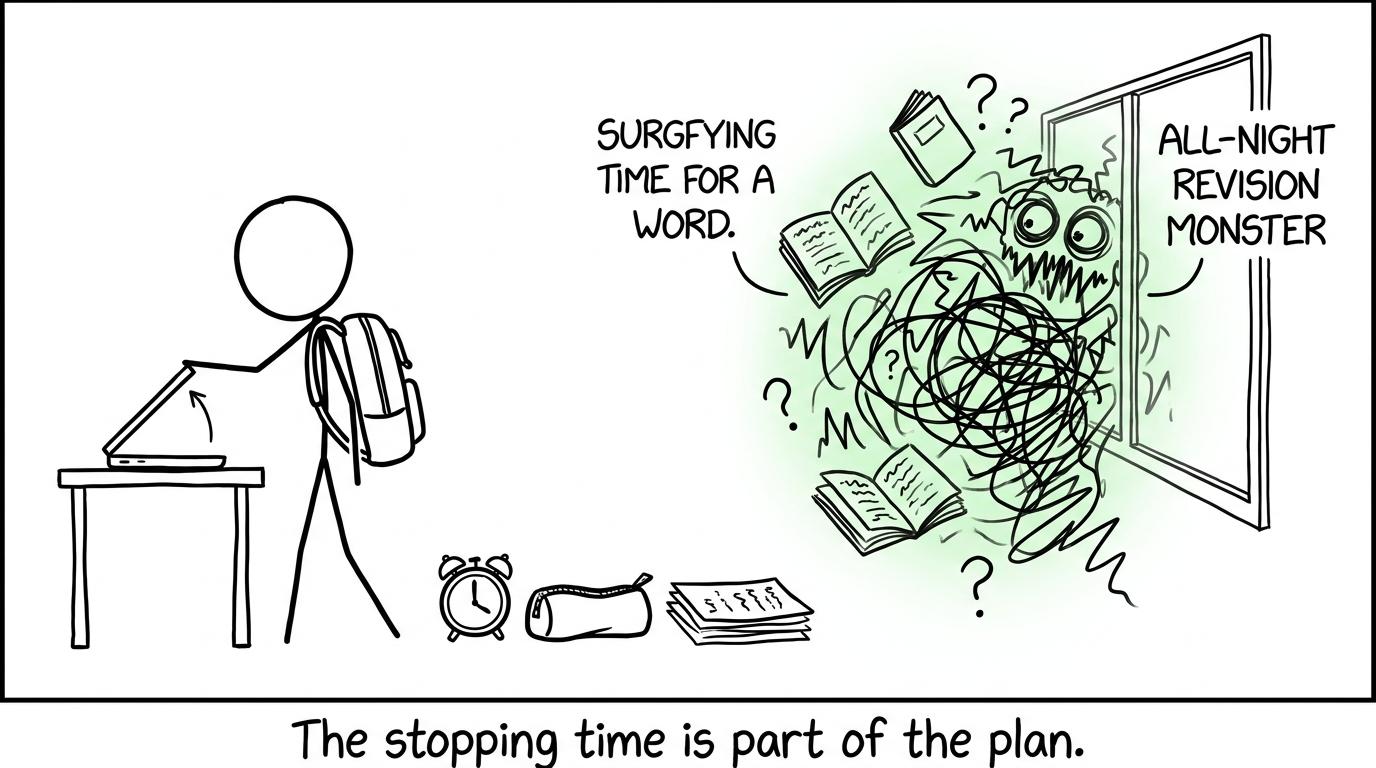 A calm Sunday stopping time keeps the revision monster outside
Make the weekend produce evidence
A useful revision weekend should leave behind more than highlighted pages. By Sunday evening, you should have a marked exam section, three repaired weaknesses, a quantitative-skills check, an updated error log and two specific tasks for the coming week.
That is progress you can see.
Use your own exam board’s Economics specification, past papers and mark schemes for subject content. Then use MathsGenie’s free GCSE and A Level maths revision to strengthen the calculations and data skills that Economics requires while preparing for your maths papers. Revision lessons, practice questions, mini tests, past papers, predicted papers, mark schemes and video solutions give you a clear next step whenever your error log exposes a gap.
Start with one closed-book retrieval session this Saturday. Mark what follows honestly. Then let the evidence decide what you revise next.