

GCSE Economics Part Time Job Balance Guide
GCSE economics part time job balance made realistic: build a flexible weekly plan, protect sleep and revise Economics and Maths around changing shifts.
A shift appears on the rota. A homework deadline moves closer. Then a Maths paper reminds you that percentages are not going to revise themselves.
A realistic GCSE economics part time job balance does not come from squeezing revision into every empty minute. It comes from deciding what must happen each week, protecting a few reliable revision windows and adapting when work changes. Start with short, focused sessions for Economics and Maths, keep one evening free, and reduce or rearrange shifts before exams if you can.
The goal is not a perfect timetable. It is a plan that still works after a tiring Saturday shift.
Your quick balance checklist
Before building a detailed revision plan, make sure these foundations are in place:
- Record every confirmed shift, lesson, deadline and exam.
- Choose two or three protected revision windows each week.
- Give difficult work to your best energy, not merely your spare time.
- Use short sessions after shifts and longer sessions on non-work days.
- Include Economics knowledge, application, evaluation and quantitative skills.
- Keep Maths practice active through questions rather than rereading.
- Protect sleep and at least one genuine period of rest.
- Tell your employer early when mock exams and final exams approach.
- Review the plan weekly instead of treating it as permanent.
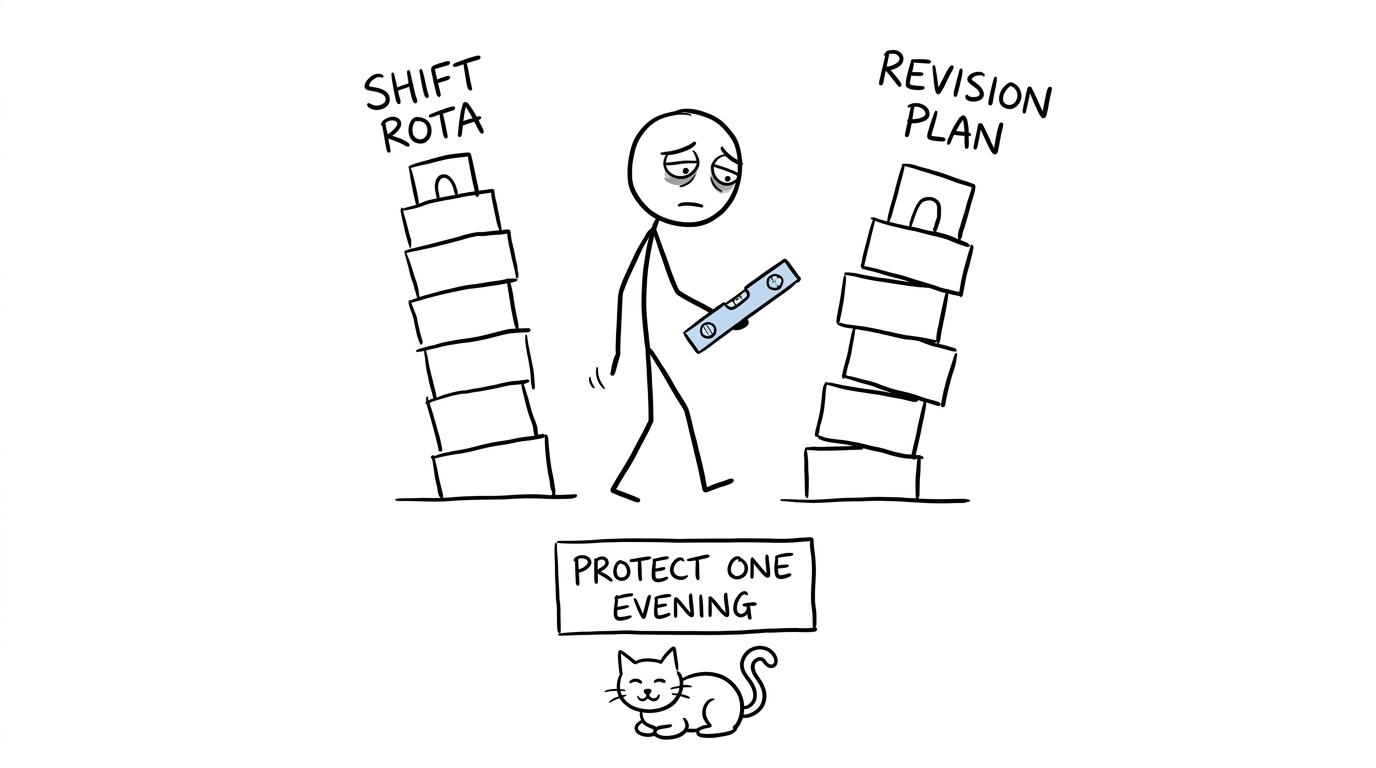 A student balancing a shift rota and revision plan
Build your week around energy, not empty space
A calendar can show that you are free after work. It cannot show whether you will be able to analyse an economic policy or complete a demanding algebra exercise at that point.
That distinction matters. Revision time and useful revision time are not always the same.
Begin with the fixed parts of your week: school, travel, meals, shifts and regular commitments. Then estimate your genuinely available time using a simple planning model:
R=W−S−J−TR = W - S - J - TR=W−S−J−THere, RRR represents realistic revision time, WWW is your usable time outside sleep, SSS is school and homework, JJJ is job time including travel, and TTT is essential rest and personal time.
The important word is realistic. Rest is not wasted time that can be deleted from the equation. If your plan depends on removing it, the plan is already fragile.
Match tasks to your energy
Use higher-energy periods for tasks that involve thinking and producing an answer:
- Economics extended responses
- interpreting case-study data
- drawing and explaining economic diagrams
- unfamiliar Maths practice questions
- timed exam sections
Lower-energy periods are better for lighter but still active tasks:
- recalling definitions without notes
- checking an answer against a mark scheme
- correcting questions attempted earlier
- organising flashcards by topic
- watching a short video solution and recording the key error
After a late shift, a brief retrieval session may be sensible. A full timed paper probably is not. That is not laziness; it is good allocation of a scarce resource: attention.
Use a minimum viable revision session
Students with jobs often abandon revision because the planned session feels too large. If there is no uninterrupted hour, nothing begins.
Create a minimum version instead. This might be ten to twenty minutes with one clear output: recall five definitions, plan one evaluation paragraph, correct one graph question or complete a small set of Maths questions.
A short session must still be active. Reading notes while tired can feel productive because the material looks familiar, but familiarity is not the same as recall. Close the notes and retrieve what you know. Answer something. Mark something. Improve something.
MathsGenie's free GCSE and A Level maths revision resources make these compact sessions easier because lessons, questions and solutions can be used as separate steps. You do not need to finish an entire topic in one evening.
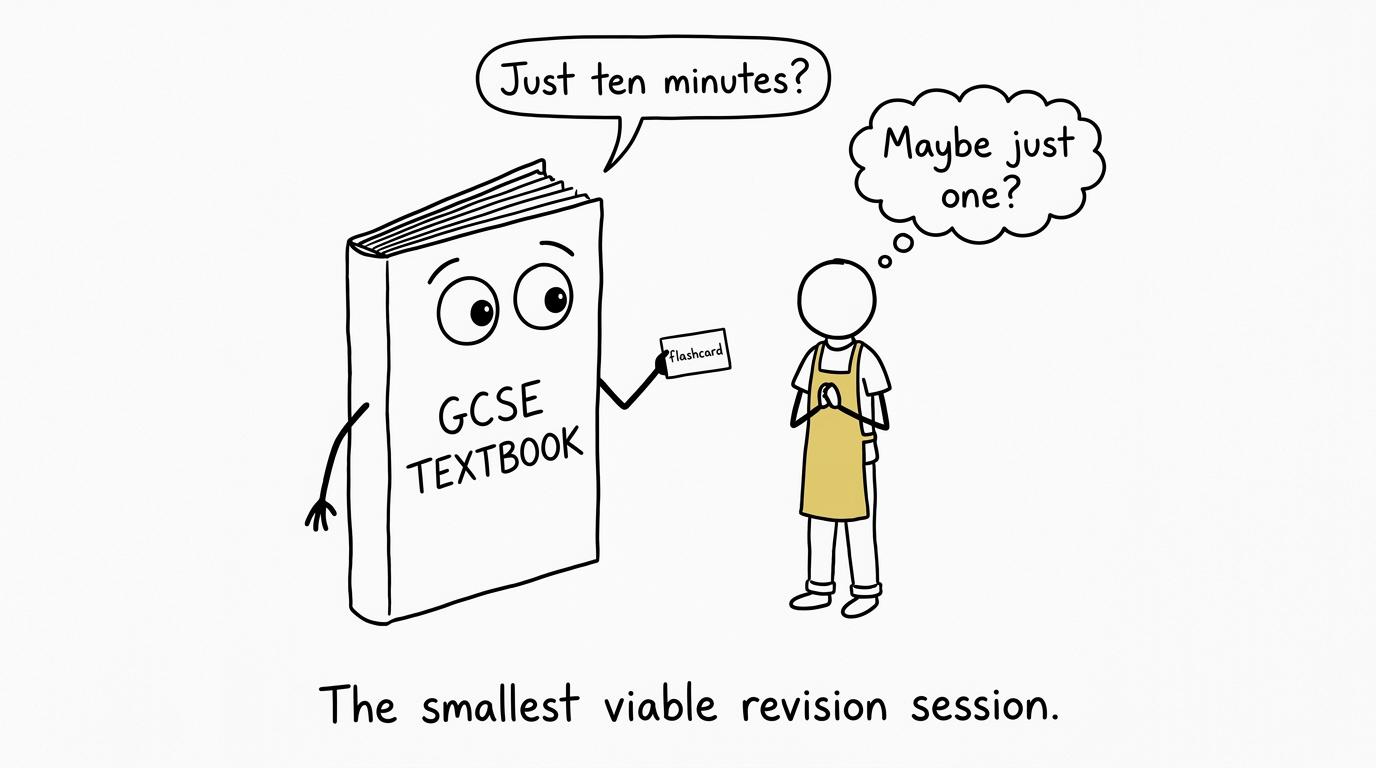 A tired student negotiating a tiny revision session with a textbook
Revise GCSE Economics in the way it is assessed
A busy timetable makes revision choices more important. Do not spend every Economics session memorising definitions simply because they are easy to organise.
GCSE Economics assessment objectives require students to demonstrate knowledge and understanding, apply ideas to contexts, and analyse and evaluate evidence. Ofqual's requirements allocate 35%35\%35% to knowledge and understanding, 35%35\%35% to application, and 30%30\%30% to analysis and evaluation. Your exact paper structure depends on your specification, so check whether you are taking AQA or OCR and use the materials provided by your school and exam board.
A balanced week should therefore contain four forms of Economics revision:
Knowledge retrieval
Recall key terms, assumptions, causes and consequences without immediately looking at notes. Keep the questions specific: what shifts demand, why markets may fail, or how inflation can affect different groups.
Context application
Take a familiar concept and connect it to the information in a question. Your job can make some contexts memorable, including wages, incentives, labour demand, productivity and opportunity cost, but an exam answer must use the case-study evidence provided, not rely only on personal experience.
Chains of analysis
Practise linking cause and effect. Each step should explain why the previous change produces the next one. A long paragraph is not automatically a developed argument.
Evaluation and judgement
Consider assumptions, affected groups, time periods and the relative importance of factors. Finish with a conclusion that answers the question rather than repeating both sides.
This structure prevents a common problem: knowing the course but being unable to turn that knowledge into marks.
Let Economics and Maths revision support each other
GCSE Economics includes quantitative skills. Official assessment requirements state that at least 10%10\%10% of the total marks must reward quantitative skills at no lower than Key Stage 3 level. These include percentages, percentage changes, averages, revenue, costs, profit, income, graphs and economic data.
That creates useful overlap with Maths revision. MathsGenie's quantitative skills in Economics revision guide covers the calculations and data interpretation expected in economic contexts.
However, do not count every Economics calculation as complete Maths revision. GCSE Maths questions may demand more varied techniques and unfamiliar problem-solving. Use Economics to reinforce common numerical skills, then maintain separate Maths practice for your foundation or higher tier specification.
A productive sequence is:
- learn or review a Maths skill;
- answer focused practice questions;
- recognise how the skill appears in Economics;
- return later and retrieve it without support.
This is more efficient than treating every subject as an isolated island.
Plan around changing shifts
A rigid timetable works until the rota changes. A flexible system uses weekly priorities instead of assigning every task permanently to a particular evening.
At the start of each week, choose:
- one essential Economics outcome;
- one essential Maths outcome;
- one secondary task for each subject;
- one catch-up window;
- one protected rest period.
Write outcomes rather than vague intentions. “Revise Economics” gives you no finish line. “Retrieve market-failure definitions and answer one application question” tells you exactly what completion looks like.
If a shift changes, move the outcome to the catch-up window. Do not rebuild the whole timetable or attempt to repay every missed minute late at night.
As examinations approach, introduce timed practice gradually. MathsGenie's guide to when GCSE students should start past papers explains how mini tests and targeted questions can lead into full timed papers. This progression is especially useful when work limits your available time.
Speak to your employer before pressure peaks
Do not wait until the week before an exam to mention that your availability needs to change. Once you know the dates of mocks or final papers, ask calmly and early whether shifts can be reduced, shortened or rearranged.
Be specific. A request covering a defined examination period is easier to understand than saying you are generally busy. If possible, offer availability after the examination period or suggest a shift swap that follows workplace procedures.
Employment rules differ according to your age and where you live in the UK. School-age employment can also be subject to local rules and permit requirements. Check current official guidance with a parent or carer, your local council and your employer. If work is interfering with school attendance, safe working conditions, sleep or your wellbeing, speak to a trusted adult or member of school staff promptly.
Protect sleep and recovery
Late-night revision can feel like proof that you care. Often, it is simply tomorrow's concentration being spent early.
Set a stopping time, especially after shifts. Keep one evening or substantial block free from both work and formal revision. A weekly plan needs slack because illness, transport delays, homework and rota changes are normal events, not planning failures.
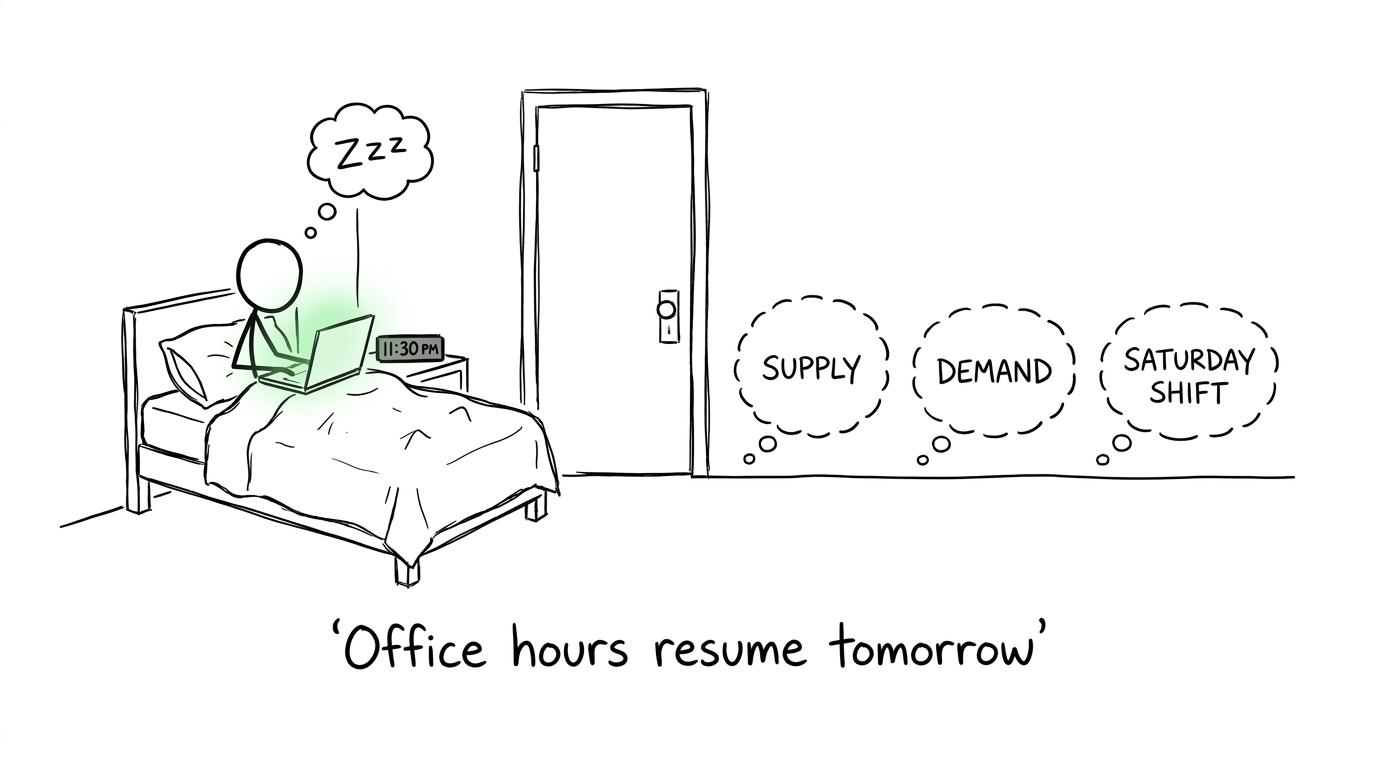 A student sending supply, demand and Saturday shifts away at bedtime
During the final run-in, use full papers selectively. MathsGenie's GCSE predicted papers can help sharpen exam technique after you have identified and repaired topic gaps. Mark the paper, classify each error and return to the relevant revision lesson or practice questions. The review is where much of the improvement happens.
If you are preparing for Edexcel Maths, the Edexcel GCSE paper collection brings together past and practice papers with solutions. Students who need to inspect the reasoning behind an answer can also use MathsGenie's foundation Paper 1 video solutions. Always select resources matching your own exam board and tier.
Common mistakes when balancing work and revision
Planning every available minute
A timetable with no spare capacity collapses after one delay. Leave a catch-up window and protect recovery time.
Saving all revision for days off
A long session once a week makes recall harder and creates pressure. Short sessions between shifts keep topics active, while days off can hold deeper practice.
Doing only comfortable tasks
Highlighting and reorganising notes can crowd out exam questions. Use retrieval, written answers, calculations and mark schemes so that revision resembles the performance required.
Treating a missed session as a debt
Trying to repay missed revision at midnight damages the next day. Move the most important outcome and deliberately drop a lower-priority task.
Ignoring the Maths inside Economics
Percentages, averages, graphs and data interpretation can produce valuable marks. Practise both the calculation and the economic interpretation.
Leaving employer conversations too late
Managers cannot always change an imminent rota. Give notice as soon as examination dates and revision commitments become clear.
Build a plan that can survive real life
Balancing GCSE Economics, Maths and a part-time job is not about becoming endlessly productive. It is about making sensible trade-offs before tiredness makes them for you.
Protect a few reliable sessions. Match demanding tasks to your strongest energy. Practise the full range of Economics assessment skills, keep Maths questions active and adjust work commitments early when exams approach.
Then let MathsGenie provide the structure: begin with free MathsGenie revision lessons and practice resources, diagnose gaps through mini tests and questions, and move towards past papers, mark schemes, video solutions and predicted papers. A plan does not need to look impressive. It needs to keep working.










