

GCSE Drama Tutoring Cost: A UK Price Guide
GCSE drama tutoring cost explained: compare realistic UK hourly rates, hidden fees, tutor checks and whether private support offers worthwhile value for you.
A tutor can look affordable when the price is shown as one hour. It feels rather different when that hour repeats every week until the exam. For students already preparing for GCSE maths, English and several other subjects, the decision is not simply whether tutoring might help. It is whether that help deserves part of a limited revision budget.
The short answer is that GCSE drama tutoring cost in the UK will commonly fall between roughly £20\pounds20£20 and £50\pounds50£50 per hour. A student tutor or small-group session may cost less, while an experienced Drama teacher, examiner or specialist in a particular specification may charge £50\pounds50£50 to £70\pounds70£70 or more. These are planning ranges rather than fixed national prices.
Recent UK tutoring listings and price guides show substantial variation. Some put general GCSE support near £20\pounds20£20 to £30\pounds30£30 per hour; others place experienced GCSE tutors closer to £30\pounds30£30 to £55\pounds55£55. Location, delivery method, qualifications and platform fees all affect the quote.
GCSE drama tutoring cost at a glance
Use this checklist before committing:
- Expect approximately £20\pounds20£20 to £50\pounds50£50 per hour for many one-to-one arrangements.
- Ask whether the tutor teaches your exam board and set text.
- Check whether preparation, feedback and resources are included.
- Compare online, in-person and small-group options.
- Confirm cancellation rules before paying for a block.
- Book a trial lesson before making a long commitment.
- Set one measurable objective for the tuition.
- Protect enough time and money for maths and your other GCSE subjects.
| Type of support | Indicative hourly cost |
|---|---|
| Student or early-career tutor | £15\pounds15£15 to £25\pounds25£25 |
| General GCSE tutor | £20\pounds20£20 to £40\pounds40£40 |
| Experienced teacher or subject specialist | £35\pounds35£35 to £55\pounds55£55 |
| Highly experienced examiner or specialist | £50\pounds50£50 to £70\pounds70£70 or more |
| Small-group tuition per student | £10\pounds10£10 to £25\pounds25£25 |
These bands overlap because job titles alone do not establish quality. A thoughtful tutor charging £25\pounds25£25 may be a better match than a poorly prepared tutor charging twice as much.
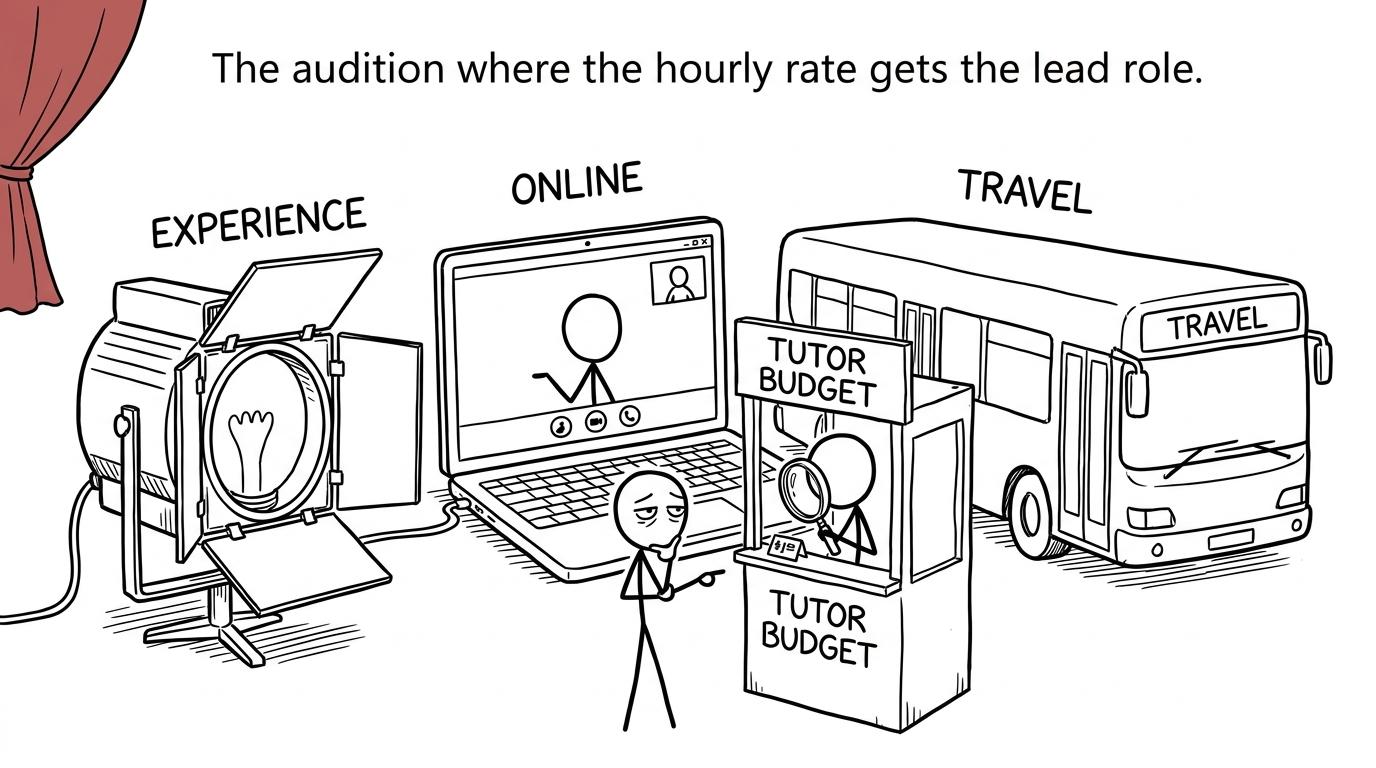 A GCSE student investigates the factors behind a tutor's hourly rate
Why GCSE Drama tutoring prices vary
Experience and teaching status
Qualified teachers and tutors with years of GCSE Drama experience usually charge more. Their value should come from knowing how to turn the specification into focused teaching: identifying the relevant assessment objective, interpreting the mark scheme and explaining how a response or performance can improve.
Examiner experience can be useful, but it should be described accurately. Ask what the tutor examined, for which board and how recently. No legitimate tutor can guarantee a grade or provide confidential information about future papers.
Exam-board and text knowledge
GCSE Drama is not one interchangeable course. AQA, Edexcel, OCR and Eduqas have their own specifications, assessment structures and prescribed texts. A tutor who knows the wrong text or an outdated specification may spend valuable time learning alongside the student.
For example, current AQA GCSE Drama includes a written examination worth 40%40\%40%, devising work worth 40%40\%40% and texts in practice worth 20%20\%20%. Edexcel also divides assessment between devising, performance from text and a written examination, but its component requirements differ. Always check the current official specification with your school.
A specialist who already understands your board, set text and performance route may charge more per hour but require fewer sessions.
Online or face-to-face tuition
Online tuition removes travel and widens the choice of tutors. It is not automatically cheaper, however. Recent UK listing data shows that online prices can match or sometimes exceed local in-person rates, particularly where the tutor has strong demand.
Drama also creates practical questions that do not arise in every subject. Can the camera capture posture and movement? Is there enough room to rehearse safely? Can the tutor give useful direction remotely? Online tuition can work well for written responses, portfolio feedback, terminology and textual analysis. Some performance coaching may benefit from being face to face.
Location, timing and demand
Rates are often higher in London and other expensive areas. Evening and weekend availability may also command a premium. Prices can rise as assessments approach because families are competing for fewer open times.
Booking earlier may give you more choice, but that does not mean paying for months of tuition by default. A short, targeted block can be more sensible than weekly lessons without a defined purpose.
What will tutoring cost over time?
The hourly rate is only the opening scene. The real figure is the total commitment:
Total cost=hourly rate×number of sessions+additional fees\text{Total cost} = \text{hourly rate} \times \text{number of sessions} + \text{additional fees}Total cost=hourly rate×number of sessions+additional feesAt £35\pounds35£35 per hour, ten sessions cost:
£35×10=£350\pounds35 \times 10 = \pounds350£35×10=£350That is a budget calculation rather than a worked Drama example, but it reveals why session frequency matters. Weekly tuition over twenty weeks at the same rate would cost:
£35×20=£700\pounds35 \times 20 = \pounds700£35×20=£700Ask about registration charges, platform commissions, travel, longer first sessions, resource fees and late-cancellation charges. Independent tuition supplied personally by an individual teacher may qualify for VAT exemption under UK rules when it covers a subject ordinarily taught in schools. Tuition supplied through a larger business can be treated differently, so the safest question is simple: is the quoted price the complete amount payable?
What should a good Drama tutor actually provide?
Price becomes meaningful only when attached to a service. Effective tuition should begin by locating the obstacle. Is the student struggling with performance technique, devising documentation, evaluation, theatre terminology, a set text or timing in the written paper?
A useful tutor should be able to:
- explain how lessons relate to the correct specification;
- establish a specific target for each session;
- give precise, respectful feedback rather than vague praise;
- model planning and analytical thinking without writing assessed work for the student;
- set manageable independent practice;
- review whether the same weakness is improving;
- communicate clearly about boundaries and safeguarding.
For non-exam assessment, support must remain legitimate. A tutor can teach skills, ask questions and explain assessment criteria, but they should not create portfolio content, devise assessed material or rewrite a student's submission.
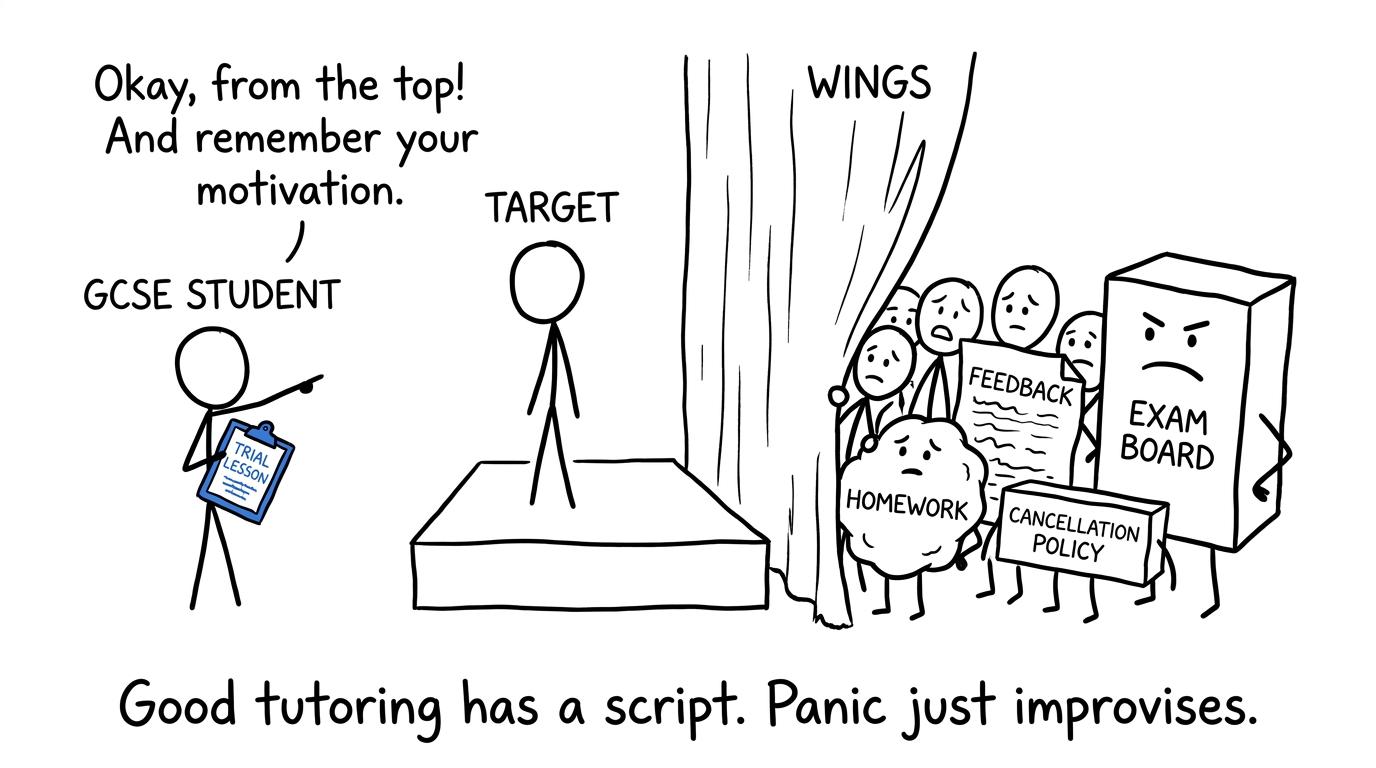 A trial tutoring lesson brings targets, feedback and exam-board knowledge on stage
How to decide whether private tutoring is worth it
The best question is not, “Is this tutor impressive?” It is, “What problem will this tuition solve that school support and independent revision are not solving?”
Start with one clear outcome
A worthwhile objective might be improving the structure of written evaluations, understanding a set text from a performance perspective or receiving feedback on vocal and physical technique. “Become better at Drama” is too broad to measure.
After several sessions, ask whether the student can do something independently that they could not do before. If every answer still depends on the tutor, the arrangement may be creating reliance rather than progress.
Compare the opportunity cost
GCSE students have finite time. An extra Drama session may remove an evening from maths revision or reduce sleep before school. That trade-off matters, especially when maths weaknesses can be addressed through high-quality free resources.
MathsGenie provides a free GCSE maths revision hub and a structured revision planner. Students can use these alongside private support in another subject, keeping their wider revision balanced without adding another tutoring bill.
If maths is the immediate concern, first diagnose the gaps. The GCSE one-month revision plan explains how to combine focused topic work, retrieval and paper practice. Sometimes structure, rather than another paid lesson, is what was missing.
Consider lower-cost alternatives
Before booking weekly one-to-one lessons, ask the Drama teacher whether school offers revision sessions, rehearsal feedback or intervention. A short block of tuition, a shared session or a lesson every fortnight may be enough.
You can also redirect independent maths revision towards free active practice. The AQA GCSE maths revision resources include lessons, questions and paper practice, while students following Edexcel can use Edexcel GCSE maths past papers with mark schemes and solutions.
Questions to ask before the trial lesson
A calm comparison is better than choosing the first available profile. Ask:
- Which GCSE Drama boards and set texts do you currently teach?
- What would you assess in the first lesson?
- What is included in the hourly fee?
- How do you give feedback on performance and written work?
- How will we know whether tuition is helping?
- Do you set work between sessions?
- What is your cancellation policy?
- Can we stop or reduce sessions without losing prepaid fees?
- What safeguarding procedures apply online or in person?
Paying for one trial lesson is usually safer than buying a large block immediately. If a package offers a discount, calculate the effective hourly price:
Effective hourly price=total package pricetotal teaching hours\text{Effective hourly price} = \frac{\text{total package price}}{\text{total teaching hours}}Effective hourly price=total teaching hourstotal package priceThen check whether unused lessons are refundable and whether the tutor, lesson length or schedule can change.
Common mistakes when comparing Drama tutors
Choosing by price alone
The cheapest tutor may lack current specification knowledge. The most expensive may simply have stronger marketing. Compare relevance, preparation and feedback, not prestige.
Booking without a defined weakness
Tuition drifts when nobody can explain its purpose. Begin with evidence from teacher feedback, mock work or an assessment objective.
Ignoring the total cost
A manageable weekly payment can become a substantial term-long expense. Calculate the full commitment before agreeing.
Assuming online always means cheaper
Delivery method does not determine value. Compare like with like, including lesson length, preparation and written feedback.
Neglecting other GCSE subjects
Drama support should fit inside a complete revision plan. Use a realistic GCSE maths revision timetable and protect regular practice in core subjects.
Expecting tutoring to replace independent practice
A tutor can identify and explain. The student still has to rehearse, retrieve knowledge and respond to feedback. The same principle applies in maths: using past papers properly means marking, repairing weaknesses and retesting rather than merely collecting scores.
Make the decision with evidence
A realistic GCSE Drama tutoring budget is often built around £20\pounds20£20 to £50\pounds50£50 per hour, with lower-cost group options and higher prices for experienced specialists. Yet the hourly figure cannot tell you whether the tuition is worth buying. That depends on fit, focus, feedback and whether improvement survives when the tutor is no longer in the room.
Choose a tutor who understands the correct specification, agrees on a precise goal and is comfortable being evaluated after a short trial. Keep the wider GCSE picture in view too.
For maths, start free with MathsGenie's revision lessons and practice questions, then build towards mini tests, past papers, predicted papers, mark schemes and video solutions. A good revision system should make every paid hour more purposeful, and every independent hour more productive.










