

GCSE Design and Technology Study Group Guide
GCSE Design and Technology study group guide: build a focused routine for exam recall, D&T maths, NEA boundaries and meetings that happen.
A study group can fail without anybody deciding to abandon it. One week, everyone is enthusiastic. The next, the group chat contains forty messages, three polls and no confirmed meeting.
A GCSE Design and Technology study group works when it has a small membership, a fixed meeting time and a clear task for every session. It should help members recall technical knowledge, discuss exam questions and practise D&T calculations. It must not become a place for sharing assessed NEA work.
The difference is structure. A useful group does not merely create more conversation about revision. It creates revision.
The quick setup checklist
Before inviting half your year group, agree these essentials:
- Choose three to five reliable members.
- Confirm that everyone follows the same exam board, or identify specification differences.
- Meet at the same time and place each week.
- Keep sessions between 454545 and 606060 minutes.
- Set one specific topic before every meeting.
- Use closed-book questions before opening notes.
- Rotate the chair, quizzer, timekeeper and checker roles.
- Finish by agreeing individual actions and the next meeting.
- Keep NEA portfolios, design ideas and assessed writing private.
The group chat should handle logistics only. If a message does not help confirm where, when or what to prepare, it probably belongs elsewhere.
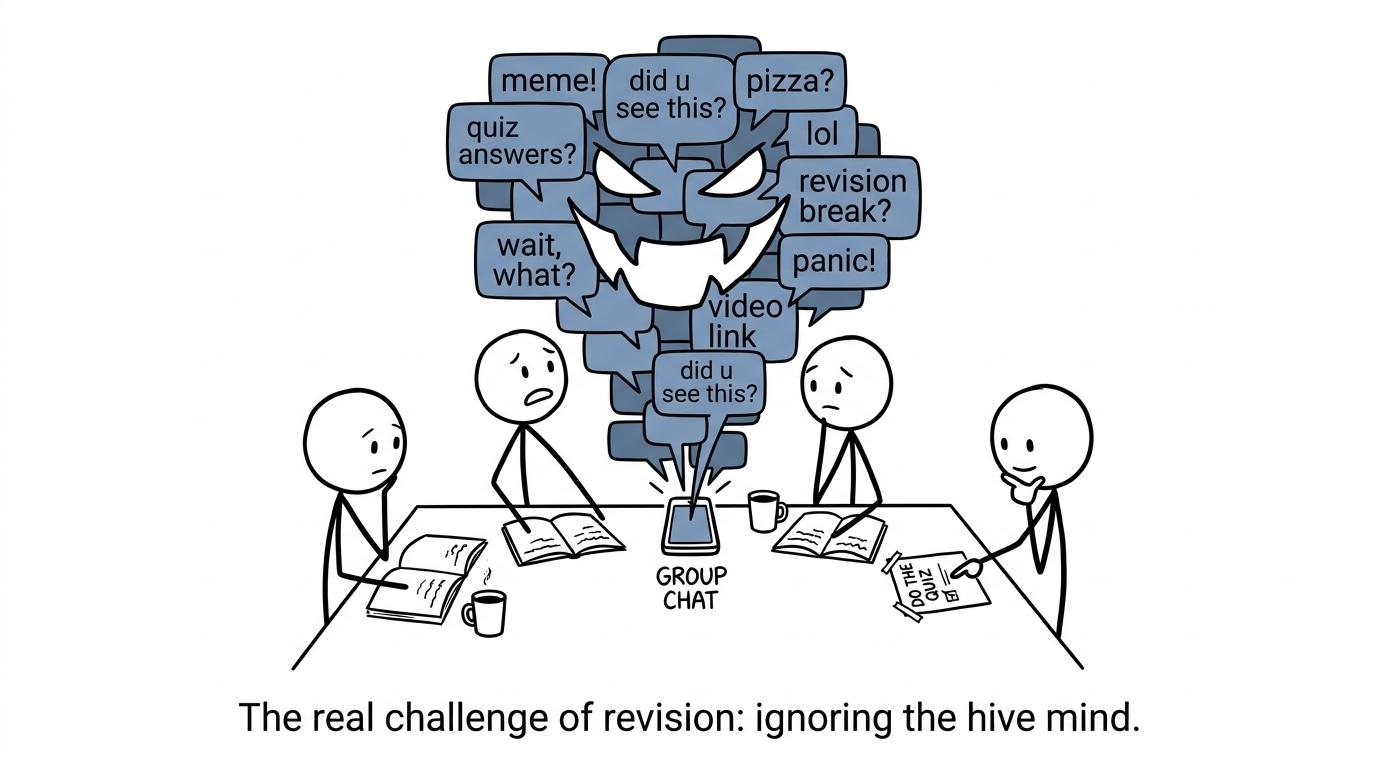 A study group escaping an enormous group-chat monster by following a simple quiz agenda
Start with the specification, not good intentions
Design and Technology is broad. Materials, manufacturing, sustainability, mechanisms, electronics, design decisions and mathematical skills can all appear, but the precise organisation depends on the exam board.
AQA, Edexcel, OCR and Eduqas do not arrange every component in exactly the same way. Official AQA and OCR specifications, for example, state that at least 15%15\%15% of the written paper assesses mathematical skills in a D&T context. Their qualifications also divide assessment between a written examination and NEA, although students should always check their own current specification and teacher guidance.
At the first meeting, write down:
- the exam board and specification code;
- the written paper structure;
- the specialist material or in-depth area studied;
- the topics each member finds hardest;
- the dates supplied by the school;
- the permitted calculator and equipment arrangements.
Do not rely on somebody remembering what a teacher said months ago. A shared revision checklist can be collaborative because it records topics, not answers. Mark each area red, amber or green individually, then use the combined pattern to choose future sessions.
This principle also matters in maths revision. The GCSE maths topics by exam board and tier guide helps students distinguish shared curriculum content from differences in how boards organise and assess it.
Give the group a job it can finish
“Revise materials” is not a useful meeting goal. It is too large to create urgency and too vague to measure.
A better goal names an observable result: recall the properties and uses of a selected material family, compare two manufacturing methods, or complete and mark a short set of calculation questions. At the end, everyone should be able to say whether the task was completed.
Use this repeatable session structure:
Opening retrieval
Spend the first ten minutes answering short questions without notes. One member reads the prompts while everyone records their own answers.
Retrieval practice requires learners to bring information back from memory rather than simply reread it. Reviews of classroom research have generally found that this can strengthen learning across subjects, particularly when answers are checked and feedback follows. The group should therefore quiz first and consult notes second.
Focused repair
Compare answers, identify uncertainty and use specifications, class resources or textbooks to resolve it. Do not spend twenty minutes debating a fact that can be checked in two.
The aim is not to prove who remembered most. It is to locate weak knowledge while there is still time to improve it.
Exam application
Attempt a small number of board-appropriate questions independently. Then discuss what the command words require and check the official mark scheme where available.
For extended responses, members can discuss what a strong answer needs without composing one shared response. Each student should plan and write independently so that vague understanding becomes usable exam technique.
Exit check
End with three fresh questions or a one-minute summary from each member. Record unresolved topics and assign preparation for the next meeting.
This is similar to the effective maths rhythm of learn, practise, mark, fix and retest. MathsGenie's guide to using GCSE past papers properly explains why the correction after a question is often more valuable than the original attempt.
Use roles to prevent passengers
Study groups become awkward when one organised person quietly does everything. Roles distribute responsibility without turning the meeting into a committee.
- Chair: keeps the group on the agreed topic.
- Quizzer: prepares short retrieval questions.
- Timekeeper: protects each section of the agenda.
- Checker: brings the relevant specification points and mark schemes.
Rotate these roles every meeting. In a group of three, the chair can also keep time. In a group of five, one member can record the next actions.
Nobody should be appointed “the clever one”. Explaining a topic can expose gaps in the speaker's understanding, but every explanation still needs checking against an authoritative resource. Confidence is not a mark scheme.
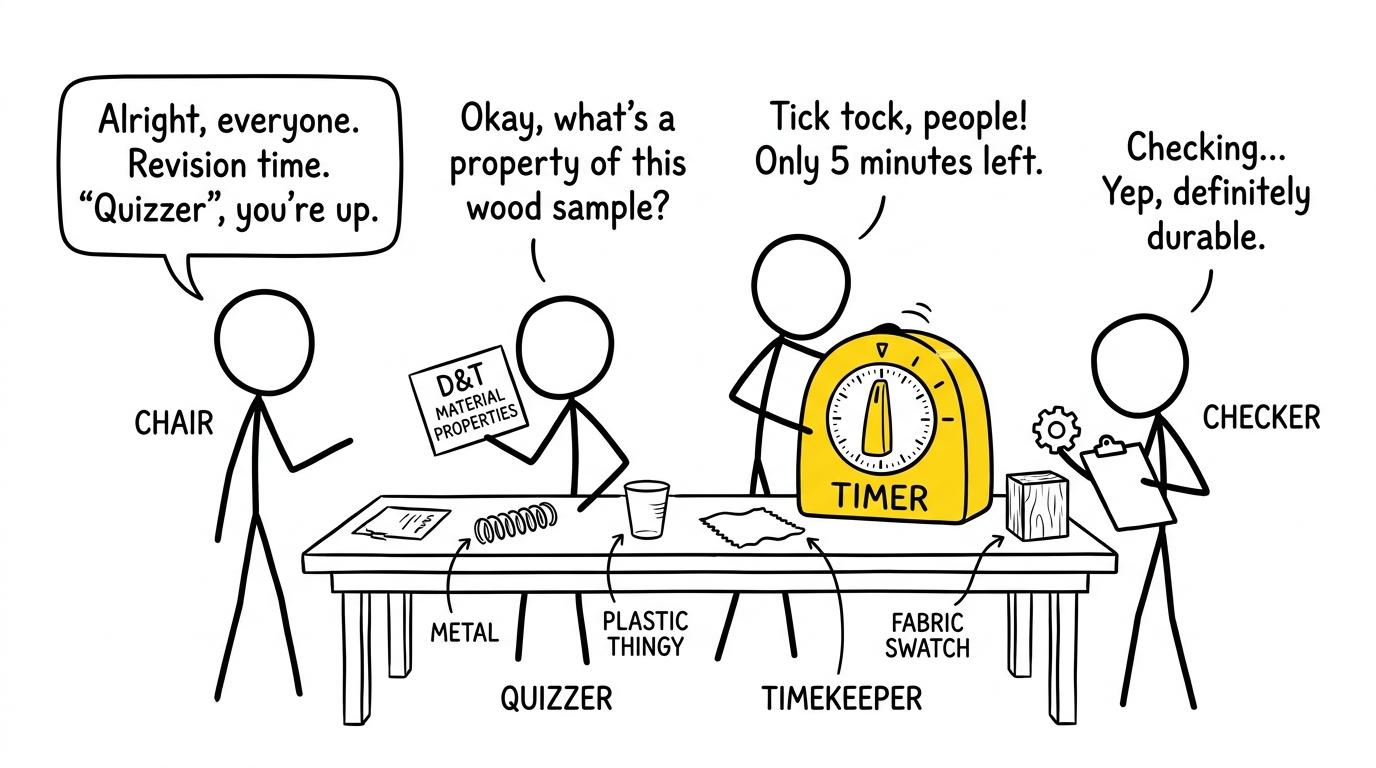 Four study-group members with rotating jobs while an enthusiastic timekeeper guards a giant timer
Build D&T maths into every other meeting
The calculations in Design and Technology are easier to neglect because they sit among large amounts of technical content. That makes them ideal for short, regular group practice.
Create a formula and skills checklist covering the areas required by your specification. Depending on the board and question context, this may include:
- percentages and percentage change;
- ratio and scale;
- area, surface area and volume;
- unit conversion;
- tolerances and limits;
- averages and interpreting data;
- speed, distance and time;
- density;
- mechanical advantage or gear relationships.
Useful relationships may include:
density=massvolume\text{density}=\frac{\text{mass}}{\text{volume}}density=volumemassand
speed=distancetime.\text{speed}=\frac{\text{distance}}{\text{time}}.speed=timedistance.The real difficulty is often not recalling a formula. It is recognising which measurements are relevant, converting units consistently and presenting an answer with an appropriate unit.
Use the free GCSE Maths revision hub when the obstacle is mathematical rather than technical. Topic lessons, practice questions, mark schemes and video solutions can repair weaknesses in ratio, percentages, geometry and compound measures. The similar shapes, area and volume revision guide is particularly useful when scale affects two-dimensional or three-dimensional designs.
Students who want a systematic order can also use the best order to learn GCSE maths topics alongside the group's D&T checklist.
Draw a firm line around NEA work
A revision group can discuss general knowledge and practise unassessed questions. It must not become a shortcut for producing assessed work.
Current JCQ guidance requires submitted NEA to be the candidate's own work. Where collaboration is permitted for research or preparatory activity, assessable outcomes must still be attributable to individuals. Candidates must write their own accounts, draw their own conclusions, acknowledge sources and keep their work secure. Subject-specific instructions and teacher guidance take priority.
For a safe group rule:
- do not share completed or partially completed portfolio pages;
- do not exchange CAD files, design ideas or written evaluations;
- do not rewrite another member's assessed work;
- do not photograph or upload somebody else's NEA;
- ask the teacher before collaborating on anything connected to assessment.
You can revise general design processes, test each other on technical principles and analyse released practice material. You cannot turn one person's assessed response into a group template.
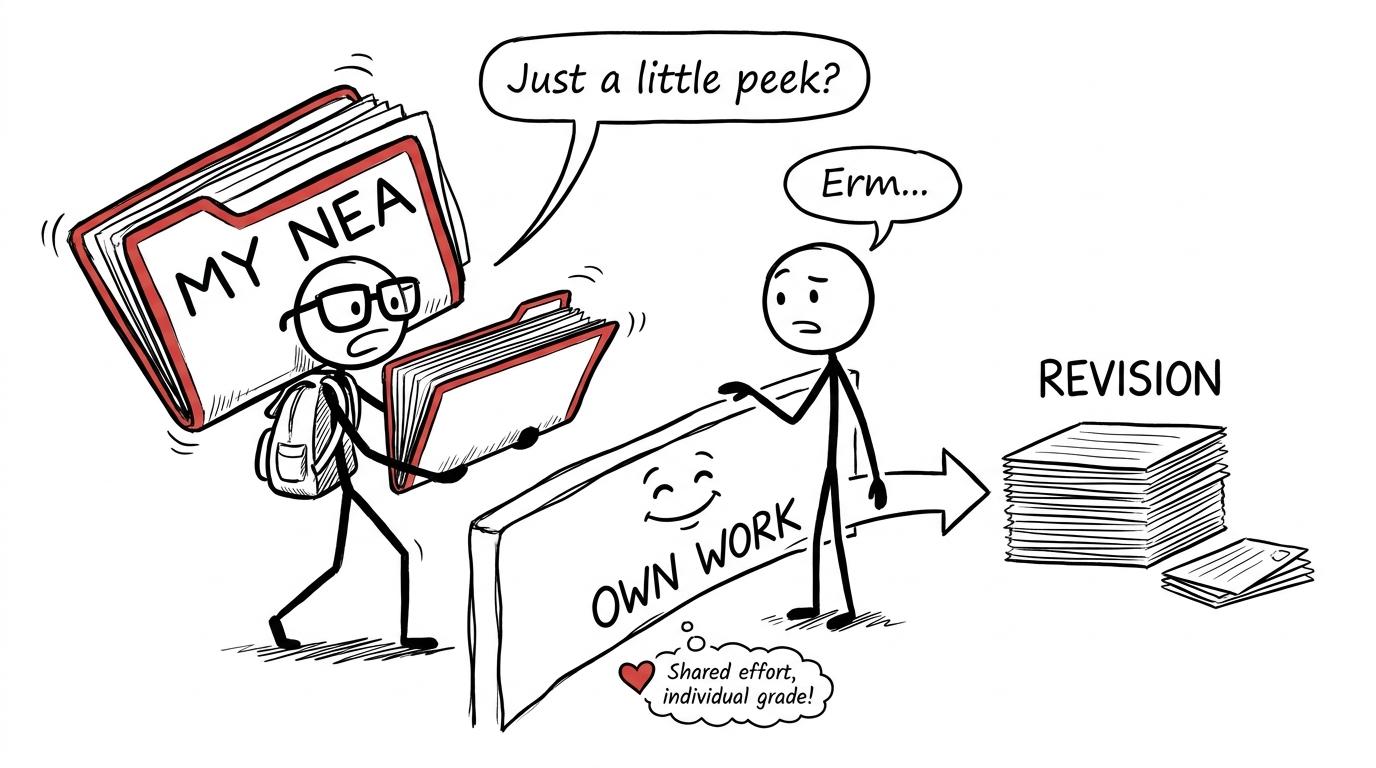 A friendly own-work barrier redirecting an NEA folder towards safe shared revision cards
Make the group chat deliberately boring
A productive chat has three uses: confirming attendance, posting the next topic and sharing links to permitted revision resources.
Use one pinned message containing:
- the regular meeting time and place;
- the next session's topic;
- what each person must bring;
- role allocations;
- the rule that silence means the meeting still goes ahead.
Avoid endless availability polls. Choose a recurring slot that works for most members and review it only when circumstances genuinely change. Reliability matters more than perfect attendance.
If two students arrive, they should still run the session. A group that requires every member to feel motivated at the same moment will rarely meet.
Common mistakes that stop study groups working
Inviting too many people
Larger groups create more schedules, more side conversations and less individual accountability. Start small. Students who attend consistently are more useful than students who merely join the chat.
Spending the meeting making resources
Beautiful flashcards can feel productive while avoiding retrieval. Prepare only what the next test requires, then use it immediately.
Letting one person teach all evening
An explanation can help, but passive listening is fragile. After any explanation, everyone should answer a question independently or summarise the idea from memory.
Marking generously
Friendly marking hides the exact gaps the meeting is meant to expose. Follow the mark scheme and record why each mark was lost. The advice on stopping forgotten GCSE content shows how retrieval, marking and spaced returns can form one routine.
Attempting full papers too early
A complete paper can reveal weaknesses, but it does not repair them automatically. Use topic questions and short tests first, then progress to timed papers. Near the exam, MathsGenie's Edexcel GCSE Maths predicted papers can provide additional maths rehearsal, while official past papers remain essential.
Ignoring the next action
A meeting without a recorded next step depends on enthusiasm returning by itself. Before leaving, agree the next topic, quizzer and date.
Turn one meeting into a reliable revision system
The best GCSE Design and Technology study group is not the busiest chat or the largest table. It is the one that meets regularly, tests memory, checks mistakes and respects the boundary around individual NEA work.
Begin with three reliable people and one 454545-minute session. Pick a narrow topic, prepare ten retrieval prompts and finish with an exit check. Then schedule the next meeting before anyone leaves.
For the mathematical side of D&T and your wider GCSE exam preparation, make MathsGenie your free revision base. Use revision lessons to rebuild methods, practice questions and mini tests to expose gaps, mark schemes and video solutions to correct them, and past papers or predicted papers to test whether the improvement holds. A group supplies accountability. A clear resource supplies direction. Together, they turn good intentions into work that actually gets done.











