

GCSE Dance Predicted Grade Process Explained
GCSE dance predicted grade process explained: see how teachers use practical work, choreography, mocks and mark schemes to estimate your likely grade fairly.
A predicted grade can feel strangely final. It appears on a report as a single number, yet you may not know which rehearsal, written assessment or practical performance produced it. That uncertainty matters when you are balancing Dance with maths revision and deciding where your time should go.
The GCSE dance predicted grade process is usually a professional estimate based on your performance work, choreography, written assessments and progress against the exam board's criteria. It is not simply your latest mock grade, and it is not your final GCSE result. Schools may use slightly different prediction policies, so your teacher is the best person to explain the precise calculation used in your centre.
The predicted grade checklist
For AQA GCSE Dance, teachers will commonly consider:
- assessed or provisional marks for performance;
- assessed or provisional marks for choreography;
- Dance Appreciation mocks and timed written assessments;
- how consistently your work meets the specification's assessment criteria;
- the amount of the course completed when the prediction is made;
- previous grade boundaries, used cautiously rather than as fixed targets;
- standardisation or moderation within the department;
- whether recent evidence shows sustained improvement.
The key word is evidence. A prediction should describe the standard your completed work currently supports, sometimes with a limited judgement about your likely performance by the end of the course. It should not be a reward for effort, a punishment for one weak lesson or a guess based on confidence.
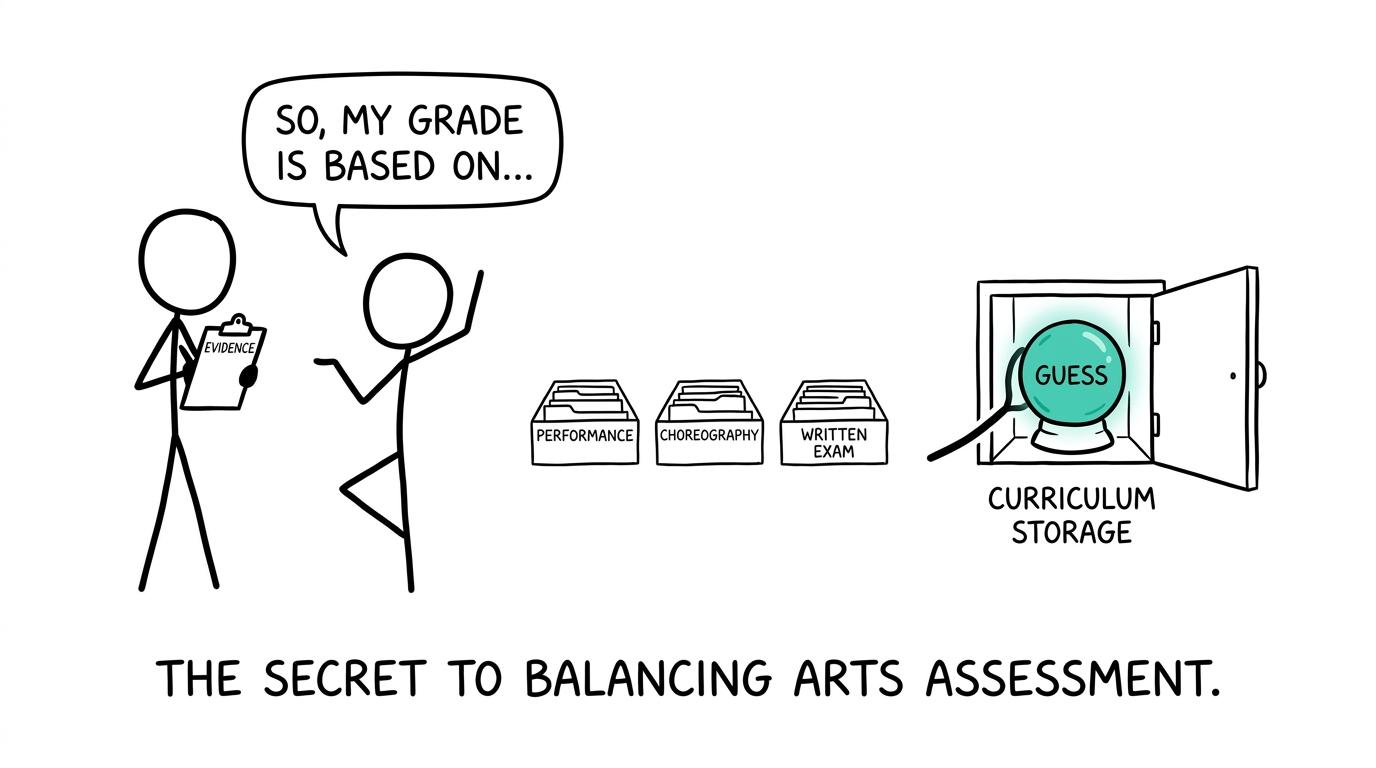 A Dance teacher files evidence while a crystal ball marked guess is put away
How AQA GCSE Dance is assessed
The exact process depends on your specification, so confirm your exam board with your school. For AQA GCSE Dance, the qualification has two components and is not divided into foundation and higher tiers.
Performance and choreography
Component 1 is non-exam assessment, usually called NEA. It contributes 60%60\%60% of the final qualification and contains:
- performance, worth 404040 raw marks and 30%30\%30% of the GCSE;
- choreography, worth 404040 raw marks and 30%30\%30% of the GCSE.
Performance includes solo work, duet or trio work, and evidence of relevant mental skills. Teachers apply the published assessment grids to physical, technical and expressive skills rather than awarding marks for enthusiasm alone.
Choreography is also marked against defined criteria. These consider how effectively a student selects and uses areas such as action, dynamics, space, structure, choreographic devices and aural setting to realise an intention.
Your teacher marks this component internally. For the final qualification, the centre's marking is externally moderated by AQA, so a provisional school mark is not necessarily untouchable.
Dance Appreciation
Component 2 is a written Dance Appreciation examination worth 40%40\%40% of the GCSE. It is marked out of 808080 and assesses knowledge, understanding, analysis, interpretation and evaluation connected with students' own practice and the prescribed professional works.
Before the final examination exists, teachers must estimate this part from evidence such as:
- full or partial mock papers;
- timed extended responses;
- shorter knowledge tests;
- anthology comparison questions;
- class assessments marked using exam-board criteria.
A teacher may trust a recent, broad mock more than a short test on one familiar work because it samples more of the required knowledge and skills. That does not mean one mock automatically determines the prediction. It means some evidence is more representative than other evidence.
How teachers turn marks into a predicted grade
For the final AQA calculation, the practical component has a maximum of 808080 raw marks and is scaled by 333. The written paper also has 808080 raw marks and is scaled by 222. If PPP is the performance mark, CCC is the choreography mark and WWW is the written mark, the scaled total is represented by:
T=3(P+C)+2WT = 3(P+C)+2WT=3(P+C)+2WThe maximum is therefore:
3(40+40)+2(80)=4003(40+40)+2(80)=4003(40+40)+2(80)=400This formula explains why teachers cannot sensibly predict the qualification from the written mock alone. Practical evidence carries 60%60\%60% of the overall result.
At prediction time, however, not every value may be final. A choreography might be unfinished. Recorded performance evidence may not yet have been formally assessed. A written mock may cover only part of the specification. The teacher therefore combines available marks with professional judgement about the reliability and coverage of that evidence.
Previous boundaries are a guide, not a promise
Once teachers have an estimated scaled total, they may compare it with boundaries from completed exam series. But official grade boundaries are set after an examination series has been marked. They can move because the demand of papers and the performance of the national cohort vary.
That is why a predicted grade should not be read as an exact conversion guaranteed to remain valid. The same principle applies in maths. The MathsGenie grade boundaries centre is useful for checking historical boundaries, but previous figures are context rather than advance confirmation of the next series.
Departments may review the judgement
A Dance teacher may compare marking with colleagues, use exam-board exemplars and apply departmental standardisation. This helps everyone interpret phrases in the assessment grid consistently. A student's final NEA evidence is also subject to the exam board's moderation process.
A routine school prediction is different from a final awarded grade. It is normally an internal estimate, and AQA does not moderate every prediction printed on a school report. Your school may also distinguish between a current working grade, a predicted grade and a target grade. Ask which one you are looking at before drawing conclusions.
What evidence usually matters most
Strong evidence has three qualities: it is relevant to the specification, marked against suitable criteria and broad enough to represent the qualification.
Completed practical evidence
Recorded or formally assessed performance and choreography are more dependable than a teacher's impression from an ordinary rehearsal. Rehearsals still matter because they reveal progress and help teachers give feedback, but the assessed outcome must meet the published criteria.
Exam-style written work
A timed response completed independently usually tells a teacher more about likely examination performance than an answer improved with notes and repeated feedback. Homework can support the overall picture, but teachers need to know that evidence is authentically yours and reflects what you can reproduce.
The same distinction is valuable in maths. A completed paper is evidence; the improvement happens when you analyse it. MathsGenie's guide to using GCSE past papers properly explains how to mark, diagnose and repair mistakes rather than merely collecting scores.
A pattern across time
One poor assessment can be unrepresentative. So can one unusually strong result. Several pieces of recent evidence showing a similar standard give a teacher a firmer basis for prediction.
Improvement matters most when it is visible in new, independent work. If feedback says your analysis needs more specific evidence, the convincing response is not a promise to improve. It is a later timed answer that applies the feedback successfully.
What can change your Dance prediction
Start by asking your teacher a precise question: Which component currently limits the evidence for the next grade? That is more useful than asking how to "get the prediction up".
Then turn the answer into a short action plan:
- request your provisional marks or assessment bands where your school can share them;
- identify whether performance, choreography or written appreciation is the weakest component;
- ask which wording in the assessment criteria describes the next standard;
- produce fresh work under the conditions your teacher specifies;
- act on feedback, then show the improvement independently;
- check when predictions are reviewed and which assessments can still contribute.
Do not neglect a heavily weighted component because another feels easier to improve. A balanced plan follows the structure of the qualification.
This evidence-first approach also protects your maths revision time. Use MathsGenie's weakest-topic diagnostic to find where marks are disappearing, then use GCSE maths mini tests for focused retesting. Your school's revision planner can then give Dance and maths specific sessions rather than vague blocks labelled "revise".
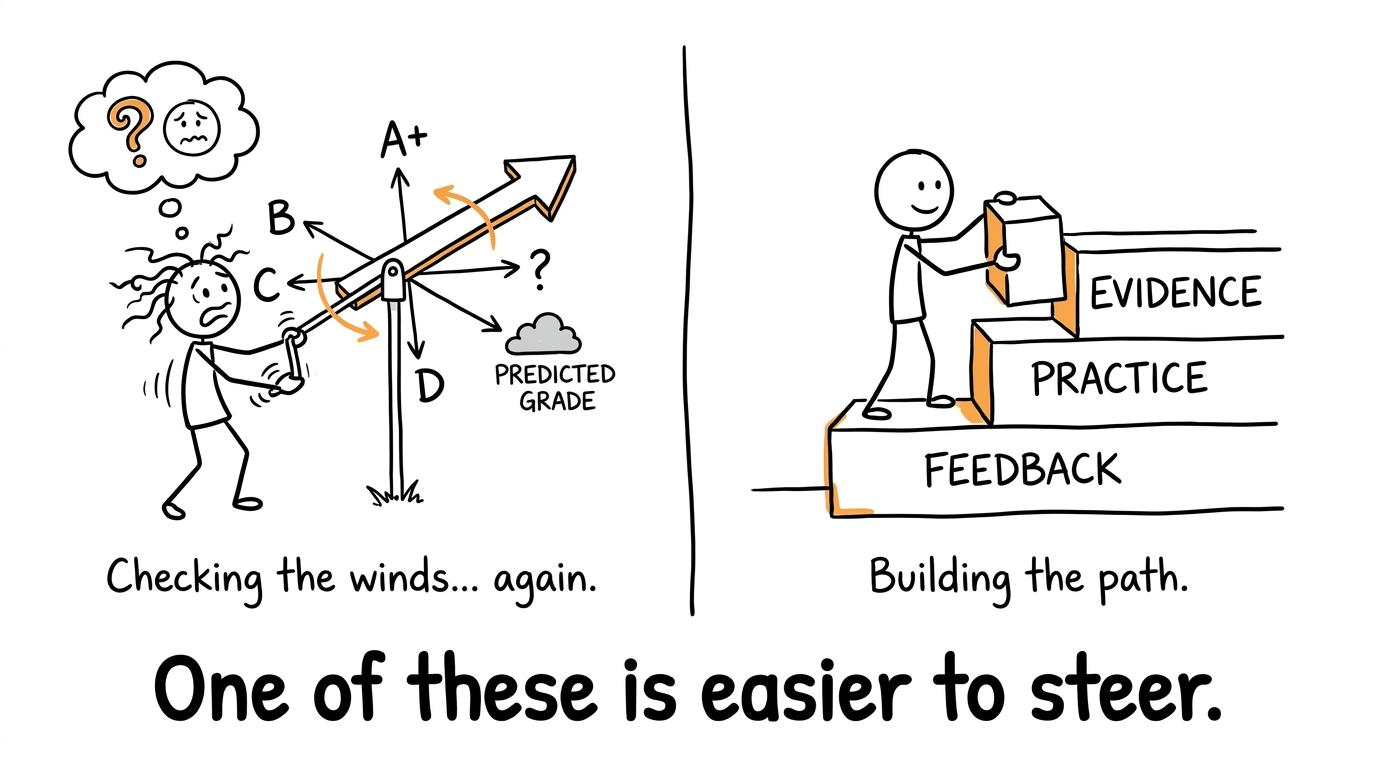 One student watches a predicted-grade weather vane while another builds a staircase from evidence
Common mistakes when interpreting a predicted grade
Treating the prediction as a guaranteed result
A prediction is an estimate made before all final evidence is available. Your actual GCSE grade comes from the assessed components and the official boundary for that examination series.
Assuming effort automatically earns marks
Effort is essential because it creates opportunities to improve. Marks, however, are awarded for evidence meeting assessment criteria. Ask how your effort can become stronger performance, choreography or written analysis.
Focusing only on the latest mock
The written examination contributes 40%40\%40% in AQA GCSE Dance. A mock result matters, but it does not erase the practical component or automatically represent every written skill.
Comparing raw marks from different components
A mark out of 404040 in choreography and a mark out of 808080 in Dance Appreciation do not contribute in the same raw form. Component weighting and scaling must be considered.
Treating old boundaries as fixed
Previous boundaries can help teachers estimate a grade range, but the next boundaries are unknown in advance. Maths students face the same trap when using predicted papers. The sensible approach is to use predictions for practice without trying to guess the exact paper, as explained in what to revise without guessing.
Revising everything equally
Equal time does not always produce equal value. Prioritise weak, high-impact areas while continuing to maintain strengths. If examinations are approaching, the guide to when to start GCSE past papers can help you organise the maths side of your timetable.
A prediction is information, not identity
A predicted grade compresses a large collection of evidence into one digit. That makes it convenient, but incomplete. It cannot show the stronger projection in your latest performance, the recurring weakness in evaluative writing or the feedback you have only just begun to apply.
Use the grade as a signpost. Find the component behind it, understand the relevant criteria and create better evidence before the next review. Then bring the same discipline to maths: learn the method, practise it independently, mark the result and retest the weakness.
MathsGenie gives you a free place to run that cycle. Begin with the MathsGenie GCSE and A Level revision hub, use revision lessons and practice questions to rebuild weak topics, and test your progress with mini tests, past papers and predicted papers. Mark schemes and video solutions show where marks were lost, while the one-week GCSE maths revision plan helps when time is tight.
You cannot control every prediction or future grade boundary. You can control the quality of the next piece of evidence you produce. That is where progress becomes visible.











