

GCSE Dance Paper 1 Exam Date 2026: AQA Guide
GCSE Dance Paper 1 exam date 2026 explained: check the AQA deadline, written exam date, practical checklist and a calm maths revision plan alongside it.
The difficult thing about an exam timetable is not usually reading the date. It is knowing whether you have found the date for the right component.
The GCSE Dance Paper 1 exam date 2026 is best understood as an AQA Component 1 deadline: Performance and Choreography, code 8236/C, must be submitted by Thursday 7 May 2026. It is non-exam assessment rather than a nationally timetabled written paper, so your school will normally arrange performances and recordings earlier.
The written Dance Appreciation exam, code 8236/W, is Friday 12 June 2026 in the afternoon. It lasts 111 hour 303030 minutes.
The essential dates at a glance
| AQA GCSE Dance component | Date and session | What it means |
|---|---|---|
| Component 1: Performance and Choreography, 8236/C | Submit by Thursday 7 May 2026 | Your school sets earlier performance, recording and evidence deadlines |
| Component 2: Dance Appreciation, 8236/W | Friday 12 June 2026, afternoon | Nationally timetabled written examination lasting 111 hour 303030 minutes |
| Final date of the wider exam period | Tuesday 23 June 2026 | Students must remain available throughout the official exam period |
| Contingency day | Wednesday 24 June 2026 | Keep this free in case national or significant local disruption requires an exam to move |
Before relying on any online date, compare it with your school-issued timetable and confirm that your entry code is AQA 8236. Your school will also tell you the exact arrival time, room and arrangements for each assessment.
Why GCSE Dance Paper 1 causes confusion
Students often use “Paper 1” to mean the first assessed part of a course. AQA uses a more precise name: Component 1: Performance and Choreography.
That distinction matters. Component 1 is not a written examination that every student sits simultaneously on 7 May. It is internally marked, externally moderated non-exam assessment. The published date is the deadline by which centres must submit the required work and marks to AQA.
Your live performances, choreography, filming and supporting evidence may therefore be completed days or weeks before 7 May. A date printed on a classroom notice or school calendar can be different from the board deadline without either date being wrong.
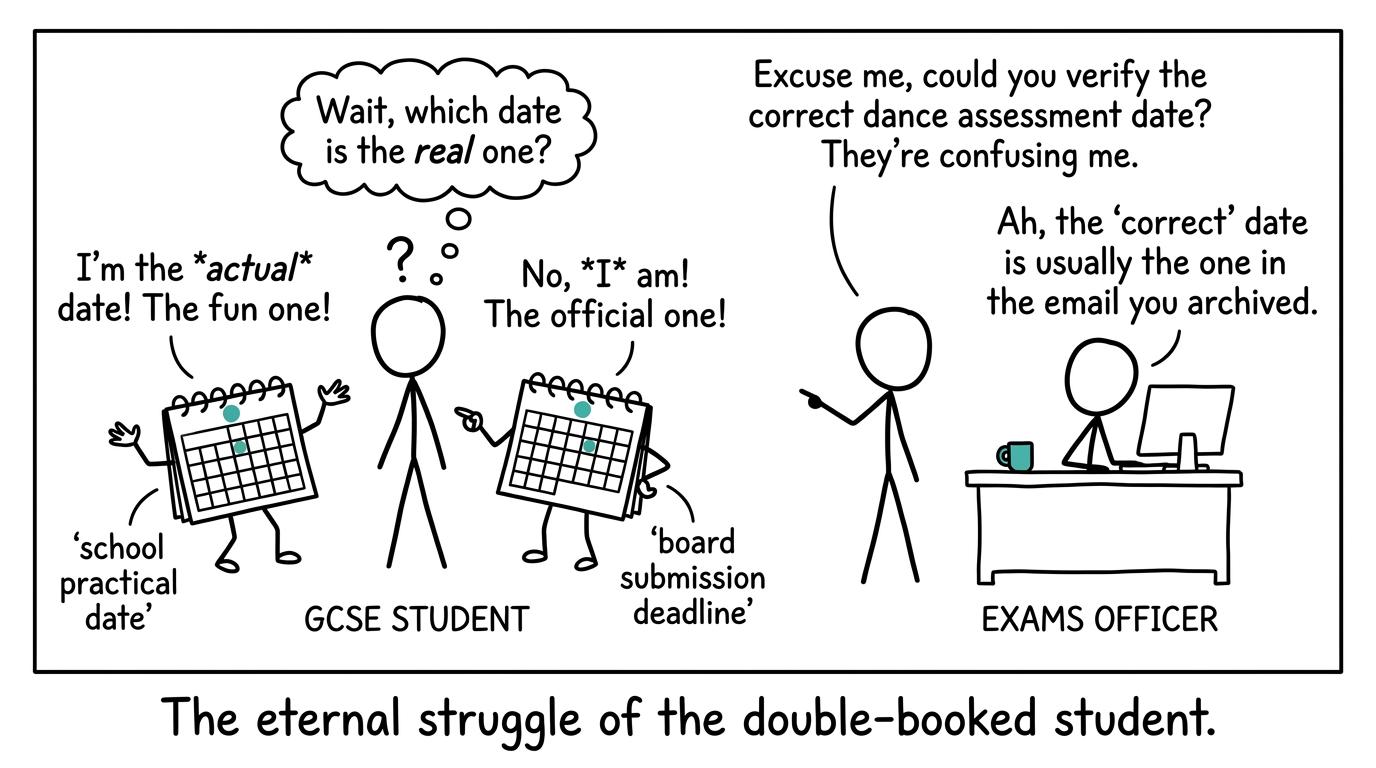 A student checks the difference between a school practical date and an exam-board deadline
The safest question to ask your teacher is not simply, “When is Dance Paper 1?” Ask:
- When is my final performance or recording?
- When must my choreography and programme note be complete?
- Is there a separate internal deadline for corrections or missing evidence?
- Which room should I attend, and how early should I arrive?
- What happens if I am ill or injured?
Those answers turn a national deadline into a usable personal timetable.
What Component 1 involves
AQA Component 1 combines performance and choreography. It contributes 60%60\%60% of the overall GCSE and has 808080 raw marks available before scaling.
The performance element includes set phrases as a solo and a duet or trio. The choreography element requires an original solo or group dance. Students also prepare a programme note of approximately 120120120 to 150150150 words to support the assessment of their choreography.
Your teacher controls the centre’s assessment arrangements, so follow school instructions about music, costume, props, recording and rehearsal access. Do not assume that another school’s practical date or procedure applies to you.
What to have ready before your school deadline
Use this checklist well before the final practical session:
- Confirmed timings: know the arrival, warm-up, performance and recording times.
- Performance material: be secure with the set phrases and duet or trio material required for your entry.
- Finished choreography: avoid leaving structural decisions until the recording session.
- Programme note: complete it in the format and by the deadline set by your teacher.
- Music and props: confirm that the school has the correct versions and that any props have been approved.
- Costume and hair arrangements: follow your department’s instructions and test anything that could restrict safe movement.
- Contingency information: know whom to contact immediately if illness, injury or another serious problem affects attendance.
Do not perform through an injury merely to protect a date. Tell your teacher promptly so that the school can consider the correct assessment and exam-board procedures.
What happens on Friday 12 June 2026
The nationally timetabled written assessment is Component 2: Dance Appreciation, not Component 1. It takes place on Friday 12 June in the afternoon and is worth 40%40\%40% of the qualification.
The paper has 808080 raw marks and lasts 909090 minutes. It assesses knowledge and understanding of choreographic processes and performing skills, critical appreciation of your own work, and critical appreciation of professional works from the GCSE Dance anthology.
Preparation should therefore go beyond remembering names and production features. You need to explain how evidence supports an interpretation, analyse relationships between movement and other components, and make justified evaluative judgements.
What to bring for the written examination
Follow your school’s candidate instructions, but your preparation should include:
- your official school timetable or a clear record of the date and session;
- the required writing equipment in a transparent case, as directed by your centre;
- any candidate identification requested by your school;
- approved access-arrangement information where relevant;
- awareness of your centre’s rules for water bottles, watches, phones and other electronic devices.
Notes, revision cards and unauthorised electronic devices must not enter the examination room. Your school’s exams officer is the right person to answer questions about permitted equipment and individual arrangements.
Plan Dance alongside GCSE maths
A practical deadline can quietly absorb revision time from other subjects. The solution is not to give every subject equal time each evening. It is to plan around fixed dates.
Begin with the MathsGenie GCSE Maths revision hub, where you can choose resources for your board and tier. Then place your Dance milestones beside your maths papers in one calendar.
In the weeks before the Component 1 submission deadline, shorter maths sessions may be easier to sustain. The 20-minute GCSE maths revision routine provides a useful structure: recall one method, complete focused questions, mark them and record the next action.
After practical work is complete, shift towards longer timed practice. The GCSE one-month maths revision plan explains how to combine topic repair with paper practice without turning every evening into an endurance test.
A sensible weekly rhythm is:
- two focused maths topic sessions using revision lessons and practice questions;
- one mini test to expose forgotten skills;
- one timed paper section or full paper where appropriate;
- one Dance Appreciation session focused on analysis or evaluation;
- a short review in which you decide what needs attention next.
Students taking Edexcel Maths can use Edexcel GCSE Maths past papers under timed conditions, then add Edexcel predicted papers during the final revision phase. Predicted papers should support official past-paper practice rather than replace it.
The most useful habit is review. The guide to starting GCSE past papers explains why marking, diagnosing and repairing errors matters more than rushing through a large stack of papers. If the whole timetable feels crowded, use the GCSE maths revision timetable guide to organise lessons, practice questions and timed work around your fixed Dance dates.
Common mistakes to avoid
Treating 7 May as the performance date
It is AQA’s Component 1 submission deadline. Your school’s internal performance and recording dates will probably be earlier.
Revising for a written “Paper 1”
AQA Component 1 is practical non-exam assessment. The written Dance Appreciation examination is Component 2 on 12 June 2026.
Copying another student’s timetable
Even students at the same school can have different practical slots, rooms or access arrangements. Use the timetable issued specifically to you.
Forgetting the afternoon session
Dance Appreciation is scheduled for the afternoon. Do not guess the start time from another school’s timetable because centres issue their own arrival instructions.
Leaving evidence and equipment checks too late
A finished dance is not the only requirement. Programme notes, music, approved props, costume arrangements and centre paperwork may all have earlier internal deadlines.
Booking plans before the contingency day
Students should remain available through Wednesday 24 June 2026. The contingency day is reserved for disruption affecting examinations; it is not an ordinary opportunity to take an exam missed for personal reasons.
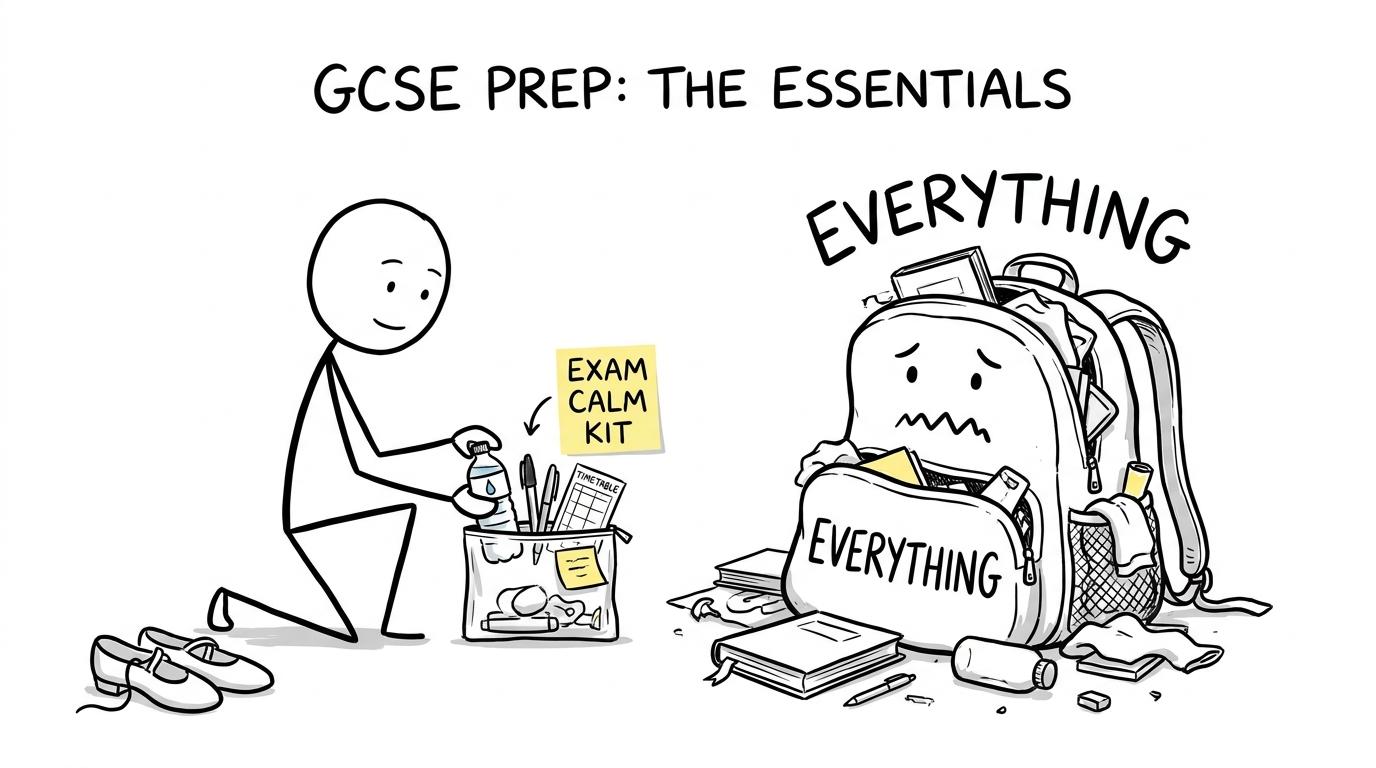 A calm student chooses a small exam kit instead of packing everything
Turn the dates into a calm plan
The key date is clear: AQA GCSE Dance Component 1 must be submitted by Thursday 7 May 2026, while the written Dance Appreciation examination is on Friday 12 June 2026 in the afternoon. What matters now is finding your school’s earlier practical deadline and preparing for that date rather than the last possible board deadline.
Once those milestones are in your calendar, protect the rest of your GCSE revision. Use MathsGenie’s free revision lessons to rebuild methods, practice questions and mini tests to check them, and past papers, predicted papers, mark schemes and video solutions to develop exam readiness. A timetable does not remove the work. It does something quieter and more useful: it tells you what the next piece of work should be.











