GCSE Combined Science Topics Breakdown: Revision Time
GCSE combined science topics breakdown showing paper weightings, high-value skills and a practical plan for spending revision time where it earns most marks.
Revision can feel strangely productive while avoiding the work that matters. You colour-code biology notes, reread a familiar chemistry chapter and leave physics calculations for another day. The hours pass, but the uncertainty remains.
This GCSE combined science topics breakdown gives you a better way to decide. Biology, chemistry and physics each contribute a substantial share of the qualification, so none can safely be ignored. However, your time should not be divided blindly into equal thirds. Begin with your exam board's paper structure, then give extra attention to weak topics, practical skills and the maths that appears throughout science.
The goal is not to predict individual questions. It is to make each revision hour respond to evidence.
Your quick revision checklist
Before planning the week:
- confirm your exam board and specification
- check whether you are entered for foundation or higher tier
- identify which topics belong to each paper
- complete a short diagnostic set from every science
- mark it strictly and classify each lost mark
- prioritise weak, frequently connected topics
- include practical skills and calculations every week
- move from topic questions to timed papers as the exams approach
If you study AQA or Edexcel, begin with the matching AQA GCSE Combined Science revision hub or Edexcel GCSE Combined Science revision hub. Mixing specifications can waste time because boards organise and name their content differently.
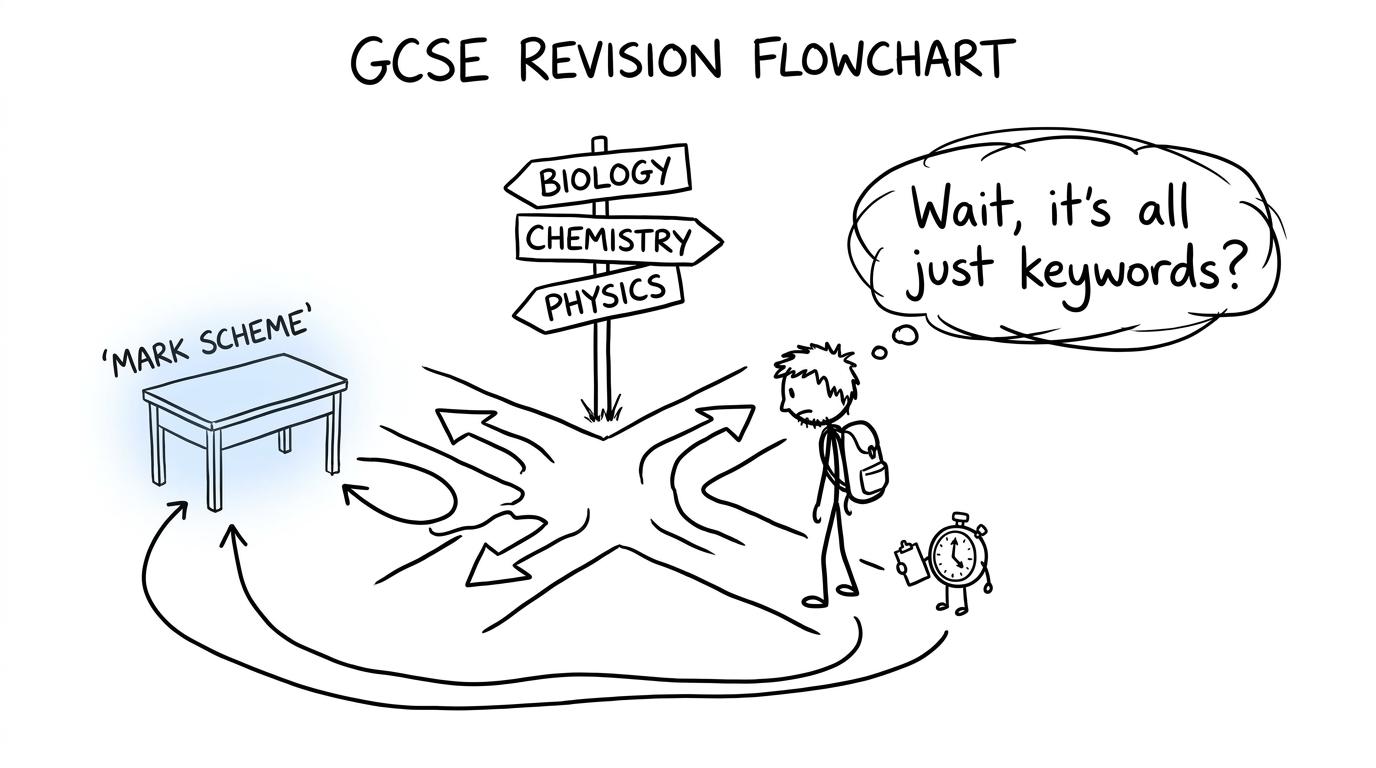 A student choosing between biology, chemistry and physics revision paths
How much does each science contribute?
GCSE Combined Science is a double-award qualification covering biology, chemistry and physics. In England, the national subject requirements state that each science must account for at least 30%30\%30% of the content. This prevents one discipline from becoming a minor part of the course.
For revision purposes, a sensible first approximation is:
| Broad area | Rough share to protect in your timetable |
|---|---|
| Biology | About one third |
| Chemistry | About one third |
| Physics | About one third |
This is a planning guide, not a promise that every named chapter will receive equal marks. Exam boards do not publish a dependable fixed percentage for every small topic, and the balance can vary between papers and exam series. A chapter with fewer specification statements may still generate demanding calculations, practical questions or extended responses.
The papers themselves provide a firmer guide.
| Exam board and route | Broad assessment structure |
|---|---|
| AQA Combined Science: Trilogy | Six equally weighted papers: two biology, two chemistry and two physics papers, each worth about 16.7%16.7\%16.7% |
| Pearson Edexcel Combined Science | Six equally weighted papers: two for each science, each worth about 16.67%16.67\%16.67% |
| OCR Combined Science A: Gateway | Six equally weighted papers, with two papers for each science, each worth about 16.7%16.7\%16.7% |
| OCR Combined Science B: Twenty First Century Science | One biology, chemistry and physics paper worth 26.4%26.4\%26.4% each, plus a synoptic combined science paper worth 20.8%20.8\%20.8% |
| Eduqas Combined Science | Biology, chemistry and physics components worth 25%25\%25% each, plus an applications component worth 25%25\%25% |
The important lesson is simple: revise from the structure for your specification. AQA and Edexcel students should not treat Paper 111 knowledge as disposable once that examination is over, because fundamental ideas can support later application. OCR and Eduqas routes also include explicitly synoptic or applications-focused assessment.
GCSE Combined Science topics breakdown by subject
Topic names vary between AQA, Edexcel, OCR and Eduqas, but the underlying scientific territory is broadly recognisable.
Biology topics
Biology commonly includes:
- cell structure, microscopy and transport
- organisation and biological systems
- health, disease and infection
- photosynthesis and respiration
- homeostasis and coordination
- genetics, inheritance and evolution
- ecology, ecosystems and biodiversity
Do not revise biology as a list of definitions alone. Many questions ask you to apply knowledge to unfamiliar organisms, interpret experimental evidence or connect several processes. Cells, enzymes, transport, respiration and photosynthesis are especially useful foundations because they reappear inside larger topics.
Biology contains less assessed mathematics than physics or chemistry, but data handling still matters. Be ready to interpret graphs, calculate rates and percentages, use ratios, understand sampling and discuss variation in results.
Chemistry topics
Chemistry commonly includes:
- atomic structure and the periodic table
- bonding, structure and properties
- quantitative chemistry
- chemical and energy changes
- acids, salts and electrolysis
- rates and equilibrium
- organic chemistry
- chemical analysis
- the atmosphere and Earth's resources
Chemistry is highly connected. Weak understanding of particles and bonding can make properties difficult; weak formula skills can damage quantitative chemistry; weak practical knowledge can affect rates, salts and analysis questions.
That makes foundational chemistry a good early investment. AQA students can use the chemistry key ideas revision guide to revisit how atomic structure, bonding, reactions and energy fit together.
Physics topics
Physics commonly includes:
- energy stores, transfers and power
- electricity and circuits
- particle models and matter
- atomic structure and radiation
- forces and motion
- waves
- magnetism and electromagnetism
Physics deserves protected calculation time. Across GCSE Combined Science, mathematical skills account for at least 20%20\%20% of the qualification's marks, allocated across biology, chemistry and physics in the ratio 1:2:31:2:31:2:3. That means the greatest share of those mathematical marks is attached to physics contexts.
This does not mean spending all your time memorising equations. You need to recognise quantities, select relationships, rearrange formulae, convert units, substitute accurately and attach the correct unit. If algebra is the obstacle, use the GCSE Maths revision hub alongside science revision. Higher-tier students who lose marks when changing the subject may also benefit from the rearranging harder formulae revision guide.
Where should you spend your revision time?
Equal coverage is a useful starting point. Equal time is not always sensible.
A topic deserves more attention when it has one or more of these features:
- you cannot retrieve the core ideas without notes
- it appears across several connected areas
- it includes calculations you regularly avoid
- it contains required or core practical knowledge
- past-paper answers show repeated command-word errors
- you understand the lesson but cannot answer unfamiliar questions
Try dividing your available time into three flexible portions:
- about 50%50\%50% repairing your weakest topics
- about 30%30\%30% maintaining medium-strength topics
- about 20%20\%20% testing stronger topics through mixed recall
These percentages are not exam weightings. They are a revision model. Change them when your evidence changes.
A strong topic should not disappear from the timetable altogether. Memory fades quietly. Short retrieval checks are usually enough to maintain it while most of the session goes towards larger marks leaks.
Practical skills are not a separate afterthought
At least 15%15\%15% of the assessment must relate to practical skills. These marks are assessed in written examinations, so simply remembering that you completed an experiment is not enough.
For each relevant practical, revise:
- the purpose and scientific idea
- apparatus and a logical method
- independent, dependent and control variables
- measurements, units and suitable ranges
- hazards and proportionate safety measures
- tables, graphs and processing of results
- repeatability, reproducibility, accuracy and validity
- limitations and specific improvements
Practical knowledge also connects the three sciences. Graph choice, variables, anomalous results and evaluation language can earn marks in many contexts. OCR students can strengthen this shared area with the OCR Combined Science practical skills guide.
Use past papers to find your real priorities
A topic list tells you what exists. A marked paper tells you what currently costs you marks.
Complete one paper section from each science, using the correct board and tier. Then place every lost mark into one of four categories:
- knowledge: the scientific fact or process was missing
- application: you knew the content but could not use it in context
- maths and data: calculation, units, graph or interpretation failed
- exam technique: the command word or required detail was missed
This distinction changes what you do next. Rereading a chapter will not necessarily fix careless unit conversion. More calculations will not fix an imprecise evaluation. Revision becomes efficient when the remedy matches the error.
Use AQA Combined Science past papers or Edexcel Combined Science past papers to build this evidence. Mark schemes matter as much as the questions: they show the precision, sequence and scientific vocabulary that receive credit.
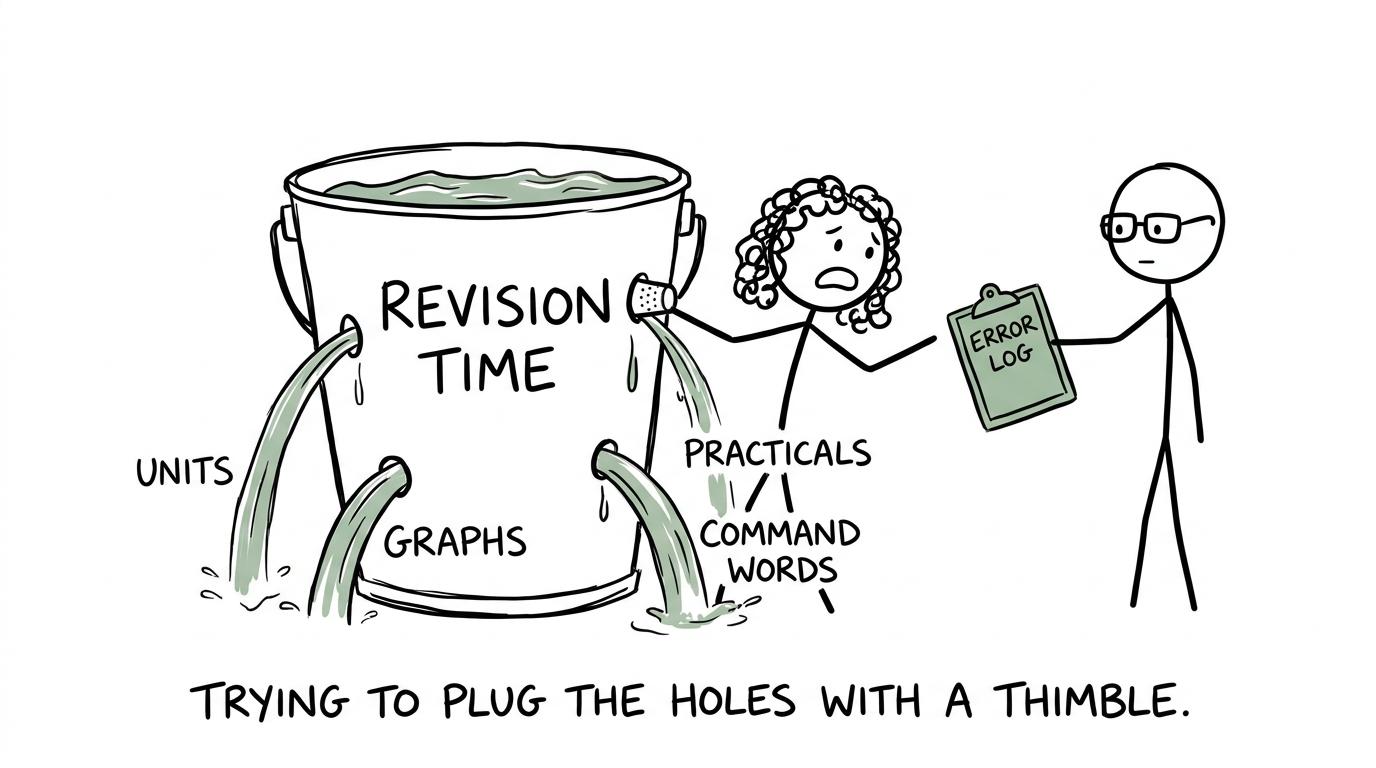 A leaking revision-time bucket being repaired with an error log
A weekly structure that protects every area
A balanced week might contain:
- one biology topic session
- one chemistry topic session
- one physics calculation session
- one practical or data-skills session
- one mixed mini test or timed paper section
Each topic session should follow the same short loop:
- retrieve what you know before opening notes
- use a revision lesson to repair the gap
- answer exam-style questions
- mark immediately
- record one precise correction
- retest the skill several days later
Nearer the examinations, increase the proportion of timed work. Do not abandon topic repair: a paper is a diagnostic tool as well as a rehearsal. The GCSE Combined Science resit revision plan offers a useful longer-term structure even if you are preparing for your first sitting.
Common GCSE Combined Science revision mistakes
Trusting unofficial topic percentages
A list claiming that one chapter is guaranteed a particular percentage can create false confidence. Use official paper weightings and your specification, then let marked questions decide the finer balance.
Revising only the science you enjoy
Enjoyment makes revision easier, which is precisely why it can absorb too much time. Keep all three sciences active and give additional sessions to weaknesses.
Treating maths as a physics-only problem
Physics carries the largest mathematical share, but chemistry and biology also assess ratios, rates, percentages, standard form, graphs and data. Practise mathematical skills in their scientific contexts.
Memorising practical methods without understanding variables
A remembered list can collapse when the apparatus or context changes. Understand what is changed, what is measured and what must remain controlled.
Completing papers without repairing mistakes
A growing stack of papers is not the same as improvement. After marking, return to the weakest two or three areas before attempting another full paper.
Turn the topic map into a marks plan
The broad weighting gives you balance; your mistakes provide direction. Protect roughly one third of your attention for each science at first, then move time towards weak, connected and calculation-heavy areas. Keep practical work, data handling and exam language running through the whole plan.
MathsGenie brings that process together for free. Start with specification-matched revision lessons, move into practice questions and mini tests, and then use past papers, predicted papers, mark schemes and video solutions to test whether the learning survives under pressure.
Choose one weak topic today. Learn it, practise it, mark it and schedule the retest. A revision plan becomes useful at the moment it tells you what to do next.