GCSE Combined Science Resit Revision Plan
GCSE Combined Science resit plan covering exam entries, revision milestones, past papers, practical skills and the maths needed to improve your grade.
Results day compresses two years of work into a pair of grades. If those grades are not what you needed, disappointment can quickly turn into uncertainty: what do you revise, when can you retake, and do you have to sit every paper again?
For a GCSE Combined Science resit, you will normally retake the complete qualification in an available summer exam series. Begin by confirming your exam board, specification, tier and entry arrangements with your school, college or exam centre. Then diagnose lost marks, rebuild weak topics and move gradually towards timed papers.
A resit is not simply another attempt at the same journey. You now have evidence. Your marked work, remembered difficulties and past-paper scores can show you where the next marks are hiding.
Your GCSE Combined Science resit checklist
Before building a timetable:
- confirm whether you studied AQA, Edexcel, OCR or Eduqas
- ask your centre when the qualification is next available
- confirm whether you will enter foundation or higher tier
- obtain the correct specification and paper structure
- complete a short diagnostic assessment in each science
- create one error log for biology, chemistry and physics
- schedule topic revision before full timed papers
- check any required practical arrangements with your centre
Do not assume there will be a November Combined Science sitting. For example, current AQA and Pearson information schedules their GCSE Combined Science qualifications in the summer series. Your centre should confirm availability and entry deadlines for your board.
Understand what you are resitting
Combined Science is a double-award GCSE, so results are reported as paired grades such as 555-555 or 666-555. It is a linear qualification: when resitting, students generally take all the required assessments in the same exam series rather than replacing one isolated paper.
Common specifications assess biology, chemistry and physics across several papers. AQA Combined Science: Trilogy and Pearson Edexcel Combined Science each use six written papers. Begin with the page matching your board, such as AQA GCSE Combined Science revision or OCR GCSE Combined Science resources, rather than mixing questions from different specifications.
Tier choice matters too. In England, foundation tier targets paired grades from 111-111 to 555-555. Higher tier targets 444-444 to 999-999, with a narrow safety-net grade below the normal range. A foundation grade has exactly the same value as the corresponding higher-tier grade, so discuss the safest suitable entry with a teacher or centre.
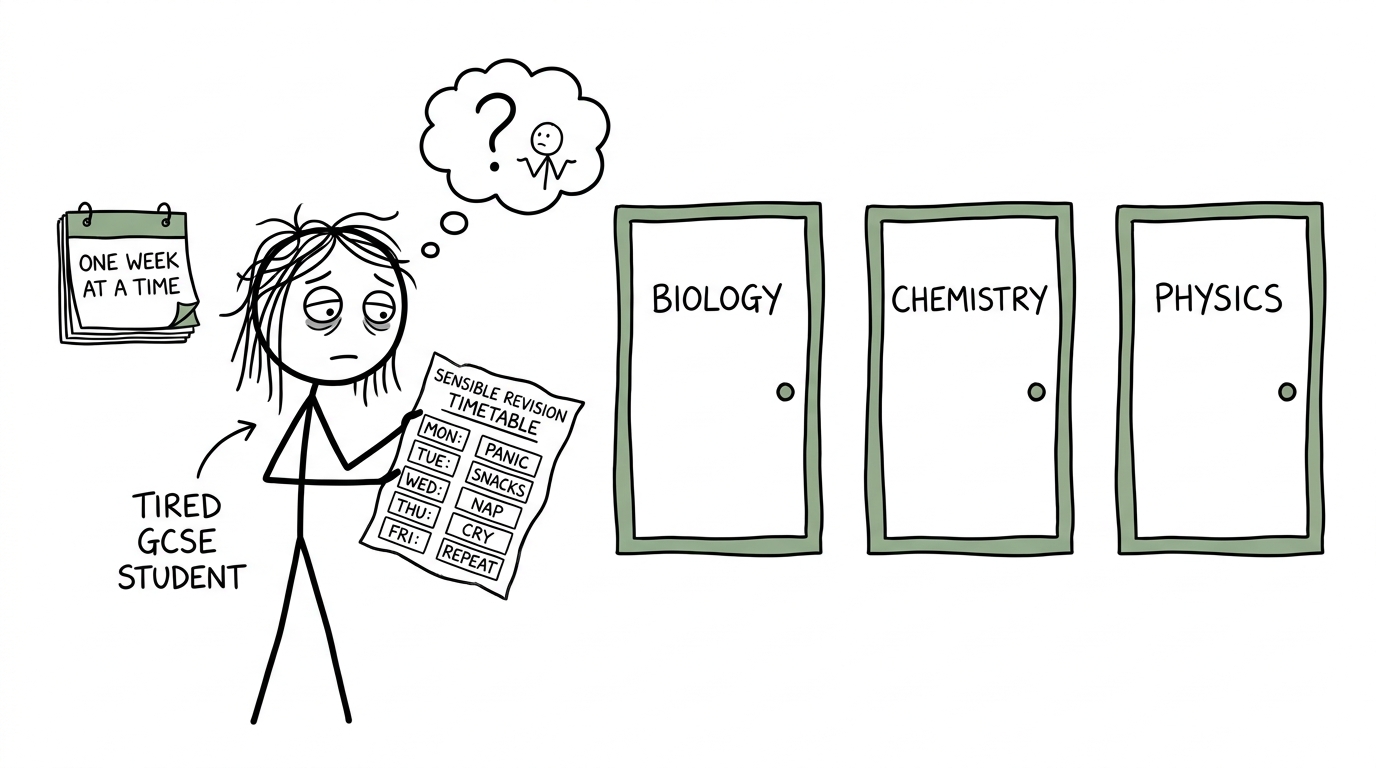 A student calmly choosing between biology, chemistry and physics revision doors
Milestone one: diagnose the gaps
During your first week, complete selected sections from the correct AQA Combined Science past papers, or the equivalent papers for your board. Use timed conditions, but treat this as diagnosis rather than a final performance.
Mark every answer strictly. Record each lost mark under one of four headings:
- missing scientific knowledge
- weak maths or data handling
- misunderstanding the command word
- incomplete practical or evaluation detail
This distinction is important. Revising electrolysis will not fix a question lost because you omitted units. Memorising more facts will not repair an answer that needed a comparison supported by data.
Choose your five weakest topics from the evidence. Those topics, not the chapters you enjoy rereading, should shape the next milestone.
Milestone two: rebuild topics over four to six weeks
Plan three or four focused sessions each week. A balanced cycle might contain one biology session, one chemistry session, one physics session and one mixed review.
Keep each session simple:
- retrieve what you remember without notes
- use a concise revision lesson to correct gaps
- answer topic questions
- mark the work immediately
- write one specific improvement in your error log
MathsGenie's Combined Science revision guides let you work through the specification by topic. You can target areas such as homeostasis and response, revisit key ideas in chemistry, or strengthen physics through the work done and energy transfer guide.
Return to each weak topic after several days. Being able to follow notes today is not the same as being able to retrieve the idea next week.
Milestone three: strengthen science maths
A GCSE Combined Science retake still demands confident numerical work. Common skills include rearranging formulae, ratios, percentages, standard form, graph interpretation, significant figures and unit conversion.
For every calculation, build the same routine:
- identify the required quantity
- select the relevant equation
- convert units before substituting
- show your substitution and calculation
- give the answer with an appropriate unit
- check whether its size is sensible
Use GCSE maths revision questions and worksheets if algebra, proportion or graphs are costing science marks. Current support arrangements provide equation sheets for GCSE physics and Combined Science examinations in 202620262026 and 202720272027, but you must still recognise the correct equation, rearrange it and use consistent units. Always check the materials confirmed for your particular exam series.
Milestone four: practical skills and exam language
Practical questions test more than recalling a method. You may need to identify variables, describe controls, explain repeats, interpret results or evaluate evidence.
Practise writing methods that include the apparatus, independent variable, dependent variable, control variables, measurements and safety considerations. OCR students can use the Combined Science practical skills revision guide; students on other boards should use their matching specification resources.
Pay attention to command words. A description states what happens. An explanation connects the observation to scientific reasoning. An evaluation judges evidence and suggests a relevant improvement.
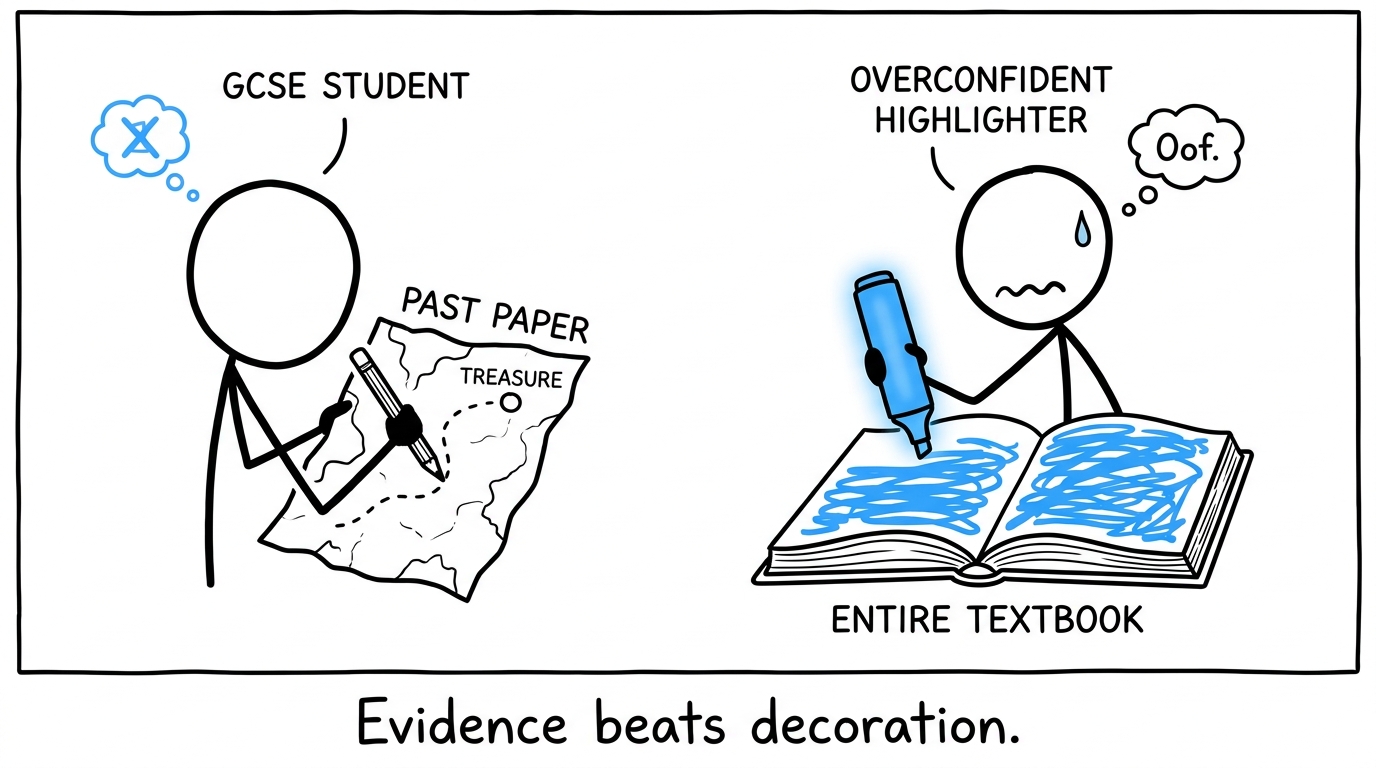 A sensible past-paper treasure map defeats an overenthusiastic highlighter
Milestone five: move into timed papers
Around six to eight weeks before the examinations, shift towards whole papers. Complete one, mark it with the official mark scheme, update your error log and repair the two largest weaknesses before attempting another.
Past papers are most valuable when they change what you do next. A score alone is history. An error log turns it into a plan.
In the final fortnight, use mixed questions, mini tests and predicted papers for additional practice, but retain unseen official papers where possible for realistic timed checks. Continue revisiting equations, practical methods and recurring errors rather than beginning large new sets of notes.
Common GCSE Combined Science resit mistakes
Revising all three sciences equally: Give more time to the topics and question types that actually lose marks.
Using resources from the wrong board: Content and paper structures differ. Match every resource to your specification and tier.
Reading instead of retrieving: Close the guide and answer questions from memory. Recognition can create false confidence.
Ignoring maths: Units, graphs and rearrangement can affect performance across several physics and chemistry topics.
Completing papers without reviewing them: Marking, classifying errors and retesting are part of the paper session.
Leaving entry arrangements too late: Your school, college or private centre needs time to confirm the board, tier, fees, practical requirements and deadlines.
Make the second attempt more deliberate
Resitting GCSE Combined Science is a sizeable project, but it does not need to feel endless. Confirm the administrative details, diagnose the real gaps and move through a steady cycle of learning, questions, marking and retesting.
Start today with MathsGenie's AQA Combined Science worksheets and revision tools, then use the Combined Science past-paper collection as your progress measure. Revision lessons rebuild understanding; practice questions and mini tests expose weak spots; mark schemes and video solutions show how marks are earned; predicted papers prepare you for unfamiliar combinations.
The result you received describes one exam series. Your revision plan determines what happens in the next one.