

GCSE Combined Science Lower Grade Than Expected?
GCSE combined science lower grade than expected? Check your marks, review options, course place and resit plan with this calm results-day guide.

Results day can compress two years of work into a few characters on a screen. If you received a GCSE Combined Science lower grade than expected, the immediate answer is simple: check what the grade means, speak to your school or college, protect your next-step options and only then decide whether a review or resit is sensible.
Disappointment is real, but it is not a plan. The useful question is no longer, “What should I have achieved?” It is, “Which action gives me the best options from here?”
Your results-day checklist
- Confirm your double grade and total mark.
- Ask how far you are from the next grade boundary.
- Contact your intended sixth form, college or training provider.
- Discuss access to scripts or a review with your exams officer.
- Check whether the result affects your chosen course.
- If necessary, investigate a summer Combined Science resit.
- Build a focused revision plan rather than restarting everything.
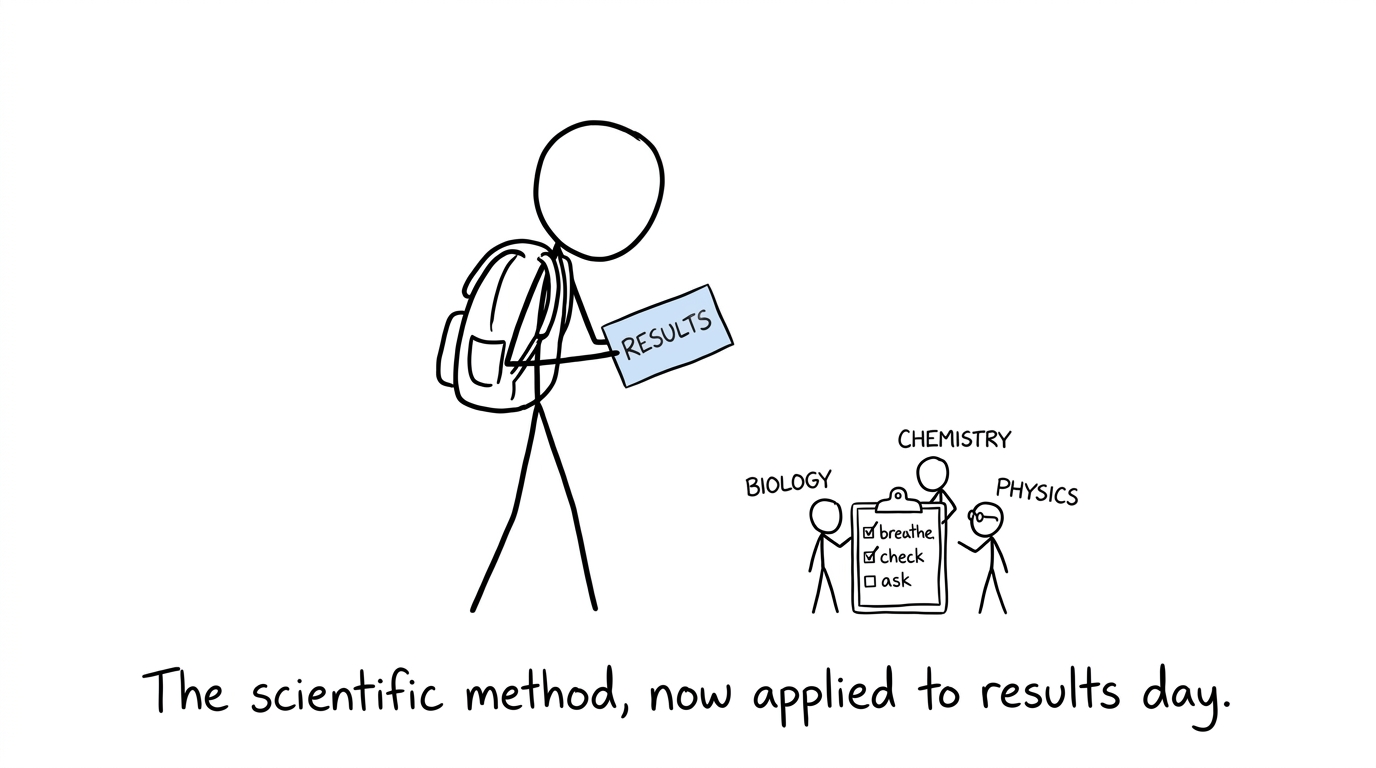 A student and three scientists calmly applying the scientific method to results day
Understand what your Combined Science grade means
Combined Science is a double award worth two GCSEs. In England, it is reported as two equal or adjacent grades, from $9$-$9$ down to $1$-$1$. A result such as $5$-$4$ is one combined qualification award, not a separate grade for two individual sciences.
Your marks across biology, chemistry and physics papers are combined. Stronger performance in one area can compensate for weaker performance elsewhere, so the final result does not tell you precisely which subject caused the difficulty.
Ask your school for:
- your overall qualification mark;
- the published grade boundaries;
- your component or paper marks;
- confirmation of your exam board and tier;
- advice from a science teacher who understands your usual work.
A disappointing result may feel like a verdict. The paper-level information turns it into evidence.
Speak to your next provider before assuming the worst
If the grade affects a sixth-form, college or apprenticeship offer, contact the provider promptly. Entry requirements differ between institutions and courses. A science course may have specific requirements, while an unrelated programme may consider your wider set of GCSE results.
Explain the exact double grade, not an estimated average. Ask whether the provider can:
- confirm your place as it stands;
- offer a related course;
- allow you to begin with additional support;
- reconsider after a review of marking;
- accept a later resit result.
Do not reject yourself on the provider’s behalf. A conversation can reveal options that are not obvious from an admissions page.
Decide whether a post-results review is justified
A predicted grade alone is not evidence of a marking error. Predictions describe an expectation; awarded grades reflect the assessed work. However, a large and unexplained gap deserves a careful conversation.
Your school or exam centre can discuss official post-results services. Access to scripts may allow a teacher to inspect a marked paper before recommending further action. A clerical re-check looks for administrative issues, while a review of marking checks whether the mark scheme was applied correctly.
This is not a risk-free second chance. Following a clerical re-check or review of marking, marks and grades can go down, remain unchanged or go up. You must provide written consent, and requests normally go through the school, college or exam centre. Fees and deadlines vary, while centres may set internal deadlines earlier than the exam board deadline.
A review is most worth discussing when a teacher identifies a credible marking concern or when you are close to a boundary and the script supports the case. Ask about the evidence, cost, risk and deadline before agreeing.
Consider a GCSE Combined Science resit
In England, the November GCSE series is available for maths and English Language, not Combined Science. A Combined Science resit would normally be taken in a future summer examination series. Arrangements elsewhere in the UK can differ, so confirm the position with your centre and exam board.
A resit may be sensible if the grade blocks an important course and the provider confirms that an improved result would help. Before committing, ask:
- Which exam board and specification will I take?
- Must I sit every paper again?
- Will I use foundation or higher tier?
- Where will practical knowledge be taught or refreshed?
- Who will enter me, and what will it cost?
- How will revision fit around my new course?
AQA students can begin with the free AQA GCSE Combined Science revision hub, which brings together foundation and higher resources. Use the Combined Science revision guides to rebuild specification knowledge, then move to AQA Combined Science past papers for timed practice and mark-scheme analysis.
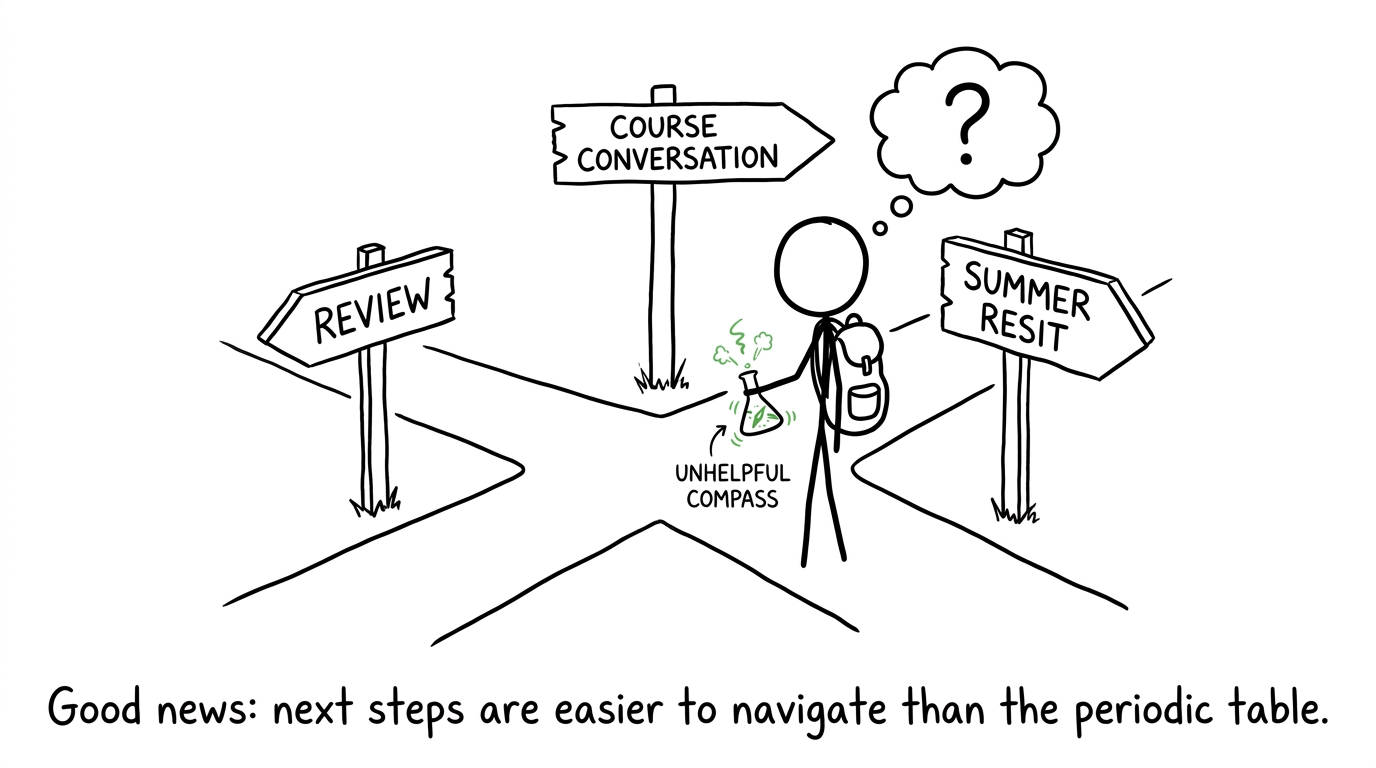 A student choosing between a review, course conversation and summer resit
Build a resit plan from the marks you lost
A resit plan should not repeat Year 111111 from the beginning. Start with your scripts or a timed paper and sort missed marks into four categories:
- missing scientific knowledge;
- weak application to unfamiliar contexts;
- calculation or graph errors;
- exam technique, including command words and incomplete explanations.
Science calculations often depend on algebra, percentages, standard form, graphs and rearranging formulae. Strengthen these through the GCSE maths revision hub, then use science questions to apply them in context. Short Edexcel GCSE Maths mini tests can also help if calculation accuracy is one of your recurring weaknesses.
Use a weekly loop: learn one weak area, answer practice questions without notes, mark them, record the precise error and revisit it later. When the examination approaches, add full past papers and relevant GCSE predicted papers. Predicted papers are useful rehearsal, but they should complement the full specification rather than replace it.
If restarting feels overwhelming, adapt the practical routine in MathsGenie’s guide to catching up on GCSE revision. A simple revision planner can keep science and maths sessions separate while ensuring both happen consistently.
Common mistakes after a disappointing result
Requesting a review without checking the risk
A review can lower the result. Discuss the marked work, boundaries and realistic benefit with your centre first.
Assuming one weak science created the double grade
Combined Science is graded from the total qualification mark. Obtain paper-level evidence before choosing what to revise.
Missing a course or post-results deadline
Contact your provider and exams officer promptly. Waiting for emotions to settle is reasonable; missing an administrative deadline is avoidable.
Revising only favourite topics
Comfortable revision feels productive but may leave the largest marks gap untouched. Let scripts, past papers and mark schemes determine priorities.
Treating maths errors as unavoidable
Calculation marks are trainable. Use targeted practice, show substitutions clearly, include units and check whether an answer is reasonable.
Turn the result into a decision
A GCSE Combined Science disappointing result can change part of your route, but it does not remove every route. First establish the facts. Then protect your course place, investigate post-results services and consider a summer resit only when it serves a clear goal.
If a resit is the right GCSE Combined Science next step, begin with MathsGenie’s free AQA Combined Science resources. Combine revision lessons and practice questions with past papers, mark schemes, predicted papers and regular corrections. The grade is already behind you. The next useful action is still yours.











