GCSE Chemistry OCR Grade Boundaries Explained
GCSE chemistry OCR grade boundaries explained for Gateway and Twenty First Century, with 2025 tables, tier rules and clear results-day advice.
Opening a results envelope can make months of revision feel as though they have collapsed into one number. If you are searching for GCSE Chemistry OCR grade boundaries, the immediate answer is simple: your final grade is based on your combined mark across two papers, and the boundary depends on your OCR route, tier and exam series.
For the June 2026 series, GCSE results day is Thursday 20 August 2026. OCR says its 2026 GCSE boundaries will be published at 8 am8\text{ am}8 am that morning. Until then, the June 2025 boundaries are the latest confirmed figures available; useful context, but not a prediction of what you will need in 2026.
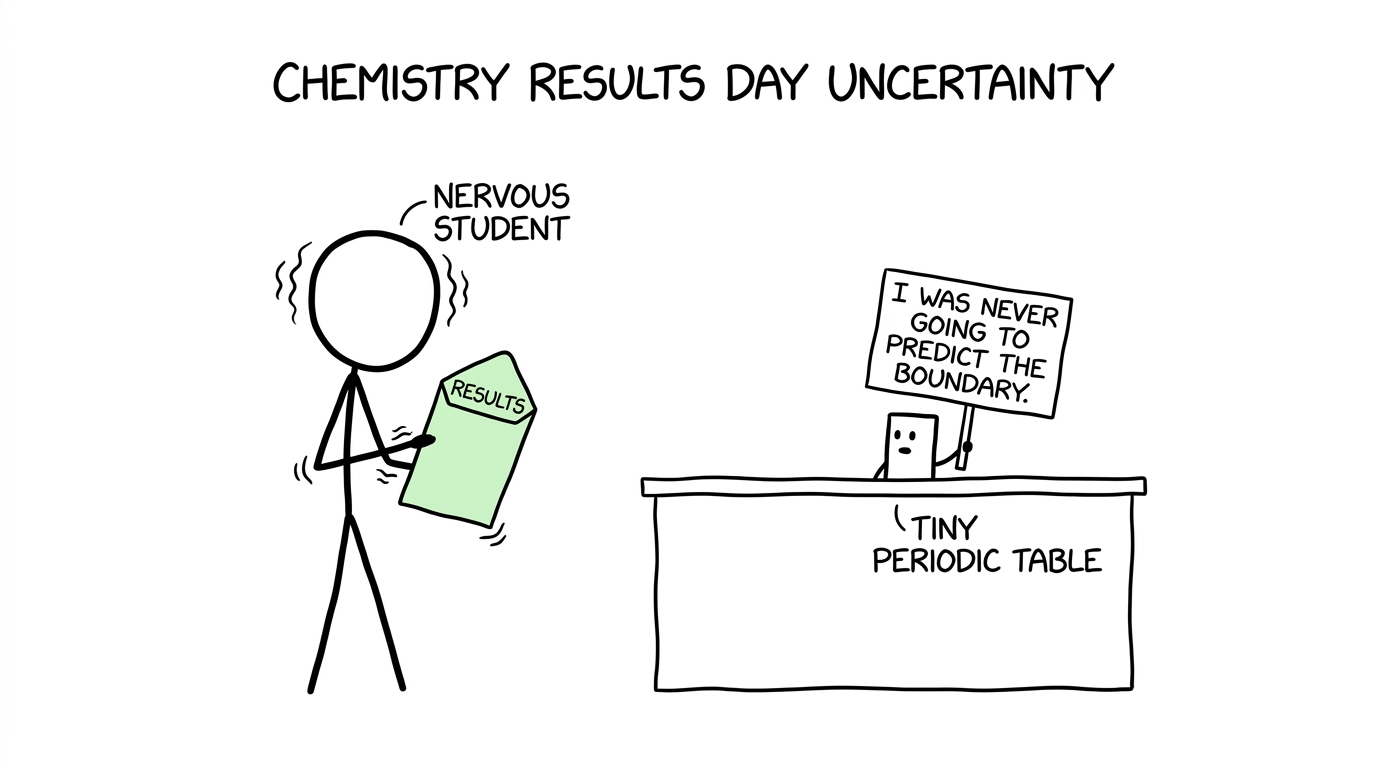 A student discovers that even the periodic table cannot predict this year's boundary
GCSE Chemistry results day checklist
Before interpreting a boundary table, check four details:
- Is your qualification Chemistry A: Gateway Science, code J248, or Chemistry B: Twenty First Century Science, code J258?
- Did you sit Foundation or Higher tier?
- Are you looking at the overall qualification boundary rather than a paper-level notional boundary?
- Are the boundaries from the correct exam series?
Your results slip may not answer every question on its own. Keep the slip, ask your school for your component marks if necessary, and compare them only with the matching OCR table.
Which OCR Chemistry qualification did you sit?
OCR offers two separate GCSE Chemistry routes. Chemistry A (Gateway Science) uses code J248. Chemistry B (Twenty First Century Science) uses code J258. They have different papers and grade boundaries, so identifying the route matters.
Both qualifications have two papers at the selected tier. Each paper is worth 909090 marks and 50%50\%50% of the qualification, giving a total of:
90+90=180 marks90+90=180\text{ marks}90+90=180 marksFoundation tier targets grades 111 to 555, while Higher tier targets grades 444 to 999. OCR specifications also permit an allowed grade 333 on Higher tier when a candidate falls narrowly below the normal grade 444 threshold; otherwise, a result below the permitted range may be unclassified.
Students taking Chemistry B can use the OCR Twenty First Century Chemistry revision hub. Gateway students can begin with MathsGenie's OCR GCSE Chemistry past papers and specification-matched topic guides.
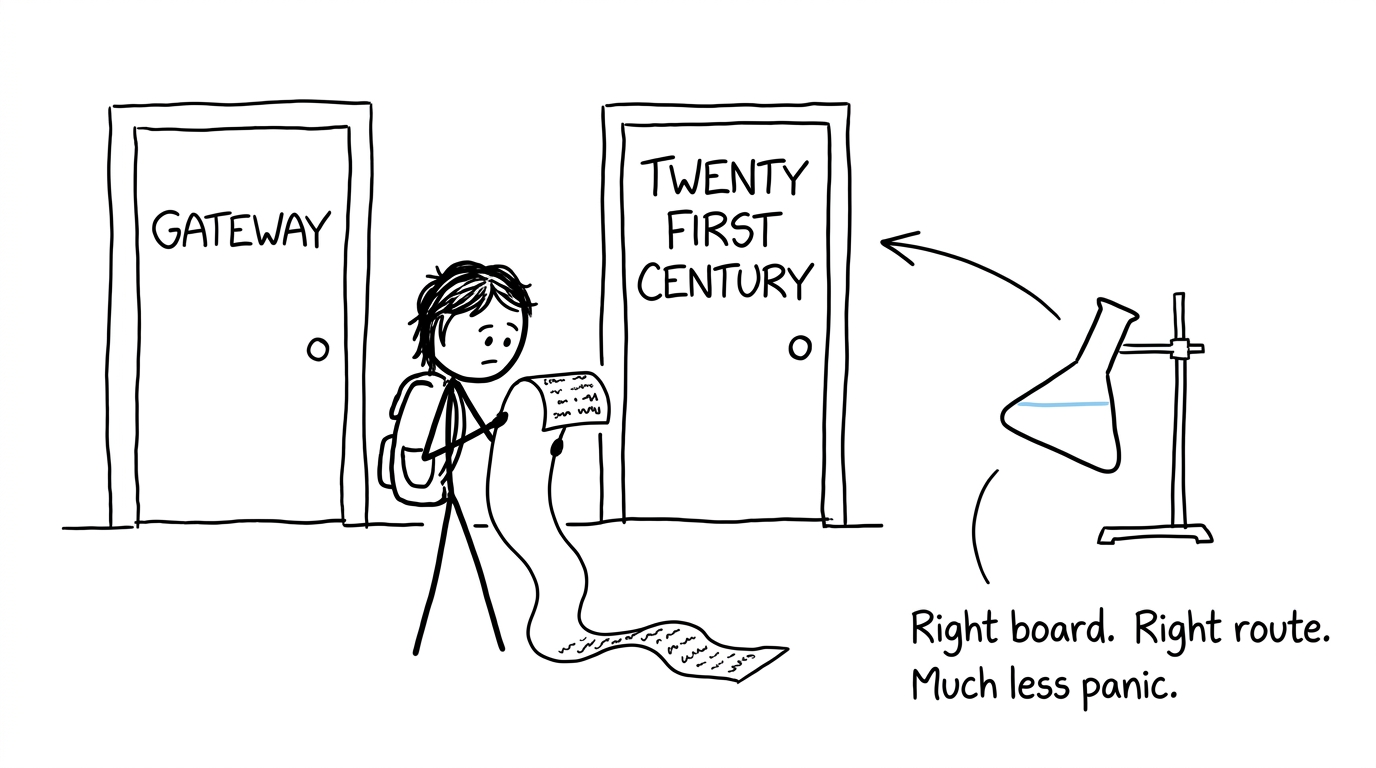 A student checks whether the chemistry route is Gateway or Twenty First Century
OCR Chemistry grade boundaries for June 2025
These are the official overall qualification boundaries for the latest completed summer series. Every figure is the minimum combined raw mark required out of 180180180.
Chemistry A: Gateway Science J248
| Grade | Foundation | Higher |
|---|---|---|
| 999 | Not available | 158158158 |
| 888 | Not available | 145145145 |
| 777 | Not available | 132132132 |
| 666 | Not available | 112112112 |
| 555 | 113113113 | 929292 |
| 444 | 979797 | 737373 |
| 333 | 747474 | 636363 |
| 222 | 515151 | Not available |
| 111 | 282828 | Not available |
Chemistry B: Twenty First Century Science J258
| Grade | Foundation | Higher |
|---|---|---|
| 999 | Not available | 141141141 |
| 888 | Not available | 127127127 |
| 777 | Not available | 114114114 |
| 666 | Not available | 949494 |
| 555 | 115115115 | 757575 |
| 444 | 959595 | 565656 |
| 333 | 737373 | 464646 |
| 222 | 515151 | Not available |
| 111 | 292929 | Not available |
The tables should not be mixed. A Higher-tier J248 mark must be compared with the Gateway Higher column, not with J258 simply because its boundary looks more favourable.
How OCR grade boundaries determine your result
A grade boundary is the minimum mark required for a grade in one particular exam series. If a boundary is BBB, a total of at least BBB reaches that grade; a total below BBB is compared with the next boundary down.
OCR sets qualification boundaries after papers have been sat and marked. Boundaries can move because papers vary in difficulty. This is why 2025 figures cannot tell you exactly what the 2026 OCR Chemistry grade boundaries will be.
OCR also publishes notional component boundaries for individual papers. These can help schools understand paper performance, but you do not receive a separate certified grade for each paper. Your qualification grade comes from the overall combined mark. A stronger Paper 111 can therefore compensate for a weaker Paper 222.
What to do if your grade is unexpected
First, confirm the route, tier and component marks with your school. Then ask a teacher to review your script or mark breakdown before deciding whether an official post-results service is sensible. A result being close to a boundary does not itself prove that marking was wrong, and a review can leave a mark unchanged, raise it or lower it.
If you are preparing for a future sitting, use boundaries as context rather than a revision target. Build secure knowledge with the introducing chemical reactions guide, strengthen a frequently tested process through the electrolysis revision guide, and review experimental reasoning with OCR Chemistry practical skills.
Calculation marks matter too. Chemistry questions can require ratios, rearranging formulae, graphs, standard form and careful units. MathsGenie's GCSE maths revision hub is useful when the chemistry is understood but the numerical method is costing marks.
Common mistakes when reading OCR boundaries
Using the wrong OCR route
J248 and J258 are different specifications. Check the qualification code before reading any figures.
Adding paper grades together
Paper-level boundaries are not separate qualification grades. Add the raw marks from the two equally weighted papers and use the overall boundary.
Treating last year's table as a forecast
Previous boundaries reveal what happened in a previous series. They do not fix the next boundary.
Forgetting the tier limits
Foundation tier cannot award grades above 555. Higher tier is designed for grades 444 to 999, with only the restricted allowed grade 333 below that range.
Revising only to scrape a boundary
Aiming at an old threshold leaves no protection against mistakes or a changing boundary. The calmer strategy is to maximise every available mark.
Turn the boundary into a next step
A grade boundary is a dividing line, not a judgement about your ability. On results day, identify your route, check the correct overall table and speak to your school if anything is unclear.
If your next exam is still ahead, move from uncertainty to evidence. Use MathsGenie's free OCR Chemistry revision guides, past papers and mark schemes, practice questions and topic support. Then use GCSE predicted papers and mini tests to strengthen exam habits across your wider revision. Boundaries are outside your control. The quality of your next practice session is not.