3.1.1 Writing formulae and balanced chemical equations
Formulae are built from chemical symbols
Chemical symbol
A one- or two-letter code for an element, such as Na for sodium, in which the first letter is always a capital.
Chemical formula
A group of element symbols and numbers that shows which elements a substance contains and how many atoms of each are present.
- Each element has a chemical symbol of one or two letters, such as H for hydrogen and Mg for magnesium.
- The first letter of a symbol is always a capital letter, and a second letter is always lower case, as in Ca for calcium and Cl for chlorine.
- The Periodic Table you are given shows the symbol, name, atomic number and relative atomic mass of every element, so you can look up any symbol you are unsure of.
- Some symbols come from Latin names, so sodium is Na, potassium is K, iron is Fe, copper is Cu, silver is Ag and lead is Pb.
- A chemical formula combines symbols to show which elements a substance contains.
- A small number written after and below a symbol, called a subscript, gives the number of atoms of that element, and no number means one atom.
Do not use two capital letters for one element, because CO\text{CO}CO is carbon monoxide, a compound of carbon and oxygen, while Co\text{Co}Co is the metal cobalt.
Formulae of elements and simple covalent compounds
Molecule
A particle made from two or more atoms joined by covalent bonds.
- Metals, carbon and the noble gases are written as their symbol alone, such as Fe, C and He.
- Seven elements exist as diatomic molecules, so their formulae are H2\text{H}_2H2, N2\text{N}_2N2, O2\text{O}_2O2, F2\text{F}_2F2, Cl2\text{Cl}_2Cl2, Br2\text{Br}_2Br2 and I2\text{I}_2I2.
- Hydrogen gas is therefore H2\text{H}_2H2, while H on its own stands for a single hydrogen atom.
- A simple covalent compound is made of small molecules, and its formula counts every atom in one molecule.
- Water is H2O\text{H}_2\text{O}H2O, ammonia is NH3\text{NH}_3NH3, methane is CH4\text{CH}_4CH4 and hydrogen chloride is HCl\text{HCl}HCl.
- In the names of covalent compounds, the prefixes mono, di and tri mean one, two and three atoms of the element they are attached to.
- Carbon monoxide is CO\text{CO}CO, carbon dioxide is CO2\text{CO}_2CO2 and nitrogen dioxide is NO2\text{NO}_2NO2.
The numbers in a formula are part of the substance's identity, so SO2\text{SO}_2SO2 and SO3\text{SO}_3SO3 are two different compounds with different properties.
Formulae and names of simple ionic compounds
Ionic compound
A compound made of positive and negative ions held together by electrostatic attraction, with charges that cancel overall.
- An ionic compound usually forms when a metal reacts with a non-metal, and the metal is named first.
- A name ending in -ide usually means the compound contains only two elements, as in sodium chloride, NaCl\text{NaCl}NaCl, and magnesium oxide, MgO\text{MgO}MgO.
- Hydroxide is the exception, because it contains oxygen and hydrogen, as in sodium hydroxide, NaOH\text{NaOH}NaOH.
- A name ending in -ate means the compound also contains oxygen, as in calcium carbonate, CaCO3\text{CaCO}_3CaCO3, copper sulfate, CuSO4\text{CuSO}_4CuSO4, and sodium nitrate, NaNO3\text{NaNO}_3NaNO3.
- The formula gives the simplest ratio of ions, because the ions form a giant lattice rather than separate molecules.
- In MgCl2\text{MgCl}_2MgCl2 there are two chloride ions for every magnesium ion.
- The common acids have the formulae HCl\text{HCl}HCl for hydrochloric acid, H2SO4\text{H}_2\text{SO}_4H2SO4 for sulfuric acid and HNO3\text{HNO}_3HNO3 for nitric acid.
Working out an ionic formula from the charges on its ions follows in the next topic, on formulae of compounds from ions.
Balanced equations conserve atoms on both sides
Balanced equation
A chemical equation with the same number of atoms of each element on the reactant side and the product side.
Balancing number
A number written in front of a formula in an equation, which multiplies every atom in that formula.
- In a reaction, atoms are rearranged into new substances, but no atoms are made or destroyed.
- The total mass of the products therefore equals the total mass of the reactants, which is the conservation of mass.
- An equation shows the reactants on the left of the arrow and the products on the right, with a plus sign between substances.
- To balance an equation, write a balancing number in front of a formula, which multiplies every atom in that formula.
- In 2H2O2\text{H}_2\text{O}2H2O there are four hydrogen atoms and two oxygen atoms.
- Never change the subscripts in a formula, because that would change the substance.
- Changing H2O\text{H}_2\text{O}H2O to H2O2\text{H}_2\text{O}_2H2O2 would turn water into hydrogen peroxide.
- Balance the equation for methane burning in oxygen: CH4+O2→CO2+H2O\text{CH}_4 + \text{O}_2 \rightarrow \text{CO}_2 + \text{H}_2\text{O}CH4+O2→CO2+H2O.
- Count the atoms: the left has 1 C, 4 H and 2 O, while the right has 1 C, 2 H and 3 O.
- Put 222 in front of H2O\text{H}_2\text{O}H2O to balance hydrogen, giving 4 H and 4 O on the right.
- Put 222 in front of O2\text{O}_2O2 to balance oxygen, giving 4 O on the left.
- Check that each side now has 1 C, 4 H and 4 O: CH4+2O2→CO2+2H2O\text{CH}_4 + 2\text{O}_2 \rightarrow \text{CO}_2 + 2\text{H}_2\text{O}CH4+2O2→CO2+2H2O.
Four steps from names to a balanced equation
Word equation
An equation that names the reactants and products instead of giving their formulae.
- Start with a word equation, such as magnesium + oxygen →\rightarrow→ magnesium oxide.
- Replace each name with its correct formula, using the Periodic Table for any symbol you need:
Mg+O2→MgO\text{Mg} + \text{O}_2 \rightarrow \text{MgO}Mg+O2→MgO
- Oxygen is written as O2\text{O}_2O2, because it is one of the diatomic elements.
- Balance one element at a time, leaving any element that appears in several formulae until last.
- Putting 222 in front of MgO\text{MgO}MgO balances oxygen, and then 222 in front of Mg\text{Mg}Mg balances magnesium: 2Mg+O2→2MgO2\text{Mg} + \text{O}_2 \rightarrow 2\text{MgO}2Mg+O2→2MgO
- Finish by recounting every atom on both sides, and use the smallest whole-number balancing numbers that work.
- When a question gives names, write every formula before you add any balancing numbers, because a wrong formula cannot be fixed by balancing.
- Write +++ between substances and an arrow between the two sides, never the word 'and' or an equals sign.
- What is the formula of chlorine gas, and why?
- What is the difference between Co\text{Co}Co and CO\text{CO}CO?
- Which elements does calcium carbonate contain, and what is its formula?
- Why must you never change a subscript when balancing an equation?
- Balance the equation Al+O2→Al2O3\text{Al} + \text{O}_2 \rightarrow \text{Al}_2\text{O}_3Al+O2→Al2O3.
3.1.2 Formulae of compounds from ions, and state symbols
Ionic compounds have no overall charge
Ion
An atom or group of atoms that carries an overall electric charge.
Ionic compound
A compound made of positive and negative ions held together by electrostatic attraction, with charges that cancel overall.
- Metal atoms lose electrons to form positive ions, and non-metal atoms gain electrons to form negative ions.
- The charge on a simple ion can be predicted from the group number of the element.
- Group 1 metals form 1+1+1+ ions, Group 2 metals form 2+2+2+ ions and aluminium, in Group 3, forms Al3+\text{Al}^{3+}Al3+.
- Group 6 non-metals form 2−2-2− ions and Group 7 non-metals form 1−1-1− ions, such as O2−\text{O}^{2-}O2− and Cl−\text{Cl}^{-}Cl−.
- A negative ion made from one element takes the ending -ide, so chlorine forms chloride ions and oxygen forms oxide ions.
- Transition metals can form ions with different charges, shown by a Roman numeral in the name, so iron(II) is Fe2+\text{Fe}^{2+}Fe2+ and iron(III) is Fe3+\text{Fe}^{3+}Fe3+.
- In the compound, the total positive charge must equal the total negative charge.
Do not call the ion in sodium chloride chlorine, because chlorine is the element Cl2\text{Cl}_2Cl2 and the ion is chloride, Cl−\text{Cl}^{-}Cl−.
Polyatomic ions stay together with one overall charge
Polyatomic ion
A charged particle made of two or more atoms covalently bonded together, such as sulfate or hydroxide.
- Some ions contain several atoms covalently bonded together, and the charge belongs to the whole group.
- The common negative ones are hydroxide, OH−\text{OH}^{-}OH−, nitrate, NO3−\text{NO}_3^{-}NO3−, carbonate, CO32−\text{CO}_3^{2-}CO32−, and sulfate, SO42−\text{SO}_4^{2-}SO42−.
- An ion name ending in -ate shows that the ion contains oxygen.
- The ammonium ion, NH4+\text{NH}_4^{+}NH4+, is a common positive polyatomic ion.
- When a formula needs more than one polyatomic ion, the ion goes inside brackets with the number after them, as in Ca(OH)2\text{Ca(OH)}_2Ca(OH)2.
- The 2 after the bracket doubles every atom inside it, so Ca(OH)2\text{Ca(OH)}_2Ca(OH)2 contains one calcium, two oxygen and two hydrogen atoms.
- The atoms inside a polyatomic ion never change, so sulfate is always SO4\text{SO}_4SO4 in a formula.
Do not write calcium hydroxide as CaOH2\text{CaOH}_2CaOH2, because the 2 would then apply only to the hydrogen and not to the whole hydroxide ion.
Writing ionic formulae so the charges cancel
- Write down the formula and charge of each ion.
- Find the smallest numbers of each ion that give equal and opposite total charges.
- For Mg2+\text{Mg}^{2+}Mg2+ and Cl−\text{Cl}^{-}Cl−, one magnesium ion balances two chloride ions, giving MgCl2\text{MgCl}_2MgCl2.
- Write the positive ion first and show the number of each ion as a subscript, leaving out any 1.
- Leave the charges out of the final formula, because the compound has no overall charge.
- When the charges are the same size, one of each ion is needed, so Mg2+\text{Mg}^{2+}Mg2+ and O2−\text{O}^{2-}O2− give MgO\text{MgO}MgO.
- Ammonium sulfate needs two NH4+\text{NH}_4^{+}NH4+ ions for each SO42−\text{SO}_4^{2-}SO42− ion, giving (NH4)2SO4(\text{NH}_4)_2\text{SO}_4(NH4)2SO4.
- Work out the formula of aluminium sulfate, made from Al3+\text{Al}^{3+}Al3+ and SO42−\text{SO}_4^{2-}SO42− ions.
- The charges are 3+3+3+ and 2−2-2−, and the smallest total charge both can reach is 666.
- Two Al3+\text{Al}^{3+}Al3+ ions give +6+6+6 and three SO42−\text{SO}_4^{2-}SO42− ions give −6-6−6.
- Put the sulfate in brackets because there are three of them: Al2(SO4)3\text{Al}_2(\text{SO}_4)_3Al2(SO4)3.
State symbols show solid, liquid, gas or aqueous
State symbol
A letter or letters in brackets after a formula in an equation, showing whether the substance is solid (s), liquid (l), gas (g) or aqueous (aq).
Aqueous solution
A solution in which the solvent is water, shown by the state symbol (aq).
- A state symbol is written in brackets straight after each formula in an equation.
- The four state symbols are (s)\text{(s)}(s) for solid, (l)\text{(l)}(l) for liquid, (g)\text{(g)}(g) for gas and (aq)\text{(aq)}(aq) for aqueous.
- Aqueous means dissolved in water, so a solution of sodium chloride is NaCl(aq)\text{NaCl(aq)}NaCl(aq).
- Pure water at room temperature is H2O(l)\text{H}_2\text{O(l)}H2O(l), but steam is H2O(g)\text{H}_2\text{O(g)}H2O(g).
- Acids and alkalis in the laboratory are solutions, so they are written as HCl(aq)\text{HCl(aq)}HCl(aq) or NaOH(aq)\text{NaOH(aq)}NaOH(aq).
- A precipitate forms as a solid when two solutions are mixed, so it takes the symbol (s)\text{(s)}(s).
Do not use (aq)\text{(aq)}(aq) for a liquid, because (aq)\text{(aq)}(aq) means dissolved in water and a pure liquid such as bromine is (l)\text{(l)}(l).
Choosing state symbols from the reaction conditions
Precipitate
An insoluble solid that forms when two solutions are mixed and react.
- Metals and solid compounds added to a reaction, such as magnesium ribbon or marble chips, are (s)\text{(s)}(s).
- Gases given off as bubbles, such as hydrogen and carbon dioxide, are (g)\text{(g)}(g).
- Magnesium reacting with hydrochloric acid is written as: Mg(s)+2HCl(aq)→MgCl2(aq)+H2(g)\text{Mg(s)} + 2\text{HCl(aq)} \rightarrow \text{MgCl}_2\text{(aq)} + \text{H}_2\text{(g)}Mg(s)+2HCl(aq)→MgCl2(aq)+H2(g)
- Marble chips reacting with hydrochloric acid are written as: CaCO3(s)+2HCl(aq)→CaCl2(aq)+H2O(l)+CO2(g)\text{CaCO}_3\text{(s)} + 2\text{HCl(aq)} \rightarrow \text{CaCl}_2\text{(aq)} + \text{H}_2\text{O(l)} + \text{CO}_2\text{(g)}CaCO3(s)+2HCl(aq)→CaCl2(aq)+H2O(l)+CO2(g)
- Mixing silver nitrate and sodium chloride solutions gives a white precipitate of silver chloride:
AgNO3(aq)+NaCl(aq)→AgCl(s)+NaNO3(aq)\text{AgNO}_3\text{(aq)} + \text{NaCl(aq)} \rightarrow \text{AgCl(s)} + \text{NaNO}_3\text{(aq)}AgNO3(aq)+NaCl(aq)→AgCl(s)+NaNO3(aq)
- The sodium nitrate stays dissolved, so it is (aq)\text{(aq)}(aq).
- When a question asks for state symbols, give one for every reactant and every product.
- Take each state from what the question describes, such as fizzing for a gas or a cloudy solid appearing for a precipitate.
- What is the formula of the compound formed from Mg2+\text{Mg}^{2+}Mg2+ and NO3−\text{NO}_3^{-}NO3− ions?
- Why is calcium hydroxide written as Ca(OH)2\text{Ca(OH)}_2Ca(OH)2 and not CaOH2\text{CaOH}_2CaOH2?
- What charge does an ion of a Group 7 element carry?
- What does the state symbol (aq)\text{(aq)}(aq) mean?
- Which state symbol does a precipitate take?
3.1.3 Conservation of mass and observed changes in mass
Mass is conserved because atoms are only rearranged
Law of conservation of mass
The rule that no atoms are made or destroyed in a chemical reaction, so the total mass of the products equals the total mass of the reactants.
- During a reaction, bonds between atoms break and new bonds form, so the atoms rearrange into new substances.
- The same atoms are present at the end as at the start, so the total mass cannot change.
- The total mass of the products therefore equals the total mass of the reactants.
- A balanced equation shows this, because it has the same number of each type of atom on both sides.
- In 2Mg+O2→2MgO2\text{Mg} + \text{O}_2 \rightarrow 2\text{MgO}2Mg+O2→2MgO, there are two magnesium atoms and two oxygen atoms on each side.
- The law applies to every reaction, including reactions that give off a gas or form a precipitate.
When a measured mass changes, a substance has moved into or out of the container, because the reaction itself never creates or destroys mass.
Conservation of mass lets you calculate a missing mass
- Add the masses of all the reactants to find the total mass of the products.
- If one product mass is unknown, subtract the known masses from the total.
- Heating 10.0 g10.0\,\text{g}10.0g of calcium carbonate gives 5.6 g5.6\,\text{g}5.6g of calcium oxide, so the mass of carbon dioxide made is 10.0−5.6=4.4 g10.0 - 5.6 = 4.4\,\text{g}10.0−5.6=4.4g.
- The masses in a reaction are always in the same proportion, so using twice the mass of reactant gives twice the mass of each product.
- Heating 20.0 g20.0\,\text{g}20.0g of calcium carbonate therefore gives 11.2 g11.2\,\text{g}11.2g of calcium oxide and 8.8 g8.8\,\text{g}8.8g of carbon dioxide.
- Check that the product masses add up to the reactant total, since any difference points to an arithmetic slip or a substance that was left out.
- 2.4 g2.4\,\text{g}2.4g of magnesium burns completely to form 4.0 g4.0\,\text{g}4.0g of magnesium oxide; find the mass of oxygen that reacted.
- The mass of the products equals the mass of the reactants, so the mass of magnesium plus the mass of oxygen is 4.0 g4.0\,\text{g}4.0g.
- Mass of oxygen =4.0−2.4=1.6 g= 4.0 - 2.4 = 1.6\,\text{g}=4.0−2.4=1.6g.
Mass falls in an open container as gas escapes
Non-enclosed system
An open container that gases can escape from or enter from the air, so its measured mass can change during a reaction.
Particle model
A model that represents all matter as tiny particles whose arrangement, spacing and movement explain the properties of solids, liquids and gases.
- Marble chips react with hydrochloric acid in an open flask to make calcium chloride, water and carbon dioxide gas.
- The balance reading falls as the reaction goes on.
- Gas particles are far apart and move quickly in random directions, so they spread out of the open flask into the room.
- The balance no longer weighs these escaped particles, so the measured mass drops by the mass of carbon dioxide lost.
- Heating copper carbonate in an open tube also loses mass, because carbon dioxide leaves: CuCO3→CuO+CO2\text{CuCO}_3 \rightarrow \text{CuO} + \text{CO}_2CuCO3→CuO+CO2
- If the escaped gas were collected and weighed, the total mass of all the products would equal the mass of the reactants.
A match gets lighter as it burns, because the carbon dioxide and water vapour it produces escape into the air.
Mass rises when a product gains gas from air
- When magnesium ribbon is heated in a crucible, it reacts with oxygen from the air to form magnesium oxide.
- The magnesium oxide has a greater mass than the magnesium that was heated.
- Oxygen particles from the air bond to the magnesium atoms and stay in the solid product, so the balance now weighs them.
- The mass gained equals the mass of oxygen that reacted.
- Iron wool heated in air also gains mass, because the iron combines with oxygen to form iron oxide.
- Before the reaction, the oxygen was part of the air and was not on the balance, so no mass was created.
The crucible lid is lifted briefly from time to time, so that oxygen can get in while only a little of the white magnesium oxide escapes as smoke.
In an enclosed system, mass stays the same
Enclosed system
A sealed container that no substance can enter or leave, so its total mass stays constant during a reaction.
- In a sealed container, no particles can leave or enter.
- Marble chips and acid in a flask closed with a bung give the same balance reading before and after the reaction.
- The carbon dioxide particles stay inside the flask, so they are still weighed.
- A reaction with no gas involved keeps the same mass, even in an open beaker.
- Mixing silver nitrate and sodium chloride solutions forms a precipitate, but the total mass of the beaker and its contents does not change.
- An observed change in mass therefore always means that a substance has crossed the boundary of the container.
When a question asks you to explain a change in mass, name the gas, say whether its particles left the container or joined the product from the air, and state that mass is still conserved.
- State the law of conservation of mass.
- Why does the mass of an open flask of marble chips and acid decrease?
- Why does magnesium gain mass when it burns in air?
- 12.0 g12.0\,\text{g}12.0g of a solid decomposes to give 7.6 g7.6\,\text{g}7.6g of a new solid and a gas; what mass of gas is made?
- Why does the mass stay the same when the same reaction is carried out in a sealed flask?
3.1.4 Half equations and balanced ionic equations
Half equations show electrons lost or gained
Half equation
An equation that shows the electrons lost or gained by one species in a reaction, with atoms and charge balanced.
- Many reactions involve electron transfer, in which one species loses electrons and another gains them.
- A half equation shows one of these changes on its own, with each electron written as e−\text{e}^{-}e−.
- When a species loses electrons, the electrons appear on the right-hand side: Na→Na++e−\text{Na} \rightarrow \text{Na}^{+} + \text{e}^{-}Na→Na++e−
- When a species gains electrons, the electrons appear on the left-hand side: Cu2++2e−→Cu\text{Cu}^{2+} + 2\text{e}^{-} \rightarrow \text{Cu}Cu2++2e−→Cu
- A correct half equation balances both the atoms and the total charge on each side.
- In the copper half equation, the left side has a total charge of 2+2+2+ plus 2−2-2−, which is zero, matching the uncharged copper atom on the right.
Losing electrons is called oxidation and gaining electrons is called reduction, and these terms are developed in the topic on redox reactions.
Writing half equations by balancing atoms then charge
- Write the starting species and the species it becomes, such as Cl−→Cl2\text{Cl}^{-} \rightarrow \text{Cl}_2Cl−→Cl2.
- Balance the atoms with balancing numbers: 2Cl−→Cl22\text{Cl}^{-} \rightarrow \text{Cl}_22Cl−→Cl2
- Work out the total charge on each side, which here is 2−2-2− on the left and 000 on the right.
- Add electrons to the side that is more positive until the charges match: 2Cl−→Cl2+2e−2\text{Cl}^{-} \rightarrow \text{Cl}_2 + 2\text{e}^{-}2Cl−→Cl2+2e−
- The same method gives Al3++3e−→Al\text{Al}^{3+} + 3\text{e}^{-} \rightarrow \text{Al}Al3++3e−→Al and 2H++2e−→H22\text{H}^{+} + 2\text{e}^{-} \rightarrow \text{H}_22H++2e−→H2.
- Hydrogen forms diatomic molecules, so two hydrogen ions are needed to make each H2\text{H}_2H2 molecule.
- Write the half equation for oxide ions, O2−\text{O}^{2-}O2−, forming oxygen gas, O2\text{O}_2O2.
- Write the species: O2−→O2\text{O}^{2-} \rightarrow \text{O}_2O2−→O2.
- Balance the oxygen atoms: 2O2−→O22\text{O}^{2-} \rightarrow \text{O}_22O2−→O2.
- The left has a total charge of 4−4-4− and the right has 000, so add four electrons to the right: 2O2−→O2+4e−2\text{O}^{2-} \rightarrow \text{O}_2 + 4\text{e}^{-}2O2−→O2+4e−.
Ionic equations show only the particles that change
Ionic equation
An equation that shows only the ions and other particles that change in a reaction, leaving out spectator ions.
Spectator ion
An ion that is present in a reaction mixture but is unchanged by the reaction.
- In solution, an ionic compound is split into separate ions, so NaCl(aq)\text{NaCl(aq)}NaCl(aq) is present as Na+(aq)\text{Na}^{+}\text{(aq)}Na+(aq) and Cl−(aq)\text{Cl}^{-}\text{(aq)}Cl−(aq).
- Some of these ions take part in the reaction, while others stay unchanged in the solution.
- The unchanged ions appear on both sides of the full equation, so they are left out of the ionic equation.
- Solids, liquids, gases and covalent molecules such as water are kept as whole formulae, because they are not present as separate ions.
- Every acid and alkali neutralisation shares one ionic equation:
H+(aq)+OH−(aq)→H2O(l)\text{H}^{+}\text{(aq)} + \text{OH}^{-}\text{(aq)} \rightarrow \text{H}_2\text{O(l)}H+(aq)+OH−(aq)→H2O(l)
- The metal ion from the alkali and the negative ion from the acid are both spectator ions.
Do not split a precipitate such as AgCl(s)\text{AgCl(s)}AgCl(s) into ions, because its ions are held together in a solid lattice.
Building ionic equations by cancelling spectator ions
- Start from the full balanced equation with state symbols.
- Split every aqueous ionic compound into its ions, keeping the balancing numbers.
- Cross out any ion that appears unchanged on both sides.
- Write what is left, then check that the atoms and charges balance.
- For magnesium reacting with hydrochloric acid, the chloride ions are spectators, leaving Mg(s)+2H+(aq)→Mg2+(aq)+H2(g)\text{Mg(s)} + 2\text{H}^{+}\text{(aq)} \rightarrow \text{Mg}^{2+}\text{(aq)} + \text{H}_2\text{(g)}Mg(s)+2H+(aq)→Mg2+(aq)+H2(g).
- The total charge is 2+2+2+ on each side, so this ionic equation is balanced.
- Write the ionic equation for silver nitrate solution reacting with sodium chloride solution: AgNO3(aq)+NaCl(aq)→AgCl(s)+NaNO3(aq)\text{AgNO}_3\text{(aq)} + \text{NaCl(aq)} \rightarrow \text{AgCl(s)} + \text{NaNO}_3\text{(aq)}AgNO3(aq)+NaCl(aq)→AgCl(s)+NaNO3(aq).
- Split the aqueous compounds: Ag+(aq)+NO3−(aq)+Na+(aq)+Cl−(aq)→AgCl(s)+Na+(aq)+NO3−(aq)\text{Ag}^{+}\text{(aq)} + \text{NO}_3^{-}\text{(aq)} + \text{Na}^{+}\text{(aq)} + \text{Cl}^{-}\text{(aq)} \rightarrow \text{AgCl(s)} + \text{Na}^{+}\text{(aq)} + \text{NO}_3^{-}\text{(aq)}Ag+(aq)+NO3−(aq)+Na+(aq)+Cl−(aq)→AgCl(s)+Na+(aq)+NO3−(aq).
- Cancel the spectator ions, Na+\text{Na}^{+}Na+ and NO3−\text{NO}_3^{-}NO3−, which are unchanged on both sides.
- Write the ionic equation: Ag+(aq)+Cl−(aq)→AgCl(s)\text{Ag}^{+}\text{(aq)} + \text{Cl}^{-}\text{(aq)} \rightarrow \text{AgCl(s)}Ag+(aq)+Cl−(aq)→AgCl(s).
Two half equations combine into an ionic equation
- In an electron-transfer reaction, every electron lost by one species is gained by another.
- Multiply one or both half equations so that the numbers of electrons match.
- Add the half equations and cancel the electrons, which now appear equally on both sides.
- For magnesium displacing copper from copper sulfate solution, Mg→Mg2++2e−\text{Mg} \rightarrow \text{Mg}^{2+} + 2\text{e}^{-}Mg→Mg2++2e− and Cu2++2e−→Cu\text{Cu}^{2+} + 2\text{e}^{-} \rightarrow \text{Cu}Cu2++2e−→Cu already have two electrons each.
- Adding them gives Mg(s)+Cu2+(aq)→Mg2+(aq)+Cu(s)\text{Mg(s)} + \text{Cu}^{2+}\text{(aq)} \rightarrow \text{Mg}^{2+}\text{(aq)} + \text{Cu(s)}Mg(s)+Cu2+(aq)→Mg2+(aq)+Cu(s), with the sulfate ions as spectators.
- For aluminium displacing copper, each aluminium atom loses three electrons and each copper ion gains two, so the aluminium half equation is multiplied by 222 and the copper half equation by 333, giving six electrons each.
- Adding and cancelling gives 2Al(s)+3Cu2+(aq)→2Al3+(aq)+3Cu(s)2\text{Al(s)} + 3\text{Cu}^{2+}\text{(aq)} \rightarrow 2\text{Al}^{3+}\text{(aq)} + 3\text{Cu(s)}2Al(s)+3Cu2+(aq)→2Al3+(aq)+3Cu(s), with a total charge of 6+6+6+ on each side.
- When a question asks for a half equation or an ionic equation, check the number of each atom and the total charge on each side before moving on.
- Leave electrons out of an overall ionic equation, because they cancel when the half equations are added.
- Write the half equation for a sodium atom forming a sodium ion.
- On which side of a half equation are the electrons written when a species gains electrons?
- Write the half equation for bromide ions forming bromine.
- What is a spectator ion?
- Write the ionic equation for the neutralisation of an acid by an alkali.
3.1.5 The mole and the Avogadro constant
Chemists count particles in moles
Mole
The amount of a substance that contains 6.02 × 10²³ particles, such as atoms, molecules or ions.
Avogadro constant
The number of particles in one mole of a substance, 6.02 × 10²³.
- One drop of water contains more than 102110^{21}1021 molecules, so chemists count particles in very large, fixed groups.
- One mole of any substance contains 6.02×10236.02 \times 10^{23}6.02×10²³ particles.
- This number is the Avogadro constant, written in standard form because it is so large.
- The amount of a substance in moles is given the unit mol.
- Always say which particles you are counting, because one mole of oxygen molecules, O2\text{O}_2O2, contains two moles of oxygen atoms.
- For an ionic compound, one mole of formula units of NaCl\text{NaCl}NaCl contains one mole of Na+\text{Na}^{+}Na+ ions and one mole of Cl−\text{Cl}^{-}Cl− ions.
A mole works like a dozen, except that it stands for 6.02×10236.02 \times 10^{23}6.02×10²³ items instead of 121212.
The Avogadro constant converts moles into particles
- Multiply the amount in moles by the Avogadro constant to find the number of particles: number of particles=moles×6.02×10²³\text{number of particles} = \text{moles} \times 6.02 \times 10^{23}number of particles=moles×6.02×10²³
- Divide a number of particles by the Avogadro constant to find the amount in moles.
- 3.01×10233.01 \times 10^{23}3.01×10²³ water molecules is 3.01×10236.02×1023=0.500 mol\dfrac{3.01 \times 10^{23}}{6.02 \times 10^{23}} = 0.500\,\text{mol}6.02×10233.01×1023=0.500mol.
- To count the atoms in molecules, multiply by the number of atoms in each molecule.
- One mole of H2O\text{H}_2\text{O}H2O contains two moles of hydrogen atoms and one mole of oxygen atoms.
- How many atoms are in 0.200 mol0.200\,\text{mol}0.200mol of carbon dioxide, CO2\text{CO}_2CO2?
- Number of molecules =0.200×6.02×1023=1.204×1023= 0.200 \times 6.02 \times 10^{23} = 1.204 \times 10^{23}=0.200×6.02×1023=1.204×10²³.
- Each molecule contains 333 atoms, so the number of atoms =3×1.204×1023=3.612×1023= 3 \times 1.204 \times 10^{23} = 3.612 \times 10^{23}=3×1.204×1023=3.612×10²³.
- To three significant figures, there are 3.61×10233.61 \times 10^{23}3.61×10²³ atoms.
Mass of one mole equals relative formula mass
Relative formula mass
The mass of one formula unit of a substance compared with one-twelfth of the mass of a carbon-12 atom, given the symbol Mr.
- The mass of one mole of an element is its relative atomic mass in grams, so one mole of carbon atoms has a mass of 12.0 g12.0\,\text{g}12.0g.
- The mass of one mole of a compound is its relative formula mass in grams, so one mole of water, Mr=18.0M_r = 18.0Mr=18.0, has a mass of 18.0 g18.0\,\text{g}18.0g.
- This works because relative masses compare particles on the same scale, and one mole always contains the same number of particles.
- A magnesium atom is about twice as heavy as a carbon atom, so 24.3 g24.3\,\text{g}24.3g of magnesium contains the same number of atoms as 12.0 g12.0\,\text{g}12.0g of carbon.
- The mass of one mole of a substance is called its molar mass, measured in grams per mole.
- Equal masses of different substances therefore contain different numbers of particles.
Do not give MrM_rMr a unit, because it is a relative value, whereas the mass of one mole is measured in grams.
Moles equal mass divided by relative formula mass
- Calculate the amount in moles from a mass using: moles=mass (g)Mr\text{moles} = \frac{\text{mass (g)}}{M_r}moles=Mrmass (g)
- Rearrange it to find the mass from an amount in moles: mass (g)=moles×Mr\text{mass (g)} = \text{moles} \times M_rmass (g)=moles×Mr
- Always work out MrM_rMr first, using the relative atomic masses from the Periodic Table.
- For calcium carbonate, Mr(CaCO3)=40.1+12.0+(3×16.0)=100.1M_r(\text{CaCO}_3) = 40.1 + 12.0 + (3 \times 16.0) = 100.1Mr(CaCO3)=40.1+12.0+(3×16.0)=100.1.
- So 0.300 mol0.300\,\text{mol}0.300mol of calcium carbonate has a mass of 0.300×100.1=30.03 g0.300 \times 100.1 = 30.03\,\text{g}0.300×100.1=30.03g, which is 30.0 g30.0\,\text{g}30.0g to three significant figures.
- Calculate the amount in moles in 11.0 g11.0\,\text{g}11.0g of carbon dioxide (ArA_rAr: C = 12.0, O = 16.0).
- Mr(CO2)=12.0+(2×16.0)=44.0M_r(\text{CO}_2) = 12.0 + (2 \times 16.0) = 44.0Mr(CO2)=12.0+(2×16.0)=44.0.
- moles=11.044.0=0.250 mol\text{moles} = \dfrac{11.0}{44.0} = 0.250\,\text{mol}moles=44.011.0=0.250mol.
Linking mass and number of particles through moles
- To go from a mass to a number of particles, convert the mass into moles first and then multiply by the Avogadro constant.
- 4.86 g4.86\,\text{g}4.86g of magnesium is 4.8624.3=0.200 mol\dfrac{4.86}{24.3} = 0.200\,\text{mol}24.34.86=0.200mol, which contains 0.200×6.02×1023=1.20×10230.200 \times 6.02 \times 10^{23} = 1.20 \times 10^{23}0.200×6.02×1023=1.20×10²³ atoms.
- To go from a number of particles to a mass, divide by the Avogadro constant and then multiply by MrM_rMr.
- The mass of one atom in grams is its relative atomic mass divided by the Avogadro constant.
- One magnesium atom has a mass of 24.36.02×1023=4.04×10⁻²³ g\dfrac{24.3}{6.02 \times 10^{23}} = 4.04 \times 10^{-23}\,\text{g}6.02×102324.3=4.04×10⁻²³g.
- Because moles count particles, equal amounts in moles of two substances contain the same number of particles, whatever their masses.
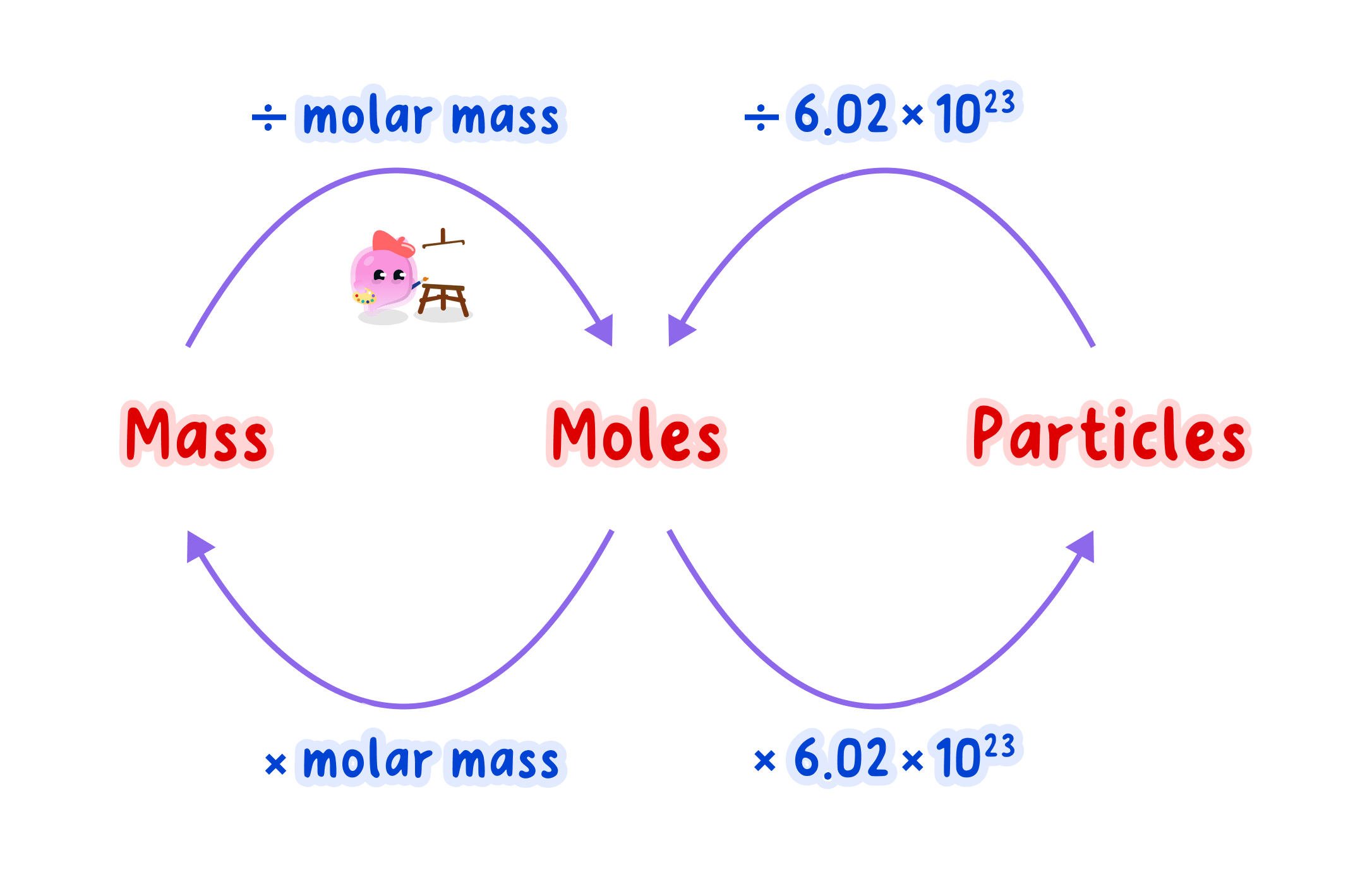
- When a question gives a mass and asks for a number of particles, divide by MrM_rMr before you multiply by 6.02×10236.02 \times 10^{23}6.02×10²³, because the Avogadro constant applies to an amount in moles.
- Give the final answer in standard form, to the number of significant figures the question asks for.
- What is the value of the Avogadro constant?
- How many molecules are in 2.00 mol2.00\,\text{mol}2.00mol of water?
- What is the mass of one mole of sodium chloride (ArA_rAr: Na = 23.0, Cl = 35.5)?
- How many moles are in 8.0 g8.0\,\text{g}8.0g of methane, CH4\text{CH}_4CH4 (ArA_rAr: C = 12.0, H = 1.0)?
- Why do 12.0 g12.0\,\text{g}12.0g of carbon and 24.3 g24.3\,\text{g}24.3g of magnesium contain the same number of atoms?
3.1.6 Stoichiometry, limiting reactants and reacting masses
Balancing numbers give the reacting ratio in moles
Stoichiometry
The ratio of the amounts in moles of the reactants and products in a reaction, shown by the balancing numbers in its balanced equation.
- In 2Mg+O2→2MgO2\text{Mg} + \text{O}_2 \rightarrow 2\text{MgO}2Mg+O2→2MgO, two moles of magnesium react with one mole of oxygen to make two moles of magnesium oxide.
- This mole ratio, 2:1:22 : 1 : 22:1:2, is the stoichiometry of the reaction.
- The reacting masses come from multiplying each amount in moles by its relative formula mass.
- Two moles of magnesium have a mass of 2×24.3=48.6 g2 \times 24.3 = 48.6\,\text{g}2×24.3=48.6g, and they react with 32.0 g32.0\,\text{g}32.0g of oxygen to make 80.6 g80.6\,\text{g}80.6g of magnesium oxide.
- The mass ratio, 48.6:32.0:80.648.6 : 32.0 : 80.648.6:32.0:80.6, is therefore not the same as the mole ratio.
- The mole ratio holds at any scale, so 0.10 mol0.10\,\text{mol}0.10mol of magnesium reacts with 0.050 mol0.050\,\text{mol}0.050mol of oxygen.
Do not compare reacting masses directly with the balancing numbers, because the numbers count moles and a mole of each substance has a different mass.
Reacting masses can be turned into balancing numbers
- Convert the mass of each reactant and product into moles by dividing by its MrM_rMr.
- Divide every amount by the smallest amount to get a simple ratio.
- If a value is a half, such as 1.51.51.5, multiply every value by 222 to reach whole numbers.
- Use the whole-number ratio as the balancing numbers in the equation.
- Check that the equation also balances atom by atom, which confirms that the formulae and the ratio fit together.
Deducing an equation from reacting masses
- 4.6 g4.6\,\text{g}4.6g of sodium reacts with 1.6 g1.6\,\text{g}1.6g of oxygen, O2\text{O}_2O2, to form 6.2 g6.2\,\text{g}6.2g of sodium oxide, Na2O\text{Na}_2\text{O}Na2O; deduce the balanced equation (ArA_rAr: Na = 23.0, O = 16.0).
- Moles of Na=4.623.0=0.20\text{Na} = \dfrac{4.6}{23.0} = 0.20Na=23.04.6=0.20, moles of O2=1.632.0=0.050\text{O}_2 = \dfrac{1.6}{32.0} = 0.050O2=32.01.6=0.050 and moles of Na2O=6.262.0=0.10\text{Na}_2\text{O} = \dfrac{6.2}{62.0} = 0.10Na2O=62.06.2=0.10.
- Divide each amount by the smallest, 0.0500.0500.050, to give the ratio 4:1:24 : 1 : 24:1:2.
- The balanced equation is 4Na+O2→2Na2O4\text{Na} + \text{O}_2 \rightarrow 2\text{Na}_2\text{O}4Na+O2→2Na2O.
Calculating reacting masses using the mole ratio
- Write the balanced equation and pick out the ratio between the substance you know and the one you want.
- Convert the known mass into moles using moles=massMr\text{moles} = \dfrac{\text{mass}}{M_r}moles=Mrmass.
- Use the mole ratio to find the moles of the substance you want.
- Convert those moles into a mass using mass=moles×Mr\text{mass} = \text{moles} \times M_rmass=moles×Mr.
- The same chain works in reverse to find the mass of reactant needed for a given mass of product.
- To make 9.53 g9.53\,\text{g}9.53g of magnesium chloride, Mr=95.3M_r = 95.3Mr=95.3, by Mg+2HCl→MgCl2+H2\text{Mg} + 2\text{HCl} \rightarrow \text{MgCl}_2 + \text{H}_2Mg+2HCl→MgCl2+H2, you need 9.5395.3=0.100 mol\dfrac{9.53}{95.3} = 0.100\,\text{mol}95.39.53=0.100mol of MgCl2\text{MgCl}_2MgCl2 and so 0.100 mol0.100\,\text{mol}0.100mol of magnesium, which is 0.100×24.3=2.43 g0.100 \times 24.3 = 2.43\,\text{g}0.100×24.3=2.43g.
- Calculate the mass of iron made from 80.0 g80.0\,\text{g}80.0g of iron oxide in the reaction Fe2O3+3CO→2Fe+3CO2\text{Fe}_2\text{O}_3 + 3\text{CO} \rightarrow 2\text{Fe} + 3\text{CO}_2Fe2O3+3CO→2Fe+3CO2 (ArA_rAr: Fe = 55.8, O = 16.0).
- Mr(Fe2O3)=(2×55.8)+(3×16.0)=159.6M_r(\text{Fe}_2\text{O}_3) = (2 \times 55.8) + (3 \times 16.0) = 159.6Mr(Fe2O3)=(2×55.8)+(3×16.0)=159.6.
- Moles of Fe2O3=80.0159.6=0.50125\text{Fe}_2\text{O}_3 = \dfrac{80.0}{159.6} = 0.50125Fe2O3=159.680.0=0.50125.
- The ratio of Fe2O3\text{Fe}_2\text{O}_3Fe2O3 to Fe\text{Fe}Fe is 1:21 : 21:2, so moles of Fe=2×0.50125=1.0025\text{Fe} = 2 \times 0.50125 = 1.0025Fe=2×0.50125=1.0025.
- Mass of iron =1.0025×55.8=55.9 g= 1.0025 \times 55.8 = 55.9\,\text{g}=1.0025×55.8=55.9g to three significant figures.
The limiting reactant is used up first
Limiting reactant
The reactant that is used up first, which stops the reaction and sets the maximum amount of product.
Excess reactant
A reactant present in more than the amount needed, so some is left over when the reaction stops.
- A reaction stops when one reactant runs out, even if some of the others remain.
- Any reactant left over at the end was present in excess.
- The amount of product depends on the limiting reactant, so doubling the limiting reactant doubles the mass of product.
- Adding more of a reactant that is already in excess makes no more product.
- Chemists often use a cheap reactant in excess, so that all of a more expensive reactant is used up.
- When marble chips are left in the flask after the fizzing stops, the hydrochloric acid was the limiting reactant.
A sandwich shop with 20 slices of bread and 6 portions of filling can make only 6 sandwiches, so the filling is limiting and 8 slices of bread are left in excess.
Find the limiting reactant before calculating product mass
- Convert each reactant mass into moles.
- Divide each amount by its balancing number in the equation.
- The reactant with the smaller result is the limiting reactant.
- Use the moles of the limiting reactant, never the excess one, to calculate the mass of product.
- The amount of excess reactant left over is the amount supplied minus the amount that reacts.
Limiting reactant and mass of iron sulfide
- 5.58 g5.58\,\text{g}5.58g of iron is heated with 4.00 g4.00\,\text{g}4.00g of sulfur, Fe+S→FeS\text{Fe} + \text{S} \rightarrow \text{FeS}Fe+S→FeS; find the limiting reactant and the mass of iron sulfide formed (ArA_rAr: Fe = 55.8, S = 32.1).
- Moles of Fe=5.5855.8=0.100\text{Fe} = \dfrac{5.58}{55.8} = 0.100Fe=55.85.58=0.100 and moles of S=4.0032.1=0.125\text{S} = \dfrac{4.00}{32.1} = 0.125S=32.14.00=0.125.
- The ratio is 1:11 : 11:1, so iron has the smaller amount and is the limiting reactant.
- Moles of FeS=0.100\text{FeS} = 0.100FeS=0.100, and Mr(FeS)=55.8+32.1=87.9M_r(\text{FeS}) = 55.8 + 32.1 = 87.9Mr(FeS)=55.8+32.1=87.9.
- Mass of iron sulfide =0.100×87.9=8.79 g= 0.100 \times 87.9 = 8.79\,\text{g}=0.100×87.9=8.79g.
- What do the balancing numbers in N2+3H2→2NH3\text{N}_2 + 3\text{H}_2 \rightarrow 2\text{NH}_3N2+3H2→2NH3 tell you?
- How can you deduce the balancing numbers of an equation from measured reacting masses?
- What mass of calcium oxide forms when 50.0 g50.0\,\text{g}50.0g of calcium carbonate decomposes by CaCO3→CaO+CO2\text{CaCO}_3 \rightarrow \text{CaO} + \text{CO}_2CaCO3→CaO+CO2 (ArA_rAr: Ca = 40.1, C = 12.0, O = 16.0)?
- Why does a reaction stop when the limiting reactant is used up?
- Why does adding more of an excess reactant not increase the mass of product?
