3.4.1 Products formed at the electrodes in electrolysis
Products at each inert electrode during electrolysis
Electrolysis
The breaking down of an ionic compound, when molten or in solution, by passing a direct electric current through it.
Inert electrode
An electrode that conducts electricity but does not react with the electrolyte or the products, such as graphite or platinum.
- The cathode is the negative electrode, so positive ions are attracted to it.
- Metal ions and hydrogen ions are positive, so a metal or hydrogen forms at the cathode.
- The anode is the positive electrode, so negative ions are attracted to it.
- Non-metal ions such as chloride and oxide ions are negative, so a non-metal forms at the anode.
- Graphite and platinum make good inert electrodes, because they conduct but do not react with the electrolyte or the products.
Opposite charges attract, so positive ions go to the negative cathode and negative ions go to the positive anode.
Molten binary ionic compounds split into their elements
Binary ionic compound
An ionic compound made from two elements only, such as sodium chloride or lead bromide.
- Melting frees the ions to move, and a molten compound contains no water, so its own ions are the only ones present.
- Molten sodium chloride contains only Na+\text{Na}^+Na+ and Cl−\text{Cl}^-Cl− ions, so it gives sodium at the cathode and chlorine at the anode.
- Molten lead bromide, PbBr2\text{PbBr}_2PbBr2, gives lead at the cathode and bromine at the anode.
- The lead collects as a silvery liquid under the cathode, and the bromine is given off as a red-brown vapour.
- Molten zinc chloride gives zinc and chlorine, and molten potassium iodide gives potassium and iodine.
- Write the non-metal products as diatomic molecules, such as Cl2\text{Cl}_2Cl2, Br2\text{Br}_2Br2 and I2\text{I}_2I2.
- Predict the product at each electrode when molten calcium bromide, CaBr2\text{CaBr}_2CaBr2, is electrolysed.
- The only ions present are Ca2+\text{Ca}^{2+}Ca2+ and Br−\text{Br}^-Br−, because the compound is molten and contains no water.
- The positive calcium ions form calcium at the cathode.
- The negative bromide ions form bromine, Br2\text{Br}_2Br2, at the anode.
Aqueous solutions contain competing ions from water
Aqueous solution
A solution in which the solvent is water, shown by the state symbol (aq).
Discharge
The change of an ion into an uncharged atom or molecule when it reaches an electrode.
- A small fraction of water molecules split into hydrogen ions and hydroxide ions, so every aqueous solution contains some of each.
- Aqueous sodium chloride therefore contains four kinds of ion: Na+\text{Na}^+Na+, H+\text{H}^+H+, Cl−\text{Cl}^-Cl− and OH−\text{OH}^-OH−.
- At the cathode, the metal ions and hydrogen ions compete, and only one of them forms a product.
- At the anode, the non-metal ions and hydroxide ions compete in the same way.
- The winner depends on the reactivity of the metal and on whether a halide ion is present.
- A molten compound has no ions from water to compete with its own, which is why molten and aqueous sodium chloride give different products at the cathode.
Electrolysis of copper(II) chloride solution
- Aim: find the products of electrolysing copper(II) chloride solution.
- Apparatus: a Petri dish with a lid, two graphite electrodes, a low-voltage direct current supply, connecting leads with crocodile clips, a dropping pipette, copper(II) chloride solution, blue litmus paper and distilled water.
Method
- Push the two graphite electrodes through holes in the base of the Petri dish, a short distance apart and not touching.
- Connect the electrodes to the low-voltage supply.
- Add about ten drops of copper(II) chloride solution, so that it covers the gap between the electrodes.
- Place a small piece of damp blue litmus paper in the dish near the positive electrode, then put the lid on.
- Switch on at about 3 V3\,\text{V}3V for up to two minutes and watch both electrodes.
- Switch off and look closely at the negative electrode and at the litmus paper.
Accuracy and safety
- A brown coating of copper forms on the negative electrode, because copper is less reactive than hydrogen.
- Bubbles form at the positive electrode and the litmus turns red and then white, showing that chlorine forms from the chloride ions.
- Keep the electrodes apart, because touching electrodes cause a short circuit.
- Keep the lid on and the room well ventilated, and run the supply for no longer than needed, because chlorine is toxic.
Hydrogen or less reactive metals form at the cathode
- Metal ions of elements more reactive than hydrogen, such as sodium, potassium, magnesium and zinc, stay in solution, and hydrogen gas bubbles off instead.
- Aqueous sodium chloride therefore gives hydrogen, not sodium, at the cathode.
- Metals less reactive than hydrogen, such as copper and silver, are deposited on the cathode.
- Aqueous copper(II) sulfate therefore gives a pink-brown coating of copper on the cathode.
- The reactivity series decides the product, with hydrogen placed between lead and copper.
Do not predict sodium or potassium at the cathode in an aqueous solution, because these metals would react with the water as soon as they formed.
A halogen or oxygen forms at the anode
Halide ion
The negative ion formed when a halogen atom gains one electron, such as chloride, bromide or iodide.
- Chloride, bromide and iodide ions are discharged first, giving chlorine, bromine or iodine.
- Aqueous sodium chloride gives chlorine, a pale green gas, at the anode.
- If no halide ion is present, hydroxide ions are discharged and oxygen gas forms.
- Sulfate and nitrate ions are not discharged from solution, so copper(II) sulfate and sodium nitrate solutions give oxygen.
- Putting both electrodes together, aqueous sodium chloride gives hydrogen and chlorine, while aqueous copper(II) sulfate gives copper and oxygen.
- When a question asks for the products from an aqueous solution, list every ion present, including H+\text{H}^+H+ and OH−\text{OH}^-OH−, before choosing the product at each electrode.
- Name the element that forms, such as chlorine, and not the ion it came from, such as chloride.
- Which electrode is the cathode, and what forms there with inert electrodes?
- What are the products when molten lead bromide is electrolysed?
- Which four ions are present in aqueous sodium chloride?
- Why does aqueous sodium chloride give hydrogen rather than sodium at the cathode?
- What forms at the anode during the electrolysis of aqueous copper(II) sulfate with inert electrodes?
3.4.2 The technique of electrolysis
Electrolysis breaks down an electrolyte using direct current
Electrolyte
A molten or dissolved ionic compound that conducts electricity because its ions are free to move.
Electrode
A solid conductor, such as a graphite rod, that carries the current into or out of the electrolyte.
- A solid ionic compound cannot be electrolysed, because its ions are held in fixed positions in the ionic lattice.
- Melting the compound or dissolving it in water lets the ions move, so the liquid can conduct.
- Two electrodes dip into the electrolyte and connect to a direct current supply, such as a battery or power pack.
- Electrons flow through the wires, but inside the electrolyte the charge is carried by moving ions.
- Positive ions drift towards the cathode and negative ions drift towards the anode, and this movement is the current in the liquid.
Do not say that electrons flow through the electrolyte, because only the ions move through the liquid.
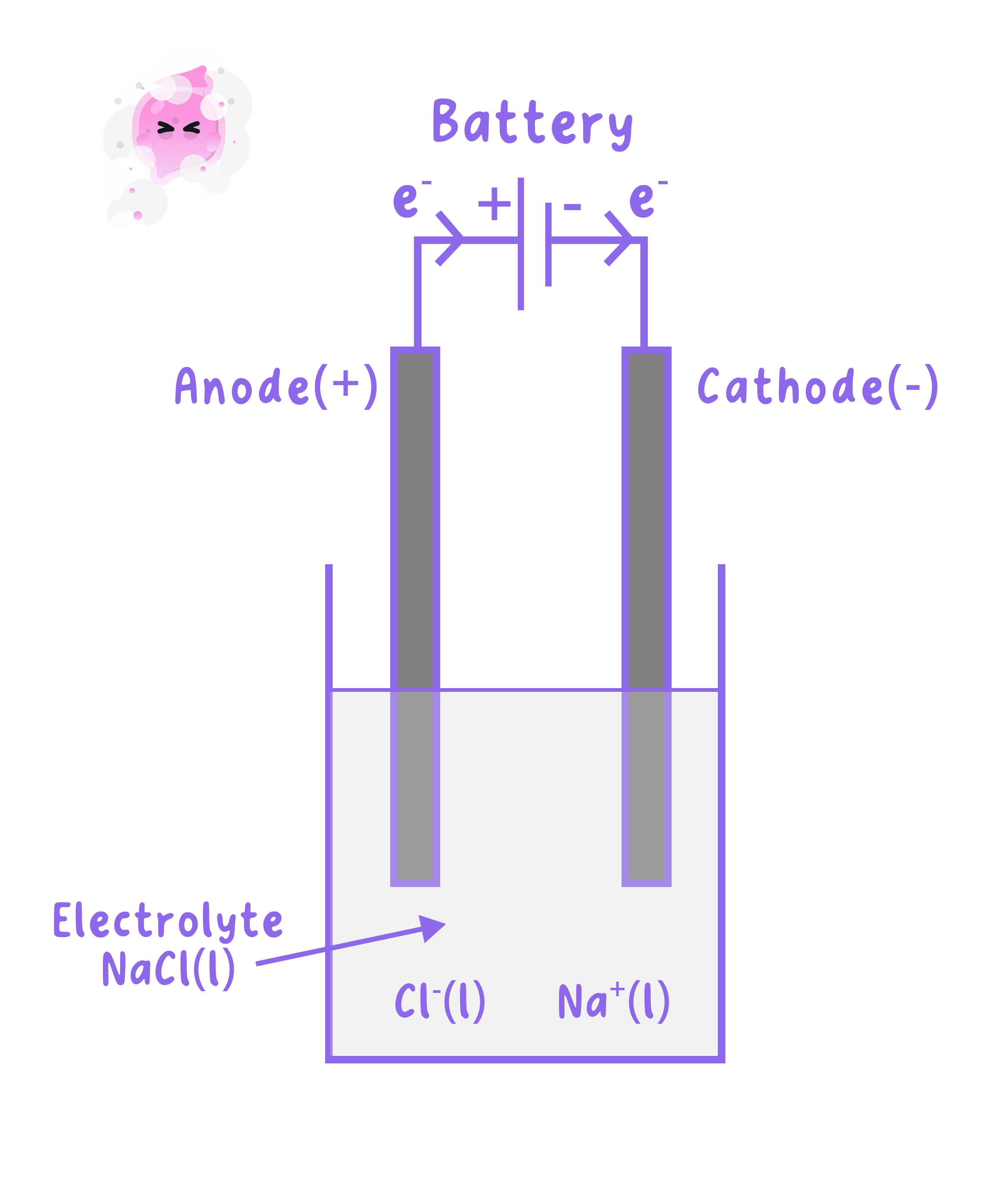
Ions gain or lose electrons at each electrode
Cathode
The negative electrode in electrolysis, which attracts positive ions.
Anode
The positive electrode in electrolysis, which attracts negative ions.
- Positive ions arriving at the cathode gain electrons from it and become uncharged atoms.
- Each Cu2+\text{Cu}^{2+}Cu2+ ion gains two electrons and becomes a copper atom, so copper builds up on the cathode.
- Negative ions arriving at the anode lose electrons to it and become uncharged atoms, which often join in pairs as molecules.
- Two chloride ions each lose one electron, and the two chlorine atoms join to form a chlorine molecule, Cl2\text{Cl}_2Cl2.
- The electrons given to the anode flow through the wires and the power supply to the cathode, so the circuit is complete.
Ions move through the electrolyte, electrons move through the wires, and the electrodes are where the two meet.
Inert electrodes stay unchanged while the electrolyte breaks down
Inert electrode
An electrode that conducts electricity but does not react with the electrolyte or the products, such as graphite or platinum.
- Graphite rods are the usual inert electrodes, because graphite conducts and has a very high melting point.
- Products either coat the electrode as a metal deposit or bubble off as a gas.
- Gases are collected in inverted test tubes, filled with the solution and placed over each electrode.
- Each gas is then identified with a test, such as a lit splint giving a squeaky pop for hydrogen.
- Electrolysis of copper(II) sulfate solution with graphite electrodes gives copper on the cathode and oxygen bubbles at the anode.
- The blue colour of the solution fades, because copper(II) ions are removed from it.
Electrolysing copper(II) sulfate with graphite electrodes
- Aim: find the products of electrolysing copper(II) sulfate solution with inert electrodes.
- Apparatus: a 250 cm3250\,\text{cm}^3250cm3 beaker, two graphite electrodes, two small test tubes, a low-voltage direct current supply, connecting leads with crocodile clips, a clamp and stand, copper(II) sulfate solution and wooden splints.
Method
- Pour copper(II) sulfate solution into the beaker.
- Clamp the two graphite electrodes so that they dip into the solution without touching.
- Fill two small test tubes with the solution and turn one upside down over each electrode, so that any gas collects at the top.
- Connect the electrodes to the supply, with the cathode joined to the negative terminal and the anode to the positive terminal.
- Switch on for a few minutes and watch each electrode.
- Switch off, lift out the tube from the anode and test the gas with a glowing splint.
Accuracy and safety
- A pink-brown coating of copper forms on the cathode, and bubbles of gas form at the anode.
- The glowing splint relights, because the gas from the anode is oxygen.
- Keep the electrodes apart, because touching electrodes cause a short circuit.
- Wear eye protection and switch off the supply before handling the electrodes.
Non-inert copper anodes dissolve and cathodes gain copper
Non-inert electrode
An electrode that takes part in the reaction at its surface, such as a copper anode that dissolves as copper ions.
- When both electrodes are copper, copper atoms at the anode lose electrons and enter the solution as Cu2+\text{Cu}^{2+}Cu2+ ions.
- The anode gets thinner and loses mass, and no oxygen is given off.
- At the cathode, Cu2+\text{Cu}^{2+}Cu2+ ions gain electrons and are deposited as copper, so the cathode gains mass.
- Copper ions enter the solution at the anode as fast as they leave it at the cathode, so the blue colour stays the same.
- With pure copper electrodes, the mass lost by the anode equals the mass gained by the cathode.
- The same set-up is used to purify copper, with an impure copper anode and a pure copper cathode.
Electrolysing copper(II) sulfate with copper electrodes
- Aim: show how the masses of copper electrodes change during electrolysis.
- Apparatus: two copper strips, emery paper, propanone, a digital balance reading to 0.01 g0.01\,\text{g}0.01g, a 250 cm3250\,\text{cm}^3250cm3 beaker, copper(II) sulfate solution, a low-voltage direct current supply, an ammeter, a variable resistor, connecting leads with crocodile clips, a stop clock and a wash bottle of distilled water.
Method
- Clean both copper strips with emery paper, rinse them with propanone and let them dry.
- Weigh each strip and record its mass.
- Dip the strips into copper(II) sulfate solution in the beaker without letting them touch.
- Connect the strips to the supply in series with the ammeter and variable resistor, and set a low, steady current.
- Switch on for about 20 minutes, keeping the current constant with the variable resistor.
- Switch off, lift the electrodes out carefully, rinse each one gently with distilled water and let it dry.
- Reweigh each electrode and work out its change in mass.
Accuracy and safety
- Handle the cathode carefully, because loose copper knocked off it would make its gain in mass too small.
- The anode loses mass and the cathode gains mass, and with pure copper the two changes are almost equal.
- Repeating with a larger current gives a larger change in mass in the same time.
- Keep propanone away from flames, because it is highly flammable.
Describe any electrolysis by its ions, electrodes and changes
- Start by listing the ions present, including H+\text{H}^+H+ and OH−\text{OH}^-OH− if the electrolyte is aqueous.
- State whether the electrodes are inert or non-inert, because a copper anode dissolves in place of releasing a gas.
- Describe which ions move to each electrode, with positive ions going to the cathode and negative ions to the anode.
- Say what forms at each electrode and what you would observe, such as bubbles, a coating or a colour change.
- Molten sodium chloride with graphite electrodes, for example, gives molten sodium at the cathode and chlorine gas at the anode.
When a question asks you to describe the electrolysis of copper(II) sulfate, check which electrodes are used, because graphite gives oxygen at the anode but copper makes the anode dissolve.
- Why must an ionic compound be molten or dissolved before it can be electrolysed?
- What carries the charge through the electrolyte?
- What happens to a copper(II) ion when it reaches the cathode?
- What forms at the anode when copper(II) sulfate solution is electrolysed with graphite electrodes?
- How does the mass of a copper anode change during electrolysis with copper electrodes?
