GCSE Chemistry Foundation Tier Grade Cap Explained
GCSE chemistry foundation tier grade cap explained: learn why grade 5 is the maximum, when Higher tier matters and how to strengthen your exam marks.
The paper can go brilliantly. You can answer every familiar calculation, explain the practical methods clearly and leave the exam feeling confident. But one rule does not change: the GCSE chemistry foundation tier grade cap is grade 555.
That is the highest available grade on Foundation tier GCSE Chemistry across the main English exam boards, including AQA, Pearson Edexcel, OCR and Eduqas. If your goal is grade 666, 777, 888 or 999, you must be entered for Higher tier. Yet Foundation is not an inferior qualification. A grade 444 or 555 earned on Foundation has the same value as the corresponding grade earned on Higher, and your certificate does not show the tier you took.
The answer at a glance
- The highest grade available in Foundation tier GCSE Chemistry is grade 555.
- Foundation tier awards grades 111 to 555, or a result of U if the minimum standard is not reached.
- Higher tier is designed for grades 444 to 999, with a narrow grade 333 safety net for students who fall just below the grade 444 boundary.
- A grade 444 or 555 has the same value on either tier.
- Students targeting grade 666 or above need Higher tier entry.
- If you take Combined Science rather than separate GCSE Chemistry, the Foundation ceiling is normally 555-555 for the overall double award.
- Grade boundaries change between exam series, but the grade cap does not.
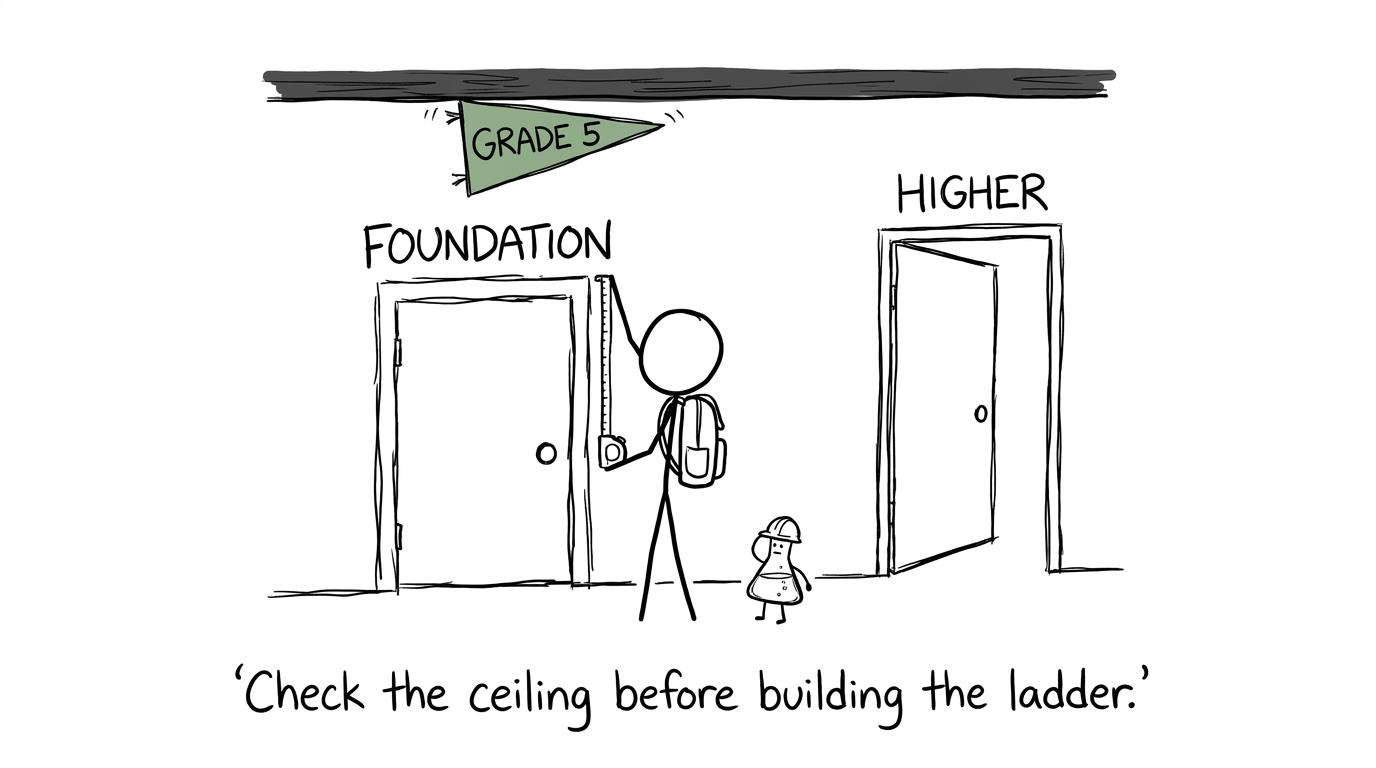 A student checking the grade ceiling before choosing a tier
What the GCSE Chemistry Foundation tier grade cap means
A grade cap is the highest grade the qualification can award on a particular tier. It is not a prediction of your result and it is not a limit on how many raw marks you may score.
If you achieve the grade 555 boundary on a Foundation paper, you receive grade 555. Scoring further above that boundary does not turn the result into grade 666, because grade 666 is not available on that tier. Even a near-perfect Foundation performance remains capped at grade 555.
This is why tier choice matters. Revision can raise your mark, but it cannot override the entry made by your school or college.
The available grades can be summarised as follows:
| Entry tier | Normal available grades | Important limitation |
|---|---|---|
| Foundation | 111 to 555 | Grades 666 to 999 are unavailable |
| Higher | 444 to 999 | A narrow grade 333 safety net may apply; below this is U |
Ofqual requires tiered GCSEs to overlap at grades 444 and 555. Common questions and awarding controls are used to align standards, so it should be no easier or harder to obtain the same grade on one tier than on the other.
That final point is easy to miss. A Foundation grade 555 is not labelled as a weaker version of a Higher grade 555. The grade is the grade.
Does the cap apply to every exam board?
For current GCSE Chemistry qualifications in England, the Foundation ceiling is grade 555 across AQA, Pearson Edexcel, OCR and Eduqas.
The paper structures and total raw marks are not identical. For example, different boards may use different paper lengths, topic groupings and maximum marks. Their grade boundaries also vary each year. None of those differences changes the Foundation grade range of 111 to 555.
Students following Pearson can explore the distinction between tiers and changing boundaries in the guide to Edexcel GCSE Chemistry grade boundaries. OCR students can use the equivalent explanation of OCR GCSE Chemistry grade boundaries.
Always check the exact specification named by your school. The exam-board logo and paper code should appear on your mock or past paper.
Separate Chemistry and Combined Science are not graded alike
This article concerns separate GCSE Chemistry, sometimes informally called triple science Chemistry. It produces one grade for Chemistry.
Combined Science is a double award. Marks from Biology, Chemistry and Physics papers are combined to produce two linked grades. On Foundation tier, the highest overall Combined Science result is normally 555-555, not a separate grade 555 for Chemistry.
That distinction matters when reading mock results. A Combined Science student is not awarded an independent Chemistry grade based only on the Chemistry papers. A stronger performance in one science can compensate for a weaker performance elsewhere because the final grade is set across the whole qualification.
Before comparing boundaries, confirm whether your entry is separate Chemistry or Combined Science. They are different qualifications with different total marks and grading structures.
Should you move to Higher tier for the top grades?
If you are securely aiming for grade 666 or above, Higher tier is necessary. But choosing a tier is not simply a matter of selecting the highest possible ceiling.
Higher papers include more demanding content and questions targeted at the upper grades. They also carry more risk at the lower end. The normal Higher range begins at grade 444, and the grade 333 safety net is deliberately narrow. A student who falls below it receives U rather than grades 222 or 111.
Foundation may therefore be the more sensible entry when the priority is securing grade 444 or 555. It offers access to both grades without exposing the student to the same unclassified-result risk.
A tier conversation should use evidence rather than hope or one difficult mock. Consider:
- recent results across several assessments;
- performance on questions common to both tiers;
- whether Higher-only content has been taught and understood;
- accuracy under timed conditions;
- the grades required for your intended sixth-form, college or apprenticeship route;
- your teacher’s assessment of which paper gives you the best opportunity to show what you know.
Entry decisions and deadlines are handled by schools and colleges, so raise the question early. Do not wait until the final days before the examination.
Why a Foundation grade 5 still demands strong revision
A cap can create a misleading thought: if the maximum is only grade 555, perhaps the paper will be straightforward. Foundation papers contain more accessible questions, but they still test the full habits of effective science examination work.
You need accurate scientific knowledge, practical understanding, data interpretation and clear written explanations. You must also apply ideas in unfamiliar contexts rather than merely repeat memorised definitions.
Mathematics is especially important. Regulatory requirements allocate at least 20%20\%20% of the marks in GCSE Chemistry to mathematical skills. Depending on the specification, these can include:
- ratios and proportional reasoning;
- percentages, percentage yield and atom economy;
- rearranging equations;
- unit conversions;
- graphs, gradients and rates;
- significant figures;
- standard form;
- interpreting tables and experimental data.
The relationships may look scientific, but the underlying skills are familiar. For example:
percentage yield=actual yieldtheoretical yield×100\text{percentage yield}=\frac{\text{actual yield}}{\text{theoretical yield}}\times 100percentage yield=theoretical yieldactual yield×100A missing unit, an early rounding error or an incorrect rearrangement can lose a mark even when your Chemistry knowledge is sound. Strengthen those foundations through the free GCSE Maths revision hub, and use the focused Standard Form revision lesson when very large or small values cause trouble.
A practical plan for reaching grade 5
Grade boundaries are set after the papers have been taken and marked. They can move because papers vary in difficulty, so revising towards an assumed raw-mark boundary is risky. Build a margin instead.
Diagnose with real questions
Complete a timed section from the correct board and tier. Mark it strictly, then classify every lost mark as one of four types:
- missing Chemistry knowledge;
- weak application or explanation;
- practical-method misunderstanding;
- mathematical or accuracy error.
This turns a vague feeling such as “I am bad at Chemistry” into a repairable list. The guide to revising GCSE Chemistry efficiently gives a useful structure for combining subject recall with calculation practice.
Repair one weakness at a time
Choose a narrow target: interpreting rate graphs, recalling ion tests, balancing equations or converting units. Review the relevant lesson, complete practice questions and check the mark scheme immediately.
Do not simply copy the correct answer. Write why your original answer lost the mark, then attempt a similar question later without notes.
Build towards complete papers
Short sets are useful early because they reveal gaps without exhausting you. As the exams approach, move towards timed papers so that topic knowledge, concentration and timing are tested together. The guide on when to start GCSE past papers explains how to make that transition gradually.
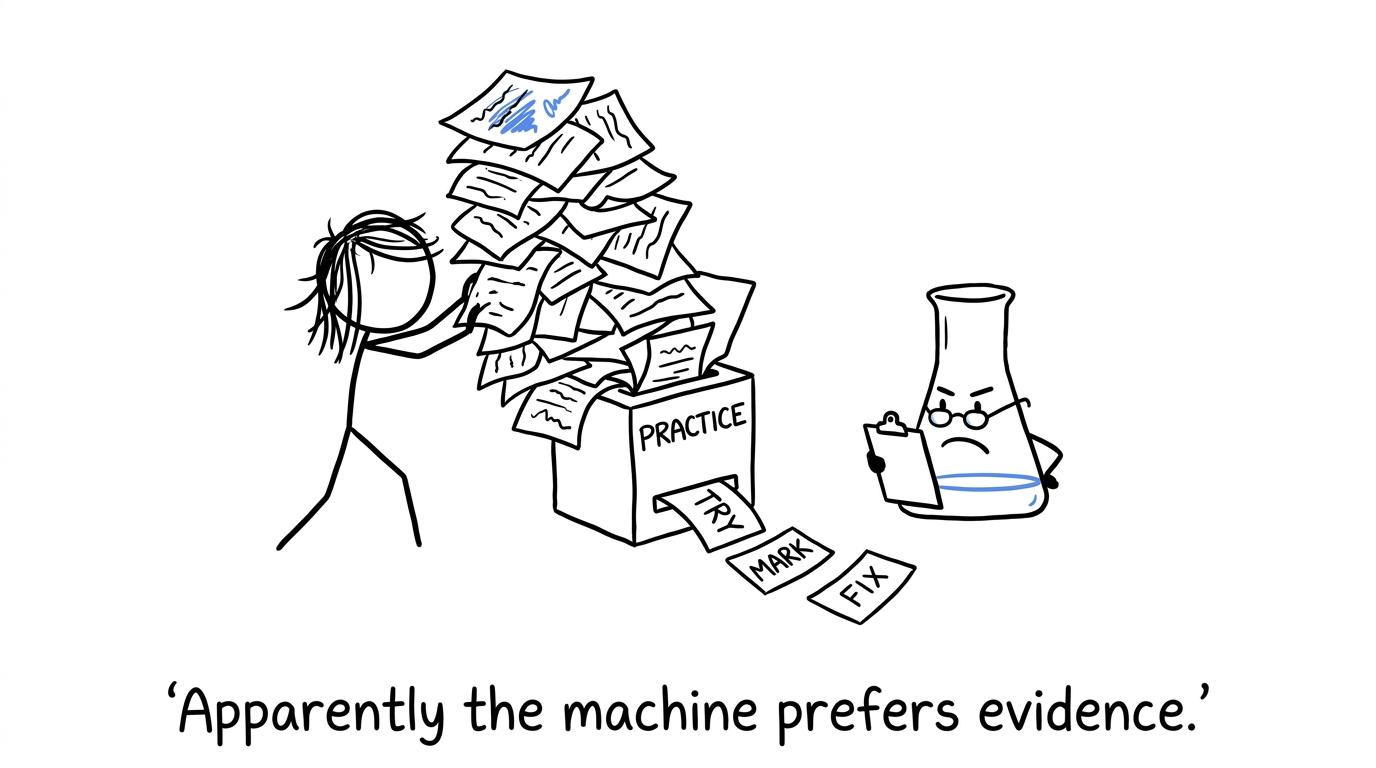 A revision machine turning attempts into useful feedback
Treat the mark scheme as feedback
Mark schemes reveal the precision an examiner expects. In calculation questions, check the formula, substitution, working, final value and unit. In explanation questions, look for the scientific links that connect cause and effect.
MathsGenie’s wider GCSE revision resources provide revision lessons, practice questions, mini tests, past papers, mark schemes and video solutions. A structured timetable such as the one-month GCSE revision plan can help turn those resources into a repeatable routine.
Common mistakes about Foundation Chemistry grades
Assuming grade boundaries are fixed
A previous boundary is historical evidence, not a promise. Boundaries can change from one exam series to another. Use past figures to understand performance, not to predict an exact target.
Believing a very high mark can become grade 6
It cannot. Grade 555 remains the maximum award on Foundation tier, regardless of how far your raw mark exceeds the grade 555 boundary.
Thinking Foundation is automatically easier for grade 5
Foundation contains more accessible material, while Higher contains more demanding upper-grade questions. However, the awarding system is designed so that grades 444 and 555 represent comparable standards across both tiers.
Confusing Chemistry with Combined Science
Separate Chemistry produces one grade. Combined Science produces a double grade based on marks across all three sciences. Check your course before interpreting results or grade boundaries.
Ignoring calculation marks
Chemistry revision is not only factual recall. Percentages, ratios, graphs, units and equation rearrangement can materially affect your result. Use the GCSE Chemistry exam-week checklist to make accuracy checks part of your routine.
 A crystal ball failing to predict the next grade boundary
The grade ceiling is a decision point, not a judgement
The GCSE Chemistry Foundation tier ceiling is grade 555. If grades 666 to 999 are your realistic target, speak to your teacher about Higher tier while there is still time to prepare for its content and level of demand. If grade 444 or 555 is the right objective, Foundation can be a sound route to that result.
Once the tier is decided, stop spending revision time worrying about the label. Concentrate on the marks available in front of you: precise knowledge, clear explanations, practical understanding and reliable calculations.
Start with MathsGenie’s free revision lessons, practise the mathematical skills that appear inside Chemistry, and test yourself with mini tests, past papers and predicted papers. Mark every attempt with the available mark schemes and use video solutions to correct methods. The ceiling may be fixed, but the quality of your preparation is still yours to raise.