

GCSE Business Homework Grade Impact: Does It Matter?
GCSE business homework grade impact explained: see what counts towards your final result, which tasks improve marks, and when maths revision should come first.
A homework deadline can feel urgent in a way that a distant GCSE does not. The unfinished worksheet is on your desk tonight; the exam is months away. Yet urgency and importance are not always the same thing.
Here is the direct answer to the GCSE business homework grade impact question: homework normally does not contribute directly to your final GCSE Business grade. Current GCSE Business qualifications from AQA, Edexcel, OCR and Eduqas are assessed through externally marked examinations. Your school may record homework marks for reports, predicted grades or intervention, but those marks are not normally added to your final qualification result.
Homework can still matter considerably. Its value is indirect: good tasks strengthen the knowledge, application, analysis, evaluation and quantitative skills that earn marks in the examination. The question is not simply whether you complete homework. It is whether the work changes what you can do without help.
The short answer: what should you prioritise?
Use this checklist when Business homework competes with maths revision:
- Complete homework that targets a genuine weakness.
- Prioritise tasks that involve recall, case-study application, calculations or structured exam answers.
- Use teacher feedback to correct the work rather than merely reading the mark.
- Avoid spending disproportionate time making notes look polished.
- Respect deadlines, but ask for support if the workload is unmanageable.
- Protect regular maths practice, especially if maths is a progression requirement for your next course.
- Judge revision by what you can retrieve and apply later, not by how many pages you produce.
The sensible choice is rarely “all homework” or “no homework”. It is to give each task the amount of attention its learning value deserves.
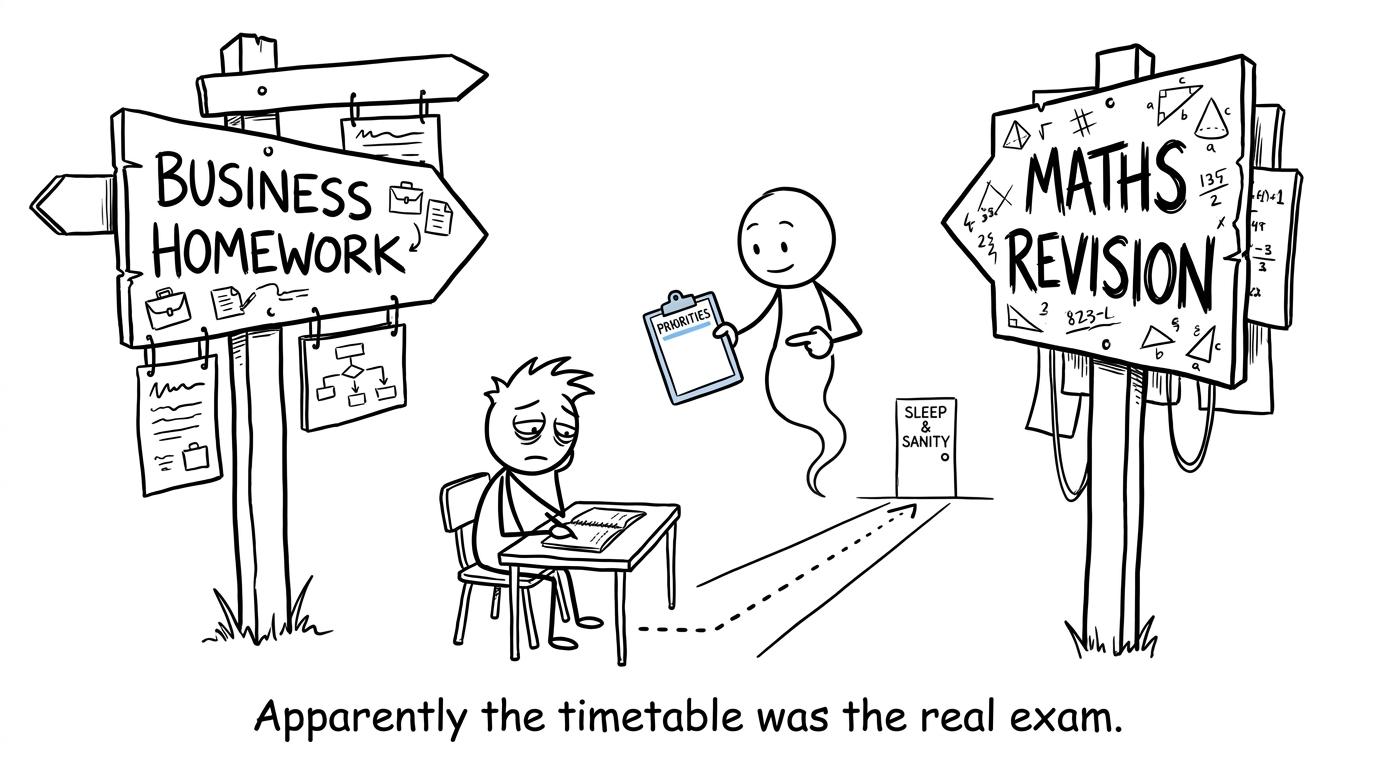 A student trying to balance Business homework and maths revision
Does Business homework count towards the final grade?
For the mainstream GCSE Business specifications, the final result comes from examinations rather than a coursework or homework component. For example, AQA, Edexcel and OCR each use two externally assessed papers. Eduqas also assesses the qualification through external components.
That distinction matters. A low homework score is not automatically a lost set of marks from your final GCSE total. Equally, a folder full of perfect homework does not guarantee a particular grade.
Your school may still use homework in other ways. It can influence:
- internal progress reports;
- conversations with parents or carers;
- predicted grades used by the school;
- decisions about support or intervention;
- your teacher’s understanding of where you need help.
These consequences are real, but they are different from the calculation of the awarded GCSE grade. If you are unsure how homework is used internally, ask your Business teacher. For the final result, consult the correct specification and remember that GCSE Business grade boundaries apply to the total assessed qualification mark, not to your homework average.
Why homework can still improve your Business result
The Education Endowment Foundation’s current evidence review reports a positive average effect for homework at secondary level, while rating the security of that evidence as low. It also stresses that the quality of the task matters more than sheer quantity. Homework tends to be more useful when it is connected to classroom learning, has a clear purpose and receives feedback.
That is a useful way to think about Business. Homework works when it rehearses the performance required by the exam.
Across GCSE Business specifications, the common assessment objectives broadly place:
- 35%35\%35% on knowledge and understanding;
- 35%35\%35% on applying knowledge to business contexts;
- 30%30\%30% on analysis, evaluation, judgements and conclusions.
A task that only asks you to copy definitions may touch the first objective, but it does little for application or evaluation. A task asking you to use evidence from a case study, explain consequences and reach a justified conclusion is much closer to the real examination demand.
Homework should build retrieval, not recognition
Reading a completed answer can create a comforting sense that you know it. Close the book and that confidence may disappear.
Useful homework requires you to retrieve ideas before checking notes. This might include recalling business terminology, explaining a chain of impact, selecting relevant case-study evidence or planning a conclusion from memory. The effort is not a sign that the method is failing. It is the part that reveals what has actually been learned.
Feedback is where many of the gains happen
A marked answer is not finished work. It is diagnostic information.
When your teacher identifies weak context, an unsupported judgement or a missing link in analysis, write a precise correction. Then attempt another question requiring the same skill. The important movement is not from blank page to submitted page; it is from first attempt to better independent performance.
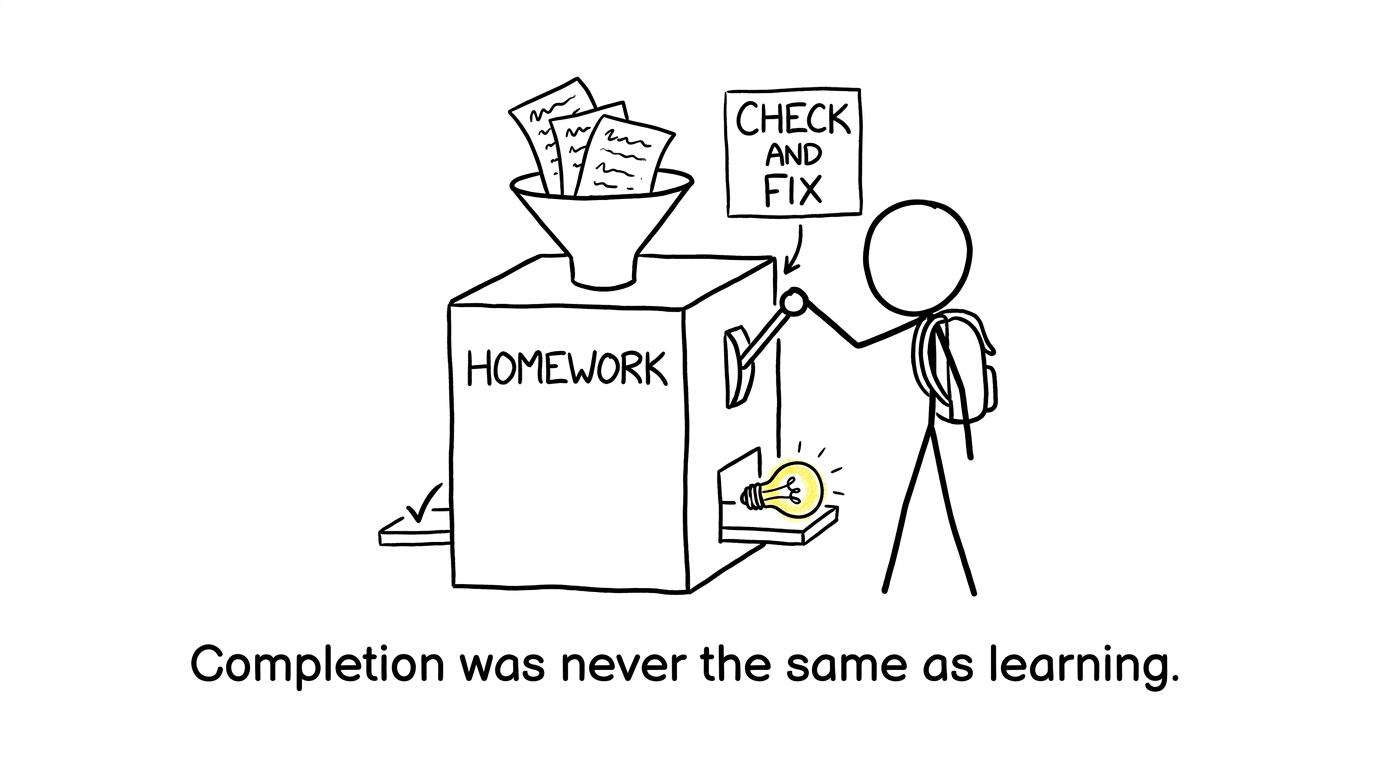 A homework machine producing learning only when the work is checked and fixed
Which Business homework has the greatest grade impact?
Not all tasks deserve equal time. A practical ranking looks like this:
| Homework type | Likely revision value |
|---|---|
| Timed exam questions followed by marking and correction | High, because they combine knowledge, application and exam technique |
| Case-study questions requiring contextual analysis | High, because Business marks depend on using the situation given |
| Quantitative questions with checked working | High when calculations or data interpretation are weak |
| Retrieval quizzes completed without notes | High for identifying gaps in knowledge |
| Targeted revision after teacher feedback | High, because it addresses a known weakness |
| Condensing a topic into a brief, usable summary | Moderate when it requires selection and recall |
| Copying definitions or rewriting a textbook | Usually low unless followed by self-testing |
| Decorating notes or repeatedly organising folders | Low as examination preparation |
GCSE Business also includes quantitative skills. Specifications require students to work with percentages, percentage change, averages, revenue, costs, profit, profitability ratios, cash flow and other business data. Those skills overlap with the fluency developed through GCSE maths revision.
For a student taking both subjects, practising percentages and interpreting data can therefore support Business as well as maths. The context changes, but accuracy, proportional reasoning and clear working remain valuable.
When is your time better spent elsewhere?
Homework has an opportunity cost: time spent on one task cannot be spent on another. The right decision depends on what is due, what you find difficult and what will affect your next stage of education.
Prioritise the Business homework when
- it must be submitted soon;
- it covers a topic you cannot yet explain independently;
- your teacher has set an exam-style task and will provide feedback;
- repeated Business errors are limiting your mock results;
- the work practises calculations, application or extended responses;
- missing it would prevent your teacher from diagnosing a problem.
Prioritise maths revision when
- the Business task is largely repetitive copying;
- you have already demonstrated the relevant Business skill securely;
- a maths mock or examination is closer;
- you have significant maths gaps that require repeated practice;
- maths is essential for your intended sixth-form, college or apprenticeship route;
- your available time is limited and maths currently offers the larger realistic mark gain.
Do not use this as permission to ignore a teacher’s instructions. If a low-value task is consuming an unreasonable amount of time, speak to the teacher rather than quietly abandoning it. There may be a purpose you have not recognised, or the task may be adaptable.
For maths, avoid replacing Business homework with vague rereading. Use a structured GCSE maths revision timetable, choose a specific weakness, practise questions and check the result.
A balanced homework and revision routine
A productive weekday does not need to become an endurance contest. Use a simple sequence:
Decide what is genuinely urgent
List deadlines, upcoming assessments and your weakest areas. Separate tasks that are urgent from those that merely feel uncomfortable. Then choose a small number of outcomes for the session.
Give Business homework a clear purpose
Before starting, finish the sentence: “This task should help me improve...” Your answer might be recalling finance terminology, applying ideas to a case study or producing a justified judgement.
If you cannot identify a purpose, complete the required task efficiently and spend your deeper concentration on a more valuable weakness.
Keep maths active and specific
Short, regular maths sessions are usually more useful than waiting for a free weekend. The best order for learning GCSE maths topics can help if you are unsure where to begin.
Use topic questions when knowledge is fragile. Once the method is secure, move to mixed or timed work. Edexcel GCSE Maths mini tests offer manageable checks, while students using other boards can choose the appropriate resources from the main revision hub.
Mark, fix and return
Whether the subject is Business or maths, completion is only the first stage. Compare your work with feedback or a mark scheme, record the exact weakness and revisit it later.
Maths students can apply the full process through past-paper practice. If you take Edexcel, the Edexcel GCSE Maths past papers place papers and marking resources together. Predicted papers are best used later as fresh practice, not as guesses about everything that will appear; the guide to GCSE predicted topics explains that distinction.
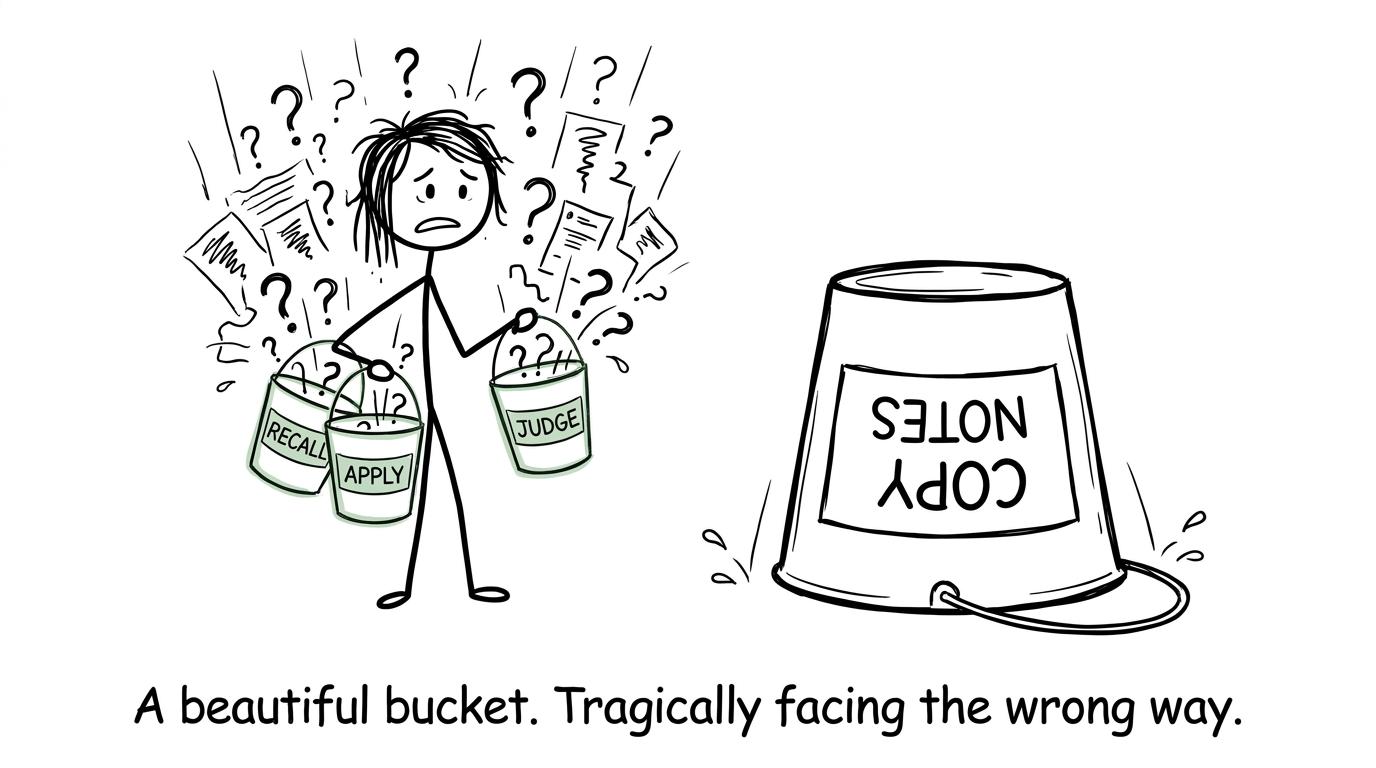 Useful revision buckets catching exam questions while copied notes miss everything
Common mistakes when judging homework value
Assuming every completed task has equal value
A page copied from a textbook and a corrected case-study answer may take the same time, but they do not create the same learning. Judge the task by the thinking it requires.
Ignoring homework because it is not directly graded
Homework may not enter the final mark calculation, but the knowledge and habits it builds can. Refusing all homework confuses the measurement with the preparation.
Spending too long making work look perfect
Neat work should be readable. Beyond that, presentation can become a safe way to avoid retrieval, calculation or evaluation. Examination marks reward the quality of the response, not decorative headings.
Checking answers without correcting the method
Seeing the right answer is not the same as being able to produce it. Explain the error, rewrite the relevant part and retest yourself later.
Sacrificing every other subject to one deadline
A single piece of homework should not routinely consume the time needed for several qualifications. If this keeps happening, discuss workload and expectations with your teachers and use the MathsGenie one-month revision plan to restore structure.
The final verdict
Business homework usually has no direct place in the calculation of your externally assessed GCSE grade. But well-designed homework can change the skills that determine that grade. Its impact comes through stronger recall, better contextual application, more developed analysis, sounder judgement and greater confidence with quantitative data.
So complete purposeful Business homework, use the feedback and avoid mistaking time spent for progress made. When a task offers little additional learning and maths needs urgent attention, allocate your revision time deliberately rather than automatically.
MathsGenie can make that decision easier. Start with the free GCSE revision lessons and practice questions, use mini tests to expose gaps, then build towards past papers and predicted papers. Mark your work with the available mark schemes and use video solutions to repair methods. Homework is useful when it leads somewhere. MathsGenie gives your maths revision that next step.











