

GCSE Business Exam Cost for a Private Candidate
GCSE business exam cost private candidate guide covering typical centre fees, extra charges, where to book and how to compare UK exam-centre quotes early.
Paying for an exam can feel strangely opaque. You know the qualification you want, but the first price you find is rarely the whole price. If you searched for “gcse business exam cost private candidate”, the short answer is this: budget roughly £175\pounds 175£175 to £300\pounds 300£300 for a standard entry booked before the centre's deadline, although some centres charge less or more.
The exam board's own entry fee is usually only around £50\pounds 50£50 to £60\pounds 60£60. The rest is normally the exam centre's charge for administration, rooms, invigilation and handling your entry. There is no single national private-candidate price, so you must obtain a complete quote from the centre where you will sit the papers.
Fees and deadlines change each academic year. The figures below were checked against published exam-board and centre information available in August 2026, but your centre's written quote is the figure that matters.
The cost checklist
Before paying, confirm all of the following:
- the exam board and specification code
- whether the quote covers the complete GCSE, including every paper
- the exam board entry fee
- the centre's administration and invigilation charges
- any late-entry fee
- charges connected with access arrangements, if applicable
- certificate collection or postage arrangements
- cancellation and refund conditions
- travel and, if necessary, accommodation costs
A simple way to think about the total is:
Ctotal=Centry+Ccentre+Cextras+CtravelC_{\text{total}} = C_{\text{entry}} + C_{\text{centre}} + C_{\text{extras}} + C_{\text{travel}}Ctotal=Centry+Ccentre+Cextras+CtravelThe exam-board fee is only one term in that expression. This is why a published board fee of about £55\pounds 55£55 does not mean a private candidate can necessarily sit the qualification for £55\pounds 55£55.
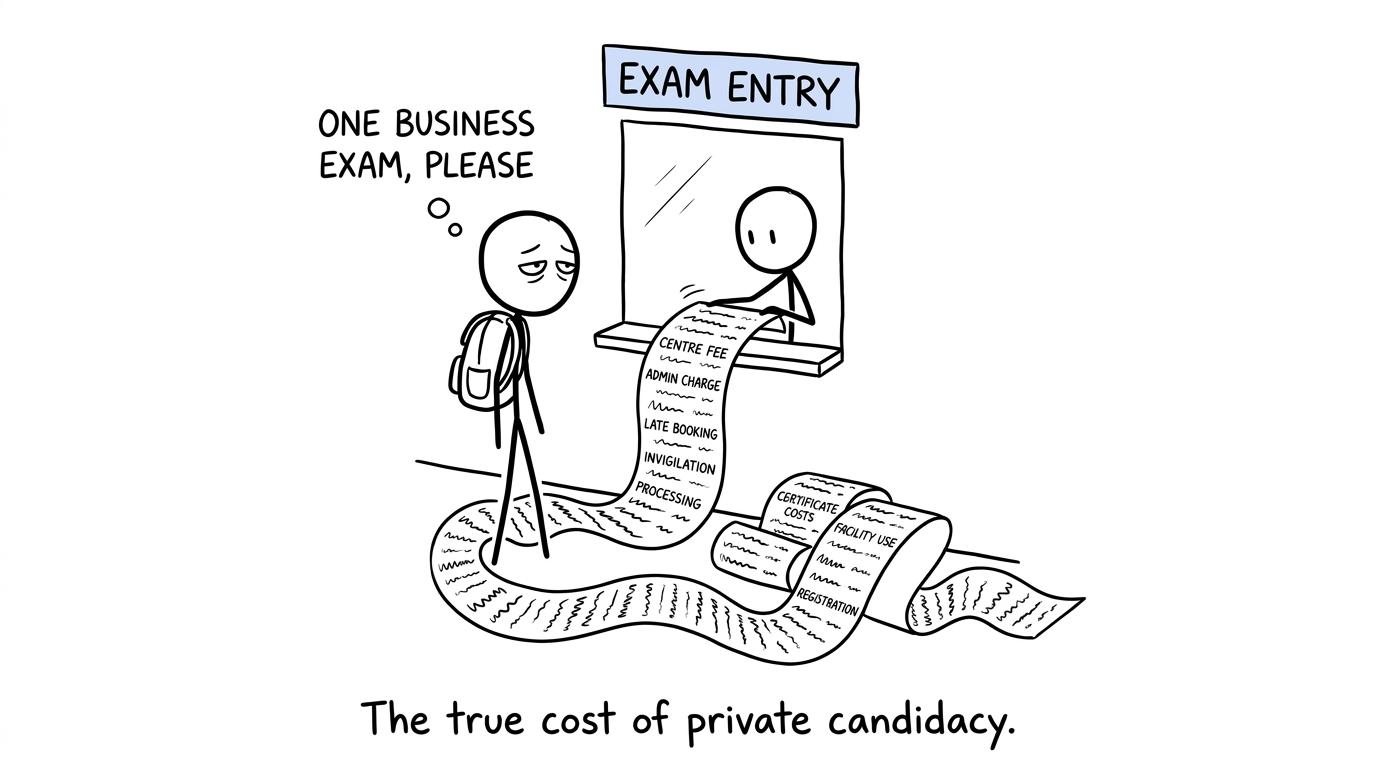 A GCSE student receives an unexpectedly long receipt at an exam-entry booth
How much does GCSE Business cost privately?
Published fees provide useful benchmarks, but they should not be mistaken for a guaranteed national tariff.
| Cost component | What recent published information suggests |
|---|---|
| Exam-board entry fee | Usually around £50\pounds 50£50 to £60\pounds 60£60 for GCSE Business before late fees |
| School or college administration | Can add around £100\pounds 100£100 or more, depending on the centre |
| Specialist exam-centre total | Published examples have included approximately £215\pounds 215£215 to £290\pounds 290£290 for a standard entry |
| Late entry | Often substantially more expensive and always subject to centre capacity |
| Travel and accommodation | Depends on how far you live from a centre offering your exact board and subject |
For context, Pearson's published UK-centre fee for Edexcel GCSE Business in the 2025/26 academic year was £55.40\pounds 55.40£55.40. OCR listed GCSE Business at £55.75\pounds 55.75£55.75 for the same period. Eduqas subsequently published a 2026/27 single-award GCSE fee of £48.60\pounds 48.60£48.60.
Those are charges to approved centres, not necessarily prices offered directly to candidates. One school publishing 2025/26 private-entry information added a £120\pounds 120£120 administration fee to the board fee. Specialist centres published higher all-in prices, including examples between £215\pounds 215£215 and £290\pounds 290£290.
The sensible planning figure is therefore around £175\pounds 175£175 to £300\pounds 300£300, plus personal travel costs. Treat this as a budgeting range rather than a promise. Location, booking date, centre policy and the examination series can all move the final figure.
Why private-candidate prices vary
A private candidate is not entered through a school at which they are enrolled. An approved centre must accept the candidate, process the entry and supervise the exams. Exam boards do not normally book candidates into examination rooms directly.
The centre may need to cover:
- exams-officer administration
- identity and document checks
- secure handling of examination materials
- room and invigilator costs
- communication before each paper
- results and certificate administration
- additional staffing or rooms for approved access arrangements
Some schools charge a modest administration fee because examinations already form part of their normal operation. A specialist centre may offer a more convenient booking service but charge more. Neither model automatically represents better value. What matters is whether the centre is approved, reliable and able to enter the correct qualification.
There is also a geographical effect. The cheapest quoted fee may stop being cheapest once repeated or long-distance journeys are included. Business GCSE usually contains more than one written paper, so check the timetable before deciding that a distant centre is affordable.
Check the correct exam board and code
“GCSE Business” is not one interchangeable entry. Centres need the awarding organisation and the correct specification code. Common current specifications include:
- AQA GCSE Business:
8132 - Pearson Edexcel GCSE Business:
1BS0 - OCR GCSE Business:
J204 - Eduqas GCSE Business:
C510QS
Do not confuse GCSE Business with International GCSE Business, a vocational business qualification or A Level Business. Their codes, papers, fees and examination series may be different.
If you have already followed a course, use the same specification unless you have a clear reason to change. The wording of assessment objectives, topic organisation and question styles differs between boards. Confirm the code against the current specification and ask the centre to repeat it on your invoice or booking confirmation.
GCSE Business is not split into foundation and higher tier. That distinction matters for subjects such as GCSE Maths, but it does not apply here. If you are also arranging a maths resit, confirm its board and tier separately, then use the GCSE Maths revision hub to prepare for the exact course you have entered.
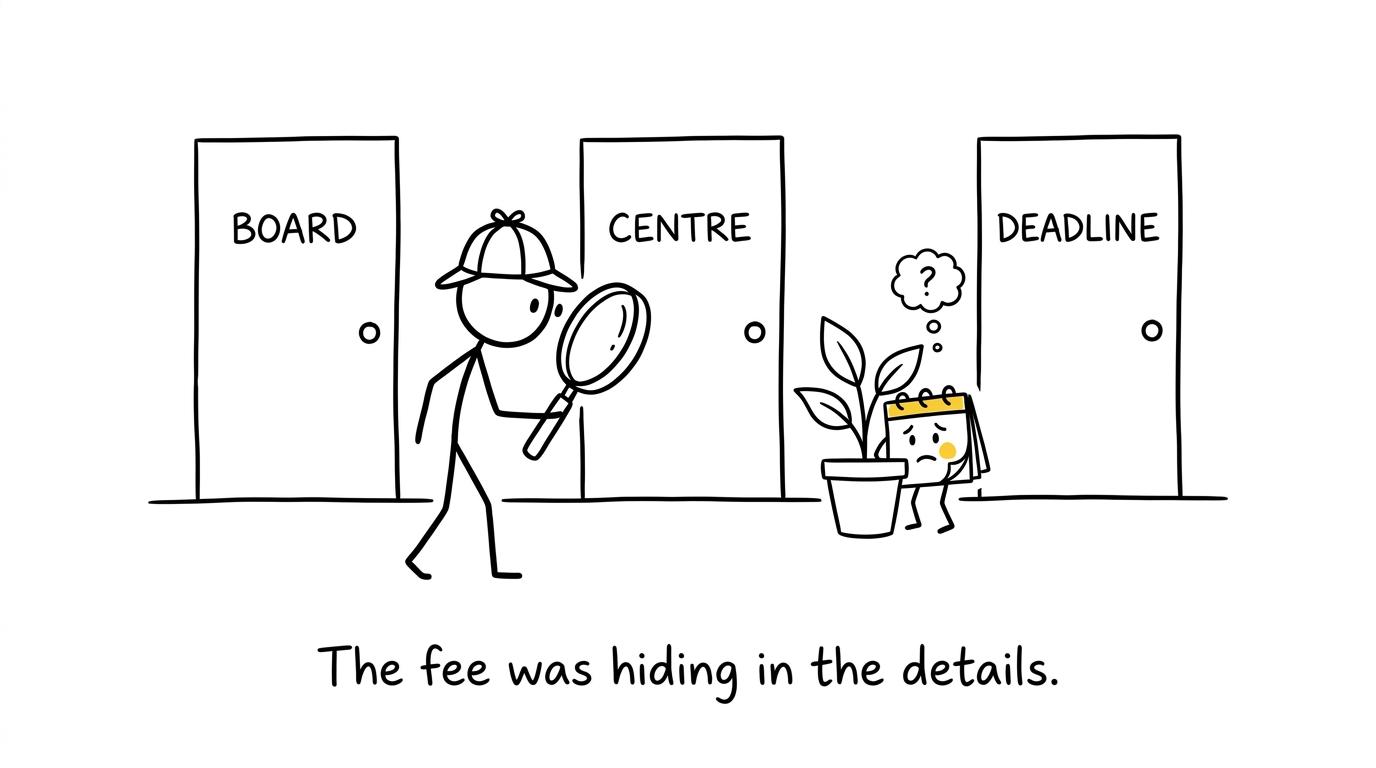 A private candidate investigates the board, centre and deadline behind an exam quote
Where to book GCSE Business as a private candidate
Start with the JCQ private-candidate centre search. JCQ is the Joint Council for Qualifications, and its search tool lists approved schools, colleges and examination centres that have indicated they may accept private candidates. You can search by postcode, qualification and awarding organisation.
A listing is a starting point, not a confirmed booking. Centres decide whether to accept each entry, and not every centre offers every subject or exam board. Contact several centres and ask the same questions so that their quotes are genuinely comparable.
What to ask the centre
Your first message should include:
- your full name and date of birth
- the qualification, board and specification code
- the examination series you want
- whether this is your first entry or a resit
- your previous Unique Candidate Identifier, if you have one
- whether you require access arrangements
- a request for the total fee and payment deadline
Ask explicitly: “Does this price include all papers, the awarding-body fee, administration, invigilation and certificate handling?”
Also request the centre's candidate handbook, cancellation policy and identification requirements. After booking, the centre should issue entry information. Check every detail immediately, especially your legal name, date of birth, subject, board and code.
Book well before the deadline
Exam boards publish entry deadlines, but a centre will usually impose its own earlier internal deadline. It needs time to check your information, receive payment and submit the entry.
GCSE Business is normally examined in the summer series, unlike GCSE English Language and Maths, which also have restricted November resit opportunities for eligible candidates. Do not assume you can postpone Business until November.
Late booking can lead to additional fees, and very late entries can cost considerably more. A centre may also refuse the booking if rooms or invigilators are already full. Contacting centres during the autumn or early winter for the following summer is safer than waiting for spring.
Access arrangements and additional costs
If you need extra time, supervised rest breaks, a reader, a word processor or another access arrangement, tell the centre at the first enquiry. An arrangement used previously does not transfer automatically without the required evidence and approval process.
The centre may need to assess your normal way of working, review evidence and provide additional staff or a separate room. This can produce extra charges, particularly for a private candidate. Ask for those costs before committing to the entry.
Do not book first and mention the arrangement shortly before the exam. Access-arrangement applications have deadlines, and a centre may be unable to complete the necessary process at short notice.
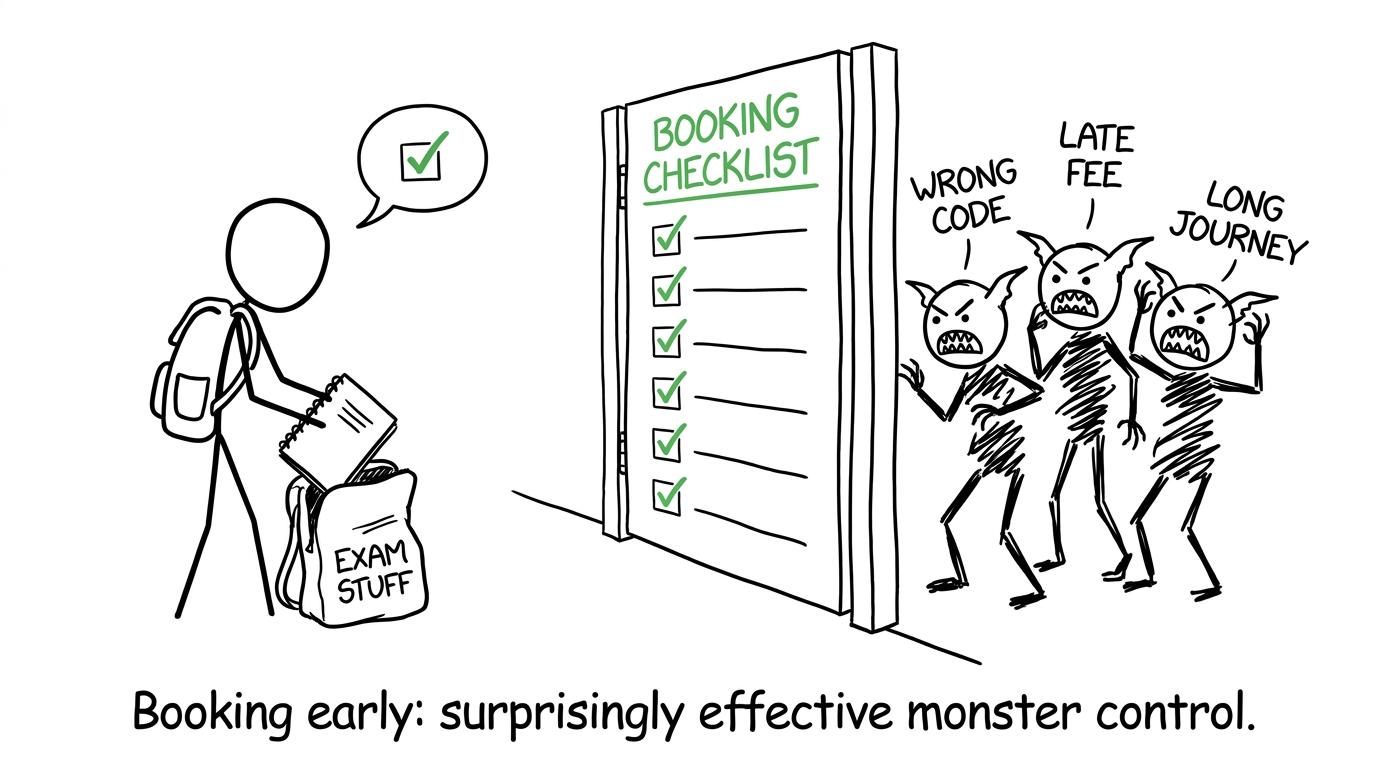 Booking early keeps wrong codes, late fees and difficult journeys under control
Budget for revision as well as entry
Once the fee has been paid, the useful question changes from “What does the exam cost?” to “How do I make the entry count?” Build a timetable around the papers you are actually taking and leave enough time for timed practice.
For your accompanying GCSE Maths revision, MathsGenie keeps the essential resources free. Start with a realistic GCSE maths revision timetable, or use the one-month maths revision plan if the examinations are approaching.
Revision should move through a repeatable cycle: learn, practise, mark, correct and retest. GCSE mini tests are useful for short checks, while Edexcel GCSE Maths predicted papers help recreate full examination pressure. The guide to using GCSE past papers properly explains how to turn each lost mark into a specific revision task.
If time is tight, use the 20-minute GCSE maths revision routine. Before each paper, the GCSE maths exam-week checklist can help you check equipment, timing and final priorities without cramming.
Common mistakes private candidates make
Comparing only the board fee
The awarding-body charge is not usually the total payable. Compare written, all-inclusive centre quotes instead.
Booking the wrong qualification
GCSE, International GCSE and vocational Business qualifications are different. Check the board, title and specification code before paying.
Waiting for the official entry deadline
Your centre's internal deadline may be weeks earlier. Late entries cost more and may not be accepted at all.
Assuming every listed centre offers Business
A centre may accept private candidates but offer only selected subjects or boards. Obtain direct confirmation.
Ignoring the full journey cost
Check the location and dates of every paper. Add transport and possible accommodation before comparing centres.
Leaving access arrangements until later
Raise access needs during the first enquiry. Evidence, assessment and approval take time.
Turn the booking into a clear revision plan
For most private candidates, the realistic GCSE Business exam cost is not simply the board's £50\pounds 50£50 to £60\pounds 60£60 entry charge. An overall budget of roughly £175\pounds 175£175 to £300\pounds 300£300 is more sensible, with extra room for travel, access-related services or late fees.
Find approved centres through the JCQ private-candidate search, request several complete quotes, verify the specification code and book before the centre's own deadline. Then put the paperwork away and focus on preparation.
For GCSE Maths, make MathsGenie your free revision base. Use revision lessons and practice questions to strengthen individual topics, mini tests to check recall, and past papers, predicted papers, mark schemes and video solutions to prepare for the real examination conditions.











