

GCSE Biology Grade 6 Meaning: What It Really Shows
GCSE biology grade 6 meaning explained: understand the ability it represents, old letter-grade comparisons, boundaries and practical revision steps.
A results page can turn one small number into a very large question. Is a grade 666 good? Is it a pass? Does it mean you are ready for A Level Biology? And what would it have been under the old letter system?
The GCSE biology grade 6 meaning is best understood as a strong overall performance. It sits above grades 444 and 555, but below the grade 777 threshold aligned with the old grade A. In everyday terms, it is often described as roughly equivalent to a high B, although the old and new scales do not match exactly.
More importantly, a grade 666 suggests that you can do more than recall biological facts. Across the assessment, you have shown a sound ability to apply knowledge, interpret evidence, use mathematical skills and analyse scientific information.
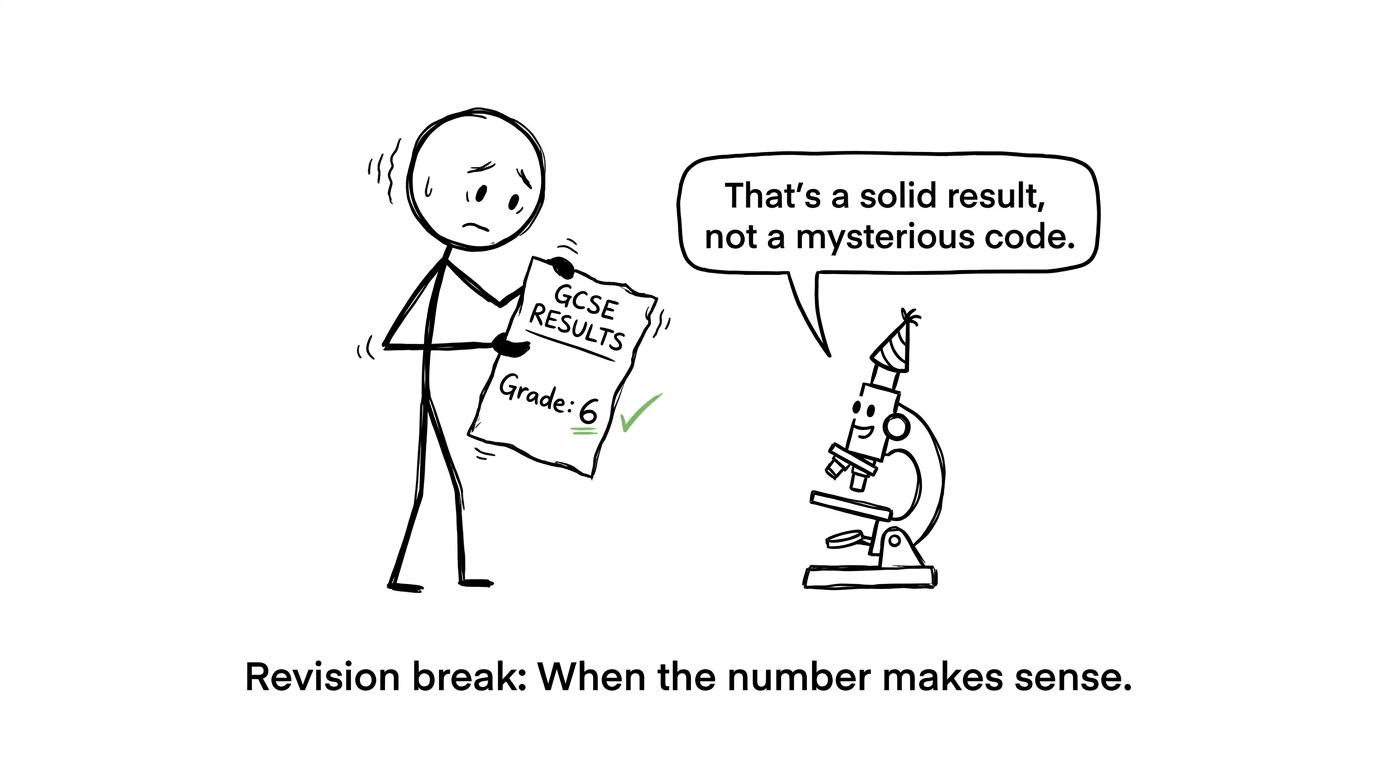 A student discovers that grade 6 is a solid result rather than a mysterious code
Grade 6 at a glance
Here is the short version:
- Grade 666 is comfortably above the standard pass benchmark of grade 444.
- It is also above grade 555, commonly described as a strong pass.
- It sits between the official comparison points for the old grades C and A.
- It is often described informally as a high B.
- It reflects performance across the complete assessment, not mastery of every Biology topic.
- There is no permanent percentage needed for a grade 666 because grade boundaries change between exam series.
- For tiered Biology specifications, grade 666 is available through higher-tier papers rather than foundation tier.
- A grade 666 in separate GCSE Biology is different from a combined science result such as 666-666.
That is the label. The more useful question is what the label says about your work.
What ability does a grade 6 in GCSE Biology represent?
A grade does not provide a detailed diagnosis of every strength and weakness. Two students can earn the same grade through different combinations of marks. One might be excellent at cell biology but less secure with ecology. Another might know fewer definitions but perform particularly well on practical and data questions.
Even so, a student working at grade 666 standard will usually demonstrate several broad abilities.
Secure knowledge across much of the specification
You are likely to understand many of the central ideas in the course, including cells, organisation, infection and response, bioenergetics, homeostasis, inheritance, variation and ecology. The exact organisation and wording vary between Edexcel, AQA, OCR and Eduqas specifications.
A grade 666 does not require every fact to be remembered perfectly. It does suggest that your knowledge is broad enough to collect marks across both papers rather than depending on one favourite topic.
An ability to apply knowledge
GCSE Biology is not simply a memory test. Questions may place familiar science in an unfamiliar situation: a new organism, an altered practical method or a data set you have not seen before.
At grade 666, a student can usually select relevant biological ideas and apply them to the context. That distinction matters. Knowing what diffusion means is one skill; recognising how diffusion explains an unfamiliar observation is another.
Competence with evidence and practical science
A grade 666 performance generally includes the ability to:
- identify independent, dependent and control variables;
- interpret results from practical work;
- comment on reliability, validity and limitations;
- suggest sensible improvements to a method;
- use evidence when reaching a conclusion;
- distinguish correlation from a supported causal explanation.
These skills are assessed alongside factual content. Revising required practicals as lists of instructions is therefore not enough. You also need to understand why each step is used and what the results can reasonably show.
Clear, relevant scientific communication
Long answers are not automatically strong answers. At this level, students tend to use appropriate biological vocabulary and build explanations in a logical sequence.
The best habit is to connect each statement to the question. If the prompt asks you to explain, a list of disconnected facts may not reach the upper levels of the mark scheme. If it asks you to evaluate, a description alone is incomplete.
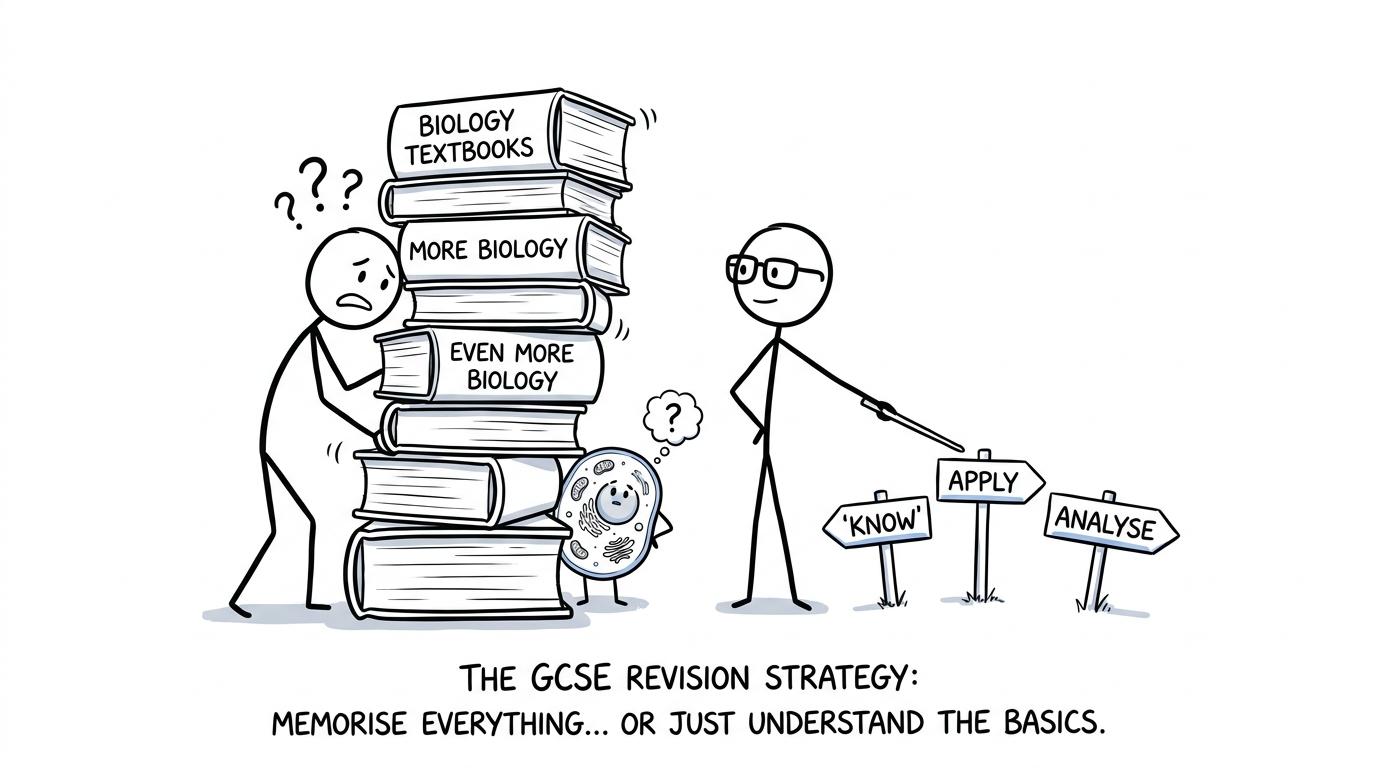 An examiner directs revision towards knowing, applying and analysing rather than memorising everything
How grade 6 compares with the old letter grades
England has used the numerical GCSE scale since 2017, with grade 999 as the highest and grade 111 as the lowest graded outcome. The replacement was not a simple renaming exercise, so there is no exact one-to-one conversion for every number.
Official comparison points align:
- the bottom of grade 777 with the bottom of the old grade A;
- the bottom of grade 444 with the bottom of the old grade C;
- the bottom of grade 111 with the bottom of the old grade G.
Grades 444, 555 and 666 provide more differentiation across the area previously occupied by grades B and C. Calling grade 666 a high B is a useful shorthand, but it should not be treated as an exact conversion.
If you want to see the earlier structure in context, MathsGenie's GCSE revision archive for the A* to G specification shows how the former letter-based system organised GCSE Maths material.
Why a grade 6 is not a fixed percentage
A common misconception is that grade 666 always means achieving a particular percentage. It does not.
Exam boards set grade boundaries after papers have been sat and marking is nearly complete. They use statistical evidence and expert review of students' work to keep the standard required for a grade comparable between years. Boundaries can move because one paper may be slightly more or less demanding than another.
This means a boundary from a previous series is useful for reviewing that particular paper, but it is not a guaranteed target for your future examination. Your school may use approximate boundaries for mocks, so ask which boundaries or assessment model it has chosen.
A safer revision goal is to build a margin above the grade 666 boundary shown on several relevant past papers. One unusually friendly paper should not be the foundation of your prediction.
Separate Biology and combined science are not the same result
If you take separate sciences, Biology produces its own GCSE grade. A grade 666 therefore refers directly to your overall performance in GCSE Biology.
Combined science produces a double grade, such as 666-666 or 666-555, based on performance across Biology, Chemistry and Physics assessments. A combined grade does not provide a separate official Biology grade, even though your teacher may analyse the Biology marks internally.
Tier also matters. Where a specification uses foundation and higher tiers, foundation tier has a maximum available grade of 555. A student aiming for grade 666 must therefore take higher-tier papers. Always confirm your qualification, exam board and tier with your school rather than relying on a generic online boundary.
The maths behind a grade 6 Biology performance
Biology contains more maths than many students expect. Official subject requirements include decimals, standard form, ratios, fractions, percentages, estimates, means, sampling, graphs, simple algebra, areas and volumes.
These are not separate from Biology. They appear inside questions about microscopy, rates, populations, practical results and changes over time. A student may understand the science but lose marks through an incorrect scale, an omitted unit or a calculator entry that was never checked.
Focus particularly on:
- percentages and percentage change;
- ratios and proportional reasoning;
- means and ranges;
- interpreting tables, charts and scatter diagrams;
- gradients and rates;
- unit conversion;
- significant figures;
- standard form.
MathsGenie's percentages revision guide and standard form lesson target two particularly transferable skills. The handling data revision guide also reinforces how to read scales, choose graphs and interpret patterns.
For a broader collection of number, algebra and graph resources, use the AQA GCSE Maths revision hub. The mathematical principles transfer across exam boards even when the presentation of individual questions differs.
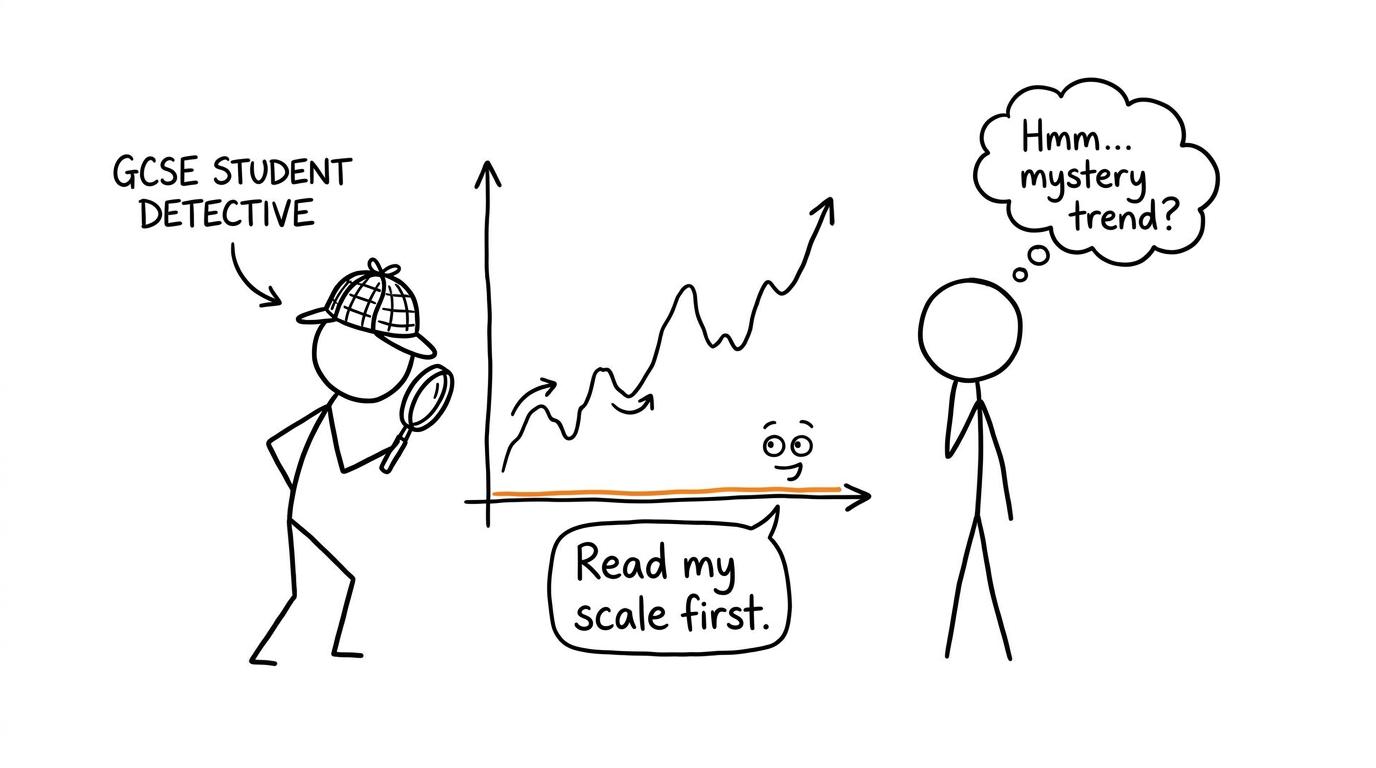 A student detective learns to inspect a graph scale before drawing conclusions
How to move from grade 6 towards grade 7
The gap is rarely closed by simply reading more notes. Grade 777 sits at an important official comparison point: its lower boundary aligns with the lower boundary of the old grade A. Reaching it normally requires greater consistency in application and analysis.
Begin with completed papers. Separate your lost marks into four categories:
- missing biological knowledge;
- failure to apply known science to the context;
- weak data, practical or mathematical skills;
- avoidable exam-technique errors.
This turns a disappointing mark into useful information. A knowledge gap needs retrieval practice. A calculation error needs targeted maths practice. A vague extended response needs comparison with the mark scheme and a clearer chain of reasoning.
The MathsGenie guide to efficient OCR Biology revision explains how to combine specification coverage, data analysis, practical evaluation and mark-scheme feedback. The underlying routine remains valuable for other boards: attempt, mark, diagnose and revisit.
Common mistakes when interpreting or chasing grade 6
Treating grade 6 as an exact old grade B
A high B is a convenient description, not an official one-to-one conversion. The numerical scale has only three fixed comparison points with the old scale.
Assuming one percentage always guarantees it
Boundaries vary by exam board, qualification and examination series. Use past boundaries to interpret past papers, not to predict an unchanging future threshold.
Confusing a Biology grade with a combined science grade
A separate Biology grade 666 and a combined science grade 666-666 describe different qualifications. Check the title on your entry or results statement.
Revising only factual recall
Recall matters, but exam questions also reward application, analysis, practical understanding and evaluation. A wall of flashcards cannot replace practice with unfamiliar contexts.
Ignoring easy mathematical marks
An incorrect unit, scale or percentage can turn understood biology into lost marks. Practise the underlying maths until the method feels routine.
Believing the grade describes every topic equally
A grade is based on the total marks across the assessment. Use question-level analysis to discover what you actually know, rather than assuming that the number tells the whole story.
Turn the grade into a plan
A grade 666 in GCSE Biology is a strong achievement. It indicates secure knowledge across much of the course and a meaningful ability to apply, analyse and communicate science. It is above both the standard and strong pass benchmarks, while leaving room to develop the consistency associated with grades 777 to 999.
The number is useful, but the mistakes behind it are more useful. Take a recent paper, mark it carefully and identify the precise skills costing you marks. Then use MathsGenie's free revision lessons, practice questions, video support, mini tests, mark schemes, past papers and predicted papers to strengthen those skills one at a time.
Start with the maths that appears inside Biology, build it into your wider revision planner, and make your next result less of a mystery.










